AHA President and CEO Rick Pollack Addresses MHA Board

AHA President and CEO Rick Pollack and MHA CEO Brian Peters pictured during a fireside chat during the April 9 MHA Board of Trustees Meeting at the MHA’s Capitol Advocacy Center in downtown Lansing.

The MHA Board of Trustees welcomed AHA President and CEO Rick Pollack to its April 9 meeting at the MHA’s Capitol Advocacy Center in downtown Lansing. The board meeting primarily focused on how to effectively advocate with state and federal lawmakers to preserve access to vital community healthcare services currently facing steep proposed funding cuts.

In a ‘fireside chat’ format moderated by MHA CEO Brian Peters, Pollack shared the political insights he’s gleaned from more than forty years of federal healthcare advocacy to provide his perspective on the current Congressional budget process, key drivers of the current administration and Congressional leadership, and the most effective messaging to help lawmakers understand how their community hospitals will be affected by the budget proposals.

Pollack shared recent public messaging from the Coalition to Strengthen America’s Healthcare, showing the faces of Medicaid and urging lawmakers to protect funding. “If lawmakers don’t hear from you, they think there’s no problem. Hospitals are not a single-issue group,” said Pollack. “Reach out to your lawmakers because we have the opportunity to be objective teachers. Bring them into your hospitals and tell your story.”

At the state level, the board affirmed its support for efforts to address medical debt relief, providing direction for the association to continue working with policymakers on this important issue. The board also discussed ongoing advocacy in support of state legislation to protect 340B contract pharmacies. In addition, the board affirmed the work of the Advisory Panel on Community Benefit Collaboration, with a focus on voluntary collaboratives to improve prenatal care and help address perinatal mood disorder.

The MHA Health PAC campaign remains on target to reach its $400,000 goal. Lastly, the board approved the Type 3 membership application of Warner, Norcross & Judd, LLP.

Members with questions about the actions of the MHA Board of Trustees may contact Amy Barkholz at the MHA.

Medicaid & Pediatric Behavioral Health Media Coverage

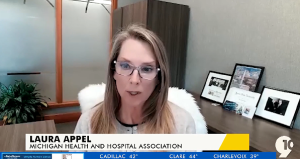
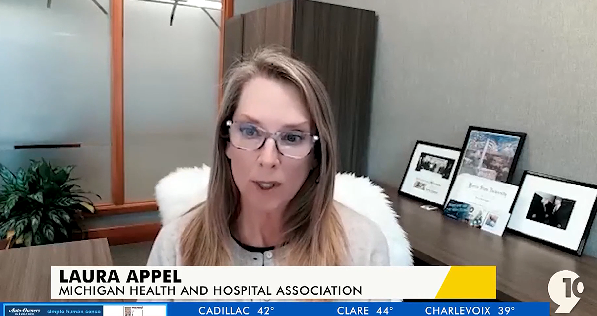
Laura Appel speaks with 9&10 News.

The MHA received media coverage the week of April 7 on potential Medicaid funding cuts, pediatric behavioral health and healthcare costs.

9&10 News aired a story April 9 on potential federal Medicaid funding cuts. MHA Executive Vice President Laura Appel spoke with 9&10 News, explaining how the cuts would specifically impact rural healthcare. Representatives from McLaren Health Care and Munson Healthcare also appeared in the story.

“In our rural areas, we have small populations, and some of them are also shrinking, which makes it that much harder to sustain certain services because of the fixed costs being spread over so few people,” said Appel. “When we lose a labor and delivery unit, we lose it for that entire population.”

Lauren LaPineSecond Wave Michigan published a story April 8 about how Michigan hospitals are improving pediatric behavioral healthcare. Lauren LaPine, MHA senior director of legislative and public policy, spoke with Second Wave Michigan about the MHA’s behavioral health work, focusing particularly on the $50 million state grant the MHA served as the fiduciary for to expand inpatient pediatric behavioral health capacity in the state. LaPine also highlighted the data the MHA collected regarding emergency department boarding, which shows at least 155 people at any point, including 17 children, are in an emergency department awaiting behavioral health care.

“Our data in Michigan reflects some of the trends that we see nationally in terms of the increasing need for behavioral health services for children and youth,” said LaPine. “So, we are paying really close attention to that need and want to make sure that our member hospitals and health systems are able to address the need when pediatric patients and their families come to the hospital in a behavioral health crisis.”

Lastly, Crain’s published a story April 9 about the role of hospitals regarding rising healthcare costs. MHA CEO Brian Peters is quoted in the story, explaining how the majority of rising costs are due to responding to market trends for labor, as well as rising costs for facilities, drugs and supplies.

“The largest expense for hospitals is labor … A large component to increased healthcare costs for hospitals is making sure healthcare workers are appropriately and competitively compensated so they can provide care to patients when and where they need it,” said Peters.

Members with any questions regarding media requests should contact John Karasinski at the MHA.

U.S. House Advances Budget Resolution, Sets Up Potential Medicaid Cuts

The United States House of Representatives advanced a Senate budget resolution April 10 that calls for a minimum of $1.5 trillion in federal spending reductions. A separate budget resolution previously passed by the House in February had specifically targeted $880 billion in cuts from the Energy and Commerce committee, which has jurisdiction over the Medicaid program.

Leadership and committee chairs from both chambers will now begin writing and seeking support for an omnibus budget bill, which could contain cuts to providers in the Medicaid program. The MHA remains strongly opposed to cuts that will limit access to care for Michigan residents and will work with members to advocate against reductions over the next several weeks.

Members may use the MHA’s Medicaid action alert to contact their congressperson and advocate for protecting Medicaid from funding cuts.

Members with questions may contact Laura Appel at the MHA.

MHA Shares Medicare and Medicaid Enrollment Analysis

The MHA recently updated its analysis of Medicaid and Medicare enrollment based on February 2025 data. The analysis includes program enrollment as a percentage of each county’s total population and the split between fee-for-service and managed care organization. Just over 27% of Michigan’s total population is enrolled in Medicaid and 23% is enrolled in Medicare.

Roughly two-thirds of Michigan’s 2.66 million Medicaid beneficiaries are enrolled in one of nine managed care plans.

Total Medicare enrollment is 2.26 million with 63% of beneficiaries enrolled in a Medicaid Advantage (MA) plan with only two counties having less than 50% of total Medicare enrollment in MA plans. MA enrollment by county ranges from 46% to 78%, with 72 counties having 55% or more of their Medicare population enrolled in an MA plan.

February enrollment is spread across 47 MA plans with up to 26 plans covering beneficiaries in several Michigan counties, with a minimum of six plans available in each county.

Members with enrollment questions should contact the Health Finance team at the MHA.

MHA Monday Report April 7, 2025

Deadline Nearing to Register for the MHA Keystone Center Safety & Quality Symposium

The April 18 registration deadline is quickly approaching for the MHA Keystone Center Safety & Quality Symposium, scheduled for April 28 –29, 2025, at the Kellogg Conference Center & Hotel, East Lansing. Multiple breakout sessions, …


New Resources for Patient Rights in Psychiatric Hospitals

The MHA recently collaborated with the Mental Health Association of Michigan and Disability Rights Michigan to develop resources outlining patient rights in psychiatric hospitals across Michigan, Indiana, Wisconsin and Ohio. These assets are modeled after …


Michigan HR Professionals Gather at the MHA Human Resources Conference

More than 100 healthcare human resources (HR) professionals from across the state gathered at the MHA Human Resources Conference March 25 in Lansing. Attendees participated in small group discussions that developed innovative ideas focused on …


MiCare Champion Cast Header PhotoHow Could Medicaid Cuts Impact Michigan?

The MHA released a new episode of the MiCare Champion Cast exploring how proposed reductions to Medicaid could disrupt access to care and harm Michigan hospitals, patients and communities. Laura Appel, executive vice president of …


MHA Rounds image of Brian PetersMHA CEO Report — Prioritizing Rural Health

While snow continues to fall in northern Michigan, spring is officially here, and for many, that means our weekend travel plans shift from skiing and snowmobiling to camping, hiking and boating. Rural Michigan is an amazing travel destination for many, …


Keckley Report

Healthcare is Low Hanging Fruit for Trump: Disruption is the Aim

“The health system is low hanging fruit for federal spending hawks and government reformers. It’s increasingly evident the Trump administration’s well aware. …

This week, Congress returns to DC to continue its budget reconciliation deliberations against a backdrop of growing anxiety about an economic downturn and potential recession.  The stock market is down 10% from its February 19 high and consumer sentiment about the economy hit a 12-year low last week. Notably, households of low and middle-income means are experiencing record levels of debt and unpaid bills: these include 4 million in lower-paying healthcare jobs and 3 million unpaid family caregivers who can’t afford to pay for outside care. And physicians, now 3 months into their fifth-year without a Medicare reimbursement increase, are simply mad and burnt-out.

Today, every healthcare organization (public/private) is operating in limbo: leaders are worried, lenders are more cautious, researchers and public health agencies are paralyzed, state and local health officials are preparing for the worst and hospitals, medical practices, ancillary and long-term care providers face an insecure, disgruntled workforce.

The playbook for everyone in U.S. healthcare—payers, providers, suppliers and advisors—is being re-written.”

Paul Keckley, March 30, 2025


News to Know

  • The MHA was recently awarded $2.5 million to expand hospital-based peer recovery coach (PRC) services and is requesting members complete a brief survey by April 11 to assess current use and interest in PRC programs.
  • The Michigan Alliance for Innovation on Maternal Health (MI AIM) is offering regional training sessions April 23 for inpatient maternal health providers focused on implementing the hypertension safety bundle and addressing common challenges with implementation.
  • MHA Endorsed Business Partner AMN Healthcare will host the free webinar Balancing the Complexities of the Healthcare Workforce in Rural Markets from 11 a.m. to noon ET April 10.

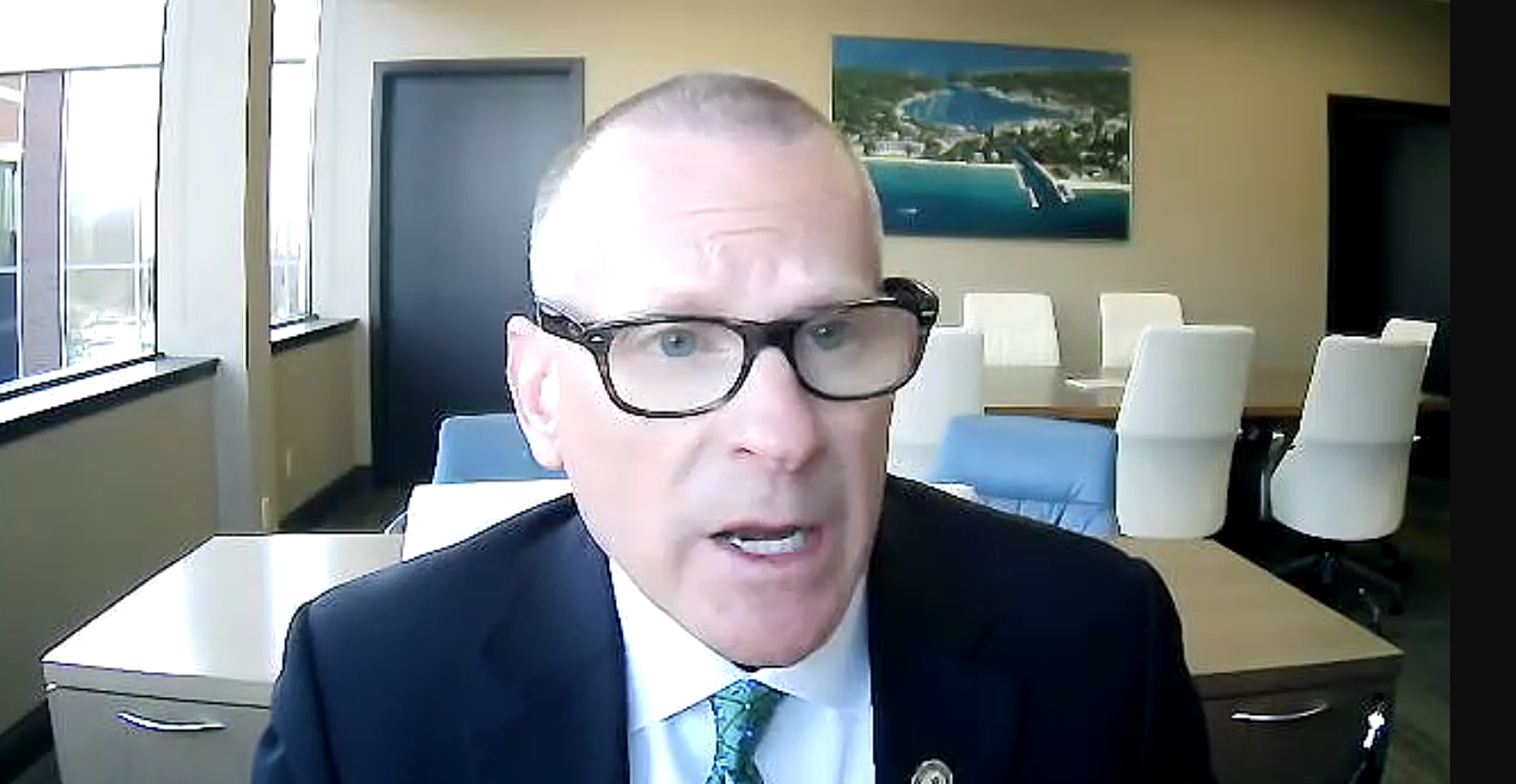
MHA CEO Brian Peters speaks during a virtual media roundtable about Medicaid.

MHA in the News

A virtual media roundtable hosted April 3 by the Michigan League for Public Policy included MHA CEO Brian Peters as a panelist, where he discussed the consequences for potential Medicaid funding cuts by Congress. Crain’s …

Virtual Media Roundtable Focuses on Medicaid Funding Cut Consequences

MHA CEO Brian Peters speaks during a virtual media roundtable about Medicaid.
MHA CEO Brian Peters speaks April 3 during a virtual media roundtable about Medicaid funding cuts.

A virtual media roundtable hosted April 3 by the Michigan League for Public Policy included MHA CEO Brian Peters as a panelist, where he discussed the consequences for potential Medicaid funding cuts by Congress.

Crain’s Detroit Business, CBS Detroit and MIRS published stories as a result of the roundtable.

“When Medicaid funding reductions force hospitals to curtail services or in fact eliminate entire service lines or in fact close hospitals … the services are no longer available to Medicaid recipients, but they’re no longer available to anyone in the community, either,” said Peters. “The cuts that are being contemplated in Washington, D.C. right now, if those were to be implemented, they would cost jobs. And more importantly, I can tell you, they would cost lives,”

Monique Stanton from the Michigan League for Public Policy.

Joining Peters during the roundtable were:

  • Monique Stanton, President & CEO, Michigan League for Public Policy
  • Russ Kolski, Interim Executive Director, Ingham Community Health Center
  • Susan Harding, Executive Director, Oakland Livingston Human Services Agency
  • Jenny Wagemann, Manager, Allen Farmers Market and Breadbasket Food Pantry

On a separate note, MLive also published a story April 3 that references the MHA’s healthcare workforce data and the 44% reduction in nursing vacancies in Michigan hospitals from 2023 to 2024. The story shares news on a nursing student loan repayment program announced by the Michigan Department of Health and Human Services. The Detroit Free Press also published an article on the program, citing the MHA’s Economic Impact of Healthcare Report.

Members with any questions regarding media requests should contact John Karasinski at the MHA.

MHA CEO Report — Prioritizing Rural Health

MHA Rounds graphic of Brian Peters

“Be sure you put your feet in the right place, then stand firm.” – Abraham Lincoln

MHA Rounds graphic of Brian PetersWhile snow continues to fall in northern Michigan, spring is officially here, and for many, that means our weekend travel plans shift from skiing and snowmobiling to camping, hiking and boating. Rural Michigan is an amazing travel destination for many, but it also is home year-round to 20% of our state’s population, and access to affordable, high-quality healthcare remains absolutely crucial. Rural hospitals are an integral part of the local fabric of their communities, treating the ill and improving the health and well-being of their residents. They work extremely hard to make sure they’re able to provide the best quality of care, while operating on a budget with slim to nonexistent margins. In a small town, there is nowhere to hide when the hospital is experiencing challenges of any kind. This is especially true when the hospital is the largest employer in the community and a vital economic engine, which is very often the case in rural Michigan.

I recently had the opportunity to attend the annual American Hospital Association (AHA) Rural Health Care Leadership Conference, along with a number of MHA senior staff and Michigan rural healthcare leaders, including Tina Freese Decker, CEO of Corewell Health and current chair of the AHA Board of Trustees; Julie Yaroch, DO, CEO of ProMedica Charles and Virginia Hickman Hospital and current chair of the MHA Board of Trustees; and JJ Hodshire, CEO of Hillsdale Hospital, current MHA Board member and host of the Rural Health Today podcast. We focused on the latest rural health challenges and innovations, as well as our shared federal advocacy priorities. Key topics included rural obstetrical care, cybersecurity, long-term care transformation and strategic partnerships.

According to the latest U.S. census and other demographic resources, rural Americans are notably older, sicker and poorer than their urban and suburban counterparts. While rural areas currently cover 97% of the nation’s land, they are home to only 19.3% of the total population. Demographers believe that we are moving toward a future state in which an even higher concentration of the population will be in non-rural settings – and that in the next five years, more than 40% of Michigan counties will have more than a quarter of their population older than 65, with nearly all of those counties being rural. As we have learned – especially during the COVID pandemic – traditional volume-based healthcare reimbursement methods do not adequately address the fixed costs inherent in healthcare delivery, a reality that is exacerbated for rural hospitals with smaller patient volumes and more constricted resources and economies of scale.

Although Medicaid expansion (a major accomplishment resulting from MHA advocacy) improved the viability of rural hospitals – a fact that is borne out when benchmarking Michigan to non-expansion states – that funding is currently in severe jeopardy given the current state of play in Washington, D.C., as discussed at length in last month’s CEO Report. In addition, the 340B program is another critically important part of the rural healthcare ecosystem, as the cost savings from the program are used by healthcare providers to offer critically important services to everyone in their respective communities, regardless of their socioeconomic status. The MHA continues to advocate at the state and federal level, in the legislative arena and in the courts, to protect and defend the 340B program.

With guidance from the MHA Council on Small or Rural Hospitals, currently chaired by Peter Marinoff, CEO of Munson Healthcare Southern Region (see Peter’s recent insights on rural healthcare), and staffed by Lauren LaPine, MHA senior director of Legislative and Public Policy, the MHA is also advocating for continuation of the rural access pool and obstetrical stabilization fund in the state budget, and promoting good public policy with respect to critical access hospitals, rural emergency hospitals and a host of other key issues.

Our rural healthcare leaders continue to prove they are exceptional at delivering extraordinary value, despite challenging circumstances. I know from first-hand experience that our rural hospitals provide high quality care and deserve to be fully supported. And we absolutely must support them, as the fragility of the current environment is real: there have been some 151 rural hospitals that have closed across the country since 2010 due to financial variables that make it extremely difficult to maintain hospital facilities in rural areas.

Now more than ever, we need to think about our rural hospitals, stand firm and do all we can to protect these vital institutions.

As always, I welcome your thoughts.

MHA Monday Report March 31, 2025

Healthcare Laws Set to Take Effect April 2025

More than 30 healthcare laws signed by Gov. Whitmer from last term are set to take effect on or after April 1. Some of these laws include state level Affordable Care Act codifications, increased …


Feedback Requested for Peer Recovery Coach Funding

The MHA was recently awarded $2.5 million to expand access to hospital-based peer recovery coach services. The funding was appropriated by the Michigan Legislature as part of the state fiscal year 2025 budget to …


MDHHS Seeks Committee Members for MMRC Program and Recommendations Workgroup

The Michigan Department of Health and Human Services (MDHHS) Maternal Mortality Surveillance Program is seeking professionals and community members to join the Maternal Mortality Review Committee (MMRC) and Recommendations Workgroup. These committees play a …


HHS Renews Ongoing Opioid Crisis PHE

U.S. Secretary of Health and Human Services (HHS) announced March 18 the renewal of the public health emergency (PHE) declaration addressing the ongoing opioid crisis. This extension, which lasts for 90 days, allows continued federal …


MDHHS Launches New Public Health Dashboard

The Michigan Department of Health and Human Services (MDHHS) recently launched the Michigan Public Health Dashboard, a tool designed to improve access to key health data and support informed decision-making. This publicly accessible resource assists …


MHA Members Share Strategies for Advancing Person and Family Engagement

Members of the MHA Person & Family Engagement (PFE) Advisory Council will share how integrating the MHA Roadmap to Person and Family Engagement develops and strengthens PFE efforts in their organizations through two upcoming PFE …


How Policy Shapes the Patient Experience: Reflections from a Public Policy Fellow

The Institute for Healthcare Improvement Patient Safety Congress brought together voices from across the healthcare spectrum March 9 – 11, uniting leaders, learners and advocates in a shared goal of delivering safer care to …


Keckley Report

The Fundamental Flaw of the Affordable Care Act

Today marks the 15th anniversary of the Patient Protection and Affordable Care Act (ACA). It is the most consequential and controversial health legislation in our country’s history since LBJ’s Social Security Amendments created Medicare and Medicaid in 1965.

When passed March 23, 2010, 41% of adults held a favorable view of the law vs. 44% who were unfavorable. Today, 64% have a favorable view vs. 36% unfavorable (KFF). The 900-page law sought expansion of insurance coverage, reduced health costs and improved quality of care. But its results to date are mixed: coverage increased from 84% to 92% but costs have grown unabated and quality improvements have been significant in some areas and negligible in others.

In retrospect, the ACA is fundamentally flawed because it failed to recognize changes in the healthcare marketplace upon which systemic improvements could be achieved …

The ACA defaulted to a focus on insurance coverage and neglected attention to cost containment and quality improvement. As its implementation unfolded from 2010-2013, insurance coverage drew the lion’s share of attention and political opposition grew. Key amendments i.e. the deletion of mandates (proposed by conservative think-tanks to stabilize risk pools) and the June 2012 Supreme Court decision that delegated Medicaid expansion to states neutered its impact. Would-be systemic reforms became incremental changes comfortable to insiders and non-responsive to outsiders.

The ACA is fundamentally flawed because its Beltway-based collaborators did not accurately assess the environment and assumed incremental improvement to the status quo was enough. They were wrong; the public’s demanding more.

The ACA is an important component in health policy today but its fundamental flaw should be acknowledged.”

Paul Keckley, March 23, 2025


News to Know

  • Registration is open for the highly anticipated MHA Keystone Center Safety & Quality Symposium, scheduled for April 28 and 29, 2025, at the Kellogg Conference Center & Hotel, East Lansing.
  • The American Hospital Association (AHA) is accepting applications for the annual 2026 AHA Foster G. McGaw Prize now through May 6, 2025.

Lauren LaPineMHA in the News

Lauren LaPine, senior director, legislative and public policy, MHA, appeared on the MIRS Monday podcast published March 24 to discuss the state behavioral health system. LaPine spoke about the challenges associated with patients boarding in …

Healthcare Laws Set to Take Effect April 2025

More than 30 healthcare laws signed by Gov. Whitmer from last term are set to take effect on or after April 1. Some of these laws include state level Affordable Care Act (ACA) codifications, increased access to telehealth services, elimination of Medicaid work requirements in state law, access to maternal health resources and services and much more. The MHA worked extensively with state lawmakers to ensure hospital voices were represented throughout the legislative process and looks forward to the enactment of supported legislation.

The MHA created a comprehensive overview of the laws taking effect for members.

Members with additional questions may reach out to Elizabeth Kutter at the MHA.

MHA Monday Report March 24, 2025

Senate Hears MHA Testimony on Medicaid; Licensure Compact House Bills Advance

The Senate Appropriations Subcommittee of the Department of Health and Human Services heard testimony from the MHA on Medicaid funding and various licensure compact bills advanced in the House during the week of March …


Registration Open for MHA Virtual Member Forum on Cybersecurity and Cyberattack Response

The MHA, in conjunction with its statewide Health Information Technology Strategy Committee, will host the virtual member forum Cybersecurity and Cyberattack Response from 9:30 – 11 a.m. May 9. During the webinar, leaders from six …


MHA Keystone Center Safety & Quality Symposium Approved for CE Credits

Registration is open for the highly anticipated MHA Keystone Center Safety & Quality Symposium, scheduled for April 28 – 29, 2025, at the Kellogg Conference Center & Hotel, East Lansing. The symposium, offering continuing education …


Applications Open for 2026 AHA Foster G. McGaw Prize

The American Hospital Association (AHA) is accepting applications for the annual 2026 AHA Foster G. McGaw Prize now through May 6, 2025. The prize honors health delivery organizations that demonstrate alignment between community health needs …


Latest AHA Trustee Insights Outlines Techniques to Build Skills in Three Critical Areas

The March edition of Trustee Insights, the monthly digital package from the AHA, highlights podcasts, videos, webinars and other resources available on today’s most pressing healthcare issues. March articles include: Ways for boards …


Keckley Report

Are the 7 Presumptions on which the U.S. Health System is Built still Relevant?

“Years ago, I taught an introductory class at Vanderbilt’s Owen Graduate School of Management to medical students also pursuing an MBA degree. Its intent was to equip future caregivers with the aptitude to lead healthcare organizations in the development of strategies for growth and innovation. …

I remain optimistic healthcare leaders will look beyond near-term incrementalism to long-term transformational change. Lacking the attention it deserves; the U.S. system will become a large public utility for most and a concierge alternative for the few.

The 7 presumptions on which the U.S. system is built are no longer valid as a foundation for its future. They need modernization. And well-intended leaders in healthcare should use that process to define the system’s future state while there’s time to consider options.”

Paul Keckley, March 17, 2025


New to KnowNews to Know

  • In order to continue sharing with key stakeholders the important impact hospitals make to their communities, the MHA invites members to share examples of strong community impact programming through a brief survey.
  • The Michigan Alliance for Innovation on Maternal Health (MI AIM) is offering regional training sessions April 23 for inpatient maternal health providers focused on implementing the hypertension safety bundle and addressing common challenges with implementation.