Senate Hears MHA Testimony on Medicaid; Licensure Compact House Bills Advance

The Senate Appropriations Subcommittee of the Department of Health and Human Services (DHHS) heard testimony from the MHA on Medicaid funding and various licensure compact bills advanced in the House during the week of March 17.

The MHA provided testimony to the Senate Appropriations Subcommittee of the DHHS in regard to recent federal funding threats to Medicaid. Adam Carlson, senior vice president, advocacy, MHA, shared how recent federal proposals could be devastating to patients, providers, hospitals and communities while leaving the state responsible for several billion dollars’ worth of funding. Carlson noted that Michigan Medicaid is the single largest payer for long-term care, maternity care and mental health services. Dr. Phillip Rogers, chair of Family Medicine at Michigan Medicine, further illustrated the importance of the program by sharing powerful patient stories. The MHA will continue to collaborate with lawmakers on this issue and oppose any efforts at the federal level that threaten Medicaid funding.

A number of bills related to licensure compact agreements advanced in the state House. House Bill (HB) 4101, sponsored by Rep. Matthew Bierlein (R-Vassar), and HB 4102, sponsored by Rep. John Fitzgerald (D-Wyoming), received testimony in the House Health Policy Committee on March 19.

The bills, collectively, create a licensure compact agreement for physical therapists in the state of Michigan. In addition to this, HB 4103, sponsored by Rep. Julie Rogers (D-Kalamazoo), and HB 4104, sponsored by Rep. Doug Wozniak (R-Shelby Township), also were part of the committee hearing. Similarly, these bills create a licensure compact agreement for occupational therapists in the state. Finally, HB 4246 was introduced by Rep. Phil Green (R-Millington) and referred to the House Health Policy Committee. This legislation creates the interstate nurse licensure compact to help strengthen our workforce and enhances patients’ access to care. The MHA supports the aforementioned bills and looks forward to further action.

Members with additional questions may reach out to Elizabeth Kutter at the MHA.

MHA Monday Report March 17, 2025

Legislative Policy Panel Acts on Opioid Treatment Policies

The MHA Legislative Policy Panel met virtually March 12 to develop recommendations on legislative and policy issues impacting Michigan hospitals. The MHA advocacy team provided important updates to the panel on healthcare activities at both …


MHA Member Supply Chain Leaders Share Insights and Resources

MHA staff recently attended the Navigating Supply Chain Challenges in the Current Healthcare Environment event hosted March 4 by the Great Lakes Chapter of the American College of Healthcare Executives. This participation represents the MHA’s …


MHA Upcoming PFE Webinars Focus on Advancing Patient-Centered Care

The MHA, in conjunction with its statewide Person & Family Engagement (PFE) Advisory Council, is excited to offer the PFE Improvement Sprints, a webinar series designed to help hospitals and health systems amplify PFE efforts. …


Applications Open for 2025-2026 Excellence in Governance Fellowship

Applications for the 2025-2026 Excellence in Governance Fellowship are now open for healthcare board members seeking innovative and effective ways to lead their organizations as hospitals and health systems navigate financial strain and labor challenges. …


Balancing the Complexities of the Healthcare Workforce in Rural Markets

MHA Endorsed Business Partner AMN Healthcare will host the webinar Balancing the Complexities of the Healthcare Workforce in Rural Markets from 11 a.m. to 12 p.m. ET April 10. Speakers John Higgins, vice president of Essentia Health, a …


Keckley Report

DOGE Healthcare Targets prompt Uncomfortable Questions

In the President’s 99-minute address to Congress last Tuesday, not a mention of healthcare. None. Nada. Go figure.

It’s not surprising but totally regrettable. Politicians on both sides of the aisle know it’s a vital industry to the population’s well-being and the economy’s overall stability. It accounts for a fourth of all job gains in monthly Bureau of Labor jobs reports. It also represents 28% of total federal spending (includes HHS + Veterans Health) with the CBO forecasting 5.5% annual growth through 2032. Thus, it’s not surprising it’s a target of ongoing DOGE federal spending cuts and prominent in this week’s budget reconciliation vote by Congress to avoid a shut down.

Two programs are initial targets: Medicaid and Veterans Affairs. Each is big and serves unique populations …

The impact of proposed Medicaid and VA cuts will draw attention to the overall health system, prompting its critics to argue its wastefulness and its defenders to blame inadequate funding or unfair regulation.”

Paul Keckley, March 10, 2025


New to KnowNews to Know

  • Registration is open for the highly anticipated MHA Keystone Center Safety & Quality Symposium, scheduled for April 28 and 29, 2025, at the Kellogg Conference Center & Hotel, East Lansing.
  • Lenise Freeman, a current Government Relations and Public Policy Fellow, was recently selected to participate in The Center for Health and Research Transformation (CHRT) at the University of Michigan Health Policy Fellowship.

MHA in the News

The MHA received media coverage the week of March 10 on the 340B program and potential federal Medicaid funding cuts with outlets including MichMash, Crain’s Grand Rapids Business and 9&10 News. MHA CEO Brian Peters appeared on the March 14 episode …

340B & Medicaid Receive Media Coverage

The MHA received media coverage the week of March 10 on the 340B program and potential federal Medicaid funding cuts with outlets including MichMash, Crain’s Grand Rapids Business and 9&10 News.

MHA CEO Brian Peters appeared on the March 14 episode of the MichMash podcast where he discussed MHA advocacy efforts to oppose Medicaid funding cuts, passage of Senate Bills 94 and 95 by the Michigan Senate that safeguard the 340B program and the healthcare workforce. The interview was conducted by hosts Cheyna Roth and Zach Gorchow. MichMash is produced by WDET Detroit Public Radio in collaboration with Gongwer News Service and is part of the NPR Network.

Crain’s Grand Rapids also published an article March 10 about the 340B legislation moving through the Senate. Peters and Elizabeth Kutter, senior director of advocacy, MHA, are quoted in the piece.

“This bill prevents drug manufacturers from continuing to issue arbitrary restrictions on 340B eligible Federally Qualified Health Centers and hospitals,” said Peters. “We continue to be grateful for the Senate’s leadership and collaboration in recognizing the need for strong, quality health care providers over out-of-state prescription drug interest groups.”

9&10 News aired a story March 11 that looked at the impact on Michigan if funding cuts to Medicaid are implemented. MHA Executive Vice President Laura Appel was interviewed and appears in the story.

“We know that work requirements are popular as a concept, but really, we need to focus on people being healthy so that they can work, as opposed to working so that they can become healthy,” said Appel.

Members with any questions regarding media requests should contact John Karasinski at the MHA.

MHA Monday Report March 10, 2025

Senate Passes 340B Hospital Protections & IMLC Clears House

The Michigan Senate passed legislation that protects 340B hospitals with bipartisan support while the Michigan House of Representations voted through legislation that removes the sunset on the Interstate Medical Licensure Compact (IMLC) during the week …


Hospital Medicaid Communications Toolkit Available

The MHA recently released a toolkit of communications resources to support hospitals in advocating against potential Medicaid funding cuts in their local communities. The toolkit includes: Talking points Template letter-to-the-editor Template press release Social media …


HHS Rescinds Richardson Waiver Policy on Public Participation

The Department of Health and Human Services (HHS) recently announced the rescinding of the Public Participation in Rule Making (Richardson Waiver), which invited public participation in rulemaking related to federal rules and regulations. HHS Secretary …


MDHHS Medicaid Provider Manual Available April 1

The Michigan Department of Health and Human Services (MDHHS) recently completed the April 2025 update to the MDHHS Medicaid Provider Manual, which will be available online April 1, 2025. This update aims to clarify coverage …


MHA Keystone Center Safety & Quality Symposium Approved for CE Credits

Registration is open for the highly anticipated MHA Keystone Center Safety & Quality Symposium, scheduled for April 28 & 29, 2025, at the Kellogg Conference Center & Hotel, East Lansing. The symposium, offering continuing education …


Regional Training April 23 for Maternal Health Providers on Hypertension Safety

The Michigan Alliance for Innovation on Maternal Health is offering regional training sessions for inpatient maternal health providers focused on implementing the hypertension safety bundle and addressing common challenges with implementation. The one-hour …


Keckley Report

The Four Unwritten Rules for Engaging the Nashville Healthcare Industry

“This year, the Nashville Heath Care Council is celebrating its 30th anniversary. Its 900 members employ 333,000 and contribute $68 billion to the local economy. It hosts global conferences (VIVE, Sessions) among its 80+ events annually and promotes Nashville as the healthcare innovation hub of the planet. It is dominated by publicly traded health services companies and the armies of advisors, lawyers, accountants and analysts they employ. …

The Nashville healthcare community will not attempt to transform the industry: that’s for others. It will engage on industry challenges that require technology-enabled solutions, private capital and experienced operators. It is not paralyzed by regulation, industry norms, trade association affiliations or tradition. It is prone to think of healthcare as a opportunistic market, celebrate its profitability and leave systemic issues for others to fix.

The Nashville healthcare community is a fast follower: the bleeding edge is for others.  But in following fast, it has emerged as a key influencer in Trump healthcare policies and their execution.”

Paul Keckley, March 3, 2025


New to KnowNews to Know

  • The MHA Human Resources Conference is quickly approaching on March 25, 2025 from 8:30 a.m. to 3:30 p.m. at the Crowne Plaza Lansing.
  • In order to continue sharing with key stakeholders the important impact hospitals make to their communities, the MHA invites members to share examples of strong community impact programming through a brief survey.

Elizabeth KutterMHA in the News

The MHA received media coverage the week of March 3 on the Michigan Senate passing legislation that protects the 340B program, the potential impact of tariffs on hospitals and healthcare costs, as well as a …

MDHHS Medicaid Provider Manual Available April 1

The Michigan Department of Health and Human Services (MDHHS) recently completed the April 2025 update to the MDHHS Medicaid Provider Manual, which will be available online April 1, 2025. This update aims to clarify coverage responsibilities among Medicaid Health Plans (MHPs), Prepaid Inpatient Health Plans (PIHPs) and Medicaid Fee-for-Service (FFS) to improve service delivery and reduce confusion among providers and beneficiaries.

The update specifically addresses coverage responsibilities for psychological and neuropsychological evaluations, including:

  • MHPs will remain responsible for evaluations related to mild to moderate conditions, particularly when driven by medical necessity.
  • PIHPs will handle evaluations and treatment if a severe condition is suspected.
  • Medicaid FFS will cover behavioral health screenings, including psychological and neuropsychological evaluations, when performed by primary care providers or other qualified professionals for FFS beneficiaries. If a service is not included under the PIHP benefit or is provided by a non-PIHP enrolled provider, Medicaid FFS will assume coverage. However, if the beneficiary qualifies for PIHP services, the PIHP will take over coverage.

These clarifications will also be incorporated into the Beneficiary Eligibility subsection within the Behavioral Health and Intellectual and Developmental Disability Supports and Services section of the Medicaid Provider Manual. This update ensures that providers better understand their roles in delivering psychological and neuropsychological evaluations and that beneficiaries receive appropriate services based on their needs.

Members with questions may contact Lauren LaPine at the MHA.

Media Coverage Includes Focus on 340B, Tariffs & Medicaid

Elizabeth Kutter

The MHA received media coverage the week of March 3 on the Michigan Senate passing legislation that protects the 340B program, the potential impact of tariffs on hospitals and healthcare costs, as well as a radio appearance discussing potential federal Medicaid funding cuts.

Michigan Public aired a story March 6 following the broad bi-partisan passage of Senate Bills 94 and 95 by the full chamber. Senate Bill 94 would safeguard the 340B program, ensuring cost savings and preserves access to affordable healthcare services in both urban and rural Michigan communities. Further, this legislation adds first of its kind drug manufacturer transparency requirements, making Michigan’s legislation the strongest in the nation.

Elizabeth KutterElizabeth Kutter, senior director, government and political affairs, MHA, was interviewed by Michigan Public for the story.

“You have to be an entity that proves their eligibility in the program, which by default means that you are serving patients who are extremely vulnerable,” said Kutter. “You’re serving kids. You’re serving cancer patients. You’re serving people who, if your hospital closes or if healthcare access becomes limited, suddenly you’re seeing a very serious hospital desert for patients.”

Gongwer and MIRS also covered the passage of the bills.

In addition, Crain’s Detroit Business published an article March 3 looking at the impact of potential tariffs on a variety of Michigan industries, including healthcare. MHA CEO Brian Peters is quoted in the story addressing the impact to hospitals.

“Implementing tariffs on Canada, Mexico and China without exceptions for medications and medical supplies could jeopardize the availability and further increase the prices of already-expensive vital medications and health care devices Michigan hospitals need to provide appropriate patient care,” said Peters. “Tariffs will particularly exacerbate existing pharmaceutical shortages. China is responsible for providing a significant number of cardiac and oncology drugs, as well as active pharmaceutical ingredients needed to produce prescription drugs domestically. Many healthcare supplies are also produced in China and the United States does not have existing capacity to meet an increased demand for product.”

Peters also appeared on WJR 760AM March 3 to discuss the impact of potential federal Medicaid funding cuts on Michigan hospitals.

Members with any questions regarding media requests should contact John Karasinski at the MHA.

MHA Monday Report March 3, 2025

340B Protections Pass Senate Committee & Governor Delivers State of the State Address

Legislation that would implement 340B program protections advanced in the Senate Oversight Committee and Gov. Whitmer delivered her seventh annual State of the State address to the Michigan Legislature during the week of Feb. 24. …


State of Michigan Launches $10 Million Employer-Assisted Housing Fund

The State of Michigan recently launched the $10 million Employer-Assisted Housing Fund to help address workforce housing shortages and improve employee retention across the state. The pilot program, in partnership with the Michigan State Housing …


A Guide to Preparing, Preventing and Responding to Violence in a Healthcare Setting

The following article was written by MHA Endorsed Business Partner Tarian (formerly HSS) and outlines essential strategies and best practices to create a safer environment for all. Workplace violence in healthcare settings is an …


Hospitals Help: Learning More About Street Medicine Oakland
The MHA released a new episode of the MiCare Champion Cast featuring Laura Ortiz, MD, Emergency Medicine Provider at Corewell Health William Beaumont University Hospital, exploring a collaborative effort that’s enhancing access to care for vulnerable communities. …


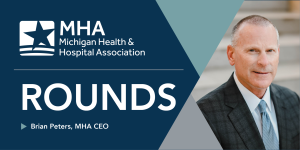
MHA Rounds graphic of Brian PetersMHA CEO Report — Protecting Medicaid Protects Michigan

Accessible and affordable healthcare is essential for communities to thrive, yet recent proposals to slash Medicaid funding threaten to destabilize this foundation for nearly three million Michiganders, including 961,000 children whose health and future depend on access to these services. …


Keckley Report

The Perfect Storm facing the Healthcare Workforce: Eight Current Issues frame the Challenge

“The healthcare workforce is unsteady: while stress and burnout are associated with doctors and nurses primarily, they cut across every workgroup and setting. …

These eight combine to make life miserable most days in health human resource management. DOGE will complicate matters more. It’s a concern in every sector of healthcare, and particularly serious in hospitals, medical practices, long-term and home care settings.

‘Modernizing the healthcare workforce’ sounds appealing, but for now, navigating these issues requires full attention. They require Board understanding and creative problem-solving by managers. And they merit a dignified and respectful approach to interactions with workers displaced by these circumstances: they’re not expendables, they’re individuals like you and me.”

Paul Keckley, Feb. 24, 2025


New to KnowNews to Know

  • Registration is open for the 2025 MHA Human Resources Conference, scheduled for March 25 from 8:30 a.m. to 3:30 p.m. at the Crowne Plaza Lansing.
  • Registration is open for the highly anticipated re-designed MHA Keystone Center Safety & Quality Symposium, scheduled for April 28 and 29 at the Kellogg Conference Center & Hotel, East Lansing.

MHA EVP Laura Appel with WJR's Guy Gordon and Lloyd Jackson.

MHA in the News

MHA Executive Vice President Laura Appel appeared on Detroit’s WJR 760 AM’s ‘JR Morning with Guy Gordon, Llyod Jackson and Jamie Edmonds’s “Live from Lansing” broadcast Feb. 26 as part of the station’s annual coverage …

MHA CEO Report — Protecting Medicaid Protects Michigan

MHA Rounds graphic of Brian Peters

“Never allow someone to be your priority while allowing yourself to be their option.” – Mark Twain

MHA Rounds graphic of Brian PetersAccessible and affordable healthcare is essential for communities to thrive, yet recent proposals to slash Medicaid funding threaten to destabilize this foundation for nearly three million Michiganders, including 961,000 children whose health and future depend on access to these services.

Medicaid is a cornerstone of our healthcare system and keeps people healthy at every stage of life. It provides coverage for two in five U.S. births, two in five children, one in six non-elderly adults, two in five non-elderly adults with a disability, one in four people with a substance use disorder or mental illness and three in five nursing facility residents.

The Affordable Care Act expanded Medicaid to cover more working Americans who do not make enough to afford other coverage. In Michigan, this expansion is known as the Healthy Michigan Plan, which has been hailed as a success for improving access to care, reducing the uninsured rate and supporting economic stability for families across the state.

Nationwide, 40 states have embraced Medicaid expansion, recognizing its transformative benefits. More than 75% of people approve of Medicaid. However, despite its overwhelming popularity, Medicaid is under threat.

Various proposals aim to cut Medicaid by enacting significant reductions in federal funding that would force states like Michigan to make devastating decisions, directly impacting families and communities. Changes like block grants, per capita caps and reduced federal matching rates could lead to an estimated $1.73 billion funding gap in Michigan, jeopardizing access to healthcare for millions.

Medicaid is the single largest payer for long-term care, maternity care and mental health services. Medicaid expansion under the ACA has saved lives, kept hospitals open and improved the overall well-being of countless individuals.

I know firsthand what Medicaid cuts would do to hospitals, essential services and Michigan’s healthcare industry and the economy as a whole. Medicaid is an important program across all Michigan hospitals, but especially for Michigan’s 65 rural hospitals that depend on it to keep their doors open.

Losing rural hospitals would devastate communities across Michigan, depriving them of access to emergency care, maternity services, mental health treatments, long-term care and other life-saving treatments. It would also eliminate jobs, weaken local economies and force residents to travel longer distances for healthcare, increasing the risk of delayed or missed treatment.

Beyond providing care, rural hospitals are economic anchors in their communities. They create jobs, attract businesses and ensure residents can live and work with the security of accessible healthcare.

Aside from the direct impact that Medicaid funding cuts would have on the functioning of hospitals around Michigan, they would have far-reaching economic consequences that impact the workforce and future health of our state. Healthcare is the largest private-sector employer in Michigan, and Medicaid funding supports thousands of jobs across the state. Hospitals, clinics, nursing homes and home health agencies rely on Medicaid payments to sustain operations and maintain their workforce. If Medicaid funding is reduced, healthcare providers will face difficult choices, including cutting services, laying off staff or even shutting their doors.

Michigan cannot afford cuts to Medicaid funding. Our state budget would face a staggering $1.73 billion shortfall if Medicaid cuts move forward. This funding gap would force the state to make decisions like reducing benefits or removing people from coverage – harming patients, providers and communities alike.

Medicaid is not and should not be a partisan issue, as it serves people in urban and rural Michigan, with no distinction between whether those receiving benefits are Democrats, Republicans or any other political affiliation.

Ensuring access to quality healthcare for all Michiganders should be a shared priority. And supporting the infrastructure to make that possible should not be considered optional.

As always, I welcome your thoughts.

Appel Joins WJR Live from Lansing Broadcast

MHA EVP Laura Appel with WJR's Guy Gordon and Lloyd Jackson.
MHA EVP Laura Appel with WJR’s Guy Gordon and Lloyd Jackson.

MHA Executive Vice President Laura Appel appeared on Detroit’s WJR 760 AM’s ‘JR Morning with Guy Gordon, Llyod Jackson and Jamie Edmonds’s “Live from Lansing” broadcast Feb. 26 as part of the station’s annual coverage of legislative and policy issues facing the state the morning after Gov. Gretchen Whitmer’s State of the State address. The MHA sponsored the program, with the broadcast hosted at the Courtyard by Marriott Lansing Downtown.

As part of the program lineup, Appel spoke with Gordon and Jackson about the state of hospitals and the many changes they face, including the healthcare workforce, the 340B program and protecting Medicaid from federal funding cuts. Other notable interviewees during the event included Senate Minority Leader Aric Nesbitt (R-Lawton) and Speaker of the House Matt Hall (R-Richland Township).

Relevant healthcare topics included in the State of the State address included expanded attention towards recruiting males to pursue post-secondary education opportunities and increased state support for forgiving patient medical debt.

Additional media stories published during the week of Feb. 24 included an article picked up by both Bridge and MIRS on the challenges of behavioral health transport services for providers in the Upper Peninsula. Lauren LaPine, senior director of Legislative & Public Policy, MHA, was quoted in the article discussing efforts with the Michigan Department of Health & Human Services to implement and fund behavioral health transportation services at hospitals across the state.

“We believe that a patient shouldn’t have to be transported via police transport for behavioral health needs,” said LaPine.

In addition, the MHA received mention in a Feb. 27 article from MIRS recapping a House Health Policy Committee hearing about the 340B program.

Members with questions should contact John Karasinski at the MHA.

MHA Monday Report Feb. 24, 2025

Earned Sick Time Act Officially Enacted

The Michigan Legislature held a late-night session Feb. 20 that ultimately led to amending the Earned Sick Time Act set to take effect at 12:01 a.m. on Feb. 21. Multiple amendments were made to …


Senate Introduces 340B Hospital Protections; MHA Testifies on IMLC

The Senate introduced MHA-driven legislation protecting the 340B program and the House Health Policy Committee heard testimony on the Interstate Medical Licensure Compact (IMLC) legislation during the week of Feb. 17. The Senate introduced Senate …


Virtual Training Offered Feb. 26 for FY 2022 Medicaid DSH Audit

Myers and Stauffer LC, Michigan’s contractor for the federally mandated Medicaid disproportionate share hospitals (DSH) audits, encourages hospital staff to register and participate in the upcoming Michigan-specific virtual training at 1:30 p.m. Feb. 26. MHA …


A Healthier Future Starts with the Heart

American Heart Month serves as a significant health observance, which shines a light on the critical work Michigan hospitals are doing to improve heart health and patient safety. As Chief Medical Officer at the MHA, it is my honor to speak with …


Keckley Report

Will the Coalition to Strengthen America’s Healthcare Design a Fix?

“If the passage of the Affordable Care Act was a tipping point for healthcare in 2010, the election result in 2024 is no less. In response, AHA is leaning into its Coalition to Strengthen America’s Health Care (CSAH) for help with advertising and advocacy.

CSAH was created by AHA, the Catholic Health Association, Federation of American Hospitals and others “to strengthen Americans’ access to 24/7 care.” Its Honor Roll includes most state hospital associations, all major national associations and several suppliers. Its priorities are “Defending Medicare, Funding Rural Health, Protecting Access to Care, Supporting the Workforce, and Protect Medicaid for American Families.” Perhaps a sixth within its reach could be added:” Fix the Health System” recognizing for some that’s a bridge too far. …

Whether the Coalition to Strengthen America’s Healthcare is inclined to be the facilitator that designs a fix is also unclear: its primary focus today is protecting hospitals. While understandable, it’s regrettable since the vast majority of hospitals view stewardship and the greater good as their calling and recognize the need for a systemic fix.

But what’s clear is that a fix is urgently needed to address affordability, accessibility and effectiveness systematically before it’s too late.”

Paul Keckley, Feb. 17, 2025


News to Know

In order to continue sharing with key stakeholders the important impact hospitals make to their communities, the MHA invites members to share examples of strong community impact programming through a brief survey.

MHA in the News

The Detroit News published an op-ed Feb. 19 from MHA CEO Brian Peters expressing the importance of protecting the Medicaid program from any potential federal funding cuts. Peters highlighted the high number of people supported …