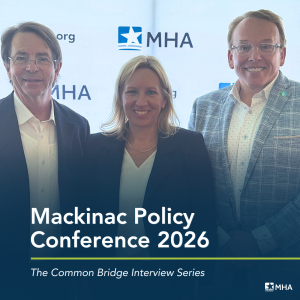
Healthcare leaders from across the state joined Rich Helppie, host of The Common Bridge Podcast, May 27 at the 2026 Mackinac Policy Conference to discuss key healthcare issues impacting Michigan hospitals and the communities they serve.
Conversation covered healthcare affordability, state and federal policy priorities, efforts to strengthen Michigan’s healthcare talent pipeline and more.
The MHA will continue to publish Mackinac Policy Conference interviews as they are available. Members with questions may contact John Karasinski at the MHA.
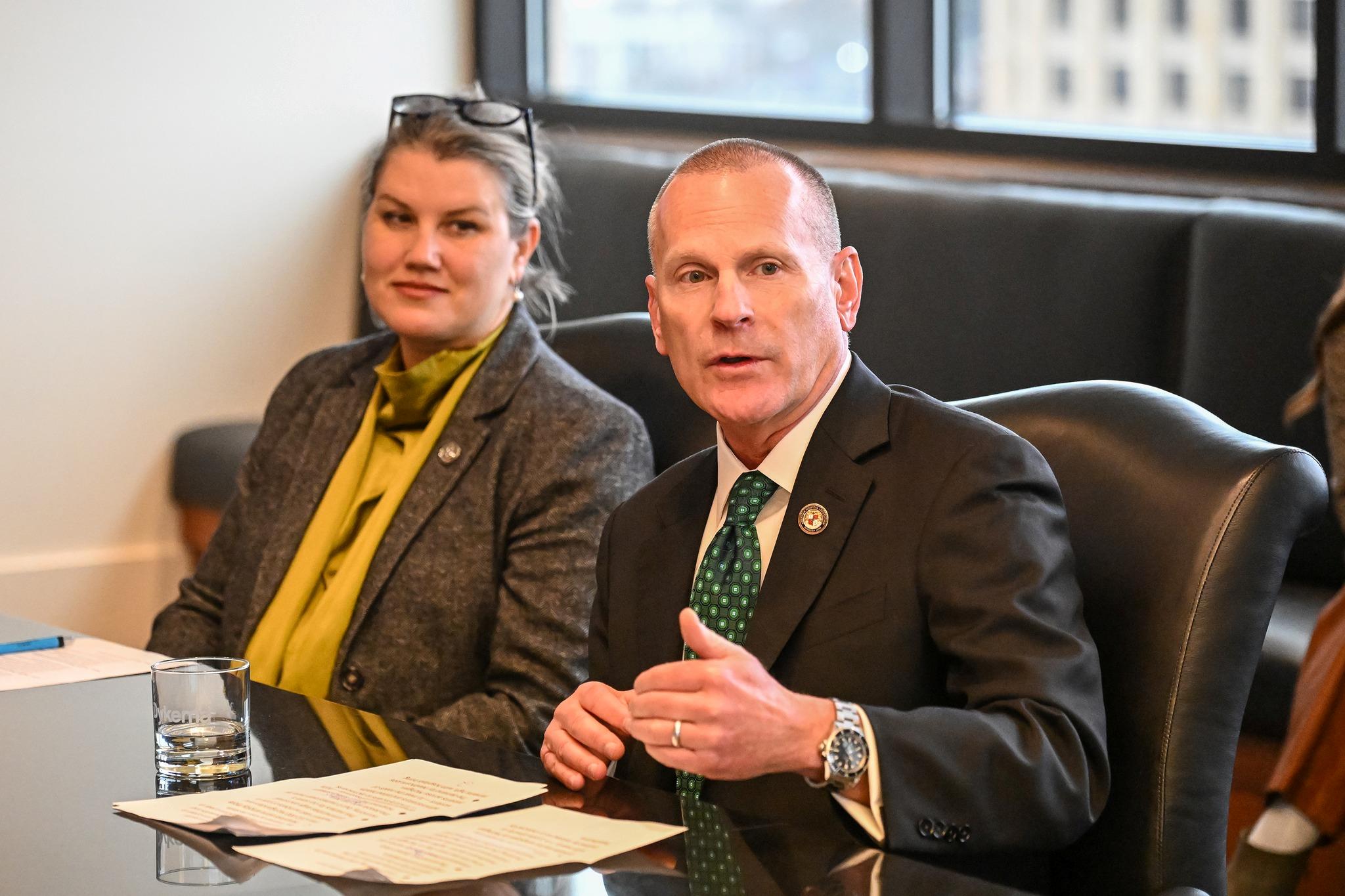
Laura Appel, MHA; and Shannon Striebich, Trinity Health Michigan; discussed hospital affordability challenges with business leaders during a May 14 event hosted by the MHA and Livonia-Westland Chamber of Commerce.
The MHA partnered with the Livonia-Westland Chamber of Commerce on May 14 to host an event at its Livonia offices to engage with business leaders about healthcare costs, listen to their needs and collaborate on potential solutions.
Laura Appel, executive vice president, government relations & public policy, MHA; and Shannon Striebich, president and CEO, Trinity Health Michigan, and current member of the MHA Board of Trustees; presented on the specific challenges facing hospitals, including rising prescription drug costs, stagnant reimbursement and hospitals’ role as large employers experiencing the same significant rise in insurance premiums as other businesses.
The event began with a welcome from Dan West, President/CEO, Livonia-Westland Chamber of Commerce, and the discussion was moderated by Chris Moyer, senior director of public affairs, Truscott Rossman.
The event is one of a series of formal events with business leaders that the MHA is hosting across the state to meet with the business community.
Members with questions about the event and future opportunities should contact John Karasinski at the MHA.
The MHA Legislative Policy Panel met virtually Jan. 21 to develop recommendations on legislative and policy issues impacting Michigan hospitals.
The meeting began with guest speakers from the Michigan Chamber of Commerce and The Cornerstone Group. Wendy Block, senior vice president of business advocacy, Michigan Chamber of Commerce, provided an overview on the Money Out of Politics ballot proposal. Laura Bozell, principal, Cornerstone Group, delivered a federal update on current activity in Congress.
John Karasinski, vice president, communications, MHA, presented on the MHA’s communications and marketing strategy supporting the program year’s Strategic Action Plan.
Jim Lee, senior vice president, data policy & analytics, MHA, shared next steps for the Rural Health Transformation Program, following Michigan’s $173 million award from the Centers for Medicare & Medicaid Services for fiscal year 2026, which will be administered by the Michigan Department of Health and Human Services (MDHHS) through grant programming identified in the state’s application. The MHA remains engaged and will continue advocacy with MDHHS on behalf of rural hospitals as next steps are shared.
The MHA advocacy and health finance teams shared a state legislative update, including a recap on hospital financial assistance policies, medical debt and affordability.
For more information on the MHA Legislative Policy Panel, contact Adam Carlson at the MHA.
MHA CEO Brian Peters joined the Michigan Association of State Universities Jan. 13 in a media roundtable to discuss the economic impact of Michigan’s public universities, which generate nearly $45 billion in net new economic activity a year.
Peters reinforced how higher education institutions are essential partners in building the healthcare workforce and preparing graduates for the rapidly evolving demands of healthcare delivery.
Healthcare employs more Michiganders than any other sector, with hospitals alone employing more than 222,000 Michiganders and supporting a vast numbers of jobs in communities large and small.
The MHA received media coverage during the week of Jan. 5, covering the increasing rate of flu-related hospitalizations in Michigan.
Both Bridge and Michigan Public published stories during the week based on interviews with Jim Lee, senior vice president, policy & data analytics, MHA. The stories address the overall growth in influenza cases and compares how the 2025-26 flu season in Michigan started earlier than during the prior year.
“It’s too early to tell when that peak will occur, but we’re definitely experiencing flu season a little bit earlier this year in our hospitals,” said Lee to Michigan Public.
Members with any questions regarding media requests should contact John Karasinski at the MHA.
The MHA received media coverage during the week of Nov. 17 covering the Rural Health Transformation Program, the MHA’s Community Impact Report and medical debt.
Bridge published a story Nov. 19 on the Rural Health Transformation Program application submitted by the Michigan Department of Health and Human Services. The article covers the lack of specific focus on rural hospitals in the application, as well as the challenges facing rural hospitals, particularly following the federal H.R. 1 Reconciliation Bill. MHA Executive Vice President Laura Appel is quoted in the article, as well as members of the MHA’s Rural Health Transformation Program Task Force.
“There is nothing here. There was an opportunity to direct as much as 10% of Michigan’s funding towards health care services delivered in hospitals and none of that happened,” said Appel.
The story was also highlighted by The Washington Post in the publication’s Nov. 21 daily newsletter.
9&10 News aired a story Nov. 11 about how health insurance rate increases will lead to lower health insurance enrollment, harming healthcare access.
MHA CEO Brian Peters is quoted in the story expressing the need to protect existing healthcare coverage tools, such as the enhanced premium tax credits.
“We cannot afford to do any more damage to what is already a fragile healthcare ecosystem in the state of Michigan,” said Peters.
Members with any questions regarding media requests should contact John Karasinski at the MHA.
The MHA received media coverage during the week of Oct. 27 as MHA CEO Brian Peters discussed the value of hospitals in light of rising insurance premiums.
MIRS published a story Oct. 30 looking at the cost drivers of increasing insurance rates, interviewing several healthcare and association leaders. Peters mentioned the various costs that have increased for hospitals that are necessary to continue to provide accessible and quality services to patients, including labor, drugs, infrastructure and medical liability.
Peters also shared how “a relatively unhealthy population” showing up with “inadequate health insurance” leads to higher utilization and costs in the system.
Gongwer and The Detroit News published articles Oct. 31 on the topic as well, following approval of the 2026 health insurance rate change requests by the Michigan Department of Insurance and Financial Services. Peters highlighted the importance of extending the enhanced premium tax credits at the federal level.
“If the Affordable Care Act passage has proved anything, it’s that we can do a much better job of dealing with these health care challenges if people have coverage, and it’s good coverage, meaning not skinny plans, where you’ve got enormous co-pays and deductibles,” said Peters to The Detroit News.
Members with any questions regarding media requests should contact John Karasinski at the MHA.
The Detroit Free Press published an op-ed Oct. 21 from MHA CEO Brian Peters that affirms the commitment of hospitals to patients and shares the actions hospitals are taking to keep costs low for patients. Those include moving care to more affordable settings, using lower-cost medication alternatives when appropriate, improving care coordination and expanding the behavioral health workforce.
Peters highlights the cost pressures impacting hospitals, including the rise in prescription drug costs, labor and inflation. He also discusses how public reimbursements routinely fail to cover the cost of that care and the issues it can cause to access to healthcare services when combined with rising costs.
“We’re the backbone of access: the nurse at the bedside at 3 a.m., the surgical team on call, the therapist helping a child walk again. Michigan hospital teams will keep showing up with compassion and professionalism,” Peters said.
Members with any questions regarding media requests should contact John Karasinski at the MHA.
Attendees during the 2025 MHA Communications Retreat on Oct. 1, 2025.
The 2025 MHA Communications Retreat brought together about 100 communications, marketing and public relations professionals from MHA-member facilities Oct. 1 to network and learn from peers across the state. The agenda featured sessions on reputation management and crisis communications.
The event began with a communications alignment activity, followed by state and federal healthcare updates from Laura Appel, executive vice president of government relations and public policy, MHA. She outlined how hospital leaders and communications teams can navigate new challenges in the evolving healthcare landscape and emphasized the importance of uplifting messaging that tells the hospital story.
Tim McIntyrce, an experienced communicator and former Domino’s Pizza executive, dived into reputation management, drawing parallels between his experience and the issues hospitals face today.
A panel discussion was conducted on crisis communications, focusing on lessons from past healthcare crises and strategies for working with and leveraging media relationships. Jeff Gaunt, founder and principal of Gaunt Strategies, moderated the panel comprised of Catherine Dewey, regional marketing communications manager, Munson Healthcare, and Mark Geary, senior director, communications & external affairs, Corewell Health.
The event concluded with an interactive tabletop exercise led by Gaunt. The session highlighted best practices in crisis communications using real-world examples and emphasized the importance of speed, accuracy, empathy, transparency and accountability. Attendees left with a first-hour checklist, templates and an action plan to help strengthen crisis communication readiness within 30 days.