Livonia-Westland Business Leaders Meet with MHA on Affordability

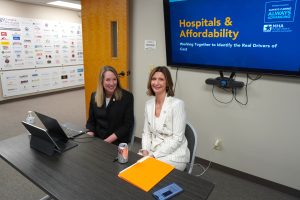
Business leaders attend a Hospitals & Affordability presentation hosted by the MHA and Livonia-Westland Chamber of Commerce.
Laura Appel and Shannon Striebich sit in front of a Hospitals & Affordability presentation slide.
Laura Appel, MHA; and Shannon Striebich, Trinity Health Michigan; discussed hospital affordability challenges with business leaders during a May 14 event hosted by the MHA and Livonia-Westland Chamber of Commerce.

The MHA partnered with the Livonia-Westland Chamber of Commerce on May 14 to host an event at its Livonia offices to engage with business leaders about healthcare costs, listen to their needs and collaborate on potential solutions.

Laura Appel, executive vice president, government relations & public policy, MHA; and Shannon Striebich, president and CEO, Trinity Health Michigan, and current member of the MHA Board of Trustees; presented on the specific challenges facing hospitals, including rising prescription drug costs, stagnant reimbursement and hospitals’ role as large employers experiencing the same significant rise in insurance premiums as other businesses.

The event began with a welcome from Dan West, President/CEO, Livonia-Westland Chamber of Commerce, and the discussion was moderated by Chris Moyer, senior director of public affairs, Truscott Rossman.

The event is one of a series of formal events with business leaders that the MHA is hosting across the state to meet with the business community.

Members with questions about the event and future opportunities should contact John Karasinski at the MHA.

CEO Report — No One Knows Healthcare Better than Hospitals

MHA Rounds image of Brian Peters

“The price of greatness is responsibility.” — Winston Churchill.

Skyrocketing healthcare costs are impacting families and communities across the state. No one is more committed to addressing this problem than those providing care around the clock.MHA Rounds image of Brian Peters

Despite being on the frontlines, hospitals are under fire. What’s worse is that conversations around healthcare affordability often involve those who don’t understand how policy decisions will play out in practice. When legislators listen to hospital voices, they gain firsthand insight on the needs of Michigan communities while better understanding the barriers that providers face.

Addressing healthcare affordability starts with taking a closer look at the largest cost drivers, many of which are beyond hospitals’ control. While they are often blamed, hospitals do not manufacture or determine drug prices. Similarly, reimbursement rates are ultimately determined by public and private insurers. Although the figures are often taken out of context, hospitals only collect a fraction of what is listed on publicly posted pricing files.

At the end of the day, nobody sees the impact of rising costs quite like hospitals do. Their teams deliver care 24/7 to anyone who walks through their doors, regardless of their ability to pay. They do this while facing acute workforce shortages, rising labor costs, mounting regulatory pressures, cybersecurity threats and more.

Our MHA affordability webpage does a great job outlining cost drivers, visualizing hospital spending and proposing meaningful solutions.

In order to keep putting communities first, hospitals need our state and federal leaders to confront the external pressures dictating how much cost they can realistically absorb. We applaud Senate Majority Leader Winnie Brinks and Sen. Hertel for bringing forth legislation last month focused on expanding coverage options, strengthening continuity of care and addressing costs drivers. Passing this bill package would be an important step toward lowering costs, but it must be part of an ongoing commitment from our lawmakers to collaborate with hospitals on strategies that keep patients at the center of every solution.

During National Hospital Week, we’re asking lawmakers who are serious about addressing healthcare affordability to give local hospitals a seat at the table to help inform decisions, identify solutions and avoid outcomes that ultimately harm Michigan patients and communities.

As always, I welcome your thoughts.

Healthcare Bills Advance in Michigan Legislature

Several healthcare-related bills advanced in the Michigan Legislature during the week of March 2, including proposals addressing medical debt, liability protections, organ donation incentives and workforce shortages.

The Senate Finance Committee advanced Senate Bills (SB) 701 and 702 on March 4. These bipartisan bills, sponsored by Sen. Sarah Anthony (D-Lansing) and Sen. Jonathan Lindsey (R-Coldwater), aim to change medical debt collection processes in the state, including restrictions on the sale of medical debt and limits on interest, among other provisions. The MHA continues to review and remains committed to engaging with legislators on opportunities to improve healthcare affordability. The bills now proceed to the full Senate for further consideration.

Also on March 4, the House Judiciary Committee approved House Bill (HB) 4582, which would restore the “open and obvious” defense for lawsuits. Sponsored by Rep. Jerry Neyer (R-Shepherd), the committee adopted a substitute that clarifies that property owners still have a duty to protect individuals from unreasonable harm. The MHA supports the legislation that moves to the full House for further consideration. 

The Senate Health Policy Committee unanimously approved SB 301 on March 4. Sponsored by Sen. Joe Bellino (R-Monroe), the MHA-supported legislation would provide a tax credit to employers whose employees take time off to serve as living organ donors. The bill now goes to the full Senate for consideration.

The House Health Policy Committee took testimony March 4 on HB 4832, sponsored by Rep. Dave Prestin (R-Cedar River). The legislation would create a state licensure process for anesthesiologist assistants to address state healthcare professional workforce shortages further. The MHA supports the legislation and encourages the committee to vote in favor of its passage.

Members with questions may contact the MHA advocacy team.

MHA CEO Report — Sustaining Hospital Funding is Key to Meaningful Reform

MHA Rounds image of Brian Peters

“We can’t become what we need to be by remaining what we are.”  — Oprah Winfrey

Michiganders heard a clear message from our state and federal leaders last week: healthcare is too expensive and the system is flawed. We agree. Michigan hospitals are deeply invested in providing timely and accessible care, reducing unnecessary administrative burden and improving transparency.MHA Rounds graphic of Brian Peters

The healthcare landscape in our country is incredibly complex, so it’s imperative to recognize no single action or one-size-fits all approach will create the substantial change we need. For decades, good-faith, reactive polices have attempted to manufacture financial stability for patients and providers by addressing immediate cost pressures, but this approach has only delayed the inevitable conversations we must have about healthcare affordability and sustainability.

Michigan hospitals continue to experience reimbursement rates that fall far below the cost of providing care and our patient population is simultaneously growing older and sicker. Hospitals are continually being asked to do more with less, but even their most innovative efficiency efforts cannot overcome reimbursement that lags far behind the growing cost and complexity of patient care. For example, general inflation rose by 14.1% from 2022 to 2024, while Medicare net inpatient payment rates increased by only 5.1% during the same time period. Access to important healthcare services is at risk when providers are reimbursed at less than the cost of care.

We’re eager to discuss long-term solutions with employers, lawmakers and other healthcare stakeholders, but we cannot address these systemic issues from our back foot. Labor, drug and supply costs are forcing hospitals, especially those in rural areas of the state, to limit services. Maintaining healthcare funding is about protecting access to care in communities across Michigan and not about preserving the status quo.

To create a more affordable system, we need one that is strong enough to withstand change. If we can pair reform and sustainability actions, we can strengthen care and lower costs for everyone long-term.

As always, I welcome your thoughts.

Governor Whitmer Delivers Final State of the State Address

Gov. Whitmer delivered her final State of the State address Feb. 25 before a joint session of the Michigan House of Representatives and Senate, outlining priorities for the remainder of her term, including healthcare affordability.

During the address, Whitmer called on Congress to renew enhanced premium tax credits for marketplace plans under the Affordable Care Act. She also referenced upcoming changes to Medicaid resulting from recent federal law changes.

Additionally, Whitmer emphasized medical debt as an ongoing policy issue that should be addressed by the state legislature. Ideas shared during the speech included capping interest rates on Medicaid changes resulting from credit reporting, requiring hospitals to establish financial assistance programs and prohibiting liens or foreclosures on homes tied to unpaid medical bills.

Whitmer reflected on accomplishments during her administration, including expanding access to pre-K, providing free school meals for all, reducing crime and overdose deaths and continuing infrastructure improvements such as road repairs and the removal of lead pipes throughout the state.

She recognized the work of state departments, legislators and community leaders who helped shape policy efforts during her tenure and emphasized the importance of bipartisan collaboration to advance policies that support Michigan residents.

The MHA looks forward to working with state lawmakers on policies that support healthcare affordability and access to care for Michigan residents.

Members with questions may contact the MHA advocacy team.

Media Recap: Healthcare Affordability and Access

MHA CEO Brian Peters bylined an op-ed Feb. 16 in The Detroit News, highlighting Michigan hospitals’ understanding of the financial strain that rising healthcare costs are creating and reinforcing their commitment to being part of the solution.

Peters outlines how hospitals are confronting the same cost pressures affecting households and businesses, including workforce shortages, supply chain costs and increased cybersecurity demands. He emphasizes that amid these challenges, hospitals are committed to collaboration, working alongside policymakers, employers and community partners to advance solutions that improve affordability while protecting access to care for all Michiganders.

Lauren LaPineLauren LaPine-Ray DrPH, MPH, vice president, policy and rural health, MHA, was quoted in a Feb. 17 Bride Magazine story expressing concern for emergency room (ER) capacity following Oakland Community Health Network’s recommendation to direct mental health patients to the ER amid paused operations at the county’s resource and crisis center.

Members with questions regarding media requests should contact Elise Gonzales at the MHA.