MHA Monday Report May 18, 2026

House Passes Multiple Healthcare Bills

The Michigan House passed legislation related to third-party litigation financing, Medicaid prescription requirements and surgical smoke plume evacuation during the week of May 11. Lawmakers also introduced legislation related to behavioral health transportation services and …


State House Minority Leader Addresses Legislative Policy Panel

State House Minority Leader Ranjeev Puri (D-Canton) addressed the MHA Legislative Policy Panel May 13 at the MHA Capitol Advocacy Center, providing the panel with a legislative and political update and sharing his commitment to …


2026 Healthcare Leadership Academy Cohort Completes Program

In partnership with Executive Core, the MHA recently celebrated the successful completion of the 2026 Healthcare Leadership Academy, which supports the development of emerging healthcare leaders across Michigan. Through two in-person modules, participants developed skills …


Keystone Quality and Safety Work Highlighted at MICAH QN Meeting
Kristy Shafer, senior manager, MHA Keystone Center, and senior lead quality improvement advisor for Superior Health, presented the Centers for Medicare & Medicaid Services quality improvement program at the Michigan Critical Access Hospital Quality …


MHA Keystone Center to Present During National Caregiver Webinar

The National Alliance for Caregiving will host the webinar “Practical Methods for Integrating Caregivers into Care Delivery” from 1 to 2 p.m. ET May 27, highlighting how hospitals and health systems are embedding caregivers into care models …


Hospitals Help: Memorial Healthcare Prioritizes Infection Control for Long-Term Care Residents


Michigan hospitals have long prioritized infection control and prevention, investing in resources that strengthen safety and quality measures for their patients and staff. The MHA Keystone Center is committed to supporting these efforts. Healthcare teams …


News to Know

  • The MHA Person & Family Engagement Advisory Council met May 14 to examine patient journey mapping, a method used to document and visualize the patient experience across healthcare touchpoints, from recognizing a health need through treatment and ongoing care.
  • Hospitals paid under the Medicare inpatient prospective payment system must submit a calendar year 2025 occupational mix survey to the Medicare Administrative Contractor by June 30.
  • Applicable laboratories, including hospital outreach laboratories, must report private payer data under the Protecting Access to Medicare Act from Jan. 1 through June 30, 2025, during the reporting window open through July 31, 2026.

MHA in the News

The MHA received coverage in a May 12 Crain’s Detroit Business story examining insurance contract negotiations with hospitals. In the article, MHA CEO Brian Peters emphasized that reimbursement contracts between hospitals and insurance companies often …

Hospitals Help: Memorial Healthcare Prioritizes Infection Control for Long-Term Care Residents
Michigan hospitals have long prioritized infection control and prevention, investing in resources that strengthen safety and quality measures for their patients and staff. The MHA Keystone Center is committed to supporting these efforts.

Healthcare teams across the state continue to monitor for cases of Candida auris (C. auris), a highly transmittable fungus identified in 2021 that can lead to serious infections. Managing the risk is especially critical across long-term care (LTC) facilities.

With this in mind, the Keystone Center team enrolled 11 Michigan-based LTC facilities last year in a project aimed at enhancing infection prevention and equipping healthcare teams with the necessary tools to address the spread of C. auris and other emerging pathogens.

Memorial Healthcare, a hospital that offers both long-term care and assisted living, was one of those given the opportunity to participate.

“We’re doing a lot of things right, but appreciate new eyes coming in to assess and give our teams unbiased feedback,” said Taryn Gemalsky, MSN, BSN, RN, director of nursing for long-term care, Memorial Healthcare. “We always want to protect our elderly residents who are at highest risk of vulnerability.”

With support from the Michigan Department of Health & Human Services and IPCWell, the project involved onsite and remote technical assistance for LTC teams to assess and enhance their infection control practices. As a part of this, staff and facility leaders are led through modules within the Centers for Disease Control and Prevention Infection Control Assessment and Response (ICAR) tool.

“Having an actionable plan with tangible tasks to hone in on is great,” said Bradley Moore, RN, manager of behavioral health and long-term care, Memorial Healthcare. “A lot of the staff have been a part of this work and it’s great to have their input on care improvements.”

Memorial Healthcare teams successfully closed every gap identified through the assessments.

“This effort has demonstrated how dedicated our members are to going above and beyond for their patients and communities,” said Joshua Suire, MHA, BSN, RN, director, safety and quality, MHA Keystone Center. “It’s been such a pleasure and inspiration to work with the teams at Memorial Healthcare who are clearly committed to excellence in the safety and quality space.”

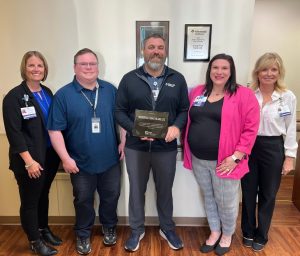
Memorial Healthcare team members pictured with their honorary plaque of completion from the MHA Keystone Center.

The MHA Keystone Center paid a visit to Memorial, awarding their team with infection glow kits, enhanced barrier precaution signage, education materials and an honorary plaque of completion to celebrate their participation in the project.

“The collaboration and support from the MHA truly makes a difference,” said Gemalsky. “Programs like this are only possible through strong partnerships and we are incredibly thankful for their continued support.

Those with questions or content ideas for the Hospitals Help series may contact Lucy Ciaramitaro at the MHA.

House Appropriations Committee Hears RHTP Testimony, IMLC Bill Advances

The Michigan House Appropriations Committee heard testimony during the week of Jan. 19 on federal funding awarded through the Rural Health Transformation Program (RHTP) and legislation to add Michigan back into the Interstate Medical Licensure Compact (IMLC). 

Several key healthcare stakeholders testified before the House Appropriations Committee, including Michigan hospitals, regarding funding allocated to the state under the RHTP. The state was awarded $173 million in RHTP funds in December 2025 to better serve rural communities and address critical access-to-care issues. Ben Frederick, associate vice president of advocacy, government relations and business development, Memorial Healthcaretestified during the committee hearing Jan. 20.  

Frederick shared the operational challenges faced by rural hospitals, the opportunities presented by the RHTP funding and the role of the legislature in supporting long-term rural hospital sustainabilityHe highlighted the economic stability that rural hospitals provide to their communities and regions, including serving as major employers, supporting small and independent businesses, and maintaining local supply chains. Frederick further discussed challenges related to workforce development, technology limitations and capital improvement needs. 

Separately, the House Rules Committee voted Jan. 22 in support of House Bill 5455, sponsored by Rep. Rylee Linting (R-Grosse Ile Township), which would restore Michigan to the IMLC. The compact supports access to care, particularly in rural areas, by allowing physicians to practice across state lines. The MHA continues to engage with lawmakers and advocate for the timely passage of the legislation to support physician participation in the compactThe legislation now heads to the full House chamber for further consideration.  

Members with questions may contact the MHA advocacy team 

Hospital Executives Recognized for Outstanding Leadership

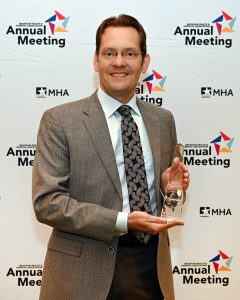
The MHA announced the winners of its 2025 Healthcare Leadership Award June 26 during its Annual Membership Meeting. Each year, the MHA recognizes outstanding individuals who have provided exceptional leadership to healthcare organizations and to the health and well-being of the community. The 2025 recipients are Ben Frederick, associate vice president, advocacy and government relations, Memorial Healthcare, Owosso; and Rosalie Tocco-Bradley, MD, PhD, chief clinical officer, Trinity Health Michigan, Livonia. The MHA will donate $1,000 on behalf of each award winner to the charity of their choice. These funds were provided to the MHA by the family of former MHA President H. Allen Barth.

Ben Frederick, associate vice president, advocacy and government relations, Memorial Healthcare, Owosso

Frederick has played a pivotal role in securing funding, advocating for policy changes and strengthening provider network integration since he joined Memorial Healthcare in January 2023. His strategic efforts have significantly expanded access to essential services, including behavioral health, maternal care and workforce development. Through his efforts, funding was secured that renovated the operating room suite in the labor and delivery unit, expanded Memorial Healthcare’s inpatient behavioral health services and supported the Memorial Childcare Academy to provide accessible childcare for healthcare employees and to local families. Frederick also established a partnership with Saginaw Valley State University to expand higher education opportunities to Memorial Healthcare employees.

In his role overseeing advocacy and government relations, Frederick can successfully navigate complex regulatory environments, ensuring the hospital remains a financially viable, rural, nonprofit, independent institution. He has worked closely with the MHA and other member hospitals and health systems in advocating for protecting the 340B program at the state level, while engaging with policymakers about the challenges and opportunities facing rural healthcare providers.

Frederick had decades of service before joining Memorial Healthcare, including as a member of the Owosso City Council, Mayor of Owosso and state representative of the 85th District. He is currently involved in numerous Shiawassee County community-based non-profit initiatives. Frederick has asked for his $1,000 monetary award go to the Michigan Brain Injury Provider Council in honor of Tristan McMillan.

Rosalie Tocco-Bradley, MD, PhD, chief clinical officer, Trinity Health Michigan, Livonia

Dr. Tocco-Bradley has been instrumental in shaping Trinity Health Michigan’s vision and operationalizing and improving clinical integration, streamlining workflows and ensuring clinicians across the organization have immediate access to patients’ data. She is a driving force behind the implementation of initiatives to address opioid use disorder, enhance population health and served as the incident command chief during the COVID-19 pandemic.

One of her key accomplishments is leading the implementation of TogetherCare, Trinity Health’s first and largest go-live of an electronic health record. TogetherCare has enhanced efficiency and the overall patient experience across all care settings. She has also worked closely in developing new opioid initiatives and advocating for comprehensive strategies to prevent opioid misuse that has brought together not only healthcare professionals, but also public health agencies, advocacy organizations and community groups to address the issue. Dr. Tocco-Bradley also worked very closely with the MHA during the pandemic, providing vital clinical feedback that informed the MHA’s efforts to make sure hospitals and healthcare workers had the resources and regulatory environment to provide care to their patients.

Dr. Tocco-Bradley has left an indelible mark on Trinity Health Michigan, as she is retiring June 30 from her role. At Dr. Tocco-Bradley’s request, the $1,000 monetary portion of the award will go to the St. Louis Center.

The MHA congratulates the winners of the 2025 MHA Healthcare Leadership Award.

MHA Awards Peer Recovery Coach Grants

The MHA has granted funding to seven institutions to support development or expansion of hospital-based peer recovery coach (PRC) programs. The funding will support the addition of 18 new hospital-based PRCs and expand treatment options for patients with a substance use disorder (SUD).

The MHA recently issued a request for proposals for a competitive grant program for Michigan healthcare entities aimed at developing or expanding hospital-based peer recovery coach programs. Funding for this effort was made available by the Michigan Legislature as part of the state fiscal year 2025 budget to expand access to hospital-based PRC services.

The MHA received nine applications from organizations in seven distinct regions of the state, encompassing many innovative approaches to provide high-quality care for individuals experiencing substance use disorders.

These seven organizations, which were granted funding, are as follows:

The MHA appreciates the time and effort that went into developing applications and looks forward to partnering to expand access to SUD services across the state.

Members with questions may contact Kelsey Ostergren at the MHA.

340B Protections Pass Senate Committee & Governor Delivers State of the State Address

Legislation that would implement 340B program protections advanced in the Senate Oversight Committee and Gov. Whitmer delivered her seventh annual State of the State address to the Michigan Legislature during the week of Feb. 24.

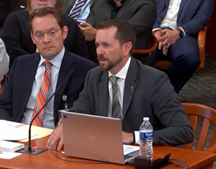
Deidra Wilson, senior vice president, government relations and public policy, McLaren Health Care; and Ben Frederick, associate vice president of advocacy and government relations, Memorial Healthcare testified Feb. 27 in the Senate Oversight Committee on legislation regarding 340B Protections.

Senate Bill (SB) 94, sponsored by Sen. Sam Singh (D-East Lansing), and SB 95, sponsored by Sen. Jonathan Lindsey (R-Allen), saw extensive action in the Senate Oversight Committee Feb. 27. SB 94 protects the 340B program in Michigan and is paired with SB 95, which requires hospital compliance with federal transparency laws. Two MHA members provided testimony during the committee in support: Deidra Wilson, senior vice president, government relations and public policy, McLaren Health Care; and Ben Frederick, associate vice president of advocacy and government relations, Memorial Healthcare.

SB 94 safeguards the 340B program, ensuring cost savings and preserves access to affordable healthcare services in both urban and rural Michigan communities. Further, this legislation adds first of its kind drug manufacturer transparency requirements, making Michigan’s legislation the strongest in the nation.

During testimony, Wilson first thanked the committee for their swift action on reintroduction of the bills and the importance of expediting this legislation to support communities. She discussed services for cancer patients across the state, such as covering copays, rural OB services and other vital services for vulnerable populations that are impacted when pharmaceutical manufacturers create restrictions around the 340B program. Wilson concluded her testimony by stating that hospitals prioritize the needs of patients and communities over the profits of drug manufacturers. Frederick emphasized the impact the 340B program has in rural communities, especially for independent and community hospitals, and shared how these rural areas can provide essential OB, cancer and family medicine services to preserve and improve access for patients. Following a successful hearing, the Senate Oversight Committee voted 5-0 to report SB 94 and SB 95 to the full Senate. The bills now await a full vote in the Senate before it can be sent to the House of Representatives.

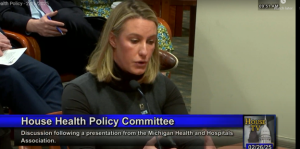
Elizabeth Kutter, senior director, government and political affairs, MHA testimony provided an overview of the 340B program in the House Health Policy Committee Feb. 26. 

The House Health Policy Committee also heard testimony on the importance of the 340B program in the state Feb. 26. Elizabeth Kutter, senior director, government and political affairs, MHA, provided an overview of the program, including examples of how the program benefits patients and communities across the state. Wilson and Frederick also testified, sharing how the program works for their hospital systems. The educational hearing enabled House Health Policy members to ask questions and engage in a constructive dialogue around the topic. The MHA continues to advocate for the 340B program and support Michigan hospitals’ efforts to expand access to quality, community-based care. Members are encouraged to use the MHA 340B Action Alert to contact their lawmakers in support of this legislation.

Lastly, Gov. Whitmer outlined her upcoming priorities to a joint convention of the Michigan Legislature in her State of the State address Feb. 26. One key highlight in her address included reducing medical debt for Michiganders. While no specific policies were discussed, she cited 700,000 Michiganders currently have medical debt and that legislators should work to find solutions for this issue going forward. In addition to this, the governor discussed working in a bipartisan fashion on issues like road funding, building affordable housing and lowering costs in the state.

Members with questions may contact Elizabeth Kutter at the MHA.


House Insurance Committee Hears Testimony on Bill to Protect 340B

Maureen D’Agostino, vice president of accreditation and regulatory CMS programs and provider and facility enrollment at McLaren Health Care testifying during The House Insurance and Financial Services Committee.

The House Insurance and Financial Services Committee convened June 5 to hear testimony on House Bill (HB) 5350, introduced by Rep. Alabas Farhat (D-Dearborn), which would protect access to affordable prescription drugs and healthcare services through the 340B Prescription Drug Pricing Program.

Testimony began with Marc Corriveau, JD, MHSA, vice president of corporate government affairs at Henry Ford Health, providing an overview of how savings from the 340B program allow vulnerable, uninsured patients to receive medical and behavioral healthcare services at little to no cost.

Sean Gehle, vice president of advocacy at Trinity Health Michigan, followed with additional examples of how the 340B program allows qualified safety net providers to extend scarce federal resources. Specifically, Gehle noted that the health system is able to provide financial assistance for prescription medications to patients in need.

Next, Ben Frederick, associate vice president of advocacy and government relations and Joseph Munroe, director of pharmacy at Memorial Healthcare, shared the impact the 340B Drug Pricing Program has in rural communities. Together, Frederick and Munroe explained how the program makes it possible for patients to receive routine and specialty care close to home including obstetrics, oncology, behavioral health and neurology care services.

Last to provide testimony was Maureen D’Agostino, vice president of accreditation and regulatory CMS programs and provider and facility enrollment at McLaren Health Care. D’Agostino overviewed how savings from the 340B program have helped McLaren offer comprehensive care for substance use disorder, cancer treatments and more. D’Agostino was accompanied by Deidra Wilson, vice president of government affairs at McLaren.

The MHA continues to advocate for the 340B program and uplift efforts by Michigan hospitals to expand access to quality, community-based care. Members with questions should contact Elizabeth Kutter at the MHA.