

Michigan hospitals have long prioritized infection control and prevention, investing in resources that strengthen safety and quality measures for their patients and staff. The MHA Keystone Center is committed to supporting these efforts.
Healthcare teams across the state continue to monitor for cases of Candida auris (C. auris), a highly transmittable fungus identified in 2021 that can lead to serious infections. Managing the risk is especially critical across long-term care (LTC) facilities.
With this in mind, the Keystone Center team enrolled 11 Michigan-based LTC facilities last year in a project aimed at enhancing infection prevention and equipping healthcare teams with the necessary tools to address the spread of C. auris and other emerging pathogens.
Memorial Healthcare, a hospital that offers both long-term care and assisted living, was one of those given the opportunity to participate.
“We’re doing a lot of things right, but appreciate new eyes coming in to assess and give our teams unbiased feedback,” said Taryn Gemalsky, MSN, BSN, RN, director of nursing for long-term care, Memorial Healthcare. “We always want to protect our elderly residents who are at highest risk of vulnerability.”
With support from the Michigan Department of Health & Human Services and IPCWell, the project involved onsite and remote technical assistance for LTC teams to assess and enhance their infection control practices. As a part of this, staff and facility leaders are led through modules within the Centers for Disease Control and Prevention Infection Control Assessment and Response (ICAR) tool.
“Having an actionable plan with tangible tasks to hone in on is great,” said Bradley Moore, RN, manager of behavioral health and long-term care, Memorial Healthcare. “A lot of the staff have been a part of this work and it’s great to have their input on care improvements.”
Memorial Healthcare teams successfully closed every gap identified through the assessments.
“This effort has demonstrated how dedicated our members are to going above and beyond for their patients and communities,” said Joshua Suire, MHA, BSN, RN, director, safety and quality, MHA Keystone Center. “It’s been such a pleasure and inspiration to work with the teams at Memorial Healthcare who are clearly committed to excellence in the safety and quality space.”
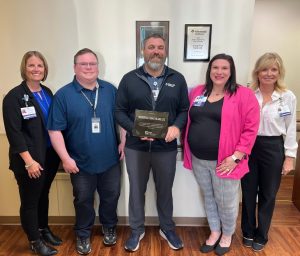
The MHA Keystone Center paid a visit to Memorial, awarding their team with infection glow kits, enhanced barrier precaution signage, education materials and an honorary plaque of completion to celebrate their participation in the project.
“The collaboration and support from the MHA truly makes a difference,” said Gemalsky. “Programs like this are only possible through strong partnerships and we are incredibly thankful for their continued support.”
Those with questions or content ideas for the Hospitals Help series may contact Lucy Ciaramitaro at the MHA.

