
Hospitals Help: Bronson Drives Change in Maternal and Infant Health

From prenatal care and labor and delivery to neonatal intensive care and postpartum follow-up, Bronson Healthcare plays a critical role in influencing health outcomes for mothers and babies across Southwest Michigan.

In celebrating a historic reduction in Black infant mortality across Kalamazoo County, Bronson acknowledged that creating change requires shared ownership across clinical, community and public health settings.

“This work does not belong to any single organization,” said Bill Manns, president and CEO, Bronson Healthcare. “It belongs to all of us who care for families before, during and after birth — and to the communities who trust us with their babies’ lives.”

In addition to local partnerships, Bronson teams are engaged with the MHA Council on Health Access and Community Impact and MHA Community Benefit Collaboratives to help advance statewide improvements in maternal health.

Below are a few of the initiatives underway at Bronson to advance maternal and infant health.

Bronson CenteringPregnancy® Program

Bronson’s CenteringPregnancy® program combines expert clinical care with peer support and education for moms-to-be. The program, covered like traditional prenatal visits by Medicaid and most insurers, has led to lower rates of preterm birth, reduced risk of low birth weight and higher breastfeeding success rates.

Participants meet regularly in groups of 8-12 based on due date. Each session includes a private check-up with a certified nurse midwife as well as a group discussion covering topics like nutrition, labor choices, breastfeeding and newborn care.

Breastfeeding Resources, Support

In addition to lactation services and milk banking, Bronson offers Baby Cafés in Kalamazoo and Battle Creek for walk-in breastfeeding support in a welcoming, coffee shop-style environment.

The goal is to help infants build better immune and brain health, improve digestion, while also reducing the risk of Sudden Infant Death Syndrome (SIDS) and chronic conditions like asthma, diabetes and certain childhood cancers. For mothers, this work supports postpartum recovery while helping lower the risk of breast and ovarian cancers.

A System-Wide Approach

Improving infant and maternal health requires care coordination. Alongside midwives who are expertly trained to provide gynecological care and pre- and postnatal obstetric care, Bronson community health workers help pregnant and postpartum patients address non-medical factors that can affect birthing outcomes. This support can look like:

  • Providing referrals at the first prenatal intake call, with additional referrals coming from obstetric and maternal fetal medicine providers.
  • Connecting families with a variety of resources, ranging from transportation, housing support and food access to breastfeeding resources and parenting programs.
  • Helping families feel more comfortable participating in services like Healthy Babies Healthy Start home visiting programs.

By addressing social drivers of health and building trust early in pregnancy, these team members help reduce gaps in prenatal care – a key factor in preventing preterm birth and other complications associated with infant mortality.

Other efforts by Bronson include their childcare collaborative and Battle Creek childcare center, family-centered educational classes, Cribs for Kids® national safe sleep hospital certification program and Bump2Baby360 patient app.

Those interested in learning more are encouraged to visit the Bronson website. Questions or content ideas for the Hospitals Help series can be directed to Lucy Ciaramitaro at the MHA.

Hospitals Help: Bronson Healthcare Guides Patients Through Billing, Benefits and Financial Support

Navigating healthcare billing and out-of-pocket costs can be overwhelming. In order to let patients focus on healing, many hospitals are expanding the role of financial counselors, social workers and patient navigators.

For example, financial counselors at Bronson Healthcare meet patients where they are. Financial counselors are available whether a person enters through the emergency room or comes in for scheduled surgery, providing price estimates, financial aid resources and insurance guidance for those who need it.

David Cavataio, director of patient accounting, Bronson Healthcare, oversees a team of 15 financial counselors strategically placed across four locations. Their mission is simple but powerful: catch patients before they fall into financial crisis.

“We’ve tried to build it where no matter where you go, we get you to the right people to help you,” said Cavataio.

The Bronson team doesn’t wait for patients to ask for help. Instead, they use admissions data to anticipate and identify who may qualify for financial assistance or Medicaid coverage. From there, a dedicated team handles upfront estimates and trained call center staff connect patients to resources and support to navigate the billing process.

Patients who receive timely guidance tend to follow treatment plans and maintain long-term relationships with their providers. The challenge? Trust. Many patients are skeptical when counselors first approach them.

“A lot of patients, when they first see our counselors, don’t trust them,” said Cavataio. “But if they see how hard our team works to help them and how we’ll drop everything to get the information they need, help them fill out forms, I think they see that we’re a partner.”

This is also a strategic choice for hospitals. When patients enroll in financial-aid programs, the amount of unpaid medical debt decreases, fewer accounts are sent to collections and administrative costs decline. In 2023 alone, Michigan hospitals paid more than $3.5 billion in uncompensated care.

Efforts to build trust at Bronson are paying off. According to the team, Medicaid applications have jumped 25% this year. Financial assistance applications are up 40%. These statistics represent thousands of Michigan families who can now afford the care they need.

“The call from your financial team was like a beacon in a storm,” said one patient. “I was about to quit my job so I could qualify for state assistance. I was near rock bottom. That changed after five minutes with the team.”

State policymakers are also moving to strengthen these efforts. Initiatives such as the 2024 medical debt-relief program have helped thousands of Michiganders reduce or eliminate existing debt.

“We’re there to help,” said Cavataio. “At Bronson Healthcare, those aren’t empty words; they’re a daily practice that’s keeping Michigan families out of medical debt and healthy, one patient at a time.”

To learn more about Medical Financial Assistance at Bronson Healthcare, visit their website. Members with questions or content ideas for the Hospitals Help series may contact Lucy Ciaramitaro at the MHA.

Building Excellence Without Barriers

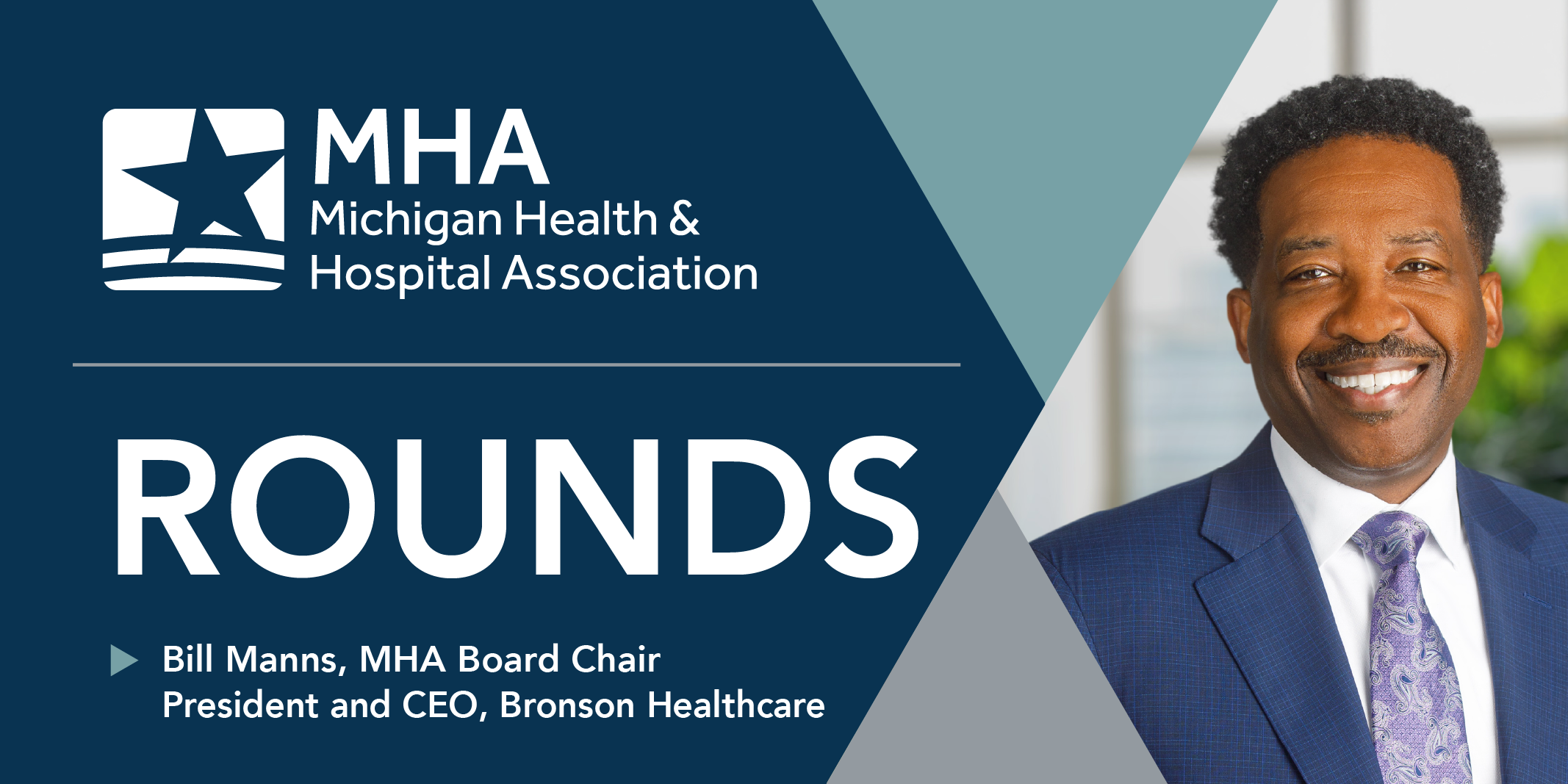
MHA Board Chair Bill Manns, president and CEO, Bronson Healthcare

“Of all the forms of inequality, injustice in health is the most shocking and the most inhuman.” – Martin Luther King Jr.

Every February, Black History Month invites us to pause and reflect on the pioneers who have redefined what’s possible for communities across the country — often in systems that were not designed with them in mind.

This rings especially true in healthcare.

Dr. Joseph Ferguson, for example, was Detroit’s first Black doctor who practiced medicine through the Civil War and offered aid during the city’s race riots. Dr. Ethelene Crockett, Michigan’s first Black board-certified OB/GYN, grew up during the depression and committed herself to becoming an activist and humanitarian. Dr. C. Allen Alexander, Kalamazoo’s first Black surgeon, pursued his career through the racial turbulence of the 1920s.

These stories, among thousands of others, are reminders that excellence has existed in every community, even when opportunity has not.

In my own career, I’ve learned that credentials alone don’t tell a person’s full story. I’ve met brilliant clinicians and administrators whose resumes didn’t follow a straight line — colleagues who worked their way through school, who supported families while earning degrees, who became leaders within their local communities long before becoming executives.

When I stepped into my role at Bronson Healthcare, staffing demands were at their peak. Still, it was imperative that we approach recruitment in a way that was innovative and committed to recognizing talent in all forms.

We cast a wide net to recruit exceptional talent that reflects the communities we serve, partnering with regional universities and community colleges, community organizations, professional associations and local workforce programs to reach candidates whose paths into healthcare may differ from traditional pipelines. This work extends through K–12 community school partnerships and strengthened internal mentorship and advancement pathways, ensuring opportunity is not limited to linear careers.

As a result, 32.8% of our 2025 new hires identify as people of color. In healthcare, that matters. When our workforce reflects the diverse lived experiences of our patients, communication improves, trust deepens and outcomes are stronger. Healthcare is personal—and strongest when those delivering care understand the people they serve.

Honoring the pioneers who came before me means ensuring that our methods for attracting new talent are rooted in skills, ability, character and the broad range of perspectives that help us strengthen patient care.

This approach has paid off. Not only have we grown a more diversified team, but in 2025 the National Association for Business Resources named Bronson one of the Best and Brightest Companies to Work For® in the nation for the third consecutive year. We also earned elite status as West Michigan’s Best of the Best, scoring in the top 5% across every category.

Representation in healthcare shapes how we listen and lead. When our teams represent the communities they serve, decisions are inherently more informed. When a variety of voices are at the table, we reduce blind spots and can create a system that works better for everyone.

Since joining Bronson in 2020, Manns oversees a full range of services from primary care to critical care across more than 100 locations. With over 9,000 employees and more than 1,500 medical staff members, Bronson is the largest employer in southwest Michigan.

Report: Access, Affordability & Community Health Improved by Hospital Programming, Investments

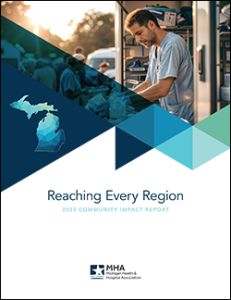
2025 MHA Community Impact Report

The Michigan Health & Hospital Association (MHA) released today its 2025 Community Impact Report highlighting community programming and investments from Michigan hospitals that are improving access to care, addressing affordability and advancing the health of communities across every region of the state.

The report showcases 12 hospital-led programs that go beyond the traditional care setting to address community health needs across the state. It also outlines investments totaling more than $4.5 billion in community benefit activities in fiscal year (FY) 2023, from education and prevention services to clinical research, healthcare workforce support and more.

“Michigan hospitals continue to redefine care delivery and create new, innovative access points across the state,” said MHA CEO Brian Peters. “The MHA Community Impact Report is a strong reminder that our hospitals are committed to listening – and responding – to the needs of their communities.”

Programs featured in the report include University of Michigan Health-Sparrow’s mobile health clinic; Henry Ford Health’s hospital-based doula program; Corewell Health Gerber Hospital’s vaping cessation initiative; Mackinac Straits Health System’s retail pharmacy; and efforts by Bronson Battle Creek Hospital to address food insecurity; among many others. This work is a result of strategic investments, local partnerships and support from state and federal healthcare champions.

“Improving community health goes beyond the bedside,” said MHA Board Chair Bill Manns, president and CEO, Bronson Healthcare. “When we invest in programs that address socioeconomic challenges like food insecurity, we’re helping people overcome the barriers that stand between them and a healthier life.”

The full report and community impact stories from hospitals across the state can be accessed on the MHA website.

Based in Greater Lansing, the MHA is the statewide leader representing all community hospitals in Michigan. Established in 1919, the MHA represents the interests of its member hospitals and health systems in both the legislative and regulatory arenas on key issues and supports their efforts to provide quality, cost-effective and accessible care. The MHA’s mission is to advance the health of individuals and communities.

House Health Policy Hears Testimony on 340B Legislation

The House Health Policy Committee took up recently introduced legislation addressing 340B contract pharmacy arrangements during the week of Sept. 22.

House Bill (HB) 4878, sponsored by Rep. Curt VanderWall (R-Ludington), was recently introduced and referred to the House Health Policy Committee for further consideration. HB 4878 contains necessary language that protects hospitals’ contract pharmacy arrangements under the federal 340B program and includes drug price transparency requirements at the state-level. In addition to this, the bill contains hospital community benefit reporting requirements. The legislation ensures that eligible, participating 340B hospitals can continue to stretch scarce resources to support healthcare providers serving vulnerable patients and communities across the state – without using state or federal taxpayer dollars.

The committee met Sept. 24 to discuss the legislation and heard from various experts and stakeholders. MHA members had the opportunity to testify in support of the legislation and answer committee questions. James (Chip) Falahee, senior vice president of legal and legislative affairs, Bronson Healthcare, shared important background information on the program and why it is vital to protect it long-term at the state-level. Stephanie Field, director of pharmacy business services, Corewell Health West and South, spoke to the technical side of the 340B program and answered specific lawmaker questions on the processes involved in managing the program from a hospital entity perspective.

The MHA will continue to work with its members and state lawmakers on protecting this critical program that supports access to affordable, community-based care across the state.

Members with any questions related to the legislation may contact the advocacy team at the MHA.


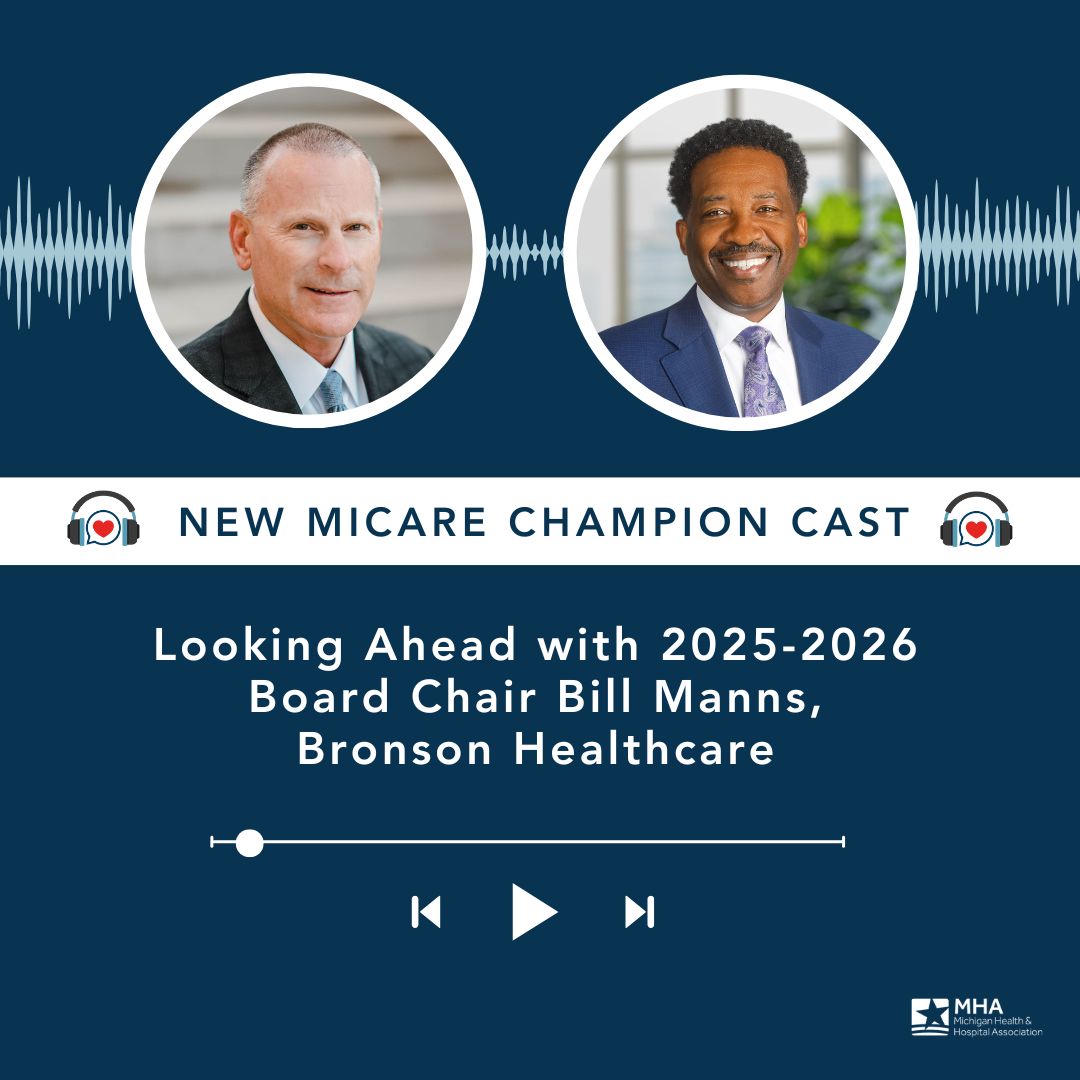
MHA Podcast Explores Healthcare Priorities with 2025-2026 Board Chair Bill Manns

The MHA released a new episode of the MiCare Champion Cast exploring what’s top of mind in healthcare as the 2025-2026 program year kicks off.

The episode, hosted by MHA CEO Brian Peters, features MHA Board Chair Bill Manns, president and CEO, Bronson Healthcare. Manns shares more about his journey to healthcare leadership, current priorities at Bronson and what work lies ahead for hospital leaders given recent activity at the state and federal level.

Since joining Bronson in 2020, Manns oversees a full range of services from primary care to critical care across more than 100 locations. Fellow officers of the 2025-2026 MHA Board of Trustees include Brittany Lavis, chair-elect; and Kent Riddle, treasurer, among many other hospital leaders across Michigan.

Manns noted during the discussion that addressing infant mortality and improving maternal health across the state remain key areas of focus for his team at Bronson Healthcare and hospital leaders across the state.

“Women of color have mortality rates during birth that is, at times, double or triple that of their white counterparts,” said Manns. “As soon as we’re born – without bias or prejudice – if we can get equality there, I think that’s a great footing to build and grow as a community and I think as a nation, quite frankly.”

Over the course of the interview, Peters and Manns discuss the impact of the “One Big Beautiful Bill Act (OBBBA)” on hospitals and patient access to care given cuts to Medicaid funding.

“One, we’ve got to do a better job of educating the public about just what’s coming,” said Manns when discussing how to approach the negative impacts of the OBBBA. “Two, we really have to advocate – even stronger – with our legislators…and three, I think we’ve really got to continue to be optimistic and not panic.”

They also explore the importance of 340B, efforts to address workplace violence and more.

The episode is available to stream on Apple PodcastsSpotifySoundCloud and YouTube. Questions or idea submissions for future MiCare Champion Cast episodes can be sent to Lucy Ciaramitaro at the MHA.

MHA Awards Peer Recovery Coach Grants

The MHA has granted funding to seven institutions to support development or expansion of hospital-based peer recovery coach (PRC) programs. The funding will support the addition of 18 new hospital-based PRCs and expand treatment options for patients with a substance use disorder (SUD).

The MHA recently issued a request for proposals for a competitive grant program for Michigan healthcare entities aimed at developing or expanding hospital-based peer recovery coach programs. Funding for this effort was made available by the Michigan Legislature as part of the state fiscal year 2025 budget to expand access to hospital-based PRC services.

The MHA received nine applications from organizations in seven distinct regions of the state, encompassing many innovative approaches to provide high-quality care for individuals experiencing substance use disorders.

These seven organizations, which were granted funding, are as follows:

The MHA appreciates the time and effort that went into developing applications and looks forward to partnering to expand access to SUD services across the state.

Members with questions may contact Kelsey Ostergren at the MHA.

Bronson Battle Creek Hospital Nurse Honored with Q1 MHA Keystone Center Speak-up! Award

speak up
Brian Peters, CEO, MHA pictured with Season Willi, RN, Pre-Operative Nurse, Bronson Battle Creek Hospital and Gary L. Roth, DO, MBA, FACOS, Chief Medical Officer, MHA.

The Michigan Health & Hospital Association (MHA) Keystone Center recognized Season Willi, RN at Bronson Battle Creek Hospital, as its quarterly MHA Keystone Center Speak-up! Award recipient May 8.

The Speak-up! Award honors individuals or teams in Michigan hospitals who demonstrate an exceptional commitment to preventing harm to patients or staff. Willi was honored for speaking up when she noticed a patient’s guardian needed medical intervention during a pre-operative admissions call.

Willi noticed irregularities in the guardian’s speech before their call was disconnected. After attempting to reconnect multiple times, Willi contacted local authorities to conduct a welfare check. First responders brought the individual to the hospital to be treated for a stroke following Willi’s request.

“I’m relieved that the individual I spoke to over the phone received the medical attention they needed,” said Willi. “We are trained to remain vigilant for life-threatening symptoms, such as changes in speech patterns, and we hold a responsibility to intervene — even when the individual is not directly under our care.”

It was later learned that the individual was home alone and would have been for several more hours had Willi not intervened.

“Season’s critical thinking, life-saving instincts and deep compassion are at the core of who she is as a nurse. Her proactive intervention ensured that the patient received timely, emergent care — ultimately saving his life, “said Lindsey Wyman, Director of Nursing, Bronson Battle Creek Hospital. “Because of her swift action, he was able to return home to his family and resume the hobbies that he loves. We are all incredibly grateful for her expertise and decisive action, and thankful that this patient is now on the path to recovery.

Additional Speak-up! finalists for the first quarter of 2025 included:

  • Gabe Pierce, RN, University of Michigan Health-Sparrow
  • Kevin Komara, Corewell Health Farmington Hills Hospital

“It’s a privilege to celebrate nurses like Season that go above and beyond,” said MHA CEO Brian Peters. “”Her quick action reflects Bronson Healthcare’s commitment to the safety of the communities it serves, extending beyond the walls of its facilities.

More information about the MHA Keystone Center Speak-up! Award, including criteria and a nomination form, are available online.