
Hospitals Help Us. Here’s How We Can Help Them.

Hospitals show up for Michigan communities around the clock to provide care, support families and strengthen the places we call home. In honor of National Hospital Week, MHA teams asked members across the state to reflect on how others — whether it be policy leaders or the general public — can show up for them. Here’s what they said:

“National Hospital Week is a reminder that hospitals in communities across Michigan are here 24/7 for every neighbor — and we can keep that promise when healthcare affordability initiatives strengthen care, not weaken it. Communities and policymakers can make a real difference by stabilizing essential services, reducing administrative burdens like prior authorization, and helping to invest in the healthcare workforce. Affordability won’t come from weakening the healthcare delivery system — it will come from collaborating across sectors to strengthen it.” — Bill Manns, CEO, Bronson Healthcare

“The Save America’s Rural Hospitals Act is essential to protecting access to care for communities served by hospitals like Schoolcraft Memorial Hospital. By strengthening Medicare reimbursement, eliminating harmful sequestration cuts, and supporting rural EMS and telehealth, the bill directly addresses the financial pressures that threaten rural providers. These provisions help ensure patients can receive timely, high-quality care close to home without the burden of traveling long distances. Supporting this legislation is critical to preserving rural healthcare access, sustaining local economies and maintaining the health of our communities.” — Robert Mach, CEO, Schoolcraft Memorial Hospital

“McLaren Health Care and our subsidiary hospitals have been the grateful recipients of support from many different sources, ever appreciative for all of it. This includes lawmakers supporting a hospital’s ability to expand its care and provide for its patients by allocating funds to assist in expanding care facilities and services. Local businesses have offered incredible support during fundraising and sponsorship opportunities to help the hospital further root itself in the community, specifically their support for mobile outreach clinics. And it has been the community members themselves who generously sharing their time, if by volunteering at the hospital or bringing in trained and certified therapy dogs for the benefit of patients and staff.” — McLaren Health Care

“Throughout healthcare week, we are reminded that the strength of the hospital is directly tied to the support of the communities we serve. Our hospital is more than a place for care, it is a lifeline. Community support, whether through advocacy, volunteering or simply choosing local care, helps ensure that high quality services remain close to home. When we invest in our hospital, we invest in the health, stability and future of our community” — Karen Cheeseman, CEO, Mackinac Straits Health System

“On behalf of rural hospitals, Hillsdale Hospital would ask our policymakers to listen to their local healthcare organizations and providers about what resources and funding are most needed for hospitals across Michigan to remain open. We would ask for open dialogue between healthcare leaders, legislators and the general public so that everyone gets a seat at the table. Most importantly, we would ask that our patients have a voice when decisions are being made that have significant downstream effects on those our hospitals serve every single day.” — Jeremiah J. Hodshire, President & Chief Executive Officer, Hillsdale Hospital

“As the only Level II Trauma Center and Level III NICU serving the Upper Peninsula, access, workforce and sustainable funding are critical to our ability to care for a highly complex and geographically dispersed population. Continued support through stable reimbursement, investment in rural workforce development, and policies that improve care coordination and reduce administrative burden would have the greatest impact. Strengthening partnerships across communities and expanding access to services closer to home will help ensure patients receive the right care, at the right time, in the right place.” Tonya Darner, Market CEO, UP Health System Marquette & Bell

“Our nurses, physicians and all our team members show up for our patients in their most vulnerable moments, offering not just care, but comfort, dignity and hope. Support for Corewell Health comes from recognizing our work as profoundly human, cherishing the lives and stories behind every patient.” — Corewell Health

Those with questions or content ideas for the Hospitals Help series may contact Lucy Ciaramitaro at the MHA.
State Legislative Weekly Recap: House Appropriations Committee Continues RHTP Testimony

The Michigan House Appropriations Committee continued testimony during the week of Jan. 26 on federal funding awarded through the Rural Health Transformation Program (RHTP) and on legislation related to the 340B program and next-of-kin designations.

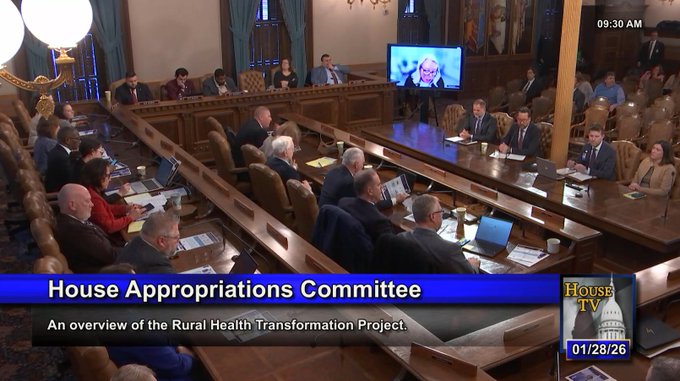
Michigan hospitals testified before the House Appropriations Committee on funding allocated to the state through the RHTP. Michigan was awarded $173 million in RHTP funding in December 2025 to support rural communities and address access-to-care challenges. MHA members testifying in front of the committee included Tonya Darner, CEO, UP Health System; Andrew Raymond, CEO, Kalkaska Memorial Health Center; and Peter Marinoff, president and CEO, Munson South Region. Lauren LaPine-Ray, DrPH, MPH, vice president of policy and rural health, MHA, and Gabe Schneider, director, government relations, Munson Healthcare, also responded to committee questions and shared feedback in support of rural hospitals and the program.

The House Appropriations Committee heard testimony Jan. 28 from rural hospital leaders. Appearing (from left to right) are Tonya Darner (Zoom), Gabe Schneider, Peter Marinoff, Andrew Raymond and Lauren LaPine-Ray.

During testimony, members highlighted challenges facing rural healthcare, including access to maternity care, EMS transportation, behavioral health services, and workforce recruitment and retention. Members noted that 22% of counties are considered maternity deserts and at least 11 hospital labor and delivery units have closed since 2010. Testimony also underscored the role rural hospitals play in supporting overextended EMS systems by holding patients when transport is unavailable, coordinating complex transfers and absorbing unreimbursed costs.

Members emphasized that RHTP funding should be targeted toward these challenges to better serve rural communities and maintain access to care.

The House Health Policy Committee voted Jan. 28 to advance House Bill (HB) 4878, sponsored by Rep. Curtis VanderWall (R-Ludington). HB 4878 protects hospitals’ contract pharmacy arrangements under the federal 340B program and includes state-level drug price transparency and hospital community benefit reporting requirements. The legislation allows eligible 340B hospitals to continue stretching limited resources to support care for vulnerable patients and communities across the state, without using state or federal taxpayer dollars. The MHA and its 340B member hospitals support the integral program protections this legislation affords, both for maintaining access to community-based care and improving affordability across Michigan communities. HB 4878 now heads to the House Rules Committee for further consideration.

The Senate Committee on Civil Rights, Judiciary and Public Safety voted in favor of HB 4418 and HB 4419, which update next of kin designations in a healthcare setting. The bills, sponsored by Rep. Jamie Thompson (R-Brownstown Township) and Rep. Angela Witwer (D-Delta Township), seek to reduce barriers in the process of designating a next of kin to inform medical decisions for a patient who is unable to make those decisions themselves. Current law requires families to pursue guardianship, a process that can be lengthy and burdensome during medical emergencies. The MHA worked with bill sponsors and stakeholders to clarify language in HB 4418 based on member hospital feedback. The bills have been referred to the full Senate for further consideration.

Lastly, the Senate Health Policy Committee heard testimony on Senate Bills (SB) 701 and 702, which make changes to medical debt collection processes in the state. The bipartisan legislation, sponsored by Sen. Jonathan Lindsey (R-Coldwater) and Sen. Sarah Anthony (D-Lansing), make changes to how and when medical debt is collected from patients. The MHA is reviewing the legislation and remains committed to working with lawmakers on opportunities to improve healthcare affordability.

Members with questions may contact the MHA advocacy team.


Investing in Rural Hospitals Means Investing in Rural Michigan

By Jeremiah Hodshire, President & CEO of Hillsdale Hospital

When the One Big Beautiful Bill Act was signed into law in July, it created the Rural Health Transformation Program, a five-year, $50 billion investment in rural healthcare. The MHA Board of Trustees took swift action empowering an MHA board-appointed task force charged with creating recommendations that the Michigan Department of Health & Human Services (MDHHS) could use when submitting the one-time application for funding.

I’ve had the pleasure of chairing the task force and working alongside my colleagues Tonya Darner, UP Health System; Karen Cheeseman, Mackinac Straits Health System; Dr. Ross Ramsey, Schuerer Health; Michael Rose, MyMichigan Health; and Peter Marinoff, Munson Healthcare. This process has been collaborative and informed by other rural hospital leaders across the state through the Rural CEO Town Hall the MHA hosted in late September. I am also deeply indebted to the MHA staff, specifically the driving force behind keeping our committee on task, Lauren LaPine-Ray, who has served as an outstanding ambassador, facilitator, researcher and connector as we navigate the federal guidelines! A few key themes emerged through this process and informed the recommendations shared with MDHHS.

When I look out across our community, I see the same faces that fill our hospital’s halls — farmers, teachers, small business owners and families who trust us to care for them when it matters most. Yet every year, it becomes harder to keep our doors open. Recruiting and retaining obstetricians, gynecologists, social workers, psychologists and primary care physicians has turned into an uphill push. Technology that could connect us to specialists hundreds of miles away remains out of reach due to inadequate broadband and out-of-date electronic medical records platforms. And the gap between what it costs to provide care and what we’re paid to deliver it keeps widening. That’s why the Centers for Medicare & Medicaid Services’ Rural Health Transformation Program matters so much right now. This new federal funding opportunity isn’t just a policy line item — it’s a lifeline. But for Michigan’s small and rural hospitals, it will only make a difference if the dollars actually reach us, the people on the ground.

Our Greatest Need: People

Every rural hospital leader will tell you the same story: we can’t hire fast enough to replace those who’ve left. Nearly 70% of Michigan hospitals report difficulty filling clinical vacancies and rural areas face the longest recruitment times in the state. Nursing wages in large systems have soared, while young physicians are drawn to urban centers where they can earn more and work less on call. Meanwhile, small hospitals like ours are paying bonuses we can’t afford just to keep labor and delivery open or to cover an emergency room shift. The costs to maintain OB/GYNs in rural areas are significant.

If the Rural Health Transformation funds are truly meant to “right-size” care delivery, they must start with stabilizing the workforce that keeps that system running. Rural hospitals should be able to use these funds for loan repayment programs, housing stipends and retention bonuses that reflect the realities of rural practice. Without people, no transformation is possible.

Technology Should Connect, not Divide

Michigan’s rural hospitals have led the way in adopting telehealth, but we are still too often left behind. Broadband is patchy and many of our systems don’t integrate with the larger hospitals where we refer patients. CMS should allow states to dedicate transformation dollars toward technology innovation — helping rural providers invest in electronic health record interoperability, remote patient monitoring and telepsychiatry tools that expand access without expanding costs. When technology works across the system, it saves time, reduces burnout and lets us keep more care local.

Payment Equity Must be Part of Transformation

Even before inflation and staffing shortages, the math didn’t add up. Rural hospitals serve older, sicker populations and depend heavily on Medicare and Medicaid. The number of births occurring in rural hospitals continues to decline, making the ability to cover costs and provide critical care even more challenging. When reimbursement rates don’t cover the cost of care, rural hospitals can’t sustain basic services like obstetrics or behavioral health. Between 2010 and 2023, 11 rural hospitals in Michigan closed or stopped providing inpatient services. Rural Transformation funds should explicitly support provider payments and shared-savings models to ensure critical healthcare access in rural areas is maintained. If rural hospitals can’t afford to pay their doctors and nurses, innovation will stall before it starts.

The Stakes for Michigan

More than 60% of Michigan’s counties are considered rural, with nearly 30 hospitals serving as the only point of care for miles. Every time one closes, an entire region loses not just its emergency room, but also its largest employer and a key part of its safety net. The Michigan Senate Fiscal Agency recently reported nearly 22% of Michigan counties are considered maternity deserts. Michigan needs true investments in rural healthcare to reverse these trends — but only if the funds flow to where they can have the greatest impact: rural hospitals themselves.

These dollars should not get lost in bureaucracy or redirected to administrative projects. They should go toward the people and places that make healthcare possible: our workforce, our technology and our providers.

If we want to build a stronger, more equitable Michigan, we must start by keeping care local, and that begins with investing in the hospitals that keep our communities alive.