New 340B Study Contains Serious Flaws

The following statement can be attributed to Brian Peters, CEO of the Michigan Health & Hospital Association, which represents 129 hospitals and health systems across Michigan:

“This latest release from the Michigan Health Purchasers Coalition is yet another entry in their long and troubling pattern of advocacy dressed as research, with predetermined conclusions in search of supporting data. MIHPC is a secretive special interest group, hiding behind the veil of claiming to represent the employer community at large. The report they are citing is not peer-reviewed and, by its own admission, fails to account for major health system variables – variables so significant that their omission alone disqualifies any direct causal claim between 340B participation and pricing differences. If MIHPC and its members are genuinely concerned about affordability, I invite them to direct some of that energy toward drug companies, whose profit margins dwarf those of any hospital system in this state and who spent years deploying every available legal mechanism to delay competition and protect their revenues. These drug companies have the power to make drugs affordable for all Michiganders today.

The MHA and our members remain, as we always have been, ready to engage with anyone willing to have an honest, evidence-based conversation about addressing the real drivers behind rising healthcare costs – all while caring for all Michiganders across the state 24/7.”

Fact Check: Drug Pricing Savings Are the Lifeline to Community Healthcare Services

Gary L. Roth, DO, Chief Medical Officer, MHA

Recent headlines have taken aim at the 340B Program – a federal drug savings initiative that serves as a lifeline to important community healthcare services. As a long-time cardiothoracic surgeon, it’s time to set the record straight on 340B.

Here’s the reality: doctors, nurses and healthcare leaders share patient’s frustration over rising healthcare costs. Michigan hospitals and health systems employ 222,000 residents, while healthcare is the largest employer in the state. We experience rising healthcare costs and premiums in lockstep with other businesses; while seeing those costs in the faces of every patient who walks through our doors and how cost can influence a person’s decision to seek care.

But attacking the 340B program is the wrong answer to a real problem.

What 340B Actually Does

The 340B program allows eligible hospitals and safety-net healthcare providers – those serving disproportionately high numbers of low-income and uninsured patients – to purchase certain outpatient drugs at reduced prices. The savings are directly reinvested into patient care: keeping rural emergency departments open, funding behavioral health services, expanding pharmacy access in underserved communities and subsidizing care for patients who cannot pay.

Hospitals located in 340B-eligible communities are reimbursed at levels below the full cost to deliver care. This federal program was created to financially support community-based healthcare services without spending any taxpayer dollars.

In Michigan, where rural hospital closures remain a persistent threat and safety-net institutions serve our most vulnerable neighbors, 340B is a lifeline to keeping healthcare close to home. For myself, who spent my career caring for critical care patients in the Greater Lansing area, 340B is a key part of supporting the healthcare we can receive in our community. I know 340B works because of my lived experience providing care because of it. Without 340B savings, some Michigan hospitals would face an impossible choice: cut lifesaving services or close their doors.

Let’s examine what these recent headlines are doing – distracting attention from the reality that drug companies are significantly driving healthcare costs. Their solution is to blame the caregivers and their hospitals that care for everyone who walks through their doors, year-round.

Drug prices in the United States have risen at rates that far outpace inflation. The cost of drugs for hospitals grew 13.6% last year, while hospital prices only increased 3.3%.

Unlike hospitals, drug companies set their own prices with virtually no regulatory check. Unlike hospitals, drug companies boast nearly 23% annual increases in revenue while still raising drug costs. Unlike hospitals, they don’t have to be open at 3 a.m. when someone’s child is struggling to breathe. Hospitals are the ones staying through the night to treat emergency aneurysms, heart attacks and strokes. I know this because I’ve treated far more than I can count.

Hospitals are always there. Always caring. Always working to advance care, regardless of ability to pay, regardless of the hour, regardless of the complexity.

This tension between drug pricing and healthcare affordability was exactly the kind of issue raised at a recent Crain’s Detroit Business Healthcare Affordability Roundtable, where Michigan hospitals and business leaders gathered to confront the systemic forces driving costs higher. The consensus was clear: meaningful reform requires looking at the full picture, including the drug supply chain, and not taking a scalpel to programs that help hospitals keep their doors open around the clock to serve the patients who need them most.

Let’s Solve the Right Problem Together

Accountability and transparency matter and the MHA support both. What I know from meeting and caring for patients is that meaningful solutions are those that impact their pocketbook without touching their healthcare services. Dismantling 340B as drug companies and their partners wish to do fails to achieve either of those outcomes. It instead pads drug company profits while risks community healthcare services.

The MHA is ready to be at the table. We invite lawmakers, business leaders, insurers and drug companies to join us in pursuing real, collaborative solutions to the cost challenges facing Michigan families.


Hospitals Help: Mackinac Straits Retail Pharmacy Serves as a Lifeline in Northern Michigan

Mackinac Straits Health System opened its retail pharmacy in St. Ignace.

Mackinac Straits Health System opened its retail pharmacy in St. Ignace following valuable feedback from the community.

Previously, the community lacked access to pharmacy services on weekends and holidays. This created additional barriers to care, requiring patients to travel in excess of 60 to 100 miles round trip to the next closest pharmacy.

Now, the retail pharmacy continues to prosper and provides a lifeline for rural communities in the Straits area, filling over 56,000 prescriptions annually.

The 340B program has allowed the health system to promote discounted medications, enhanced vaccination offerings and specialty care services. Created by Congress more than 30 years ago, the 340B program helps hospitals and community health centers stretch their limited resources further without using any state taxpayer dollars.

“The 340B program directly benefits patients by allowing us to stretch scarce federal resources to offer critical services including additional pharmacy access and personalized prescription delivery to those who have limited means of transportation on Mackinac Island and beyond,” said Karen Cheeseman, president and chief executive officer, Mackinac Straits Health System.

Those interested in learning more about the program can visit the 340B webpage. To read more positive hospital stories, check out more Hospitals Help webpage and the 2025 Community Impact Report.

Members with questions may contact Lucy Ciaramitaro at the MHA.

MHA Monday Report Feb. 2, 2026

State Legislative Weekly Recap: House Appropriations Committee Continues RHTP Testimony

The Michigan House Appropriations Committee continued testimony during the week of Jan. 26 on federal funding awarded through the Rural Health Transformation Program (RHTP) and on legislation related to the 340B program and next-of-kin designations. …


MHA Events2026 MHA Human Resources Conference Registration Open

The 2026 MHA Human Resources Conference, scheduled for March 24 at the Crowne Plaza Lansing, will convene human resources leaders and professionals who are shaping the future of the healthcare workforce. In an evolving healthcare …


MHA Shares Recent Medicare and Medicaid Enrollment Analysis

The MHA recently updated its analysis of Medicaid and Medicare enrollment based on December 2025 data. The analysis includes program enrollment as a percentage of each county’s total population and the split between fee-for-service …


New MHA Infographic Provides Overview of RHTP Program in Michigan

The MHA recently released a new infographic that provides an overview of the RHTP in Michigan. This infographic highlights the scope of the program, Michigan’s rural health landscape and the $173 million awarded to the …


Pediatric Vaccination Guidance: What Michigan Providers Need to Know

The American Academy of Pediatrics recently published its 2026 immunization schedule for children and adolescents, recommending protection against 18 diseases including polio, measles, respiratory syncytial virus and meningococcal disease. This comprehensive schedule draws …


Deadline Approaching for MHA Healthcare Leadership Academy

The enrollment deadline for the MHA Healthcare Leadership Academy is Feb. 6. The cohort meets Feb. 25-27 and May 7-8 at the MHA headquarters in Okemos. The Healthcare Leadership Academy, in partnership with Executive Core, has …


Hospitals Help: Munson Healthcare, Community Partners Offer Free Family Support Program

Healthy Futures is a free family support program that helps answer questions and assists families in finding services and resources in the community. The program, which has no eligibility requirements, is a collaboration between Munson …


MHA Rounds graphic of Brian PetersMHA CEO Report — The Reality Behind a Hospital Ribbon-Cutting

Hospital ribbon-cutting ceremonies tend to spotlight the new and modern elements of a hospital expansion: bright windows, sleek patient rooms or advanced diagnostic technology. But what you don’t see is often more important than what …

New to Know


News to Know

  • The MHA recently created a dedicated newsroom webpage #HospitalsHelp, highlighting stories from member hospitals across Michigan and their community benefit efforts.
  • Stay connected with the MHA for the latest healthcare updates in Michigan across its social media platforms, including Facebook, X, LinkedIn, Instagram, Bluesky and Threads.

MHA in the News

The Detroit News published a story Jan. 29 on two recent House Appropriations Committee hearings on the distribution of RHTP funds. The article details concern from House lawmakers and rural providers …

State Legislative Weekly Recap: House Appropriations Committee Continues RHTP Testimony

The Michigan House Appropriations Committee continued testimony during the week of Jan. 26 on federal funding awarded through the Rural Health Transformation Program (RHTP) and on legislation related to the 340B program and next-of-kin designations.

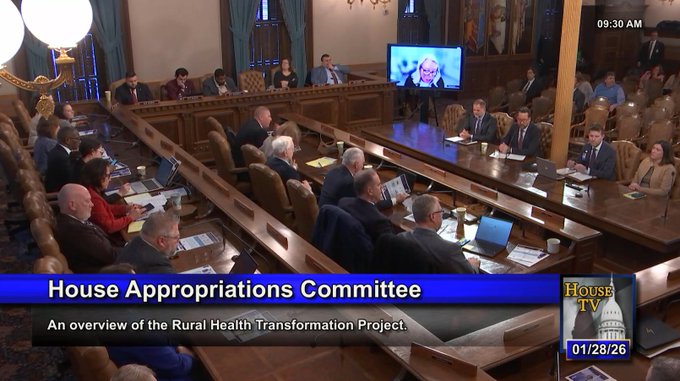
Michigan hospitals testified before the House Appropriations Committee on funding allocated to the state through the RHTP. Michigan was awarded $173 million in RHTP funding in December 2025 to support rural communities and address access-to-care challenges. MHA members testifying in front of the committee included Tonya Darner, CEO, UP Health System; Andrew Raymond, CEO, Kalkaska Memorial Health Center; and Peter Marinoff, president and CEO, Munson South Region. Lauren LaPine-Ray, DrPH, MPH, vice president of policy and rural health, MHA, and Gabe Schneider, director, government relations, Munson Healthcare, also responded to committee questions and shared feedback in support of rural hospitals and the program.

The House Appropriations Committee heard testimony Jan. 28 from rural hospital leaders. Appearing (from left to right) are Tonya Darner (Zoom), Gabe Schneider, Peter Marinoff, Andrew Raymond and Lauren LaPine-Ray.

During testimony, members highlighted challenges facing rural healthcare, including access to maternity care, EMS transportation, behavioral health services, and workforce recruitment and retention. Members noted that 22% of counties are considered maternity deserts and at least 11 hospital labor and delivery units have closed since 2010. Testimony also underscored the role rural hospitals play in supporting overextended EMS systems by holding patients when transport is unavailable, coordinating complex transfers and absorbing unreimbursed costs.

Members emphasized that RHTP funding should be targeted toward these challenges to better serve rural communities and maintain access to care.

The House Health Policy Committee voted Jan. 28 to advance House Bill (HB) 4878, sponsored by Rep. Curtis VanderWall (R-Ludington). HB 4878 protects hospitals’ contract pharmacy arrangements under the federal 340B program and includes state-level drug price transparency and hospital community benefit reporting requirements. The legislation allows eligible 340B hospitals to continue stretching limited resources to support care for vulnerable patients and communities across the state, without using state or federal taxpayer dollars. The MHA and its 340B member hospitals support the integral program protections this legislation affords, both for maintaining access to community-based care and improving affordability across Michigan communities. HB 4878 now heads to the House Rules Committee for further consideration.

The Senate Committee on Civil Rights, Judiciary and Public Safety voted in favor of HB 4418 and HB 4419, which update next of kin designations in a healthcare setting. The bills, sponsored by Rep. Jamie Thompson (R-Brownstown Township) and Rep. Angela Witwer (D-Delta Township), seek to reduce barriers in the process of designating a next of kin to inform medical decisions for a patient who is unable to make those decisions themselves. Current law requires families to pursue guardianship, a process that can be lengthy and burdensome during medical emergencies. The MHA worked with bill sponsors and stakeholders to clarify language in HB 4418 based on member hospital feedback. The bills have been referred to the full Senate for further consideration.

Lastly, the Senate Health Policy Committee heard testimony on Senate Bills (SB) 701 and 702, which make changes to medical debt collection processes in the state. The bipartisan legislation, sponsored by Sen. Jonathan Lindsey (R-Coldwater) and Sen. Sarah Anthony (D-Lansing), make changes to how and when medical debt is collected from patients. The MHA is reviewing the legislation and remains committed to working with lawmakers on opportunities to improve healthcare affordability.

Members with questions may contact the MHA advocacy team.


Help Protect 340B in Michigan: MHA Action Alert Available

Hospitals throughout Michigan rely on savings from the 340B Prescription Drug Pricing Program every day to spread scarce resources and care for those with limited or no access to healthcare. As manufacturers and other players at the state and federal level work to scale back the program, the MHA team is engaged in efforts to protect 340B and generate public awareness about the benefits it provides to Michigan patients and communities. Those interested in advocating for the 340B program are encouraged to contact House Insurance and Financial Services Committee members in a few quick steps through an MHA Action Alert.Two women hugging in a hospital setting with overlay text that reads, "340B Protects Access to Lifesaving Care" with text below that says learn more at MHA.org

The action alert requests committee members pass House Bill (HB) 5350, introduced by Rep. Alabas Farhat (D-Dearborn), to protect the 340B program and preserve healthcare cost-savings for Michigan hospitals and the communities they serve. The House Insurance and Financial Services Committee convened June 5 to hear testimony on the bill, allowing representatives from Henry Ford Health, Memorial Healthcare, McLaren Healthcare and Trinity Health to speak in support of the legislation.

Additionally, the MHA created a 340B webpage, downloadable infographic, digital ads and informational social media content. Targeted messages have been displayed more than 150,000 times to audiences in the downtown Lansing region.

Elizabeth Kutter, senior director of government and political affairs, MHA, provided first-hand insight on the strong impact of the 340B program in an MHA Rounds article.

“I’ve had countless conversations with our members about the benefits of 340B,” said Kutter. “The sentiment across the board – especially among rural hospitals and urban safety net hospitals – is that the program is essential for meeting patients where they are…every effort spent to manage the new onslaught of administrative burden created by manufacturers, is less savings going directly into communities in need of affordable care.”

The MHA continues to advocate for 340B and uplift the efforts of Michigan hospitals to expand access to quality, community-based care. Members with questions should contact Elizabeth Kutter at the MHA.