House, Senate Advance Budget Proposals; MHA-Supported Bills Move

Budget proposals from the House and Senate advanced in their respective chambers, while MHA-supported legislation saw action during the week of April 20.

House Bill (HB) 5619, sponsored by Rep. Ann Bollin (R-Brighton), passed the Michigan House April 22. The bill contains all state funding for fiscal year 2026-27, including the budget for the Michigan Department of Health and Human Services (MDHHS). Within the MDHHS portion, the bill includes:

  • Full funding for Medicaid, except for a reduction of $300 million in unspecified savings
  • Recognition of hospital provider taxes and the ability to access those funds without additional legislative action or administrative barriers
  • Specialty Network Access Fee funding
  • Support for rural and obstetrics stabilization pools
  • Funding for Maternal Levels of Care verification
  • $22 million and additional state employees to implement Medicaid work reporting requirements as required by H.R. 1
  • Language encouraging timely allocation of Rural Health Transformation funds

The Senate advanced its MDHHS budget under Senate Bill (SB) 857, sponsored by Sen. Sarah Anthony (D-Lansing). Key highlights of the bill include:

  • Full funding for Medicaid
  • Recognition of hospital provider taxes and the ability to access those funds without additional legislative action or administrative barriers
  • Specialty Network Access funding
  • Support for rural and obstetrics stabilization pools
  • Funding for Maternal Levels of Care verification

Unlike the governor’s executive recommendation and the House proposal, the Senate plan does not include unspecified Medicaid savings. Instead, it identifies funding through caseload adjustment savings, Most Favored Nation drug pricing savings, and other efficiencies. The Senate Appropriations Committee passed this bill out of committee to the full Senate on April  23.

The MHA will continue working with lawmakers to ensure the final product maintains support for hospitals, providers and patients.

In addition, the Senate approved SB 301. Sponsored by Sen. Joe Bellino (R-Monroe), the MHA-supported legislation would provide a tax credit to employers whose employees take time off to serve as living organ donors. The bill has been referred to the House Finance Committee.

Senate Bills (SB) 590 and 591 were taken up for testimony in the House Health Policy Committee. The bills would strengthen the state’s Good Samaritan Law for all individuals acting in good faith when applying bleeding control techniques in emergency situations. SB 590 and SB 591 are sponsored by Sen. Stephanie Chang (D-Detroit) and Sen. Rick Outman (R-Six Lakes), respectively. The MHA supports this legislation.

Members with questions may contact the MHA advocacy team.

Medical Debt Legislation Clears Senate, MHA-Supported Bills Advance in the House

Legislation addressing medical debt collection processes and hospital financial assistance policies passed the Michigan Senate, while the House of Representatives moved MHA-supported bills during the week of March 9. 

The Senate voted in support of Senate Bills (SB) 449450 and 451 as well as SBs 701 and 702. The bipartisan three-bill package, SBs 449-451, codifies the existence of hospital financial assistance programs (FAPs), creates new reporting requirements on the benefits provided by FAPs and prohibits medical debt from being reported by credit bureaus. The bills, sponsored by Sen. Sarah Anthony (D-Lansing) and Sen. Jonathan Lindsey (R-Coldwater), require the following: 

  • Hospitals to develop and implement a FAP that provides up to a 100% discount based on a sliding scale for an uninsured patient whose annual income is at or below 350% of federal poverty guidelines. The FAP must also apply to patients who owe the hospital an unpaid bill greater than 30% of their annual income. 
  • Hospitals to post information about the FAP on bills, invoices and the hospital website. 
  • Hospitals to submit an annual report to the Michigan Department of Health and Human Services (MDHHS) stating the number of applications to the hospital’s FAP and the benefits provided by the FAP in a given year. 
  • The state to create a process allowing hospitals to check patient income eligibility. 
  • Prohibits consumer reporting agencies from including medical debt in consumer credit reports. 

Additionally, SBs 701-702 aim to change medical debt collection processes in the state, including restrictions on the sale of medical debt and limits on interest.  

Each bill was approved by the full Senate and has been referred to the House of Representatives for further review and consideration. The MHA secured several key amendments to the legislation and will continue engaging with lawmakers as the process continues. 

Additionally, the House of Representatives acted on several healthcare-related bills this week, including House Bill (HB) 4582SB 398, and HB 5281The full House voted 58-48 on HB 4582, sponsored by Rep. Jerry Neyer (R-Shepherd), which clarifies Michigan’s premises liability law. The bill has now been referred to the Senate for consideration. SB 398, sponsored by Sen. Joe Bellino (R-Monroe), modifies opioid treatment program requirements under the Department of Licensing and Regulatory Affairs, and was supported by the House Health Policy Committee.  The Behavioral Health Integration Council previously engaged with bill sponsors on SB 398 and other opioid use disorder bills, resulting in the MHA’s support. The House Judiciary Committee also took testimony on HB 5281. The bill, sponsored by Rep. Mike Harris (R-Waterford Township), would regulate third-party litigation funding transactions and require transparency measures. The MHA supports these bills and looks forward to their progress through the legislative process. 

Members with questions may contact the MHA advocacy team. 

State Legislative Weekly Recap: House Appropriations Committee Continues RHTP Testimony

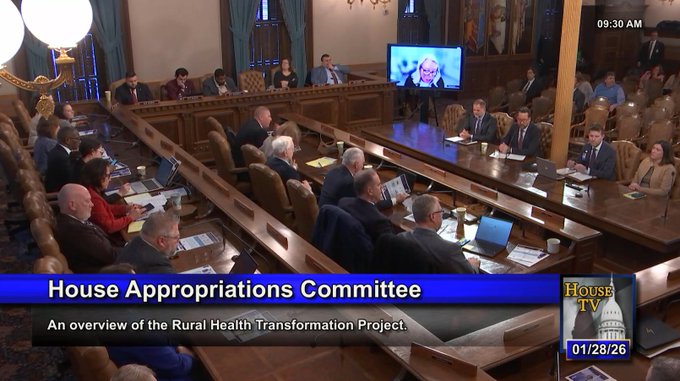
The Michigan House Appropriations Committee continued testimony during the week of Jan. 26 on federal funding awarded through the Rural Health Transformation Program (RHTP) and on legislation related to the 340B program and next-of-kin designations.

Michigan hospitals testified before the House Appropriations Committee on funding allocated to the state through the RHTP. Michigan was awarded $173 million in RHTP funding in December 2025 to support rural communities and address access-to-care challenges. MHA members testifying in front of the committee included Tonya Darner, CEO, UP Health System; Andrew Raymond, CEO, Kalkaska Memorial Health Center; and Peter Marinoff, president and CEO, Munson South Region. Lauren LaPine-Ray, DrPH, MPH, vice president of policy and rural health, MHA, and Gabe Schneider, director, government relations, Munson Healthcare, also responded to committee questions and shared feedback in support of rural hospitals and the program.

The House Appropriations Committee heard testimony Jan. 28 from rural hospital leaders. Appearing (from left to right) are Tonya Darner (Zoom), Gabe Schneider, Peter Marinoff, Andrew Raymond and Lauren LaPine-Ray.

During testimony, members highlighted challenges facing rural healthcare, including access to maternity care, EMS transportation, behavioral health services, and workforce recruitment and retention. Members noted that 22% of counties are considered maternity deserts and at least 11 hospital labor and delivery units have closed since 2010. Testimony also underscored the role rural hospitals play in supporting overextended EMS systems by holding patients when transport is unavailable, coordinating complex transfers and absorbing unreimbursed costs.

Members emphasized that RHTP funding should be targeted toward these challenges to better serve rural communities and maintain access to care.

The House Health Policy Committee voted Jan. 28 to advance House Bill (HB) 4878, sponsored by Rep. Curtis VanderWall (R-Ludington). HB 4878 protects hospitals’ contract pharmacy arrangements under the federal 340B program and includes state-level drug price transparency and hospital community benefit reporting requirements. The legislation allows eligible 340B hospitals to continue stretching limited resources to support care for vulnerable patients and communities across the state, without using state or federal taxpayer dollars. The MHA and its 340B member hospitals support the integral program protections this legislation affords, both for maintaining access to community-based care and improving affordability across Michigan communities. HB 4878 now heads to the House Rules Committee for further consideration.

The Senate Committee on Civil Rights, Judiciary and Public Safety voted in favor of HB 4418 and HB 4419, which update next of kin designations in a healthcare setting. The bills, sponsored by Rep. Jamie Thompson (R-Brownstown Township) and Rep. Angela Witwer (D-Delta Township), seek to reduce barriers in the process of designating a next of kin to inform medical decisions for a patient who is unable to make those decisions themselves. Current law requires families to pursue guardianship, a process that can be lengthy and burdensome during medical emergencies. The MHA worked with bill sponsors and stakeholders to clarify language in HB 4418 based on member hospital feedback. The bills have been referred to the full Senate for further consideration.

Lastly, the Senate Health Policy Committee heard testimony on Senate Bills (SB) 701 and 702, which make changes to medical debt collection processes in the state. The bipartisan legislation, sponsored by Sen. Jonathan Lindsey (R-Coldwater) and Sen. Sarah Anthony (D-Lansing), make changes to how and when medical debt is collected from patients. The MHA is reviewing the legislation and remains committed to working with lawmakers on opportunities to improve healthcare affordability.

Members with questions may contact the MHA advocacy team.


Workforce Bills Highlight Healthcare Legislation Advanced in the State Legislature

Advocacy image tileSeveral workforce bills highlighted the healthcare legislation that advanced in the state legislature during the week of Nov. 11.

The Senate Appropriations Committee approved Senate Bills (SBs) 406 and 407, led by Sen. Sarah Anthony (D-Lansing). The bills provide the statutory changes to continue expanded eligibility for the Michigan Reconnect program. The legislation amends the Michigan Reconnect Grant Recipient Act to reduce the age of eligibility to receive Michigan Reconnect from 25 to 21. The MHA supports this legislation, as it will make it easier for Michigan residents to access high-demand healthcare credentials through the program. The legislation now awaits a vote from the full Senate.

The Michigan House passed House Bill 4224, sponsored by Rep. Julie Rogers (D-Kalamazoo). This legislation would repeal the onerous Medicaid work requirements that have been in statute for the last several years, although not officially enforced. The MHA supports the bill to clean up Michigan’s Medicaid statute to ensure that the program remains a sustainable safety net for those in need of health insurance. The legislation now advances to the Senate for their likely consideration by the Health Policy Committee.

The Senate Local Government committee also advanced SB 660, sponsored by Sen. Rosemary Bayer (D-Keego Harbor). The legislation would establish a process to allow local units of government to levy taxes on certain impermeable surfaces to fund projects related to stormwater control and runoff. The MHA opposes the legislation, as it removes the current requirement that such taxes must be approved by a vote of the people in the community and could increase costs for healthcare. The bill now advances to the full Senate.

Members with questions can reach out to Elizabeth Kutter.