The MHA received media coverage the week of March 10 on the 340B program and potential federal Medicaid funding cuts with outlets including MichMash, Crain’s Grand Rapids Business and 9&10 News.
MHA CEO Brian Peters appeared on the March 14 episode of the MichMash podcast where he discussed MHA advocacy efforts to oppose Medicaid funding cuts, passage of Senate Bills 94 and 95 by the Michigan Senate that safeguard the 340B program and the healthcare workforce. The interview was conducted by hosts Cheyna Roth and Zach Gorchow. MichMash is produced by WDET Detroit Public Radio in collaboration with Gongwer News Service and is part of the NPR Network.
Crain’s Grand Rapids also published an article March 10 about the 340B legislation moving through the Senate. Peters and Elizabeth Kutter, senior director of advocacy, MHA, are quoted in the piece.
“This bill prevents drug manufacturers from continuing to issue arbitrary restrictions on 340B eligible Federally Qualified Health Centers and hospitals,” said Peters. “We continue to be grateful for the Senate’s leadership and collaboration in recognizing the need for strong, quality health care providers over out-of-state prescription drug interest groups.”
9&10 News aired a story March 11 that looked at the impact on Michigan if funding cuts to Medicaid are implemented. MHA Executive Vice President Laura Appel was interviewed and appears in the story.
“We know that work requirements are popular as a concept, but really, we need to focus on people being healthy so that they can work, as opposed to working so that they can become healthy,” said Appel.
Members with any questions regarding media requests should contact John Karasinski at the MHA.
The Michigan Senate passed legislation that protects 340B hospitals with bipartisan support while the Michigan House of Representations voted through legislation that removes the sunset on the Interstate Medical Licensure Compact (IMLC) during the week …
The MHA recently released a toolkit of communications resources to support hospitals in advocating against potential Medicaid funding cuts in their local communities. The toolkit includes: Talking points Template letter-to-the-editor Template press release Social media …
The Department of Health and Human Services (HHS) recently announced the rescinding of the Public Participation in Rule Making (Richardson Waiver), which invited public participation in rulemaking related to federal rules and regulations. HHS Secretary …
The Michigan Department of Health and Human Services (MDHHS) recently completed the April 2025 update to the MDHHS Medicaid Provider Manual, which will be available online April 1, 2025. This update aims to clarify coverage …
Registration is open for the highly anticipated MHA Keystone Center Safety & Quality Symposium, scheduled for April 28 & 29, 2025, at the Kellogg Conference Center & Hotel, East Lansing. The symposium, offering continuing education …
The Michigan Alliance for Innovation on Maternal Health is offering regional training sessions for inpatient maternal health providers focused on implementing the hypertension safety bundle and addressing common challenges with implementation. The one-hour …
“This year, the Nashville Heath Care Council is celebrating its 30th anniversary. Its 900 members employ 333,000 and contribute $68 billion to the local economy. It hosts global conferences (VIVE, Sessions) among its 80+ events annually and promotes Nashville as the healthcare innovation hub of the planet. It is dominated by publicly traded health services companies and the armies of advisors, lawyers, accountants and analysts they employ. …
The Nashville healthcare community will not attempt to transform the industry: that’s for others. It will engage on industry challenges that require technology-enabled solutions, private capital and experienced operators. It is not paralyzed by regulation, industry norms, trade association affiliations or tradition. It is prone to think of healthcare as a opportunistic market, celebrate its profitability and leave systemic issues for others to fix.
The Nashville healthcare community is a fast follower: the bleeding edge is for others. But in following fast, it has emerged as a key influencer in Trump healthcare policies and their execution.”
The MHA Human Resources Conference is quickly approaching on March 25, 2025 from 8:30 a.m. to 3:30 p.m. at the Crowne Plaza Lansing.
In order to continue sharing with key stakeholders the important impact hospitals make to their communities, the MHA invites members to share examples of strong community impact programming through a brief survey.
The MHA received media coverage the week of March 3 on the Michigan Senate passing legislation that protects the 340B program, the potential impact of tariffs on hospitals and healthcare costs, as well as a …
The Michigan Senate passed legislation that protects 340B hospitals with bipartisan support while the Michigan House of Representations voted through legislation that removes the sunset on the Interstate Medical Licensure Compact (IMLC) during the week of March 3.
Following successful reporting from the Senate Oversight Committee, the full Senate took swift action on Senate Bill (SB) 94, sponsored by Sen. Sam Singh (D-East Lansing). The MHA-supported legislation passed the Senate 33-3, with overwhelming bipartisan support, on March 6, reflecting the Senate’s commitment to protecting access to care and the 340B program. The Senate paired this legislation with SB 95, sponsored by Sen. Jonathan Lindsey (R-Allen), which requires hospital compliance with federal cost transparency laws.
SB 94 safeguards the 340B program in Michigan, ensuring cost savings and preserving access to affordable healthcare services in both urban and rural Michigan communities. Further, this legislation adds first of its kind pharmaceutical manufacturer transparency requirements, making Michigan’s legislation the strongest in the nation.
The legislation will now be sent to the House of Representatives for further action. The MHA continues to advocate for the 340B program and support Michigan hospitals’ efforts to expand access to quality, community-based care. Members are encouraged to use the MHA 340B Action Alert to contact their lawmakers in support of this legislation.
In addition, House Bill (HB) 4032, sponsored by Rep. Rylee Linting (R-Grosse Ile), passed the full House 106-1 on March 6. The legislation eliminates the sunset on the interstate medical licensure compact, which streamlines the licensing process and allows physicians licensed in one state to practice in multiple, participating states.
By removing additional licensing requirements for physicians seeking to practice across state lines, patients experience increased access to care, especially in rural and underserved areas, by physicians included in the compact. States involved in the compact can share disciplinary and investigative information through the state medical board to strengthen public protection for patients and the program. Michigan’s participation in the compact is currently set to expire March 28, 2025. The MHA supports this legislation and is working quickly with lawmakers to move it through the legislative process before the compact’s current expiration date.
The MHA received media coverage the week of March 3 on the Michigan Senate passing legislation that protects the 340B program, the potential impact of tariffs on hospitals and healthcare costs, as well as a radio appearance discussing potential federal Medicaid funding cuts.
Michigan Public aired a story March 6 following the broad bi-partisan passage of Senate Bills 94 and 95 by the full chamber. Senate Bill 94 would safeguard the 340B program, ensuring cost savings and preserves access to affordable healthcare services in both urban and rural Michigan communities. Further, this legislation adds first of its kind drug manufacturer transparency requirements, making Michigan’s legislation the strongest in the nation.
Elizabeth Kutter, senior director, government and political affairs, MHA, was interviewed by Michigan Public for the story.
“You have to be an entity that proves their eligibility in the program, which by default means that you are serving patients who are extremely vulnerable,” said Kutter. “You’re serving kids. You’re serving cancer patients. You’re serving people who, if your hospital closes or if healthcare access becomes limited, suddenly you’re seeing a very serious hospital desert for patients.”
Gongwer and MIRS also covered the passage of the bills.
In addition, Crain’s Detroit Business published an article March 3 looking at the impact of potential tariffs on a variety of Michigan industries, including healthcare. MHA CEO Brian Peters is quoted in the story addressing the impact to hospitals.
“Implementing tariffs on Canada, Mexico and China without exceptions for medications and medical supplies could jeopardize the availability and further increase the prices of already-expensive vital medications and health care devices Michigan hospitals need to provide appropriate patient care,” said Peters. “Tariffs will particularly exacerbate existing pharmaceutical shortages. China is responsible for providing a significant number of cardiac and oncology drugs, as well as active pharmaceutical ingredients needed to produce prescription drugs domestically. Many healthcare supplies are also produced in China and the United States does not have existing capacity to meet an increased demand for product.”
Peters also appeared on WJR 760AM March 3 to discuss the impact of potential federal Medicaid funding cuts on Michigan hospitals.
Members with any questions regarding media requests should contact John Karasinski at the MHA.
The following statement can be attributed to Brian Peters, CEO of the Michigan Health & Hospital Association.
The Senate sent a strong message for the second time in four months that Michigan prioritizes patients and their local healthcare services over drug manufacturer profits by passing 340B protections through Senate Bill 94 with yet again broad bipartisan support.
This bill prevents drug manufacturers from continuing to issue arbitrary restrictions on 340B eligible Federally Qualified Health Centers and hospitals. We continue to be grateful for the Senate’s leadership and collaboration in recognizing the need for strong, quality healthcare providers over out-of-state prescription drug interest groups.
We encourage our friends in the Michigan House of Representatives to match the Senate’s commitment to local hospitals and further demonstrate that patients and communities come first in Michigan.
Legislation that would implement 340B program protections advanced in the Senate Oversight Committee and Gov. Whitmer delivered her seventh annual State of the State address to the Michigan Legislature during the week of Feb. 24. …
The State of Michigan recently launched the $10 million Employer-Assisted Housing Fund to help address workforce housing shortages and improve employee retention across the state. The pilot program, in partnership with the Michigan State Housing …
The following article was written by MHA Endorsed Business Partner Tarian (formerly HSS) and outlines essential strategies and best practices to create a safer environment for all. Workplace violence in healthcare settings is an …
The MHA released a new episode of the MiCare Champion Cast featuring Laura Ortiz, MD, Emergency Medicine Provider at Corewell Health William Beaumont University Hospital, exploring a collaborative effort that’s enhancing access to care for vulnerable communities. …
Accessible and affordable healthcare is essential for communities to thrive, yet recent proposals to slash Medicaid funding threaten to destabilize this foundation for nearly three million Michiganders, including 961,000 children whose health and future depend on access to these services. …
“The healthcare workforce is unsteady: while stress and burnout are associated with doctors and nurses primarily, they cut across every workgroup and setting. …
These eight combine to make life miserable most days in health human resource management. DOGE will complicate matters more. It’s a concern in every sector of healthcare, and particularly serious in hospitals, medical practices, long-term and home care settings.
‘Modernizing the healthcare workforce’ sounds appealing, but for now, navigating these issues requires full attention. They require Board understanding and creative problem-solving by managers. And they merit a dignified and respectful approach to interactions with workers displaced by these circumstances: they’re not expendables, they’re individuals like you and me.”
Registration is open for the 2025 MHA Human Resources Conference, scheduled for March 25 from 8:30 a.m. to 3:30 p.m. at the Crowne Plaza Lansing.
Registration is open for the highly anticipated re-designed MHA Keystone Center Safety & Quality Symposium, scheduled for April 28 and 29 at the Kellogg Conference Center & Hotel, East Lansing.
MHA Executive Vice President Laura Appel appeared on Detroit’s WJR 760 AM’s ‘JR Morning with Guy Gordon, Llyod Jackson and Jamie Edmonds’s “Live from Lansing” broadcast Feb. 26 as part of the station’s annual coverage …
Legislation that would implement 340B program protections advanced in the Senate Oversight Committee and Gov. Whitmer delivered her seventh annual State of the State address to the Michigan Legislature during the week of Feb. 24.
Deidra Wilson, senior vice president, government relations and public policy, McLaren Health Care; and Ben Frederick, associate vice president of advocacy and government relations, Memorial Healthcare testified Feb. 27 in the Senate Oversight Committee on legislation regarding 340B Protections.
Senate Bill (SB) 94, sponsored by Sen. Sam Singh (D-East Lansing), and SB 95, sponsored by Sen. Jonathan Lindsey (R-Allen), saw extensive action in the Senate Oversight Committee Feb. 27. SB 94 protects the 340B program in Michigan and is paired with SB 95, which requires hospital compliance with federal transparency laws. Two MHA members provided testimony during the committee in support:Deidra Wilson, senior vice president, government relations and public policy, McLaren Health Care; and Ben Frederick, associate vice president of advocacy and government relations, Memorial Healthcare.
SB 94 safeguards the 340B program, ensuring cost savings and preserves access to affordable healthcare services in both urban and rural Michigan communities. Further, this legislation adds first of its kind drug manufacturer transparency requirements, making Michigan’s legislation the strongest in the nation.
During testimony, Wilson first thanked the committee for their swift action on reintroduction of the bills and the importance of expediting this legislation to support communities. She discussed services for cancer patients across the state, such as covering copays, rural OB services and other vital services for vulnerable populations that are impacted when pharmaceutical manufacturers create restrictions around the 340B program. Wilson concluded her testimony by stating that hospitals prioritize the needs of patients and communities over the profits of drug manufacturers. Frederick emphasized the impact the 340B program has in rural communities, especially for independent and community hospitals, and shared how these rural areas can provide essential OB, cancer and family medicine services to preserve and improve access for patients. Following a successful hearing, the Senate Oversight Committee voted 5-0 to report SB 94 and SB 95 to the full Senate. The bills now await a full vote in the Senate before it can be sent to the House of Representatives.
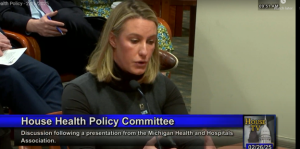
Elizabeth Kutter, senior director, government and political affairs, MHA testimony provided an overview of the 340B program in the House Health Policy Committee Feb. 26.
The House Health Policy Committee also heard testimony on the importance of the 340B program in the state Feb. 26.Elizabeth Kutter, senior director, government and political affairs, MHA, provided an overview of the program, including examples of how the program benefits patients and communities across the state. Wilson and Frederick also testified, sharing how the program works for their hospital systems. The educational hearing enabled House Health Policy members to ask questions and engage in a constructive dialogue around the topic. The MHA continues to advocate for the 340B program and support Michigan hospitals’ efforts to expand access to quality, community-based care. Members are encouraged to use the MHA 340B Action Alert to contact their lawmakers in support of this legislation.
Lastly, Gov. Whitmer outlined her upcoming priorities to a joint convention of the Michigan Legislature in her State of the State address Feb. 26. One key highlight in her address included reducing medical debt for Michiganders. While no specific policies were discussed, she cited 700,000 Michiganders currently have medical debt and that legislators should work to find solutions for this issue going forward. In addition to this, the governor discussed working in a bipartisan fashion on issues like road funding, building affordable housing and lowering costs in the state.
As part of the program lineup, Appel spoke with Gordon and Jackson about the state of hospitals and the many changes they face, including the healthcare workforce, the 340B program and protecting Medicaid from federal funding cuts. Other notable interviewees during the event included Senate Minority Leader Aric Nesbitt (R-Lawton) and Speaker of the House Matt Hall (R-Richland Township).
Relevant healthcare topics included in the State of the State address included expanded attention towards recruiting males to pursue post-secondary education opportunities and increased state support for forgiving patient medical debt.
Additional media stories published during the week of Feb. 24 included an article picked up by both Bridge and MIRS on the challenges of behavioral health transport services for providers in the Upper Peninsula. Lauren LaPine, senior director of Legislative & Public Policy, MHA, was quoted in the article discussing efforts with the Michigan Department of Health & Human Services to implement and fund behavioral health transportation services at hospitals across the state.
“We believe that a patient shouldn’t have to be transported via police transport for behavioral health needs,” said LaPine.
In addition, the MHA received mention in a Feb. 27 article from MIRS recapping a House Health Policy Committee hearing about the 340B program.
Members with questions should contact John Karasinski at the MHA.
The MHA defeated legislation that would have established government-mandated nurse staffing ratios and legislation that would have made detrimental revisions to Michigan’s strong medical liability laws during the week of Dec. 16. The MHA opposed …
The MHA Keystone Center recently released its 2023-24 Annual Report, which demonstrates the organization’s commitment to advancing the safety and quality of care alongside Michigan hospitals. The report showcases MHA Keystone Center-led patient and workforce …
The MHA Keystone Center has recognized Ronald Patterson, a police authority officer at University of Michigan Health-Sparrow, as its quarterly MHA Keystone Center Speak-up! Award recipient for December. The Speak-up! …
Through an ongoing partnership with the Michigan Department of Health & Human Services, Michigan birthing hospitals are reminded to enroll as a Vaccine for Children (VFC) Specialty Provider in order to administer the respiratory …
The Superior Health Quality Alliance – a coalition of eight Midwest healthcare quality improvement organizations including the MHA Keystone Center – recently released a report detailing its work over the past five years as the …
The MHA will host the webinar Building Effective Peer Recovery Coach Programs in Hospitals Feb. 12 from 8:30 – 9:30 a.m. to help hospitals create hospital-based peer recovery coach programs, providing background information and …
“The murder of UnitedHealth Group executive Brian Thompson (aka BT) December 4 and prosecution of his alleged killer Luigi Mangione in Pennsylvania and New York will be in the media spotlight for months to come. The 26-year-old data scientist’ antipathy toward the health industry will be the sidebar in most coverage. …
Our system is fragmented by design, opaque by habit, resistant to change and considers criticism by outsiders unfair or ill-informed. Success and incentives in most healthcare organizations are based on short-term financial performance. Transparency is a threat and innovation is incremental. In the vast majority, Boards are rarely more than rubber stamps for management as long as “the numbers are hit.”
Tension between payers and providers, investor-owned and not-for-profit ownership and preventive health and specialty care has calcified and Executives are promoted as celebrities. In the process, the public’s attention is drawn to the industry where ministry and mission appear subordinate to corporatization and profit. …
That’s not the future. The public expects more and they’re tired of industry pushback and excuses.”
The MHA offices will be closed and no formal meetings will be scheduled Dec. 24 – Jan. 1, 2025.
Due to the holidays, Monday Report will not be published Dec. 30 and Jan. 6 and will resume its normal schedule Jan. 13.
The December edition of Trustee Insights, the AHA’s monthly digital package, highlights resources on key topics such as quality and safety priorities, social determinants of health, board diversity, behavioral health integration and financial performance.
In 2025, the MHA will host the second Human Resources Conference and welcome back the MHA Keystone Center’s Safety & Quality Symposium for the first time since 2019
MHA CEO Brian Peters joined Michigan’s Big Show Dec. 16 to discuss the 340B drug pricing program and legislation that would have safeguarded the program. Peters joined guest host Mel Seifert and discussed Senate Bill …
MHA CEO Brian Peters joined Michigan’s Big Show Dec. 16 to discuss the 340B drug pricing program and legislation that would have safeguarded the program.
Peters joined guest host Mel Seifert and discussed Senate Bill 1179, which would have protected cost savings from manufacturer encroachment and preserved access to affordable healthcare services in both urban and rural Michigan communities. The interview occurred days after the bill passed the Senate with broad bipartisan support following a 30-3 vote.
“The average cost of a prescription drug is now over $300,000 for a newly introduced prescription medication,” said Peters. “That is just remarkable and does affect all Michiganders in some way or form. We’re excited our state 340B legislation passed the state Senate on a very, very strong bipartisan vote.”
The bill did not see further action due to inactivity by the House during the week of Dec. 16.
Members with any questions regarding media requests should contact John Karasinski at the MHA.