The FAQ clarifies that RHTP funding is temporary and intended to support specific care transformation activities. Funds cannot be used to cover routine operating costs, financial losses or to replace existing funding. Repayment may be required if funds are used for purposes not approved or if required documentation and reporting are not completed.
The document also addresses common questions raised by hospitals, including the use of RHTP funds for provider payments, health information technology investments, electronic medical record upgrades and limited facility improvements. In all cases, expenses must be directly connected to transformation activities approved by the Centers for Medicare & Medicaid Services (CMS).
Additional RHTP information and resources are available on the MHA’s Rural Health Transformation Program webpage. The MHA will continue to update both the FAQ and the webpage as more guidance becomes available from the Michigan Department of Health and Human Services and CMS.
The Michigan House Appropriations Committee continued testimony during the week of Jan. 26 on federal funding awarded through the Rural Health Transformation Program (RHTP) and on legislation related to the 340B program and next-of-kin designations. …
The 2026 MHA Human Resources Conference, scheduled for March 24 at the Crowne Plaza Lansing, will convene human resources leaders and professionals who are shaping the future of the healthcare workforce. In an evolving healthcare …
The MHA recently updated its analysis of Medicaid and Medicare enrollment based on December 2025 data. The analysis includes program enrollment as a percentage of each county’s total population and the split between fee-for-service …
The MHA recently released a new infographic that provides an overview of the RHTP in Michigan. This infographic highlights the scope of the program, Michigan’s rural health landscape and the $173 million awarded to the …
The American Academy of Pediatrics recently published its 2026 immunization schedule for children and adolescents, recommending protection against 18 diseases including polio, measles, respiratory syncytial virus and meningococcal disease. This comprehensive schedule draws …
The enrollment deadline for the MHA Healthcare Leadership Academy is Feb. 6. The cohort meets Feb. 25-27 and May 7-8 at the MHA headquarters in Okemos. The Healthcare Leadership Academy, in partnership with Executive Core, has …
Healthy Futures is a free family support program that helps answer questions and assists families in finding services and resources in the community. The program, which has no eligibility requirements, is a collaboration between Munson …
Hospital ribbon-cutting ceremonies tend to spotlight the new and modern elements of a hospital expansion: bright windows, sleek patient rooms or advanced diagnostic technology. But what you don’t see is often more important than what …
The MHA recently created a dedicated newsroom webpage #HospitalsHelp, highlighting stories from member hospitals across Michigan and their community benefit efforts.
Stay connected with the MHA for the latest healthcare updates in Michigan across its social media platforms, including Facebook, X, LinkedIn, Instagram, Bluesky and Threads.
The Detroit News published a story Jan. 29 on two recent House Appropriations Committee hearings on the distribution of RHTP funds. The article details concern from House lawmakers and rural providers …
The Detroit News published a story Jan. 29 on two recent House Appropriations Committee hearings on the distribution of Rural Health Transformation Program (RHTP) funds.
The article details concern from House lawmakers and rural providers surrounding the program, particularly the designation of Wayne and Oakland counties as partially rural in the Michigan Department of Health and Human Services (MDHHS) RHTP application.
Lauren LaPine-Ray, DrPH, MPH, vice president, policy and rural health, MHA, is quoted in the story clarifying the department’s commitment expressed to the MHA to ensure rural communities benefit from the funding.
“The state is juggling varying state and federal definitions of rural as it applies for and administers the program,” LaPine-Ray said.
“I can say, very transparently, in our conversations with MDHHS, they did not intend to define a rural community as being one within Wayne or Oakland County,” she said. “They were very specific and intentional in making sure the definition that they used really focused on rural community and rural populations.”
The MHA recently released a new infographic that provides an overview of the Rural Health Transformation Program (RHTP) in Michigan. This infographic highlights the scope of the program, Michigan’s rural health landscape and the $173 million awarded to the Michigan Department of Health and Human Services (MDHHS) to support rural health initiatives across the state.
The infographic also provides demographic and access-related data to help contextualize the need for targeted rural health investment, including information on rural population distribution, Medicaid coverage, distance to care, workforce shortages and the reliance of rural communities on local hospitals as critical access points.
Timely updates, resources and additional information about the program are available on the MHA RHTP webpage. Members with questions may contact the MHA policy team.
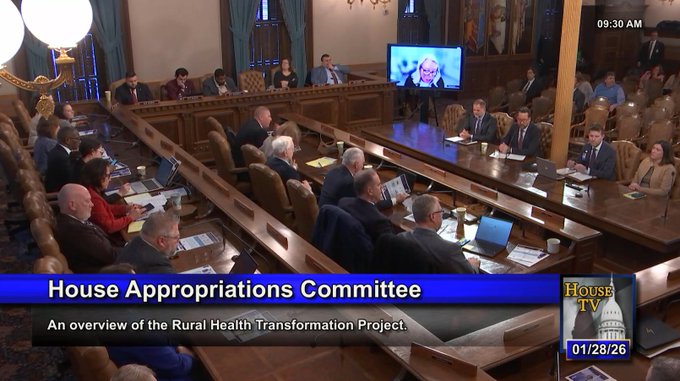
The Michigan House Appropriations Committee continued testimony during the week of Jan. 26 on federal funding awarded through the Rural Health Transformation Program (RHTP) and on legislation related to the 340B program and next-of-kin designations.
Michigan hospitals testified before the House Appropriations Committee on funding allocated to the state through the RHTP. Michigan was awarded $173 million in RHTP funding in December 2025 to support rural communities and address access-to-care challenges. MHA members testifying in front of the committee included Tonya Darner, CEO, UP Health System; Andrew Raymond, CEO, Kalkaska Memorial Health Center; and Peter Marinoff, president and CEO, Munson South Region. Lauren LaPine-Ray, DrPH, MPH, vice president of policy and rural health, MHA, and Gabe Schneider, director, government relations, Munson Healthcare, also responded to committee questions and shared feedback in support of rural hospitals and the program.
The House Appropriations Committee heard testimony Jan. 28 from rural hospital leaders. Appearing (from left to right) are Tonya Darner (Zoom), Gabe Schneider, Peter Marinoff, Andrew Raymond and Lauren LaPine-Ray.
During testimony, members highlighted challenges facing rural healthcare, including access to maternity care, EMS transportation, behavioral health services, and workforce recruitment and retention. Members noted that 22% of counties are considered maternity deserts and at least 11 hospital labor and delivery units have closed since 2010. Testimony also underscored the role rural hospitals play in supporting overextended EMS systems by holding patients when transport is unavailable, coordinating complex transfers and absorbing unreimbursed costs.
Members emphasized that RHTP funding should be targeted toward these challenges to better serve rural communities and maintain access to care.
The House Health Policy Committee voted Jan. 28 to advance House Bill (HB) 4878, sponsored by Rep. Curtis VanderWall (R-Ludington). HB 4878 protects hospitals’ contract pharmacy arrangements under the federal 340B program and includes state-level drug price transparency and hospital community benefit reporting requirements. The legislation allows eligible 340B hospitals to continue stretching limited resources to support care for vulnerable patients and communities across the state, without using state or federal taxpayer dollars. The MHA and its 340B member hospitals support the integral program protections this legislation affords, both for maintaining access to community-based care and improving affordability across Michigan communities. HB 4878 now heads to the House Rules Committee for further consideration.
The Senate Committee on Civil Rights, Judiciary and Public Safety voted in favor of HB 4418 and HB 4419, which update next of kin designations in a healthcare setting. The bills, sponsored by Rep. Jamie Thompson (R-Brownstown Township) and Rep. Angela Witwer (D-Delta Township), seek to reduce barriers in the process of designating a next of kin to inform medical decisions for a patient who is unable to make those decisions themselves. Current law requires families to pursue guardianship, a process that can be lengthy and burdensome during medical emergencies. The MHA worked with bill sponsors and stakeholders to clarify language in HB 4418 based on member hospital feedback. The bills have been referred to the full Senate for further consideration.
Lastly, the Senate Health Policy Committee heard testimony on Senate Bills (SB) 701 and 702, which make changes to medical debt collection processes in the state. The bipartisan legislation, sponsored by Sen. Jonathan Lindsey (R-Coldwater) and Sen. Sarah Anthony (D-Lansing), make changes to how and when medical debt is collected from patients. The MHA is reviewing the legislation and remains committed to working with lawmakers on opportunities to improve healthcare affordability.
The Michigan House Appropriations Committee heard testimony on federal funding awarded through the Rural Health Transformation Program (RHTP), and legislation to add Michigan back into the Interstate Medical Licensure Compact (IMLC) advanced during the week of Jan. 19. The House Appropriations Committee heard …
The MHA Legislative Policy Panel met virtually Jan. 21 to develop recommendations on legislative and policy issues impacting Michigan hospitals. The meeting began with guest speakers from the Michigan Chamber of Commerce and The Cornerstone …
The Centers for Medicare & Medicaid Services (CMS) recently implemented a new online form for providers to submit complaints related to Medicare Advantage plans. A CMS memorandum announced the implementation of the form, which is …
The MHA has launched a new webpage dedicated to the Rural Health Transformation Program, providing members with a centralized source of information on Michigan’s participation in the program. The webpage includes an overview of …
Michigan has updated its mandated reporter guidance for infants born exposed to substances, establishing distinct reporting requirements for exposure to non-medically prescribed substances and exposure related to prescribed treatment. The updates are intended to clarify …
The MHA and MHA Endorsed Business Partner AMN Healthcare Revenue Cycle Solutions will host A Tale of Three Health Systems: Their Mid-Revenue Cycle Insights and Road to Revenue Integrity webinar from 11 to 11:50 …
Rural schools in Newaygo County, like so many across Michigan, were seeing an increase in the number of students caught vaping. To address this community-wide concern, Corewell Health Gerber Hospital established the Corewell Health Gerber …
“As media attention focused on Minneapolis, Greenland and Venezuela last week, the Center for Medicaid & Medicare Services (CMS) released its 2024 Health Expenditures report Thursday: the headline was “Health care spending in the US reached $5.3 trillion and increased 7.2% in 2024, similar to growth of 7.4% in 2023, as increased demand for health care influenced this two-year trend. “…
The current environment for the healthcare economy is increasingly hostile to the status quo. Voters think the system is wasteful, needlessly complicated and profitable. Lawmakers think it’s no man’s land for substantive change, defaulting to price transparency, increased competition and state regulation in response. Private employers, who’ve bear the brunt of the system’s ineffectiveness, are timid and reformers are impractical about the role of private capital in the health economy’s financing.
The healthcare economy will be an issue in Campaign 2026 not because aggregate spending increased 7-8% in 2025 per CMS, but because it’s no longer justifiable to a majority of Americans for whom it’s simply not affordable. Regrettably, as noted in Corporate Board Member’s director surveys, only one in five healthcare Boards is doing scenario planning with this possibility in mind.
The MHA Person & Family Engagement Advisory Council met virtually Jan. 15 to identify ways to support the MHA strategic action plan.
MHA Endorsed Business Partner CyberForce|Q is hosting the webinar Proactive Cyber Risk Measures from 11 a.m. to noon ET on Jan. 29.
The enrollment deadline for the MHA Healthcare Leadership Academy is Feb. 6. The cohort meets Feb. 25–27 and May 7–8 at the MHA headquarters in Okemos.
The following statement can be attributed to Brian Peters, CEO of the Michigan Health & Hospital Association.
We are disappointed the Michigan Rural Health Transformation Program application submitted by the Michigan Department of Health and Human Services does not include explicit support for Michigan’s 73 rural hospitals.
The application lists four initiatives, none of which include recommendations from Michigan’s rural hospital leaders, who know rural healthcare needs best. Michigan hospitals are set to lose more than $6 billion over the next 10 years due to the federal H.R. 1 Reconciliation Bill. It’s unfortunate Michigan’s application ignored this impact and the intent of Congress to assist rural hospitals most impacted by these federal changes through this program.
This application provided an opportunity to maximize the healthcare impact for rural communities by providing the resources needed by rural Michigan’s leading healthcare providers. While the four initiatives are well intended, the application as submitted fails to maintain access to care in the most meaningful way.
Topics include Medicaid budget reductions, state-directed payments, recipient work requirements, the Rural Health Transformation Program and strategies for messaging and advocacy.
The webinar is free of charge to MHA members. Members with questions may contact Brenda Carr at the MHA.
Topics include Medicaid budget reductions, state-directed payments, recipient work requirements, the Rural Health Transformation Program and strategies for messaging and advocacy.
The webinar is free of charge to MHA members. Members with questions may contact Brenda Carr at the MHA.


 The MHA recently released a new frequently asked questions (FAQ) document to help members better understand allowable uses, limitations and compliance requirements related to Michigan’s Rural Health Transformation Program (RHTP).