
MHA Monday Report Jan. 20, 2025

House Committee Advances Earned Sick Time Act Changes

The House Select Committee on Protecting Michigan Employees and Small Businesses voted unanimously to report House Bill 4002 during the week of Jan.13. The bill, introduced by Rep. Jay DeBoyer (R-Clay), makes important clarifications …


2024 MHA Community Impact ReportReport: Michigan Hospital Programming, Investments Improve Health and Well-being of Residents
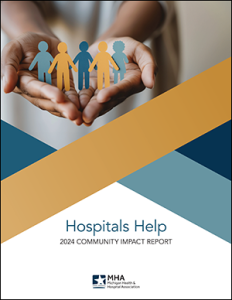
The MHA released the 2024 Community Impact Report Jan. 13 highlighting how Michigan hospitals are strengthening the healthcare workforce, enhancing access to care and building community health and wellness. This report …


Workforce Webinars Available for MHA Members

The MHA is pleased to announce a series of upcoming free webinars addressing healthcare workforce issues that leverage the expertise of MHA Endorsed Business Partners to provide guidance and thought leadership for members. Registration …


mha advancing safe care awardDeadline Approaching for Advancing Safe Care Award
The MHA is currently accepting nominations for its annual Advancing Safe Care Award, which recognizes hospitals that tackle issues daily to make care safer and more dependable. Eligible nominees include teams from hospitals across the …


Newly Expanded Mobile Crisis Services Grant Application Opens

The Michigan Department of Health and Human Services recently announced a new grant opportunity to expand mobile crisis intervention services across the state. The expansion of mobile crisis services aims to increase access to …


MHA Webinar Promoting Effective Peer Recovery Coaching Programs

The MHA will host a webinar Building Effective Peer Recovery Coaching Programs in Hospitals Feb. 12 from 8:30 to 9:30 a.m. to help hospitals create hospital-based peer recovery coach programs, providing background information and …


Latest AHA Trustee Insights Outlines Trends for Industry and Governance

The January edition of Trustee Insights, the monthly digital package from the American Hospital Association (AHA), highlights the podcasts, videos, webinar and other resources available on today’s most pressing issues. The AHA released its 2025 Environmental …


Advancing Community Access to Health for All

Advancing community access to health for all Michiganders is a key focus of Gov. Whitmer and the Michigan Department of Health and Human Services, as Gov. Whitmer declared January Social Determinants of Health (SDOH) Month. …


Keckley Report

Reality Check: Is Private Equity Ownership of Hospitals the Problem?

Last week, the Senate Budget Committee released a 171-page staff report about private equity (PE) ownership of hospitals—its second in two years. This report focused on Apollo Global Management’s ownership of Brentwood, Tennessee-based Lifepoint Health, which runs the Ottumwa Regional Health Center in Iowa, and Leonard Green’s ownership of Los Angeles-based Prospect Medical, which has two Rhode Island hospitals in its portfolio. …

Attention to PE ownership of hospitals by the Senate Budget Committee is notable because it’s Bipartisan and part of a larger effort in Congress to rein in hospitals.  It’s understandable: hospitals account for 31% total healthcare spending—the biggest piece. Concern about healthcare affordability is increasing and trust in the U.S. system is sinking. Per Gallup, NORC, Pew and KFF polls, the majority of Americans are dissatisfied with the medical system and believe profit incentives are more important to insurers and hospitals than patient care. …

PE ownership is not the issue: how hospitals operate, how hospital services are designed and delivered to address clinical innovation and whole person care, and how they’re funded as many shift from traditional hospital to integrated systems of health. …

Paul Keckley, Jan. 13, 2025


News to Know

MHA offices will be closed, and no formal meetings will be scheduled Jan. 20, in honor of Martin Luther King Jr. Day.

Advancing Community Access to Health for All

Byline: Ewa Panetta, CPPS, Director of Health Equity and Experience, MHA 

Designing Community Access to Health Programs 

Advancing community health access for all Michiganders is a key focus of Gov. Whitmer and the Michigan Department of Health and Human Services, as Gov. Whitmer declared January Social Determinants of Health (SDOH) Month. This opportunity recognizes the importance of addressing social and economic factors that have a greater impact on overall health than factors like biology, behavior or medical care. Successful community health access programs require considering the most impactful SDOH in the local communities to ultimately improve health.

Step one is understanding the factors and barriers that impact the way communities and individuals experience health and healthcare. At the community level, these are referred to as social determinants (drivers) of health (SDOH), while at the individual level, they are referred to as health-related social needs (HRSNs).

It is no surprise that accreditation and regulatory bodies are including requirements and quality measurements that call on hospitals to effectively assess and understand SDOH and HRSNs, with the ultimate goal of improving the quality of care for all patients. By identifying these factors, hospitals can better understand what steps are needed to address patient level needs and inform investment in long-term solutions that improve health outcomes at the community level.

No single organization or sector has sole responsibility for addressing these factors – it takes authentic partnerships, long-term investment and designing programs that are intentional in addressing root causes of poor health outcomes. As we enter a new year, let January serve as a reflection of hospitals’ commitment to the MHA’s mission of advancing the health of all individuals and communities.

Below are resources available to help you and your organization address these factors.

Organizational Level

Assess patient and community social needs and integrate social care navigation into clinical workflows.

  • Use the Guide and Action Plan to Integrating CMS and TJC Health Equity Requirements to identify key data collection requirements across SDOH/HRSNs and design programs and interventions that address these factors. The exclusive MHA-member resource was developed to support hospitals and health systems with establishing and maintaining a program that meets The Joint Commission and CMS requirements and standards by centering quality improvement best practices to guide implementation.

Community Level

Build relationships to address local social, political and economic structures and conditions that affect health outcomes.

The MHA and the MHA Keystone Center remain committed to supporting member hospitals improve health access and to deliver safe, high-quality care! We look forward to sharing additional resources and association activities throughout the program year.


Three Key Takeaways from the MHA Webinar Featuring Health Equity Regulatory Requirements

Written by Ewa Panetta, Director, Community Health Impact and Engagement

Earlier this month, the MHA, in partnership with the MHA Keystone Center, hosted a member webinar highlighting the current and future state of health equity priorities and requirements from the Centers for Medicare & Medicaid Services (CMS) and The Joint Commission (TJC) that impact acute care settings.

Accrediting and regulatory bodies are sending a clear message with the evolving requirements – health equity must be central to all quality improvement efforts. Simply put, high quality care is not attainable if care isn’t equitable.

Levering quality improvement as a tool for advancing health equity is a critical first step that helps hospitals meet the new regulatory standards, but we must move toward intentional actions that foster a culture of equity across healthcare systems.

The MHA Keystone Center created the Guide and Action Plan to Integrating CMS and TJC Health Equity and Health Disparities Requirements to provide guidance for implementing compliant health equity programming that goes above and beyond checking a box.

We collaborated with Julia Finken, senior vice president for accreditation and regulatory compliance, Patton Healthcare Consulting and Barrins & Associates, to facilitate the webinar. The purpose of the virtual meeting was to provide members with tools and resources needed to not only comply with the new quality improvement health equity requirements, but also implement robust health equity programming across their systems.

Here were the top three takeaways from the discussion:

  1. The MHA Keystone Center Health Equity Guide and Action Plan, along with supplemental modules, are valuable tools for implementing CMS/TJC compliant health equity programs. The action plan also provides hospitals with the tools necessary to track progress and document compliance across the regulatory and accrediting standards.
  2. Achieving the new health equity requirements requires embedding equity as a cornerstone of quality improvement efforts – from planning to goal development, design, interventions and measurement. Webinar participants expressed that demographic and social needs data collection and use are persistent challenges. We’ve created data resources to support members.
  3. As accreditation and regulatory requirements evolve, operationalizing the principles of health equity will require integrating equity into every aspect of care delivery and hospital operations.

I encourage members interested in learning more to watch the webinar recording.

MHA Monday Report Oct. 7, 2024

MHA Participates in Southwest Michigan Behavioral Health Healthcare Policy Forum

Southwest Michigan Behavioral Health hosted Oct. 4 the ninth annual regional healthcare policy forum in Kalamazoo. Moderated by Dr. Colleen Allen, CEO, Autism Alliance of Michigan, the forum focused on the theme of “Working Together” …


MHA Webinar Explores How Boards and Leaders Can Deploy AI Responsibly and Ethically

The MHA is hosting the webinar How Boards and Leaders Can Deploy AI Responsibly and Ethically, scheduled 4:30 – 6 p.m. ET Dec. 3 which features respected healthcare leaders in artificial intelligence (AI), healthcare operations …


Fall MI AIM Regional Training Events

The Michigan Alliance for Innovation on Maternal Health (MI AIM) is offering training events across Michigan for inpatient maternal healthcare providers. The events, scheduled from late October to November, will focus on using quality improvement …


MDHHS Releases Medicaid Doula Services Proposed Policy

The Michigan Department of Health and Human Services (MDHHS) recently released a proposed policy updating Medicaid coverage for doula services, effective Oct. 1, 2024. Key updates include increasing the number of covered doula visits to …


MHA Highlights Behavioral Health Priorities at Michigan Children and Families Summit

Lauren LaPine, senior director, legislative and public policy, MHA, participated in a discussion Oct. 3 in Grand Rapids during the Michigan Children and Families Summit hosted by the Steelcase Foundation. The summit explored the results …


MHA Race of the Week – U.S. Senate

The MHA’s Race of the Week series highlights the most pivotal statewide races for the 2024 General Election. The series will provide hospitals and healthcare advocates with the resources they …


MHA Rounds graphic of Brian PetersMHA CEO Report — Protecting Access to Care Through 340B

Protecting access to high quality, affordable healthcare for all Michiganders is a key tenet of the MHA. Stated simply, the 340B drug pricing program, created by Congress in 1992, is absolutely crucial to our member …


Keckley Report

Tax Exemptions for Not-for-Profit Hospitals: Are they Worth it?

It’s a question lots of folks inside and outside of healthcare are asking these days. …

The JAMA study did not focus on a ratio; instead, it focused on quantifying the amount of state and local exemptions that should be considered by policymakers in addition to their federal exemptions.  Notably, this study quantifies wide variation in which hospitals benefit most when local, state and federal exemptions are included and proposes that policies around NFP hospital tax exemptions be delegated in part to state and local determinations (as is already the case in at least 3 states). …

The Boards and leaders in each not-for-profit hospitals must account for the tax exemptions they currently enjoy and anticipate changes that limit them in the future. These studies point clearly to that inevitability. And each must answer this question for their organization objectively: are our tax exemptions truly worth it to the communities we serve, or simply a financial maneuver to use our money elsewhere?

Paul Keckley, Sept. 30, 2024


News to Know

Members looking to support hospitals impacted by Hurricane Helene can contribute to relief efforts through the North Carolina Disaster Relief Fund and the Tennessee Hospital Association Disaster Relief Fund.

MHA Monday Report Sept. 30, 2024

Legislation Impacting Hospitals Introduced in State Legislature

A variety of bills impacting hospitals and health systems were introduced and discussed in the state legislature during the week of Sept. 23. Senate Bill 701, introduced by Sen. Singh (D-East Lansing), updates the statutory framework for the rural and obstetrical …


NAIC Meeting Evaluates Impact of Pharmaceutical Costs on Rural Hospitals

Michigan Department of Insurance and Financial Services Director Anita Fox invited the MHA and Munson Healthcare to present to the Midwest Zone meeting of the National Association of Insurance Commissioners (NAIC) held Sept. 25. The …


CE Credits Available for Health Equity Regulatory Requirements Webinar

The MHA and the MHA Keystone Center are hosting an educational webinar from 8:30 to 9:30 a.m. Oct. 10 about the current and future state of regulatory and accrediting health equity requirements from the Centers …


2024 Election Materials Available for Michigan Hospitals

The MHA is offering election communication materials geared toward hospital staff, volunteers, patients and visitors to encourage voter participation in the 2024 general election. Additionally, the MHA elections webpage will be updated regularly with relevant …


Keckley Report

The Commonwealth Health System Study in Context: Will it Prompt Meaningful Action in the U.S.?

“Last Thursday, the Commonwealth Fund released its assessment of how the U.S. health system compares to other developed systems of the world. The title says it all: Mirror, Mirror 2024: A Portrait of the Failing U.S. Health System.

The real question prompted by the Commonwealth study is this: is the ineffectiveness of the U.S. system fixable? Private investors, operators and trade groups say yes so long as a transition is smooth and their interests are protected. Systemic change is unwelcome. Healthcare in the U.S. is an industry that does well financially so, for many politicians, pensioners and insiders, they’d prefer it be left alone.

But the majority of Americans, including the majority in the 18-million healthcare workforce, aren’t sure. They see corporate profits, executive compensation, mergers and takeovers as indicators of its corporatization and business acumen but its layoffs, cost-cutting, surprise bills and inexplicable prices as evidence the system puts profit ahead of fixing problems that matter to them.

This study is worth discussion in every Boardroom in healthcare and in every household interested in health reforms. At a minimum, It merits collaborative action led by AHA, AHIP, AMA and others to develop meaningful, long-term solutions to its flaws that subordinate their proprietary preferences for the greater good.”

Paul Keckley, Sept. 23, 2024


MHA CEO Brian Peters

MHA in the News

Detroit’s WJR 760 AM interviewed MHA CEO Brian Peters Sept. 22 for a segment on healthcare as part of “The Capital Report,” a new show focused on exploring issues happening within state politics and Michigan’s …

Advancing Safe Care Award Nominations Due April 26

mha advancing safe care award

mha advancing safe care awardNominations for the 2024 Advancing Safe Care Award close on April 26. The award recognizes Michigan hospitals for improving care safety and reliability, with eligible nominees including teams dedicated to transparency in care quality and serving diverse patient populations.

The MHA believes focusing on transparency, health equity, quality improvement and safety culture can result in the advancement of care within healthcare facilities and produce safer, more reliable outcomes.

Award winners will be recognized at the MHA Annual Membership Meeting in June on Mackinac Island. Members seeking more information may contact Erica Leyko at the MHA.

MHA Board Uplifts Funding for Birthing Hospitals

The MHA Board of Trustees continued work on advancement of the 2023-2024 Strategic Action Plan at its April 10 meeting, with focus on its four pillars, which include workforce support and innovation, viability and improved behavioral healthcare. Opposition to government mandated staffing ratios remains a top priority for the association within the workforce pillar, as it has been shown to be a harmful approach to addressing workforce shortages. Instead, the association supports specific measures to address educational barriers, support innovation and grow the talent pipeline.

The board recognized the work within the viability pillar through the MHA and the Michigan Council for Maternal and Child Health partnership to secure $10 million in state grant funding to assist Michigan’s birthing hospitals to pay for new mandatory state Maternal Level of Care (MLC) verifications. Pending state legislation will require the Michigan Department of Health and Human Services (MDHHS) to register each birthing hospital’s MLC verification. Under the terms of the grant, the MDHHS will provide funding for birthing hospitals that fully participate in MI-AIM and complete an application to participate in the MLC verification through The Joint Commission (TJC). Funding per hospital will range from $50,000-$400,000 this fiscal year and the MHA Keystone Center will fund TJC fees. More information will be provided in an upcoming member webinar.

The board also received the final report from the Community Access to Health Task Force and endorsed converting the task force into a standing Council on Community Access to Health for the 2024-2025 program year to continue the work of the board to ensure that high quality and safe care is available for everyone. The board recognized the association’s work in furtherance of behavioral health priorities through continued input on behavioral health legislation, Psychiatric Residential Treatment Facilities and the hosting of its ongoing five-part behavioral health member webinar series.

Lastly, the board approved new member applications from R1 RCM, Origami and Bay Street Orthopedics and Spine.

Members with questions about the MHA Board of Trustees may contact Amy Barkholz at the MHA.

MHA Monday Report Feb. 26, 2024

MHA Monday Report

Workplace Safety Posters Available

The MHA has new, updated signage available for MHA members to order at no cost to help hospitals comply with the requirement from Public Acts 271 and 272 of 2023 that hospitals display signage informing …


Trinity Health IHA Medical Group Medical Assistant and Nurse Receive Q1 MHA Keystone Center Speak-up! Award

The Michigan Health & Hospital Association (MHA) Keystone Center celebrated Joni Hunter, MA, and Dorothy Zsenyuk, RN, at Trinity Health IHA Medical Group Nurse Midwives Feb. 8 as Speak-up! Award recipients. The quarterly MHA Keystone …


MHA Podcast Explores Impact of Medical Mistrust Among Black Americans

The MHA released a new episode of the MiCare Champion Cast exploring the impact medical mistrust has on health outcomes for Black Americans featuring Lynn Todman, PhD, vice president of Health Equity and Community Partnerships …


The Keckley Report

Paul KeckleyThe Four Conflicts that Hospitals Must Resolve in 2024

If you’re a U.S. health industry watcher, it would appear the $4.5 trillion system is under fire at every corner. Pressures to lower costs, increase accessibility and affordability to all populations, disclose prices and demonstrate value are hitting every sector. Complicating matters, state and federal legislators are challenging ‘business as usual’ seeking ways to spend tax dollars more wisely with surprisingly strong bipartisan support on many issues. No sector faces these challenges more intensely than hospitals. …

Nonetheless, conflict resolution on these issues must be pursued if hospitals are to be effective, affordable and accessible contributors and/or hubs for community health systems in the future. The risks of inaction for society, the communities served and the 5.48 million (NAICS Bureau of Labor 622) employed in the sector cannot be overstated. The likelihood they can be resolved without the addition of new voices and fresh solutions is unlikely.”

Paul Keckley, Feb. 19, 2024


News to Know

  • Registration is open for the 2024 MHA Human Resources Conference, scheduled for March 5, 2024 at the ACH Hotel Marriott University Area, Lansing.
  • MHA Endorsed Business Partner CommerceHealthcare® recently published an annual report on 2024 Healthcare Finance Trends presenting a set of themes that capture the positive momentum, significant challenges and major strategies for provider organizations in 2024 and beyond.
  • The Joint Commission is hosting a webinar March 26 from 1 to 2:15 p.m. EST to review recent updates to Michigan regulations for Cardiac Systems of Care (STEMI Referring and STEMI Receiving).

MHA CEO Brian PetersMHA in the News

Crain’s Grand Rapids published a story Feb. 22 about the decision by the Kalamazoo-based cooperative air ambulance program between Bronson Healthcare and Ascension Borgess Hospital to end flights later this year. MHA CEO Brian Peters …

MHA Podcast Explores Impact of Medical Mistrust Among Black Americans

Lynn Todman, PhD, vice president of Health Equity and Community Partnerships, Corewell Health joined for the February episode of the MiCare Champion Cast.

The MHA released a new episode of the MiCare Champion Cast exploring the impact medical mistrust has on health outcomes for Black Americans featuring Lynn Todman, PhD, vice president of Health Equity and Community Partnerships for Corewell Health.

As hospitals and health systems uplift Black History Month, it’s important to acknowledge the long, complex history of medical mistrust among Black Americans that is rooted in systemic racism and countless acts of medical exploitation, unethical experimentation and mistreatment. Repairing trust between Black patients and medical providers requires honest and open dialogue about the lasting impact of injustices that have spanned centuries.

With this in mind, Todman shared further insight about the influence medical mistrust has on Black communities and what action hospital leaders and healthcare teams can take to address gaps in care.

Research has found that individuals who experience medical mistrust are less likely to adhere to treatment plans, engage in routine screenings or participate in medical trials. Mistrust can also play a role in delayed diagnoses and poorer prognoses for a patient, and higher levels of stress that can exacerbate existing health conditions.

“It’s a perfectly rational, protective behavior,” said Todman when speaking about the history of patient-provider mistrust. She notes that systemic change at the organizational, local and national levels are necessary to effectively address this reality for many Black Americans.

Todman, who holds a Masters of Science in City Planning and earned a Doctor of Urban and Regional Planning from MIT, leads efforts to align health equity activities across the integrated health system in her role at Corewell. She has years of experience in leadership and research in social and structural determinants of health, health impact assessment, urban poverty and community development.

When asked what action providers can take to address mistrust, Todman noted the importance of taking the time to listen and understand the social determinants that may influence a patient’s lifestyle, health, history and access to care.

“We’re starting to hear more around structural competency as a compliment to cultural competency to close gaps [in care],” said Todman. “Understanding people’s cultural background is important, but also understanding the structural forces that make things like housing or food less available…those things are also important.”

MiCare Champion Cast · A Closer Look at Medical Mistrust Among Black Americans

The episode is available to stream on SpotifyYouTubeApple Podcasts and SoundCloud. Questions or idea submissions for future MiCare Champion Cast episodes can be sent to Lucy Ciaramitaro at the MHA.

MHA Monday Report Feb. 19, 2024

MHA Monday Report

Workforce and Innovation Addressed by MHASC Board and HR Council

The MHA Service Corporation (MHASC) board focused its Feb. 7 meeting on supporting the MHA Strategic Action Plan priorities to address workforce support and innovation, viability, behavioral health improvement, health equity and more. The board …


Registration Open for 2024 Communications Retreat

Registration is open for the 2024 MHA Communications Retreat scheduled Tuesday, May 7 from 8:30 a.m. to 4 p.m. at the Henry Center for Executive Development in Lansing. The daylong event is geared toward the …


Online Learning Modules Created to Support Health Equity Programming

The MHA Keystone Center recently published an online learning module series to support hospitals and health systems in establishing and maintaining a health equity program compliant with new requirements from The Joint Commission and …


New CPT Codes for RSV Vaccine Administration

The Centers for Medicare & Medicaid Services added two new Current Procedural Terminology (CPT) codes for administration of monoclonal antibodies (Nirsevimab) for respiratory syncytial virus (RSV), for dates of service on and after Oct. …


Act Fast: Register for 2024 MHA HR Conference

Registration is open for the 2024 MHA Human Resources Conference, scheduled for March 5, 2024 at the ACH Hotel Marriott University Area, Lansing. Attending the conference provides human resource (HR) professionals with an opportunity …


Latest AHA Trustee Insights Highlights AI Controversies and Philanthropic Strategy

The February edition of Trustee Insights, the monthly digital package from the American Hospital Association (AHA), includes articles on artificial intelligence (AI) and philanthropy. There is no question that artificial intelligence will fundamentally transform healthcare. It …


The Keckley Report

Two Lawsuits. Two Issues. One Clear Message.Paul Keckley

“Last Monday, two lawsuits were filed that strike at a fundamental challenge facing the U.S. health system …

The issue is this: is a health system’s liable when its consolidation activities result in higher prices for services provided communities and employers in communities where they operate? Is there a direct causal relationship between a system’s consolidation activities and their prices, and how should alleged harm be measured and remedied? …

Healthcare organizations and their trade groups can no longer defend against lack of transparency by defaulting to the complexity of our supply chains and payment systems. They’re excuses. The realities of generative AI and interoperability assure information driven healthcare that’s publicly accessible and inclusive of prices, costs, outcomes and business practices. In the process, the public’s interest will heighten and lawsuits will increase. …”

Paul Keckley, Feb. 12, 2024


News to Know

  • MHA offices will be closed and no formal meetings will be scheduled Feb. 19 in honor of President’s Day.
  • The MHA is offering its popular Healthcare Leadership Academy program March 13-15 and May 1-2.
  • The AHA’s Institute for Diversity and Health Equity recently launched their 2024 Diversity, Equity and Inclusion Survey.