Medicaid Cuts and Hospital Economic & Workforce Impact News Coverage

Laura Appel

Laura AppelThe MHA received news coverage during the week of May 12 related to federal Medicaid funding cuts and the release of the hospital economic and workforce impact data.

Crain’s Detroit Business published an article May 13 following the release of draft bill language from the House Energy and Commerce Committee as part of the budget reconciliation process, which calls for imposing federal work requirements and freezing state directed payment programs for healthcare providers.

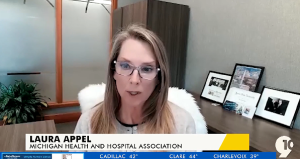
MHA Executive Vice President Laura Appel spoke with Crain’s, expressing the MHA’s concerns on the draft language.

“We of course remain deeply concerned about things like doing redetermination of folks’ eligibility for the coverage on less than an annual basis and things like work requirements or community benefit requirements for certain folks who currently qualify for coverage,” said Appel. “All of those things are barriers to folks.”

Second Wave Michigan also published a story May 13 about potential Medicaid funding cuts, as part of their MI Mental Health Series. Lauren LaPine, senior director, legislative and public policy, MHA, is quoted in the piece discussing what impact the cuts would have to hospitals.

“A real consequence of Medicaid cuts will be closures of service lines and even hospitals,” said LaPine. “When hospitals have to cut services because Medicaid is cut, those services are lost for all patients and not just those who receive health care coverage through Medicaid. Medicaid is the single largest payer for long-term care, maternity care, and mental health services. It is a cornerstone of our health care system and keeps people healthy at every stage of life.”

The MHA also received news coverage from Gongwer and dBusiness following the release May 12 of the association’s annual Economic Impact of Healthcare report and hospital workforce survey results.

Lastly, MHA CEO Brian Peters provided a quote of support in a press release issued by U.S. Sen. Gary Peters (D-MI) following introduction of the Mapping America’s Pharmaceutical Supply (MAPS) Act.

Members with any questions regarding media requests should contact John Karasinski at the MHA.

Medicaid Remains Focus of Healthcare News Coverage

The MHA was successful in placing several news stories during the week of April 28 related to potential federal Medicaid funding cuts.

The Lansing State Journal published an op-ed from MHA CEO Brian Peters that was shared as part of the MHA’s participation in the Protect MI Care coalition that is urging members of Congress to protect Medicaid. The op-ed expressed the importance of Medicaid to Michigan’s healthcare system and the consequences to access to care for all Michiganders if significant funding cuts are implemented.

“The effects would ripple far beyond those who rely on Medicaid — every hospital, mental health clinic and nursing home that depends on Medicaid funding would feel the impact,” said Peters. “When facilities close, it’s not just Medicaid patients who lose out — it’s everyone in the community, regardless of what kind of insurance they have.”

MHA Executive Vice President Laura Appel also sat down with WILX News 10 on April 30 to discuss the potential funding cuts and appeared in a story published by Bridge on May 1 about the impact to rural providers.

“When we close intensive care for newborns, when we close labor and delivery units, they are closing for everyone,” said Appel to Bridge.

In other news, Crain’s Detroit Business published an article April 30 committee testimony on legislation that would have Michigan join the nurse licensure compact. MHA Chief Nursing Officer Amy Brown testified in support of the legislation and is quoted in the article.

“In addition to recruitment and coordination of care in our state’s border areas, joining the compact would positively benefit telehealth access,” said Brown. “Compact licensure means residents in Michigan can access more telehealth professionals in other compact states, increasing access points for our state’s residents.”

Appel also appeared on 760 WJR’s All Talk With Kevin Dietz on May 1 to discuss the compact.

Members with any questions regarding media requests should contact John Karasinski at the MHA.

MHA CEO Brian Peters Joins 2025 State of Reform Health Policy Panel

MHA CEO Brian Peters pictured with Farah Hanley, managing principal, Health Management Associates and Dominick Pallone, executive director, Michigan Association of Health Plans (MAHP) during the 2025 Michigan State of Reform Conference April 17.

The 2025 Michigan State of Reform Health Policy Conference convened April 17 in East Lansing, MI. The morning session began with a panel moderated by Farah Hanley, managing principal, Health Management Associates, alongside MHA CEO Brian Peters and Dominick Pallone, executive director, Michigan Association of Health Plans (MAHP). Discussion focused on the evolving federal landscape and its impact on healthcare and health policy in Michigan.

Panelists explored the impact of recent federal activity and what it means for Michigan communities, hospitals and the healthcare workforce. Throughout the discussion, Medicaid, the 340B program and tariffs were highlighted. Peters emphasized that the current threats to Medicaid go beyond those enrolled in the program, warning that cuts will have a ripple effect across the entire healthcare system.

“This isn’t just about Medicaid recipients,” said Peters. “It’s about every Michigander’s access to care.”

The MHA continues to work with members of Congress to underscore that slashing Medicaid funding puts hospitals, providers and patient care at risk across the state.

Peters and Pallone also discussed partnership between the MHA and MAHP in response to recent proposals and the role tariffs play in healthcare. Peters noted the impact tariffs have on the healthcare supply chain and limitations when it comes to responding to financial shifts in real time, which puts a significant strain on providers trying to maintain care quality amid mounting costs.

Members with questions regarding current legislative activity may contact Laura Appel at the MHA.

Medicaid & Pediatric Behavioral Health Media Coverage

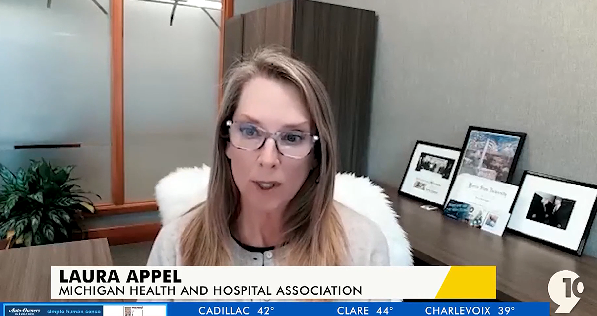
Laura Appel speaks with 9&10 News.

The MHA received media coverage the week of April 7 on potential Medicaid funding cuts, pediatric behavioral health and healthcare costs.

9&10 News aired a story April 9 on potential federal Medicaid funding cuts. MHA Executive Vice President Laura Appel spoke with 9&10 News, explaining how the cuts would specifically impact rural healthcare. Representatives from McLaren Health Care and Munson Healthcare also appeared in the story.

“In our rural areas, we have small populations, and some of them are also shrinking, which makes it that much harder to sustain certain services because of the fixed costs being spread over so few people,” said Appel. “When we lose a labor and delivery unit, we lose it for that entire population.”

Lauren LaPineSecond Wave Michigan published a story April 8 about how Michigan hospitals are improving pediatric behavioral healthcare. Lauren LaPine, MHA senior director of legislative and public policy, spoke with Second Wave Michigan about the MHA’s behavioral health work, focusing particularly on the $50 million state grant the MHA served as the fiduciary for to expand inpatient pediatric behavioral health capacity in the state. LaPine also highlighted the data the MHA collected regarding emergency department boarding, which shows at least 155 people at any point, including 17 children, are in an emergency department awaiting behavioral health care.

“Our data in Michigan reflects some of the trends that we see nationally in terms of the increasing need for behavioral health services for children and youth,” said LaPine. “So, we are paying really close attention to that need and want to make sure that our member hospitals and health systems are able to address the need when pediatric patients and their families come to the hospital in a behavioral health crisis.”

Lastly, Crain’s published a story April 9 about the role of hospitals regarding rising healthcare costs. MHA CEO Brian Peters is quoted in the story, explaining how the majority of rising costs are due to responding to market trends for labor, as well as rising costs for facilities, drugs and supplies.

“The largest expense for hospitals is labor … A large component to increased healthcare costs for hospitals is making sure healthcare workers are appropriately and competitively compensated so they can provide care to patients when and where they need it,” said Peters.

Members with any questions regarding media requests should contact John Karasinski at the MHA.
U.S. House Advances Budget Resolution, Sets Up Potential Medicaid Cuts

The United States House of Representatives advanced a Senate budget resolution April 10 that calls for a minimum of $1.5 trillion in federal spending reductions. A separate budget resolution previously passed by the House in February had specifically targeted $880 billion in cuts from the Energy and Commerce committee, which has jurisdiction over the Medicaid program.

Leadership and committee chairs from both chambers will now begin writing and seeking support for an omnibus budget bill, which could contain cuts to providers in the Medicaid program. The MHA remains strongly opposed to cuts that will limit access to care for Michigan residents and will work with members to advocate against reductions over the next several weeks.

Members may use the MHA’s Medicaid action alert to contact their congressperson and advocate for protecting Medicaid from funding cuts.

Members with questions may contact Laura Appel at the MHA.

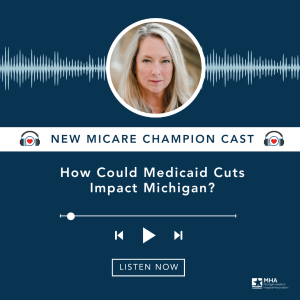
How Could Medicaid Cuts Impact Michigan?

MiCare Champion Cast Header Photo

The MHA released a new episode of the MiCare Champion Cast exploring how proposed reductions to Medicaid could disrupt access to care and harm Michigan hospitals, patients and communities.

Laura Appel, executive vice president of government relations & public policy, MHA, first explored the history and purpose of Medicaid and the Healthy Michigan Plan, which has been hailed a success for improving access to care, reducing the uninsured rate and supporting economic stability for families across the state.

Appel explained the potential impact of recent federal proposals, which include instructions to cut Medicaid by at least $880 billion over 10 years. Changes like block grants, per capita caps and reduced federal matching rates could lead to a staggering $1.73 billion shortfall in the state budget, jeopardizing access to healthcare for millions.

“Cutting funding is cutting care,” said Appel. “Not every hospital is on the financial footing it wishes it were and there are a lot of hospitals across the country that are already in difficult financial straits…this could be the reason that they close all together.”

Michigan hospitals are asking members of Congress to protect the Medicaid program and oppose proposed reductions. Appel noted those interested in helping with this effort and reaching members of Congress are encouraged to visit the MHA Legislative Action Center.

Listeners can also expect to learn more about the impact proposed cuts would have on rural healthcare and Michigan’s economy. The episode is available to stream on Apple PodcastsSpotifySoundCloud and YouTube.

340B & Medicaid Receive Media Coverage

The MHA received media coverage the week of March 10 on the 340B program and potential federal Medicaid funding cuts with outlets including MichMash, Crain’s Grand Rapids Business and 9&10 News.

MHA CEO Brian Peters appeared on the March 14 episode of the MichMash podcast where he discussed MHA advocacy efforts to oppose Medicaid funding cuts, passage of Senate Bills 94 and 95 by the Michigan Senate that safeguard the 340B program and the healthcare workforce. The interview was conducted by hosts Cheyna Roth and Zach Gorchow. MichMash is produced by WDET Detroit Public Radio in collaboration with Gongwer News Service and is part of the NPR Network.

Crain’s Grand Rapids also published an article March 10 about the 340B legislation moving through the Senate. Peters and Elizabeth Kutter, senior director of advocacy, MHA, are quoted in the piece.

“This bill prevents drug manufacturers from continuing to issue arbitrary restrictions on 340B eligible Federally Qualified Health Centers and hospitals,” said Peters. “We continue to be grateful for the Senate’s leadership and collaboration in recognizing the need for strong, quality health care providers over out-of-state prescription drug interest groups.”

9&10 News aired a story March 11 that looked at the impact on Michigan if funding cuts to Medicaid are implemented. MHA Executive Vice President Laura Appel was interviewed and appears in the story.

“We know that work requirements are popular as a concept, but really, we need to focus on people being healthy so that they can work, as opposed to working so that they can become healthy,” said Appel.

Members with any questions regarding media requests should contact John Karasinski at the MHA.

Appel Joins WJR Live from Lansing Broadcast

MHA EVP Laura Appel with WJR's Guy Gordon and Lloyd Jackson.
MHA EVP Laura Appel with WJR’s Guy Gordon and Lloyd Jackson.

MHA Executive Vice President Laura Appel appeared on Detroit’s WJR 760 AM’s ‘JR Morning with Guy Gordon, Llyod Jackson and Jamie Edmonds’s “Live from Lansing” broadcast Feb. 26 as part of the station’s annual coverage of legislative and policy issues facing the state the morning after Gov. Gretchen Whitmer’s State of the State address. The MHA sponsored the program, with the broadcast hosted at the Courtyard by Marriott Lansing Downtown.

As part of the program lineup, Appel spoke with Gordon and Jackson about the state of hospitals and the many changes they face, including the healthcare workforce, the 340B program and protecting Medicaid from federal funding cuts. Other notable interviewees during the event included Senate Minority Leader Aric Nesbitt (R-Lawton) and Speaker of the House Matt Hall (R-Richland Township).

Relevant healthcare topics included in the State of the State address included expanded attention towards recruiting males to pursue post-secondary education opportunities and increased state support for forgiving patient medical debt.

Additional media stories published during the week of Feb. 24 included an article picked up by both Bridge and MIRS on the challenges of behavioral health transport services for providers in the Upper Peninsula. Lauren LaPine, senior director of Legislative & Public Policy, MHA, was quoted in the article discussing efforts with the Michigan Department of Health & Human Services to implement and fund behavioral health transportation services at hospitals across the state.

“We believe that a patient shouldn’t have to be transported via police transport for behavioral health needs,” said LaPine.

In addition, the MHA received mention in a Feb. 27 article from MIRS recapping a House Health Policy Committee hearing about the 340B program.

Members with questions should contact John Karasinski at the MHA.

MHA Monday Report Dec. 23, 2024

MHA Prevents Staffing Ratios and Medical Liability Changes

The MHA defeated legislation that would have established government-mandated nurse staffing ratios and legislation that would have made detrimental revisions to Michigan’s strong medical liability laws during the week of Dec. 16. The MHA opposed …


MHA Keystone Center Annual Report Features Hospital Quality and Safety Improvements
The MHA Keystone Center recently released its 2023-24 Annual Report, which demonstrates the organization’s commitment to advancing the safety and quality of care alongside Michigan hospitals. The report showcases MHA Keystone Center-led patient and workforce …


speak upUniversity of Michigan Health-Sparrow Police Authority Officer Honored with Q3 MHA Keystone Center Speak-up! Award

The MHA Keystone Center has recognized Ronald Patterson, a police authority officer at University of Michigan Health-Sparrow, as its quarterly MHA Keystone Center Speak-up! Award recipient for December. The Speak-up! …


Obtaining Beyfortus Through the VFC Program

Through an ongoing partnership with the Michigan Department of Health & Human Services, Michigan birthing hospitals are reminded to enroll as a Vaccine for Children (VFC) Specialty Provider in order to administer the respiratory …


Superior Health Quality Alliance Report Highlights Improvements in Care for Medicare Beneficiaries

The Superior Health Quality Alliance – a coalition of eight Midwest healthcare quality improvement organizations including the MHA Keystone Center – recently released a report detailing its work over the past five years as the …


MHA Offers Webinar on Creating Peer Recovery Coach Programs

The MHA will host the webinar Building Effective Peer Recovery Coach Programs in Hospitals Feb. 12 from 8:30 – 9:30 a.m. to help hospitals create hospital-based peer recovery coach programs, providing background information and …


Keckley Report

Health System Transformation: The Mandate is Clear but Insider Pushback is Strong

“The murder of UnitedHealth Group executive Brian Thompson (aka BT) December 4 and prosecution of his alleged killer Luigi Mangione in Pennsylvania and New York will be in the media spotlight for months to come. The 26-year-old data scientist’ antipathy toward the health industry will be the sidebar in most coverage. …

Our system is fragmented by design, opaque by habit, resistant to change and considers criticism by outsiders unfair or ill-informed. Success and incentives in most healthcare organizations are based on short-term financial performance. Transparency is a threat and innovation is incremental. In the vast majority, Boards are rarely more than rubber stamps for management as long as “the numbers are hit.”

Tension between payers and providers, investor-owned and not-for-profit ownership and preventive health and specialty care has calcified and Executives are promoted as celebrities. In the process, the public’s attention is drawn to the industry where ministry and mission appear subordinate to corporatization and profit. …

That’s not the future. The public expects more and they’re tired of industry pushback and excuses.”

Paul Keckley, Dec. 16, 2024


News to Know

  • The MHA offices will be closed and no formal meetings will be scheduled Dec. 24 – Jan. 1, 2025.
  • Due to the holidays, Monday Report will not be published Dec. 30 and Jan. 6 and will resume its normal schedule Jan. 13.
  • The December edition of Trustee Insights, the AHA’s monthly digital package, highlights resources on key topics such as quality and safety priorities, social determinants of health, board diversity, behavioral health integration and financial performance.
  • In 2025, the MHA will host the second Human Resources Conference and welcome back the MHA Keystone Center’s Safety & Quality Symposium for the first time since 2019

MHA CEO Brian Peters

MHA in the News

MHA CEO Brian Peters joined Michigan’s Big Show Dec. 16 to discuss the 340B drug pricing program and legislation that would have safeguarded the program. Peters joined guest host Mel Seifert and discussed Senate Bill …

MHA Prevents Staffing Ratios and Medical Liability Changes

The MHA defeated legislation that would have established government-mandated nurse staffing ratios and legislation that would have made detrimental revisions to Michigan’s strong medical liability laws during the week of Dec. 16. The MHA opposed these policies during the entire legislative session. The end of legislative business puts an end to all pending bills for this legislative session.

Late in the term, the House passed legislation restricting mandatory overtime policies for registered nurses. HB 5999 would have prohibited mandatory hospital overtime policies in certain circumstances. The Senate did not take any action on HB 5999 and the bill will expire with the end of legislative business.

This means none of the bills originally introduced in May 2023 that would have instituted government-mandated nurse staffing ratios and added additional requirements to hospitals are eligible to be signed into law.

In addition, neither chamber acted on bills designed to dramatically alter Michigan’s medical liability laws by significantly raising the caps on noneconomic damages, as well as reinstituting and expanding wage loss awards. These changes would undo tort reforms hospitals championed in the 1990s, leading to increased healthcare costs and hindered physician recruitment and retention in Michigan.

The lack of action on any of these bills is a testament to the advocacy work of the MHA and its membership.

Contention among lawmakers from both parties in the House reduced session attendance on multiple occasions over the last two weeks, resulting in both extreme chaos and little legislative work. The political infighting and inability to garner a quorum prevented any further movement on Senate Bill 1179, a bill to safeguard the 340B drug pricing program. SB 1179 would have protected cost savings from manufacturer encroachment and preserved access to affordable healthcare services in both urban and rural Michigan communities. The MHA will pursue this legislation again in the new legislative session at the beginning of 2025, recognizing the strong bipartisan support it received in the Senate when it passed with a 30-3 vote.

Several other bills the MHA pursued this session will need reintroduction in the 2025-26 session:

  • HB 5964 – Continues the Interstate Medical Licensure Compact, which is scheduled for repeal in March 2025.
  • HB 5833 – Allows surrogate consent for medical decisions.
  • HB 4833 – Eliminating duplicate licensure requirements for hospitals.
  • SB 802 – Creates information sharing regarding outpatient behavioral health services.

The MHA opposed legislation that would allow local units of government to establish their own ordinances governing minimum wage, working hours and staffing ratios, and a bill to subject hospitals to the Michigan Consumer Protection Act. All this legislation expires with the expected ending of the 102nd Legislature.

Members with questions on legislative activity may contact Laura Appel at the MHA.