Senate Protects Healthcare Services from PhRMA Attacks

The following statement can be attributed to Brian Peters, CEO of the Michigan Health & Hospital Association.

MHA CEO Brian PetersWe are grateful for the broad bipartisan collection of senators who passed Senate Bill 1179 to protect community healthcare services from pharmaceutical manufacturers’ arbitrary attacks on the 340B drug pricing program.

Safety net providers, from Federally Qualified Health Centers to cancer and rural hospitals, and the services they offer to vulnerable patients are under threat from drug manufacturers prioritizing their own profits over healthcare access.

Michigan’s senators stood up to the out-of-state pharmaceutical interest groups and we applaud them for their efforts.
We now call on the Michigan House of Representatives to follow the Senate’s lead and get this bill over the finish line. Michiganders can’t afford to continue to have their healthcare services attacked to pad PhRMA balance sheets.

Senate Committee Puts Patients Over PhRMA Profits

The following statement can be attributed to Brian Peters, CEO of the Michigan Health & Hospital Association.
MHA CEO Brian Peters

Members of the Senate Oversight Committee put patients over pharmaceutical profits by reporting out Senate Bill 1179 to the full Senate, which adds state-level protections to the 340B drug pricing program and the affordable, community-based care it supports.

The 340B program is an essential safety net program that supports vulnerable patients and the providers that care for them. It allows eligible Michigan hospitals to stretch incredibly scarce resources to provide care for more patients in their communities, increasing access to care.

These protections prevent manufacturers from arbitrarily restricting program participation that threatens access to care by cutting program savings. Such harmful actions by these companies risk the closure of birthing units, nursing homes and even critical access hospitals.

We look forward to the full Senate passing this bill and will continue to work with our partners in the House to make sure this important piece of legislation reaches Gov. Whitmer’s desk before the end of the year.

MHA Opposes Staffing Ratios on WJR

MHA CEO Brian PetersMHA executives appeared on WJR 760 AM during the weeks of Nov. 25 and Dec. 2 to discuss the association’s opposition to government mandated nurse staffing ratios.

MHA CEO Brian Peters appeared on Focus with Paul W. Smith Nov. 26 while MHA Executive Vice President Laura Appel joined Guy Gordon, Lloyd Jackson and Jamie Edmonds Dec. 4 during the weekly Capital Report segment of WJR’s morning show.

Both Peters and Appel focused on House Bills 4550 – 4552, which would mandate one-size-fits-all nurse staffing ratios for all Michigan hospitals. The bills received a committee hearing Nov. 9 in the House Health Policy Committee and the interviews addressed how these bills remain the MHA’s top priority during the state’s legislative lame-duck session.

Laura AppelIf the bills did become law, Michigan communities would face the loss of important access to healthcare services, as up to 5,100 hospitals beds throughout the state would close.

More information about the proposed legislation is available on the Think it Through website.

Members with any questions regarding media requests should contact John Karasinski at the MHA.

Media Recap: Healthcare Workplace Violence Research & Community Mental Health

The MHA received media coverage the week of Nov. 21 on healthcare workplace violence research and the relationship between hospitals and community mental health organizations.

The Oakland Press published a story Nov. 18 on the new Healthcare Violence Reduction Center at Lawrence Technological University in Southfield, MI. The MHA Keystone Center is a founding partner of the center as it seeks to develop strategies to reduce violence, enhance safety and improve patient care.

MHA CEO Brian PetersMHA CEO Brian Peters was interviewed for the story, highlighting the importance of increased penalties for individuals who assault a healthcare worker.

“It occurs in small rural hospitals in the UP to big medical centers and everything in between,” said Peters. “We haven’t signaled to the public that it is not OK,” he said.

Second Wave Media also published an article Nov. 20 on the benefits of collaboration between Michigan hospitals and community mental health agencies.

Lauren LaPine“In Michigan, our hospital members work with community mental health agencies on a daily basis all the time to make sure that patients that come to the emergency department for behavioral health care are getting the care that they need, where and when they need it,” said Lauren LaPine, senior director of legislative and public policy, MHA.

LaPine discussed a state grant to expand inpatient site capacity statewide and provided examples from several hospitals across the state about how they’re using the funds. She also mentioned Senate Bill 806, which expands the three-hour assessment responsibility by allowing clinically qualified staff to conduct pre-admission screenings for a patient presenting in an emergency department.

Members with any questions regarding media requests should contact John Karasinski at the MHA.

Workforce Bills Highlight Healthcare Legislation Advanced in the State Legislature

Advocacy image tileSeveral workforce bills highlighted the healthcare legislation that advanced in the state legislature during the week of Nov. 11.

The Senate Appropriations Committee approved Senate Bills (SBs) 406 and 407, led by Sen. Sarah Anthony (D-Lansing). The bills provide the statutory changes to continue expanded eligibility for the Michigan Reconnect program. The legislation amends the Michigan Reconnect Grant Recipient Act to reduce the age of eligibility to receive Michigan Reconnect from 25 to 21. The MHA supports this legislation, as it will make it easier for Michigan residents to access high-demand healthcare credentials through the program. The legislation now awaits a vote from the full Senate.

The Michigan House passed House Bill 4224, sponsored by Rep. Julie Rogers (D-Kalamazoo). This legislation would repeal the onerous Medicaid work requirements that have been in statute for the last several years, although not officially enforced. The MHA supports the bill to clean up Michigan’s Medicaid statute to ensure that the program remains a sustainable safety net for those in need of health insurance. The legislation now advances to the Senate for their likely consideration by the Health Policy Committee.

The Senate Local Government committee also advanced SB 660, sponsored by Sen. Rosemary Bayer (D-Keego Harbor). The legislation would establish a process to allow local units of government to levy taxes on certain impermeable surfaces to fund projects related to stormwater control and runoff. The MHA opposes the legislation, as it removes the current requirement that such taxes must be approved by a vote of the people in the community and could increase costs for healthcare. The bill now advances to the full Senate.

Members with questions can reach out to Elizabeth Kutter.

Media Recap: IV Solutions Shortage & Community Impact

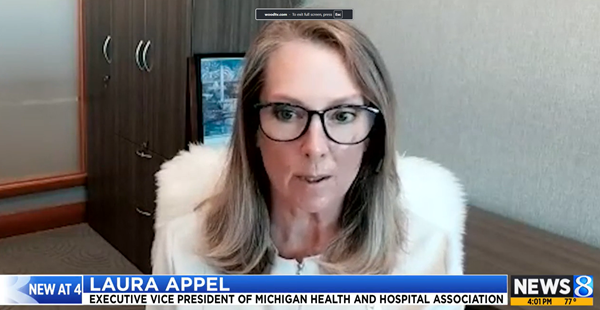
MHA EVP Laura Appel speaks with WOOD TV about the Baxter IV solutions shortage.

The MHA received media coverage the week of Oct. 21 regarding the Baxter IV solutions shortage and the impact hospitals have in their local communities.

WOOD TV aired a story Oct. 21 about the impact the Baxter IV solutions shortage is having on Michigan hospitals. The story includes quotes from Laura Appel, executive vice president and government relations and public policy, MHA, sharing updates on the situation and how hospitals are managing supply.

“I would say with few exceptions, I believe just about every health system in the state is doing what are called conservation measures,” said Appel.

The MHA is also featured in the October issue of FOCUS Magazine, the Lansing Regional Chamber of Commerce’s monthly business publication. The article, located on page 16, focuses on the role healthcare plays in the community, particularly as an employer, and includes quotes from MHA CEO Brian Peters.

“There’s no single answer,” said Peters about issues the MHA is focused on, including workforce shortages, greater behavioral health demands, workplace violence, health equity concerns and hospital viability. “These are obviously very complex issues, so the answers are multiple.”

Members with any questions regarding media requests should contact John Karasinski at the MHA.

Continued Coverage on Baxter IV Solutions Shortage

Laura Appel speaks with NBC25 about the Baxter IV solutions shortage.

The MHA continued to engage with media requests on the Baxter IV solutions shortage during the week of Oct. 14.

NBC25/Fox66 in Flint aired a story Oct. 16 on the shortage, which includes an interview with MHA Executive Vice President Laura Appel. She spoke to the current situation regarding reduced allocations from Baxter to hospitals and how hospitals are managing the shortage.

“Hospitals that use their services would get a smaller allocation than usual,” said Appel. “Many organizations sent out information on how to conserve solutions, how to use less of them all altogether and how to use them differently.”

Michigan Public also published a story Oct. 17 on the topic. The reporting includes sourcing to the MHA and quotes from an association spokesperson.

Members with any questions regarding media requests should contact John Karasinski at the MHA.

Headline Roundup: IV Solutions Shortage, Physician Retention & More

Laura Appel
Laura Appel
MHA EVP Laura Appel spoke with WJR, Michigan Public and WILX during the week of Oct. 7, 2024.

The MHA received media coverage the week of Oct. 7 that includes coverage on a potential national shortage of IV solutions products, physician retention and rural hospital funding.

The closure of a Baxter manufacturing facility in North Carolina due to Hurricane Helene led to several media stories, as the plant manufactures approximately 60% of the IV solutions used every day in the U.S.

Meanwhile, Bridge Michigan published a story looking at physician retention while Michigan Radio published a story on the recently signed Senate Bill 701, which eliminates the definition of “critical access hospital” and modifies the definition of “rural hospital.” It also raises the population limit to be considered a “rural hospital” to include counties with 195,000 people or less for the rural hospital funding pool.

Several MHA representatives participated in the news coverage, including Brian Peters, CEO; Laura Appel, executive vice president, government relations & public policy; Elizabeth Kutter, senior director, government & political affairs; and John Karasinski, senior director, communications.

Friday, Oct. 11

Thursday, Oct. 10

Wednesday, Oct. 9

Tuesday, Oct. 8

Monday, Oct. 7

Members with any questions regarding media requests should contact John Karasinski at the MHA.

MHA CEO Report — Protecting Access to Care Through 340B

MHA Rounds image of Brian Peters

“I alone cannot change the world, but I can cast a stone across the water to create many ripples.” Mother Teresa

MHA Rounds image of Brian PetersProtecting access to high quality, affordable healthcare for all Michiganders is a key tenet of the MHA. Stated simply, the 340B drug pricing program, created by Congress in 1992, is absolutely crucial to our member hospitals’ ability to maintain this access. And remarkably, since its inception to the current day, it has never required any state or federal taxpayer dollars.

One of my favorite elements of my MHA job is the opportunity to travel around the state and visit with the executives, clinicians and other important employees of our Michigan hospitals. I always ask the question: “What are your highest priorities and how can we help?” One of the most consistent answers for years has been: “We need to protect 340B.” Erosion or elimination of the program would quite literally mean the closure of key service lines, or even the hospital itself, in some cases.

At a time when drug prices are the most rapidly growing expense for hospitals, the 340B program has never been more important. It acts as a force multiplier, allowing hospitals to stretch incredibly scarce resources to provide high quality care for more patients in their communities, including our most vulnerable residents. The savings created from the ability to purchase certain prescription drugs at a discount enables hospitals to keep care in the community in various ways. Examples include funding free or heavily discounted prescription drugs for patients, trauma care, care for people with HIV/AIDs, behavioral health services, oncology clinics, nursing homes and treatment for substance use disorder.

It allows qualifying hospitals, particularly rural hospitals and those serving low-income patients, to deliver care and programming based on the needs of their individual communities. Many larger 340B hospitals are academic medical centers that care for the sickest and most complex patients. They establish arrangements with pharmacies outside of their immediate geographic area so patients who travel long distances to the hospital for specialized care can still access needed drugs at pharmacies near the patient’s home.

Unfortunately, prescription drug manufacturers are working to put arbitrary limits on the 340B program at the state and federal level and Michigan hospitals are at risk of losing their ability to provide affordable, accessible care to those in need. This comes at the same time when costs for new drugs launched by pharmaceutical companies rose by 35% from 2022 to 2023 and for the first time in history, the median price of a new drug is $300,000 – more than four times the median annual household income in the U.S. These attacks will make it more difficult to administer the 340B program and unnecessarily cut needed savings that could be invested in the community. These restrictions threaten access to care by risking the closure of birthing units, nursing homes and even critical access hospitals.

The MHA and Michigan hospitals are currently advocating for the passage of House Bill 5350 to counteract these attacks. The proposed legislation would help protect the 340B drug pricing program at the state level and the healthcare cost-savings generated for hospitals and the communities they serve. We highly encourage you to use our action alert to express the importance of the program to your lawmakers as the bill currently awaits passage out of the House Insurance and Financial Services committee.

Other harmful actions by manufacturers include Johnson & Johnson’s recent attempt to institute an unapproved rebate requirement for two drugs. The MHA opposed that proposal and we’re pleased to see that our advocacy with the Health Resources and Services Administration (HRSA) and our Congressional delegation, along with other hospitals and state hospital associations from across the country, influenced Johnson &  Johnson into discontinuing their pursuit of this unauthorized plan, after multiple HRSA notices of opposition.

This specific work is just the latest example of the MHA’s long-time strident advocacy at the state and federal level related to 340B. We have engaged in the state legislature, Congress, the courts and with our MHA Service Corporation Endorsed Business Partners, demonstrating just how impactful we know this program is.

The 340B program has helped to improve the health and wellness of individuals and communities for 30 years. It operates without any taxpayer-funded support and has positively impacted millions of lives. Attempts at eroding the program would not only harm hospitals, but more importantly patients and communities. As I have often said, the healthcare ecosystem is incredibly complex and there is rarely if ever a single silver bullet solution to any aspect of our challenges. But there is no doubt that the 340B program is one of those critically important stones that creates many positive ripples.

As always, I welcome your thoughts.

WJR’s Capital Report Focuses on Healthcare

MHA CEO Brian Peters

Detroit’s WJR 760 AM interviewed MHA CEO Brian Peters Sept. 22 for a segment on healthcare as part of “The Capital Report,” a new show focused on exploring issues happening within state politics and Michigan’s legislative landscape.

Peters spoke with host Guy Gordon on a variety of topics, including the 340B drug pricing program, proposed government mandated nurse staffing ratio legislation and maternal and infant health.

“We have always been supportive of public policy at both the state and federal level that limits the individual’s exposure to the high cost of healthcare,” said Peters. “If there are policies that can help ensure access to care, whether that be inpatient or outpatient hospital care, or access to prescription drugs, we support that.”

The 12-minute interview begins at the 10-minute mark of the show.

Members with any questions regarding media requests should contact John Karasinski at the MHA.