MHA Monday Report Aug. 5, 2024

Michigan Supreme Court Issues Ruling on Paid Sick Leave & Minimum Wage

The Michigan Supreme Court issued a ruling July 31 in Mothering Justice v. Attorney General that upholds voter initiative petitions on paid sick leave and minimum wage. Those laws, as originally enacted, will go into …


Michigan Medicaid Facility Rates Increased for Dental Procedures Under General Anesthesia

The Michigan Department of Health and Human Services issued a final policy to increase Medicaid payment rates for dental services provided to patients under general anesthesia in ambulatory surgical centers and outpatient hospitals, …


MDHHS and Michigan 211 Launches New Website for Grief and Bereavement Support

The Michigan Department of Health and Human Services (MDHHS), in partnership with Michigan 211, recently launched a new website aimed to providing support services for families who have experienced loss of a mother or infant. …


Kelley Cawthorne Ad


CMS Releases FY 2025 Final Rule for Inpatient Psychiatric Facilities

The Centers for Medicare & Medicaid Services (CMS) recently released a final rule to update the Medicare fee-for-service prospective payment system for inpatient psychiatric facilities for federal fiscal year (FY) 2025. Key provisions …


Applications Open for MI Behavioral Health Internship Stipend Program

The Michigan Department of Health and Human Services has allocated $3.5 million for the Behavioral Health Internship Stipend Program. This program will offer up to $15,000 stipends to student interns enrolled in behavioral health …


CMS Releases FY 2025 Final Rule for Inpatient Rehabilitation Facilities

The Centers for Medicare & Medicaid Services (CMS) recently released a final rule to update the Medicare fee-for-service prospective payment system for inpatient rehabilitation facilities for federal fiscal year (FY) 2025. Key provisions …


The Keckley Report

The Five Characteristics of the Blame and Shame Game in Healthcare

“The Blame and Shame Game spikes in election cycles as candidates pit themselves against their opponents. Healthcare plays its own version: last week is indicative: …

As Congress heads home for their August recess this week and Campaign 2024 intensifies, there’s no doubt healthcare issues will be prominent in local, state and national news. It’s also likely much of that coverage will be negative due to mounting cynicism about the industry’s business, consolidation, and opaque pricing and intensifying blame and shame games between hospitals and insurers, primary care and specialty physicians, PBMs and drug manufacturers, public health and healthcare delivery and others.

Blame and shame rhetoric about these tensions is not new, but its intensity is higher than ever as are the stakes. Blame and Shame is Chapter Two in most organization’s playbooks. Chapter One, the organization’s mission, vision, purpose and strategic plan is often missing and frequently premised on false assumptions. Thus, the “strategy” defaults to calling out the wrongdoings/shortcoming of adversaries and critics and little more. And their rhetoric is laced with terms for which accountability is suspect i.e. community benefit, affordability, value, quality and others. …

Here’s too much at stake to expect any inside sector to do this on its own: Blame and Shame is easier.”

Paul Keckley, July 29, 2024


News to Know 

The Primary Election is Tuesday, Aug. 6. Polls open at 7 a.m. and close at 8 p.m. Voters in line at 8 p.m. can still cast ballots. Those who missed the deadline to register online or by mail can do so in-person through Election Day with their local clerk. To check registration status, polling location or preview a ballot, visit the Michigan voter webpage.

MHA Monday Report July 29, 2024

Governor Signs FY 25 Budget and FY 24 Supplemental


Gov. Whitmer signed the fiscal year (FY) 2025 state budget on July 24. The budget proposal fully funds the Michigan Medicaid program, including significant increases to provider-funded Medicaid reimbursements in FY 24 and 25. The budget also …


Governor Signs Law Reducing Medical Waste

Gov. Whitmer signed Senate Bill 482, now Public Act (PA) 105 of 2024, on July 23, which extends the timeline for the disposal of sharps containers. Previously, state law mandated that sharps containers be removed …


June Medicaid and Medicare Enrollment in Michigan


The MHA updated its analysis of Medicaid and Medicare enrollment to reflect June 2024 data. The analysis now includes program enrollment as a percentage of each county’s total population and the split between fee-for-service and …


CMS Releases 2025 Physician Fee Schedule Proposed Rule

The Centers for Medicare & Medicaid Services (CMS) recently released a proposed rule to update the physician fee schedule (PFS) payment system effective Jan. 1, 2025. The proposal would: Reduce the PFS conversion factor by …


Webinar Explores Connection Between Person and Family Engagement and Performance

The MHA is hosting the webinar Tying Person and Family Engagement (PFE) to Culture and Performance from noon to 1 p.m. Aug. 20. The webinar will provide examples of how peers at hospitals are creating a PFE …


Engaging Providers and Transforming Revenue and Quality Performance Simultaneously

The MHA’s Endorsed Business Partner (EBP) program promotes industry-leading firms and connects member hospitals to solutions that alleviate pain points. The MHA recently endorsed ModusOne Health, which is the only physician-founded and operated clinical diagnosis improvement company (CDxI®) …


MDHHS

MDHHS Seeks Feedback from Older Adults and Caregivers on the 988 Suicide & Crisis Lifeline

The Michigan Department of Health & Human Services (MDHHS) is now surveying adults aged 60 and older and their caregivers about their experience with the 988 Suicide & Crisis Lifeline. The survey is scheduled to …


Expanding Peer Recovery Coach Services to Improve Patient Outcomes

The fiscal year (FY) 2025 budget includes critical funding to support the work of peer recovery coaches (PRCs) in Michigan hospitals. Kelsey Ostergren, director of health policy initiatives, MHA, and Michelle Norcross, senior director of safety & quality, MHA Keystone Center, share the impact these resources have on patients and communities …


Applications are Now Open for the Infection Prevention and Control Scholarship

The Association for Professionals in Infection Control and Epidemiology (APIC) has opened applications for the 2025 Critical Access Hospital (CAH) Scholarship program …


The Keckley Report

Campaign 2024 and US Healthcare: 7 Things we Know for Sure

“Over the weekend, President Biden called it quits and Democrats seemingly coalesced around Vice President Harris as the Party’s candidate for the White House. While speculation about her running mate swirls, the stakes for healthcare just got higher. Here’s why: …

Healthcare, to the Democratic-leaning voters is a right, not a privilege. Its majority think it should be universally accessible, affordable, and comprehensive akin to Medicare. They believe the status quo isn’t working: the federal government should steward something better. …

Regardless of the election outcome November 5, the U.S. healthcare industry will be under intense scrutiny in 2025 and beyond. It’s unavoidable.

Discontent is palpable. No sector in U.S. healthcare can afford complacency. And every stakeholder in the system faces threats that require new solutions and fresh voices.”

Paul Keckley, July 22, 2024


News to Know 

  • July 22 was the deadline to register by mail or online to be eligible to vote in the Primary Election on Aug. 6.


MHA in the NewsMHA CEO Brian Peters

Becker’s Hospital Review published an article July 23 that includes MHA CEO Brian Peters as one of 76 healthcare executives sharing their focus for the second half of 2024. Peters covered the importance of the …


June Medicaid and Medicare Enrollment in Michigan

The MHA updated its analysis of Medicaid and Medicare enrollment to reflect June 2024 data. The analysis now includes program enrollment as a percentage of each county’s total population and the split between fee-for-service and managed care organization. Nearly 27% of Michigan’s total population are enrolled in Medicaid and 22% are enrolled in Medicare.

The Michigan Department of Health and Human Services completed the Medicaid redetermination process, as required by the Consolidated Appropriations Act.  June 2024 enrollment, including the Healthy Michigan Plan, is at nearly 2.7 million, which is down approximately 603,000 since July 2023. 67% of Medicaid beneficiaries are enrolled in one of nine managed care plans.

The impact on hospitals is unknown since many enrollees had other coverage and their services were not billed to Medicaid. Many individuals who lost coverage have subsequently reenrolled in the program, have other third-party coverage or have sought coverage on the federal marketplace.

Total Medicare enrollment is 2.26 million, with 62% of beneficiaries enrolled in a Medicaid Advantage (MA) plan and only two counties having less than 50% of total Medicare enrollment in MA plans. MA enrollment by county varies from 45% to 77%, with most counties having 55% or more of their Medicare population enrolled in an MA plan, as highlighted below.

June enrollment is spread across 48 MA plans, with up to 28 plans covering beneficiaries in several Michigan counties.

Members with enrollment questions should contact the Health Finance team at the MHA.

MHA Monday Report July 22, 2024

Introducing New Infection Prevention Education

The MHA Keystone Center, in partnership with the Michigan Department of Health and Human Services, created a series of online learning modules for infection control and prevention education. The modules cater to the needs …


CMS Releases Medicare 2025 Outpatient Prospective Payment System Proposed Rule

The Centers for Medicare & Medicaid Services (CMS) recently released a proposed rule to update the Medicare fee-for-service outpatient prospective payment system effective Jan. 1, 2025. The proposed rule: Provides a net 2.3% increase …


MHA Webinar Reviews CMS Medication Administration and Management Requirement Updates

The MHA is hosting the webinar CMS Medication Administration and Management: IV Medication, Blood Administration and Safe Opioid Use from 10 a.m. to noon ET Aug. 27. Knowing medication is involved in 80% of treatment …


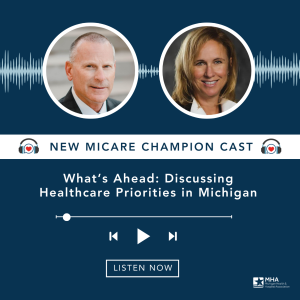
MHA Podcast Welcomes New Board Chair, Explores Healthcare Priorities in Michigan

The MHA released a new episode of the MiCare Champion Cast kicking off the 2024-2025 program year discussing healthcare viability, public health, workforce, cybersecurity, the election and more. The episode, hosted by MHA CEO Brian Peters, features MHA Board Chair Julie Yaroch, DO …


The Keckley Report

Most Hospitals Fall Short on Affordability, Vision and Trust

“This weekend, the American Hospital Association kicks-off its annual Leadership Summit in San Diego. Its agenda is organized around 8 themes: Transforming Care Delivery and Payment, Patient Centricity Through Digital Transformation, Building a More Flexible and Sustainable Workforce, Financial and Operating Excellence, Igniting Innovation, Elevating Health Equity, Improving Behavioral Health and Governance Excellence. They’re important. …

Collectively, that’s welcome news for a nation that’s anxious and divided. The current state in U.S. healthcare is much the same. It needs its hospitals to step up.

Some Boards and their hospital leadership teams take affordability, vision and trust seriously. Some don’t.”

Paul Keckley, July 15, 2024


News to Know

  • July 22 is the deadline to register by mail or online to be eligible to vote in the Primary Election on Aug. 6.

MHA CEO Brian Peters

MHA in the News

The MHA received media coverage the week of July 15 on healthcare priorities in Michigan, the state budget and the intersection between public health and healthcare. Hillsdale Hospital published an episode of the Rural Health …


MHA CEO Report — Moving the Workforce Needle

MHA Rounds image of Brian Peters

“Luck is not chance, it’s toil; fortune’s expensive smile is earned.” — Emily Dickinson

The healthcare workforce has been one of the MHA’s strategic action priorities for the past several years. As we near completion of our 2023-2024 program year, I’m extremely pleased to see the results of the MHA’s second annual hospital workforce survey, which shows Michigan hospitals are making real progress in reducing staffing shortages. Michigan hospitals hired more than 61,000 employees in 2023, including 13,000 nurses. Overall job vacancies were reduced by 29%, while nursing vacancies dropped by 44%. These gains are seen across nearly all job categories and they’re significant, with double-digit decreases for many of them. I can tell you with certainty: our “luck” in this regard has been earned through extremely hard work.

Michigan hospitals still have 19,000 job openings, including 4,700 for nurses, so more work and investment needs to be done. However, the accomplishments of Michigan hospitals in this area shows the recruitment, retention and training tactics implemented throughout the state are working.

It starts with retaining the existing workforce, which leads to improved morale and reduced recruiting expenses. Michigan hospitals are outperforming hospitals across the country when it comes to registered nurse retention. Michigan’s turnover rate is 3.7 percentage points lower than the national average. Offering better pay, improved benefits, flexible scheduling and integration of technology to improve patient monitoring and reduce the administrative burden on nurses are examples of tactics implemented by Michigan hospitals that are making a difference.

Michigan remains an aging state, and as more people become eligible for Medicare, the demand for healthcare services will continue to grow. In response, our hospitals are very serious about expanding the talent pipeline and increasing awareness of hospital careers to students. Hospitals are expanding educational opportunities and partnerships with higher education institutions to attract more students to healthcare, including clinical positions like nursing. The MHA is assisting by leading the MI Hospital Careers public awareness campaign that targets students and professionals considering a career change to consider healthcare as a great option.

The MHA also recently published the latest results from the Economic Impact of Healthcare in Michigan report, which shows the important role hospitals have in Michigan’s workforce and economy. Healthcare remains Michigan’s largest employer of direct, private-sector jobs. Hospitals provide the largest percentage of healthcare jobs in the state, employing 217,000 full-and part-time employees. Not only are these good-paying, stable jobs, but many offer career pathways that allow employees to further develop their skills and move up the job ladder with additional certifications and/or degrees. Many of Michigan’s communities also depend on their local hospital as one of, if not their very largest, employer.

These results led our conversations last week while a team of MHA staff attended the Detroit Regional Chamber’s annual Mackinac Policy Conference, connecting with business, higher education and political leaders throughout Michigan. In addition to this public announcement, we also produced a palm card and video for event attendees to highlight our work. Our goal is to increase the awareness of the large role hospitals play in the economy and the success they’re having in welcoming new talent to their organizations.

Reducing job vacancies and staffing shortages is a marathon and not a sprint. The Michigan Legislature has played a large part in assisting hospitals, whether it be through direct worker funding or new policies, such as increased penalties for violence committed against healthcare workers or allowing community colleges to offer Bachelor of Science in Nursing degree programs in collaboration with a four-year institution. The MHA is proud to help lead many of these discussions with policymakers to find more ways to reduce barriers to healthcare careers.

Public policy, advocacy and communications are key – but we are using every tool in our toolbox to address our workforce challenges. The MHA Endorsed Business Partner (EBP) program promotes industry-leading firms, carefully vetted by the MHA, that can meet the most pressing needs of our member hospitals and health systems, and we just announced a new endorsement of AMN Healthcare as a national leader in workforce solutions. The MHA has endorsed several of AMN’s legacy brands, including Merritt Hawkins, a physician search division, for many years. As AMN brings its solutions under one brand, we proudly continue this partnership with AMN Healthcare. They are the largest workforce solutions company in the market, which allows them to serve clients more effectively across all levels of healthcare.

Economic development and workforce are not just a one-year strategy. This will continue to remain a priority for hospitals and health systems, and we’re encouraged that at this time next year, we will have a similar story to tell in the reduced number of healthcare vacancies in the state. Until then, please join us and encourage as many people as you can to consider a job in healthcare. Make no mistake: whether clinical or non-clinical, healthcare is hard work; but it truly is one of the most rewarding, mission-driven careers you can pursue.

As always, I welcome your thoughts.

MHA Responds to Rand Corp. Hospital Pricing Study in Crain’s Grand Rapids Article

Crain’s Grand Rapids published an article May 16 on the release of Rand Corp. study on hospital pricing. Michigan reportedly has the third lowest hospital care costs relative to Medicare in the country, although the analysis relies on limited data sets and provides an inaccurate view of pricing.

MHA CEO Brian Peters is quoted in the article criticizing the methodology used in the study. He also explains the consequences of being a state with low hospital reimbursement.

“Even if the findings were proven accurate, the study’s results would show Michigan hospitals are reimbursed at some of the lowest levels in the country,” said Peters. “Hospitals are price takers where fixed reimbursement rates are either negotiated in advance with commercial payers or dictated by the government. These reimbursement models put hospitals at a disadvantage because commercial and government payers are insulated from adjusting rates to recognize increased costs and inflation. Hospitals must bear all cost increases with minimal or no payment adjustments.”

The American Hospital Association (AHA) also criticized the report as “a skewed and incomplete picture of hospital spending.”

“In benchmarking against woefully inadequate Medicare payments, Rand makes an apples-to-oranges comparison that presents an inflated impression of what hospitals are actually getting paid for delivering care while facing continued financial and other operational challenges,” said Molly Smith, the AHA’s group vice president for public policy. “Ultimately, the Rand study only underscores what we already know — that hospitals are chronically underpaid for Medicare services. Anything beyond that should be taken with a healthy measure of skepticism.”

This is the fifth version of the study published by the Rand Corp.

Peters also appears in a Becker’s Hospital review article published May 17 that shares the most important lesson hospital executives have learned throughout their career. Peters appears in the article as one of 90 executives speaking at the Becker’s Healthcare 12th Annual CEO+CFO Roundtable on Nov. 11-14.

Members with any questions regarding media requests should contact John Karasinski at the MHA.

MHA Monday Report March 25, 2024

MHA Monday Report

Registration Open for Webinar on Virtual Care Models

Registration is open for the MHA webinar, Virtual Care Models that Improve Engagement and Support Staff, scheduled from noon to 1 p.m. May 2. Attendees will learn from experts and peers about how hospitals and …


Healthcare Leadership Award Nominations Due March 29

Nominations are being accepted for the annual MHA Healthcare Leadership Award, which honors those who have demonstrated outstanding healthcare leadership within individual facilities and in their communities. The deadline to nominate an exceptional healthcare trustee, …


Updates on Medicare Advantage Enrollment in Michigan

The MHA recently updated its analysis of Medicare enrollment data to reflect Medicare enrollment as a percentage of each county’s total population and the split for Medicare between traditional fee-for-service and Medicare Advantage. …


The Keckley Report

Paul KeckleyIt’s time to Repair the Affordable Care Act

This Saturday marks the 14th anniversary of the Affordable Care Act passage. It is arguably the most consequential healthcare legislation since passage of the Medicare and Medicaid Act in 1965. …

So, at best, the ACA moved needles in each of the three but its effectiveness is a mixed bag. Nonetheless, it has survived 7 Supreme Court challenges and more than 70 Repeal votes in Congress and is now a permanent fixture in healthcare’s regulatory framework. Hanging chads aside, it is here to stay.

The need for ACA 2.0 is apparent and urgent. The motivation to initiate the process is uncertain: tribalism in U.S. healthcare, where near-term advantage takes precedent over long-term solutions by many organizations, is the rule, not the exception.

What’s needed is a coalition committed first and foremost to the long-term future of the health system: it doesn’t exist today.”

Paul Keckley, March 18, 2024


News to Know

The American Hospital Association (AHA) is accepting applications for the AHA’s 2025 Foster G. McGaw Prize.


MHA in the News

The MHA received media coverage since March 15 on efforts to reform the state’s auto no-fault insurance system as well as the future for healthcare teams. The Detroit News published an article March 17 describing …

Congressional Spending Package Solidifies Medicare SUD Coverage

The President signed March 9 a six-bill Congressional funding package to avoid a federal government shutdown that evening. The funding package included several healthcare provisions, including a measure expanding access to substance use disorder (SUD) services.

Specifically, the legislation permanently requires state Medicaid plans to cover medication-assisted treated for opioid use disorder. This includes counseling services, behavioral therapy and methadone. The bills also add the option for states to cover care in Certified Community Behavioral Health Clinics, as well as Institutions of Mental Disease, regardless of the size of the facility, for up to 30 days per 12-month period. The MHA will follow-up with the Michigan Department of Health and Human Services  to ensure the Michigan Medicaid program is prepared to comply.

Finally, the package calls for states to monitor the prescribing of antipsychotic medications to adults in institutional care setting, home health and community-based settings and requires the U.S. Department of Health and Human Services to issue guidance on integrating behavioral health services with other medical services under Medicaid and the Children’s Health Insurance Program.

The following healthcare measures were also included in the funding package:

  • Eliminated Medicaid Disproportionate Share Hospital cuts for fiscal year (FY) 2024 and delays FY 2025 cuts until Jan. 1, 2025.
  • Provides partial relief for Medicare physician reimbursement rates by increasing the Medicare conversation factor adjustment from 1.25% to 2.93%. This results in a final cut of 1.66%, compared to a previously expected 3.4% cut.
  • Extends incentive payments for alternative payment models though calendar year 2026.
  • Extends the Work Geographic Index Floor (GPCI) under the Medicare program by extending a 1.0 floor on the GPCI through Dec. 31, 2024.
  • Extends the Medicare-dependent hospital and enhanced low-volume hospital programs for three months through Dec. 31, 2024 opposed to Sept. 30, 2024.

Members with questions should contact Megan Blue at the MHA.


MHA Monday Report March 11, 2024

MHA Monday Report

capitol buildingMichigan Legislature Advances Healthcare and Economic Measures

The Michigan Legislature reviewed, discussed and moved forward legislation the week of March 4 that positively impacts patients, hospitals and health systems. Notably, the legislature took final action a bill related to the Renaissance Zone …


Congressional Spending Package Solidifies Medicare SUD Coverage

The President signed March 8 a six-bill Congressional funding package to avoid a federal government shutdown that evening. The funding package included several healthcare provisions, including a measure expanding access to substance use disorder (SUD) …


Michigan HR Professionals Gathers at the MHA HR Conference

More than 90 healthcare human resources (HR) professionals from across the state gathered at the MHA Human Resources Conference March 5 in Lansing. Attendees participated in hands-on facilitated discussions that developed innovative ideas focused on …


Change Healthcare Outage Continues to Impact Members

The MHA has been in close contact with the American Hospital Association, the Michigan Healthcare Security Operations Center and other partners regarding the Change Healthcare cyberattack that has impacted hospitals nationwide over the …


MHA Behavioral Health Learning Series: Second Webinar

The MHA is hosting a five-part webinar series to provide hospital staff with a deeper understanding of Michigan’s behavioral health system and the hospital’s role in connecting patients with care. These webinars are part of …


MIHI Hosts Webinar Series on BEAD State Challenge Process

The Michigan High-Speed Internet Office (MIHI) will be hosting three educational webinars to answer questions about the Broadband Equity Access and Deployment (BEAD) State Challenge Process, which is currently pending approval from the National Telecommunications …


MHA Podcast Uplifts Importance of Submitting Adverse Event Data to Improve Patient, Staff Safety

The MHA released a new episode of the MiCare Champion Cast during Patient Safety Awareness Week to uplift why hospitals should prioritize submitting adverse event data, in addition to what can be done to improve the culture around reporting. …


The Keckley Report

Paul KeckleyHealthcare Spending 2000-2022: Key Trends, Five Important Questions

“Last week, Congress avoided a partial federal shutdown by passing a stop-gap spending bill and now faces March 8 and March 22 deadlines for authorizations including key healthcare programs. …

The reality is this: no one knows for sure what the U.S. health economy will be in 2025 much less 2035 and beyond. There are too many moving parts, too much invested capital seeking near-term profits, too many compensation packages tied to near-term profits, too many unknowns like the impact of artificial intelligence and court decisions about consolidation and too much political risk for state and federal politicians to change anything. …”

Paul Keckley, March 4, 2024


News to Know

MHA-member communications professionals are encouraged to save the date for this year’s MHA Communications Retreat, scheduled from 8:30 a.m. to 4 p.m. Tuesday, May 7, at the Henry Center for Executive Development in Lansing.


MHA CEO Brian PetersMHA in the News

Chief Healthcare Executive published an article March 5 about the impact of the Change Healthcare cyberattack on hospitals and health systems across the country. The publication spoke with several state hospital associations representing Michigan, Florida, …