Medicaid Remains Focus of Healthcare News Coverage

The MHA was successful in placing several news stories during the week of April 28 related to potential federal Medicaid funding cuts.

The Lansing State Journal published an op-ed from MHA CEO Brian Peters that was shared as part of the MHA’s participation in the Protect MI Care coalition that is urging members of Congress to protect Medicaid. The op-ed expressed the importance of Medicaid to Michigan’s healthcare system and the consequences to access to care for all Michiganders if significant funding cuts are implemented.

“The effects would ripple far beyond those who rely on Medicaid — every hospital, mental health clinic and nursing home that depends on Medicaid funding would feel the impact,” said Peters. “When facilities close, it’s not just Medicaid patients who lose out — it’s everyone in the community, regardless of what kind of insurance they have.”

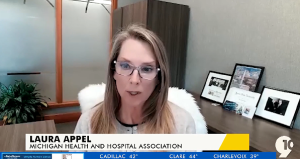
MHA Executive Vice President Laura Appel also sat down with WILX News 10 on April 30 to discuss the potential funding cuts and appeared in a story published by Bridge on May 1 about the impact to rural providers.

“When we close intensive care for newborns, when we close labor and delivery units, they are closing for everyone,” said Appel to Bridge.

In other news, Crain’s Detroit Business published an article April 30 committee testimony on legislation that would have Michigan join the nurse licensure compact. MHA Chief Nursing Officer Amy Brown testified in support of the legislation and is quoted in the article.

“In addition to recruitment and coordination of care in our state’s border areas, joining the compact would positively benefit telehealth access,” said Brown. “Compact licensure means residents in Michigan can access more telehealth professionals in other compact states, increasing access points for our state’s residents.”

Appel also appeared on 760 WJR’s All Talk With Kevin Dietz on May 1 to discuss the compact.

Members with any questions regarding media requests should contact John Karasinski at the MHA.

Lee Discusses AI in Healthcare

Jim Lee speaks with Mid-Michigan NOW about AI.

Jim Lee, senior vice president, data policy & analytics, MHA, appeared in a story about artificial intelligence (AI) in healthcare aired by Mid-Michigan NOW on April 23.

Lee discussed how AI is being used by hospitals and providers to assist with medical data and information and to reduce administrative burden.

“AI and healthcare is sort of like having a super smart assistant that helps doctors and nurses by quickly sorting through mountains of data and medical information,” said Lee.

Lansing political news outlet Gongwer also published two articles on April 23 that quote MHA representatives.

MHA CEO Brian Peters appeared in a story covering the newly launch Protect MI Care coalition to protect against Medicaid funding cuts.

“[Medicaid is] the financial lifeline that keeps hospitals, mental health providers and nursing homes open,” said Peters. “Cuts at this scale would lead to facility closures, creating health care deserts that hurt everyone, regardless of how they’re insured.”

MHA Chief Nursing Officer Amy Brown also appeared in an article following her testimony in the House Health Policy Committee in support of House Bill 4246, which would add Michigan to the nurse licensure compact.

“An important tactic to improve our ability as a state to attract talent and make it easy for nurses to choose Michigan to practice is to join the nurse license compact,” said Brown. “Hospitals continue to prioritize recruitment and retention efforts, but with the aging demographics of our state and the lack of participation in the compact hinder our ability to recruit younger nurses to replace the many nurses nearing and entering retirement.”

Members with any questions regarding media requests should contact John Karasinski at the MHA.

MHA Monday Report April 21, 2025

MHA Member Provides Testimony to House Health Policy Committee; Occupational Therapy Licensure Compact Bills Clear Committee

The House Health Policy Committee heard testimony from stakeholders on legislation to establish a Physician Assistant Licensure Compact in the state and Occupational Therapy Licensure Compact bills were voted to the House floor …


MHA CEO Brian Peters Joins 2025 State of Reform Health Policy Panel

The 2025 Michigan State of Reform Health Policy Conference convened April 17 in East Lansing, MI. The morning session began with a panel moderated by Farah Hanley, managing principal, Health Management Associates alongside MHA CEO …


MHA Keystone Center Receives Harry L. McKinley Workplace Safety Leadership Award

The MHA Keystone Center was honored April 15 at the Michigan Workplace Safety Conference for providing essential workplace safety resources to Michigan healthcare organizations and their staff. The Harry L. McKinley Workplace Safety Leadership Award …


CMS Releases FY 2026 LTCH Prospective Payment System Proposed Rule

The Centers for Medicare & Medicaid Services (CMS) recently released a proposed rule to update the Medicare fee-for-service long-term care hospital (LTCH) prospective payment system for fiscal year (FY) 2026. Specifically, the rule proposes …


RFP Available for Hospital-Based Peer Recovery Coach Services

The MHA is issuing a request for proposal (RFP) for a $2.5 million competitive grant program for Michigan healthcare entities to expand access to hospital-based peer recovery coach services. The funding was appropriated by …


Updated Hospital Medicaid Communications Toolkit Available

The MHA recently updated a toolkit of communications resources to support hospitals in advocating against potential Medicaid funding cuts in their local communities. The toolkit includes: Talking points Template letter-to-the-editor Template press release Social media …


CMS Releases FY 2026 Hospital IPPS Proposed Rule

The Centers for Medicare & Medicaid Services (CMS) recently released a proposed rule to update the Medicare fee-for-service inpatient prospective payment system (IPPS) for fiscal year (FY) 2026. The rule proposes to: Increase the standard …


MW-TEC to Host Informational Webinar on Social Work Apprenticeship Opportunities

The Michigan Workforce Training & Education Collaborative (MW-TEC) will host an informational webinar at 10 a.m. April 23 discussing social work apprenticeship opportunities. With a growing demand for behavioral health workers, apprenticeship programs can serve …


Latest AHA Trustee Insights Outlines the Value of Nursing Board Leadership and Compliance Duties

The April edition of Trustee Insights, the monthly digital package from the American Hospital Association (AHA), highlights the podcasts, videos, webinar and other resources available on today’s most pressing healthcare issues. National Nurses Week honors the …


Keckley Report

For U.S. Healthcare, Public Reaction to Tariffs is Instructive

“Last week, new cycles paid close attention to the economy with news mixed: The University of Michigan Consumer Sentiment Index hit a five year low of 50.80. But the Consumer Price Index showed a slight decline (2.4% in March) as gas prices continued to drop. And speculation about a recession drew coverage as Goldman, BlackRock, JP Morgan and others raised their estimates of its likelihood. …

While tariffs and trade policy are not understood by the vast majority of the U.S. population, most of the population feels the complicated issues around trade policy, tariffs and the economy beyond their control. The same can be said for views about U.S. healthcare.  Most don’t understand the system and how it operates. They think it’s complicated and expensive and believe corporate interests are playing a larger role.  What they do understand is what they spend and how unpredictable those expenses are. Like tariffs, they’re anxious and concerned. …

As Congress debates Budget Reconciliation aka ‘One Big Beautiful Bill’ this week and the IRS’ Income Tax deadline hits taxpayers tomorrow, what’s spent on healthcare by the government and by taxpayers will not escape notice. The majority of Americans and lawmakers think the system is underperforming and unnecessarily expensive. And acrimony between insurers, hospitals, physicians and drug companies will deepen old wounds and lend to public confusion.

The Trump administration’s first 3 months is getting mixed reviews largely because tariffs are not understood. The same is true for the health system. Its prices and their underlying costs are largely hidden and the public’s tired of excuses.

Tariffs might be a good thing for the economy or something else. Like healthcare, the public’s anxious about the future of the U.S. economy and unsure about what’s next.”

Paul Keckley, April 14, 2025


New to KnowNews to Know

In the latest episode of the MiCare Champion Cast, Laura Appel, executive vice president of government relations & public policy at the MHA, explores how proposed reductions to Medicaid could disrupt access to care and harm Michigan hospitals, patients and communities.


MHA in the News

MHA CEO Brian Peters was quoted in a Crain’s Grand Rapids article pushing back against the release of a Lown Institute report about Michigan nonprofit hospital community benefit spending. The report intentionally omits IRS Form …

News to Know – April 21, 2025

New to Know

In the latest episode of the MiCare Champion Cast, Laura Appel, executive vice president of government relations & public policy at the MHA, explores how proposed reductions to Medicaid could disrupt access to care and harm Michigan hospitals, patients and communities. Listeners can also expect to learn more about the impact proposed cuts would have on rural healthcare and Michigan’s economy. The episode is available to stream on Apple PodcastsSpotifySoundCloud and YouTube.

MHA CEO Brian Peters Joins 2025 State of Reform Health Policy Panel

MHA CEO Brian Peters pictured with Farah Hanley, managing principal, Health Management Associates and Dominick Pallone, executive director, Michigan Association of Health Plans (MAHP) during the 2025 Michigan State of Reform Conference April 17.

The 2025 Michigan State of Reform Health Policy Conference convened April 17 in East Lansing, MI. The morning session began with a panel moderated by Farah Hanley, managing principal, Health Management Associates, alongside MHA CEO Brian Peters and Dominick Pallone, executive director, Michigan Association of Health Plans (MAHP). Discussion focused on the evolving federal landscape and its impact on healthcare and health policy in Michigan.

Panelists explored the impact of recent federal activity and what it means for Michigan communities, hospitals and the healthcare workforce. Throughout the discussion, Medicaid, the 340B program and tariffs were highlighted. Peters emphasized that the current threats to Medicaid go beyond those enrolled in the program, warning that cuts will have a ripple effect across the entire healthcare system.

“This isn’t just about Medicaid recipients,” said Peters. “It’s about every Michigander’s access to care.”

The MHA continues to work with members of Congress to underscore that slashing Medicaid funding puts hospitals, providers and patient care at risk across the state.

Peters and Pallone also discussed partnership between the MHA and MAHP in response to recent proposals and the role tariffs play in healthcare. Peters noted the impact tariffs have on the healthcare supply chain and limitations when it comes to responding to financial shifts in real time, which puts a significant strain on providers trying to maintain care quality amid mounting costs.

Members with questions regarding current legislative activity may contact Laura Appel at the MHA.

MHA Pushes Back Against Lown Institute Report in Crain’s

MHA CEO Brian Peters was quoted in a Crain’s Grand Rapids article pushing back against the release of a Lown Institute report about Michigan nonprofit hospital community benefit spending.

The report intentionally omits IRS Form 990 categories, including Medicaid payment shortfall and health professional education, which significantly reduces a hospital’s community benefit contributions. Peter’s statement provided to Crain’s criticized the Lown Institute methodology, while highlighting the impact that providing care to those with Medicaid coverage has on a community. Peters also uplifted the importance of health professional education in increasing the numbers of providers while the country continues to experience a shortage of healthcare professionals, particularly in rural Michigan.

“The latest version of the Lown Institute’s report on community benefit activities of nonprofit hospitals remains flawed, shortsighted and fails to highlight all the important programs and services hospitals and health systems provide to their communities and patients,” said Peters. “It is irresponsible to intentionally ignore these categories that make a significant difference in Michigan’s communities and the viability of hospitals.”

MHA Executive Vice President Laura Appel also joined state officials and leaders at Munson Healthcare Cadillac Hospital April 18 to discuss the negative impacts of potential cuts to Medicaid funding on patient care and the financial health of rural hospitals and their local communities. Speakers included Michigan Department of Health and Human Services Director Elizabeth Hertel, Michigan Department of Labor and Economic Opportunity (LEO) Director Susan Corbin and Munson Healthcare President and CEO Ed Ness. LEO published a press release, while media outlets including Cadillac News, UpNorthLive and WWMT News 3 published stories that day on the subject.

Members with any questions regarding media requests should contact John Karasinski at the MHA.

MHA Monday Report April 14, 2025

U.S. House Advances Budget Resolution, Sets Up Potential Medicaid Cuts

The United States House of Representatives advanced a Senate budget resolution April 10 that calls for a minimum of $1.5 trillion in federal spending reductions. A separate budget resolution previously passed by the House in …


Registration Now Open for MHA Annual Membership Meeting

Registration is now open for the MHA Annual Membership Meeting June 25 through 27 at the Grand Hotel on Mackinac Island. The annual meeting will feature an outstanding lineup of speakers, including Geeta Nayyar, MD, …


AHA President and CEO Rick Pollack Addresses MHA Board

The MHA Board of Trustees welcomed AHA President and CEO Rick Pollack to its April 9 meeting at the MHA’s Capitol Advocacy Center in downtown Lansing. The board meeting primarily focused on how to effectively …


MHA to Host GME Capitol Day May 21

The MHA is hosting the 2025 MHA Graduate Medical Education (GME) Capitol Day from 9 a.m. – 3:30 p.m. May 21 in Lansing. The event is an opportunity for Michigan’s physician residents from teaching hospitals …


MI AIM Spring Regional Training Approaching

The Michigan Alliance for Innovation on Maternal Health (MI AIM) is offering regional training sessions for inpatient maternal health providers focused on implementing the hypertension safety bundle and addressing common challenges with implementation. The one-hour …


MHA Virtual Member Forum on Cybersecurity and Cyberattack Response

The MHA, in conjunction with its statewide Health Information Technology Strategy Committee, is hosting the virtual member forum Cybersecurity and Cyberattack Response from 9:30 to 11 a.m. May 9 as an ongoing effort to strengthen …


MHA Shares Medicare and Medicaid Enrollment Analysis

The MHA recently updated its analysis of Medicaid and Medicare enrollment based on February 2025 data. The analysis includes program enrollment as a percentage of each county’s total population and the split between fee-for-service and …


Excellence in Governance Fellowship Offers Meaningful Dialogue Among Trustees and Experts

Applications are now being accepted for the 2025-2026 the MHA Excellence in Governance Fellowship. Launched more than 20 years ago, is a rigorous and comprehensive program delivering tools and knowledge in effective governance, improving quality …


The Power of Patient-Centered Care

It’s no secret that patient experience within hospitals and health systems has evolved over the years – especially following the COVID-19 pandemic. With Patient Experience Week (PX Week) around the corner, it’s a good time to recognize the …


Keckley Report

The 5 Emergent Issues for Boards in Trump-DOGE Healthcare

“This was a week for healthcare that’s unprecedented in modern history …

None of these is a surprise. Since the Trump inauguration January 20, a shake-up in federal government has been promised and last week’s actions show it’s serious.  Polls show a majority of Americans distrust the federal government, Congress, the media and the health system, so disruption is expected. But the nation’s divided about solutions, and healthcare is no exception.  …

The events of last week portend more pressure on healthcare Boards and management to execute. In these 5 areas, each organization should revisit current policies and strategies and refresh where appropriate. And each organization should evaluate current relationships with trade groups with whom advocacy efforts are coordinated to assure they’re responsive to the realities of healthcare in the Trump-DOGE era.”

Paul Keckley, April 6, 2024


New to KnowNews to Know

  • Kara Heck, MHA, BSN, RN-BC, CCRN, chair of the MHA Safety & Quality Committee, shares a testimonial encouraging healthcare leaders to attend the MHA Keystone Center Safety & Quality Symposium, taking place April 28–29, 2025, at the Kellogg Conference Center & Hotel in East Lansing.
  • The American Hospital Association (AHA) is accepting applications for the annual 2026 AHA Foster G. McGaw Prize now through May 6, 2025.

Laura Appel speaks with 9&10 News.

MHA in the News

The MHA received media coverage the week of April 7 on potential Medicaid funding cuts, pediatric behavioral health and healthcare costs. 9& 10 News aired a story April 9 on potential federal Medicaid funding cuts. MHA …

AHA President and CEO Rick Pollack Addresses MHA Board

AHA President and CEO Rick Pollack and MHA CEO Brian Peters pictured during a fireside chat during the April 9 MHA Board of Trustees Meeting at the MHA’s Capitol Advocacy Center in downtown Lansing.

The MHA Board of Trustees welcomed AHA President and CEO Rick Pollack to its April 9 meeting at the MHA’s Capitol Advocacy Center in downtown Lansing. The board meeting primarily focused on how to effectively advocate with state and federal lawmakers to preserve access to vital community healthcare services currently facing steep proposed funding cuts.

In a ‘fireside chat’ format moderated by MHA CEO Brian Peters, Pollack shared the political insights he’s gleaned from more than forty years of federal healthcare advocacy to provide his perspective on the current Congressional budget process, key drivers of the current administration and Congressional leadership, and the most effective messaging to help lawmakers understand how their community hospitals will be affected by the budget proposals.

Pollack shared recent public messaging from the Coalition to Strengthen America’s Healthcare, showing the faces of Medicaid and urging lawmakers to protect funding. “If lawmakers don’t hear from you, they think there’s no problem. Hospitals are not a single-issue group,” said Pollack. “Reach out to your lawmakers because we have the opportunity to be objective teachers. Bring them into your hospitals and tell your story.”

At the state level, the board affirmed its support for efforts to address medical debt relief, providing direction for the association to continue working with policymakers on this important issue. The board also discussed ongoing advocacy in support of state legislation to protect 340B contract pharmacies. In addition, the board affirmed the work of the Advisory Panel on Community Benefit Collaboration, with a focus on voluntary collaboratives to improve prenatal care and help address perinatal mood disorder.

The MHA Health PAC campaign remains on target to reach its $400,000 goal. Lastly, the board approved the Type 3 membership application of Warner, Norcross & Judd, LLP.

Members with questions about the actions of the MHA Board of Trustees may contact Amy Barkholz at the MHA.

Medicaid & Pediatric Behavioral Health Media Coverage

Laura Appel speaks with 9&10 News.

The MHA received media coverage the week of April 7 on potential Medicaid funding cuts, pediatric behavioral health and healthcare costs.

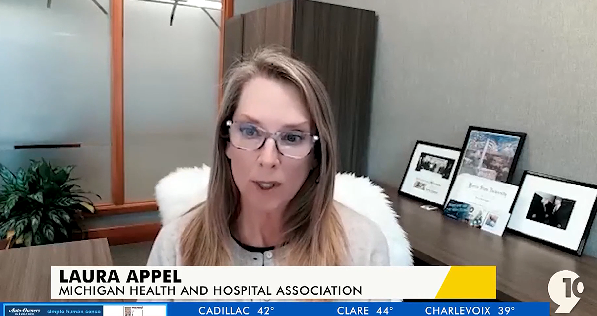
9&10 News aired a story April 9 on potential federal Medicaid funding cuts. MHA Executive Vice President Laura Appel spoke with 9&10 News, explaining how the cuts would specifically impact rural healthcare. Representatives from McLaren Health Care and Munson Healthcare also appeared in the story.

“In our rural areas, we have small populations, and some of them are also shrinking, which makes it that much harder to sustain certain services because of the fixed costs being spread over so few people,” said Appel. “When we lose a labor and delivery unit, we lose it for that entire population.”

Lauren LaPineSecond Wave Michigan published a story April 8 about how Michigan hospitals are improving pediatric behavioral healthcare. Lauren LaPine, MHA senior director of legislative and public policy, spoke with Second Wave Michigan about the MHA’s behavioral health work, focusing particularly on the $50 million state grant the MHA served as the fiduciary for to expand inpatient pediatric behavioral health capacity in the state. LaPine also highlighted the data the MHA collected regarding emergency department boarding, which shows at least 155 people at any point, including 17 children, are in an emergency department awaiting behavioral health care.

“Our data in Michigan reflects some of the trends that we see nationally in terms of the increasing need for behavioral health services for children and youth,” said LaPine. “So, we are paying really close attention to that need and want to make sure that our member hospitals and health systems are able to address the need when pediatric patients and their families come to the hospital in a behavioral health crisis.”

Lastly, Crain’s published a story April 9 about the role of hospitals regarding rising healthcare costs. MHA CEO Brian Peters is quoted in the story, explaining how the majority of rising costs are due to responding to market trends for labor, as well as rising costs for facilities, drugs and supplies.

“The largest expense for hospitals is labor … A large component to increased healthcare costs for hospitals is making sure healthcare workers are appropriately and competitively compensated so they can provide care to patients when and where they need it,” said Peters.

Members with any questions regarding media requests should contact John Karasinski at the MHA.

U.S. House Advances Budget Resolution, Sets Up Potential Medicaid Cuts

The United States House of Representatives advanced a Senate budget resolution April 10 that calls for a minimum of $1.5 trillion in federal spending reductions. A separate budget resolution previously passed by the House in February had specifically targeted $880 billion in cuts from the Energy and Commerce committee, which has jurisdiction over the Medicaid program.

Leadership and committee chairs from both chambers will now begin writing and seeking support for an omnibus budget bill, which could contain cuts to providers in the Medicaid program. The MHA remains strongly opposed to cuts that will limit access to care for Michigan residents and will work with members to advocate against reductions over the next several weeks.

Members may use the MHA’s Medicaid action alert to contact their congressperson and advocate for protecting Medicaid from funding cuts.

Members with questions may contact Laura Appel at the MHA.