Healthcare Advocates Honored with MHA Special Recognition Award

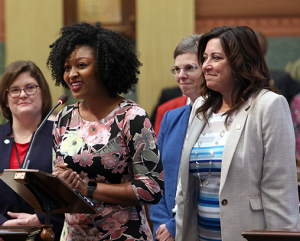
Sen. Anthony and Rep. Witwer

The MHA announced two winners of its Special Recognition Award during the Annual Membership Meeting June 27, recognizing them for extensive contributions to healthcare. Each of the winners has uniquely influenced healthcare in Michigan. The winners include Sen. Sarah Anthony (D-Lansing) and Rep. Angela Witwer (D-Delta Township).

The lawmakers each chair their chamber’s appropriations committee, with Anthony the first Black woman to ever chair the Senate Appropriations Committee. These committees are responsible for determining the annual state budget, covering important healthcare areas including Medicaid, the Healthy Michigan Plan, graduate medical education, the rural access pool and obstetrical stabilization fund, and critical access hospital reimbursement rates. Both lawmakers were strong supporters of Public Act 5 of 2023, sponsored by Witwer, which provided $75 million for hospital workforce recruitment, retention and training in the fiscal year 2023 state budget. In addition, they each fought to include enhanced funding for ongoing Level I and Level II trauma centers, inpatient psychiatric payment rates and maternal health in the fiscal year 2024 budget. Both Anthony and Witwer are strong supporters of funding Medicaid appropriately to ensure adequate reimbursement rates for providers and protect access to healthcare services.

Sen. Sarah Anthony (D-Lansing)

In addition to her committee role, Anthony prioritizes expanding access to healthcare. She sponsored Michigan’s first mental health parity law, signed into law May 21 by Gov. Whitmer. Public Act 41 of 2024 requires insurance coverage for mental health and substance use disorder treatments at the same level as physical health services. This new law eliminates existing disparities and ensure equal access to necessary care for all Michiganders. Anthony also co-sponsored key legislation last session to support the healthcare talent pipeline signed into law by Gov. Whitmer Dec. 22, 2022. Public Acts 251 and 252 of 2022 expanded the Michigan Reconnect program, allowing for several additional certifications to qualify for the post-secondary scholarship program including high-demand healthcare credentials. Other healthcare legislation Anthony sponsors includes Senate Bill 531, which is part of a package of bills supported by the MHA that would improve Michigan’s amended auto no-fault laws. The package would simplify and increase Medicare hospital reimbursements, clarify the definition of Medicare and create a new post-acute care provider fee schedule. The bills passed the Senate in a bipartisan vote and await consideration by the House.

Rep. Angela Witwer (D-Delta Township)

Witwer’s role as a healthcare champion is inspired by more than the 22 years she spent working in healthcare to begin her career. She first started as a clinician, working in University of Michigan Health – Sparrow Lansing’s burn unit and later as the manager of pediatric rehabilitation. She later became manager of the hospital’s community relations and marketing department, before leaving the organization to co-found her own public relations, marketing and advocacy firm. These life experiences inspired Witwer’s support for Public Acts 271 and 272 of 2023, which increase the penalties for assaulting a healthcare worker or volunteer by doubling the financial fines for those found guilty of such a crime.

Expanded AMN Healthcare Partnership Offers Greater Member Solutions

The MHA’s Endorsed Business Partner (EBP) program promotes industry-leading firms that can meet the most pressing needs of our member hospitals and health systems. The MHA recently endorsed a national leader in workforce solutions. The MHA has endorsed several of AMN’s legacy brands for many years, including Merrit Hawkins, BE Smith and AMN Language Services. Effective 2023, AMN Healthcare is now one brand, one AMN, and as they bring their solutions under one brand, the MHA is proud to continue this partnership.

AMN Healthcare is the largest workforce solutions company in the market, which allows them to serve clients more effectively across all levels of healthcare. They offer an extensive network of talent, innovative technologies, recruiting expertise and talent solutions to help healthcare organizations optimize their workforce. They focus on using technology and data to help organizations create a fiscally responsible balance of flexible, core and external labor. With nearly 40 years of industry expertise, AMN provides a customized and tailored approach to meet organizations’ holistic workforce goals.

For more information about AMN Healthcare, members may contact JJ Ewing at AMN Healthcare. Members seeking information about the MHA’s EBP program may contact Rob Wood at the MHA.


MHA CEO Report — Moving the Workforce Needle

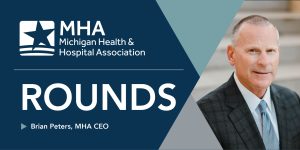
MHA Rounds image of Brian Peters

“Luck is not chance, it’s toil; fortune’s expensive smile is earned.” — Emily Dickinson

The healthcare workforce has been one of the MHA’s strategic action priorities for the past several years. As we near completion of our 2023-2024 program year, I’m extremely pleased to see the results of the MHA’s second annual hospital workforce survey, which shows Michigan hospitals are making real progress in reducing staffing shortages. Michigan hospitals hired more than 61,000 employees in 2023, including 13,000 nurses. Overall job vacancies were reduced by 29%, while nursing vacancies dropped by 44%. These gains are seen across nearly all job categories and they’re significant, with double-digit decreases for many of them. I can tell you with certainty: our “luck” in this regard has been earned through extremely hard work.

Michigan hospitals still have 19,000 job openings, including 4,700 for nurses, so more work and investment needs to be done. However, the accomplishments of Michigan hospitals in this area shows the recruitment, retention and training tactics implemented throughout the state are working.

It starts with retaining the existing workforce, which leads to improved morale and reduced recruiting expenses. Michigan hospitals are outperforming hospitals across the country when it comes to registered nurse retention. Michigan’s turnover rate is 3.7 percentage points lower than the national average. Offering better pay, improved benefits, flexible scheduling and integration of technology to improve patient monitoring and reduce the administrative burden on nurses are examples of tactics implemented by Michigan hospitals that are making a difference.

Michigan remains an aging state, and as more people become eligible for Medicare, the demand for healthcare services will continue to grow. In response, our hospitals are very serious about expanding the talent pipeline and increasing awareness of hospital careers to students. Hospitals are expanding educational opportunities and partnerships with higher education institutions to attract more students to healthcare, including clinical positions like nursing. The MHA is assisting by leading the MI Hospital Careers public awareness campaign that targets students and professionals considering a career change to consider healthcare as a great option.

The MHA also recently published the latest results from the Economic Impact of Healthcare in Michigan report, which shows the important role hospitals have in Michigan’s workforce and economy. Healthcare remains Michigan’s largest employer of direct, private-sector jobs. Hospitals provide the largest percentage of healthcare jobs in the state, employing 217,000 full-and part-time employees. Not only are these good-paying, stable jobs, but many offer career pathways that allow employees to further develop their skills and move up the job ladder with additional certifications and/or degrees. Many of Michigan’s communities also depend on their local hospital as one of, if not their very largest, employer.

These results led our conversations last week while a team of MHA staff attended the Detroit Regional Chamber’s annual Mackinac Policy Conference, connecting with business, higher education and political leaders throughout Michigan. In addition to this public announcement, we also produced a palm card and video for event attendees to highlight our work. Our goal is to increase the awareness of the large role hospitals play in the economy and the success they’re having in welcoming new talent to their organizations.

Reducing job vacancies and staffing shortages is a marathon and not a sprint. The Michigan Legislature has played a large part in assisting hospitals, whether it be through direct worker funding or new policies, such as increased penalties for violence committed against healthcare workers or allowing community colleges to offer Bachelor of Science in Nursing degree programs in collaboration with a four-year institution. The MHA is proud to help lead many of these discussions with policymakers to find more ways to reduce barriers to healthcare careers.

Public policy, advocacy and communications are key – but we are using every tool in our toolbox to address our workforce challenges. The MHA Endorsed Business Partner (EBP) program promotes industry-leading firms, carefully vetted by the MHA, that can meet the most pressing needs of our member hospitals and health systems, and we just announced a new endorsement of AMN Healthcare as a national leader in workforce solutions. The MHA has endorsed several of AMN’s legacy brands, including Merritt Hawkins, a physician search division, for many years. As AMN brings its solutions under one brand, we proudly continue this partnership with AMN Healthcare. They are the largest workforce solutions company in the market, which allows them to serve clients more effectively across all levels of healthcare.

Economic development and workforce are not just a one-year strategy. This will continue to remain a priority for hospitals and health systems, and we’re encouraged that at this time next year, we will have a similar story to tell in the reduced number of healthcare vacancies in the state. Until then, please join us and encourage as many people as you can to consider a job in healthcare. Make no mistake: whether clinical or non-clinical, healthcare is hard work; but it truly is one of the most rewarding, mission-driven careers you can pursue.

As always, I welcome your thoughts.

Michigan Hospitals Fill 61,000 Jobs in 2023

Healthcare Remains the Largest
Private-Sector Employer in Michigan

The Michigan Health & Hospital Association (MHA) published results from their second annual Michigan hospital workforce survey that shows hospital recruitment, retention and training efforts in 2023 helped fill 61,000 total positions in 2023, reducing job vacancies by 29% to a total of 19,000 statewide. More than 13,000 nurses were hired during that time, decreasing the number of nursing vacancies by 44%. The survey includes responses from more than 95% of all Michigan acute-care inpatient hospitals.

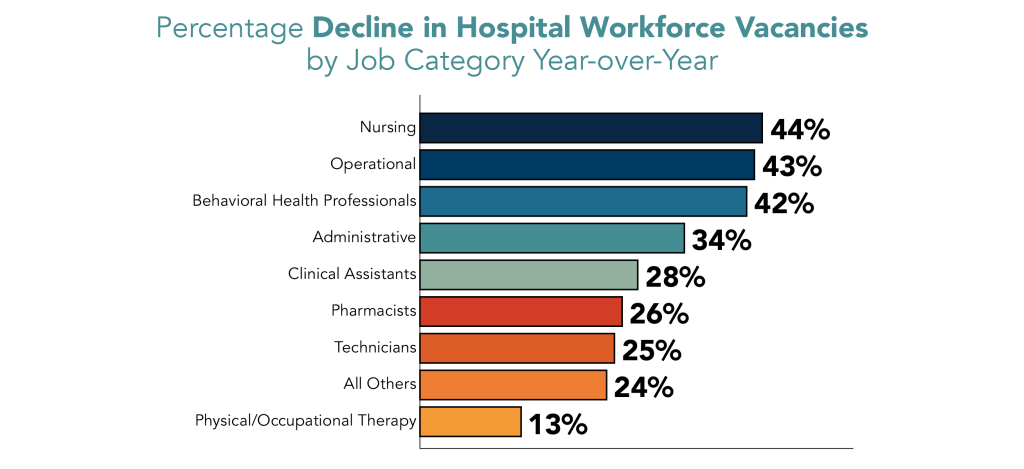
Nearly all job categories in the survey experienced double-digit percentage decreases in vacancies year-over-year. Hospitals successfully reduced vacancies in the following job categories:

  • Nursing – 44% decrease
  • Operations – 43% decrease
  • Behavioral health – 42% decrease
  • Administration – 34% decrease
  • Clinical assistants – 28% decrease
  • Pharmacists – 26% decrease
  • Technicians – 25% decrease

Bar graph of decline in hospital job vacancy by category.

Amidst a national nursing shortage, the results show Michigan hospitals are outperforming national nurse retention rates. The registered nurse (RN) turnover rate for Michigan hospitals is 3.7 percentage points lower than the national average of 18.4%. Examples of how Michigan hospitals are retaining and recruiting nurses include offering better and faster pay, improved benefits and employee support, and expanding educational opportunities for students to consider a nursing career. State funding obtained through Public Act 9 of 2022 and Public Act 5 of 2023 contributed to these efforts and have directly benefitted at least 69,000 healthcare workers.

To complement the efforts of individual hospitals, the MHA launched the statewide MI Hospital Careers public awareness campaign in 2023 targeting students and professionals considering a career change to express the value of healthcare careers. The MHA also engaged in efforts that ultimately led to four-year Bachelor of Science in Nursing programs at community colleges, expansion of the Michigan Reconnect program to allow funds to support Michiganders accessing healthcare credentials for technician and nursing careers, and new state law that increases the penalties for individuals who commit acts of violence against healthcare workers.

Michigan hospitals remain focused on solutions that build the healthcare workforce that patients need now, and in the future, to fill the remaining 19,000 open hospital positions, including 4,700 in nursing.

These efforts will strengthen healthcare in Michigan, which remains the state’s largest employer of direct, private-sector jobs according to 2024 Economic Impact of Healthcare in Michigan data. More than one million jobs in Michigan were directly or indirectly related to or induced by healthcare in fiscal year 2022, the most recent data available. Hospitals collectively employ 217,000 full- and part-time employees, remaining one of the largest employers in many Michigan communities. In addition, direct healthcare workers in Michigan earned nearly $47 billion in wages, salaries and benefits.

“Retaining and growing the workforce is a top priority shared by hospitals throughout the state,” said Michigan Health & Hospital Association CEO Brian Peters. “We’re extremely encouraged by the data demonstrating the success of hospitals over the past year in increasing the talent pipeline to care for patients and strengthening the healthcare workforce. Hospitals provide Michigan communities with good jobs that help drive our state’s economy and keep residents healthy.”

The 19th edition of The Economic Impact of Healthcare in Michigan was compiled using IMPLAN® cloud software to quantify healthcare’s significant economic impact in the state. The data represents direct, indirect[1] and induced[2] healthcare jobs; taxes paid by those workers and their employers; and salaries, wages and benefits earned. The report is an online, interactive tool that allows users to examine these economic impacts from a statewide perspective and by region, county or congressional district. It is available at www.economicimpact.org.

[1] Indirect jobs are those created to support a larger employer or industry (for example, a laundry that cleans linens for a hospital).

[2] Induced jobs are those created by the spending of people who work in the indirect jobs (for example, a restaurant waiter who serves the laundry workers).

Public Relations Professionals Gather at MHA Communications Retreat

MHA Events
Sue Tetzlaff, co-founder, Capstone Leadership Solutions; Emily R. Sexton, communications coordinator, Holland Hospital; Hannan Deep, director of strategic communications operations, Henry Ford Health; and Lauren Zakalik, director, public & media relations strategy, Henry Ford Health, during a panel discussion. 

The 2024 MHA Communications Retreat brought together nearly 100 communications, marketing and public relations professionals from MHA-member facilities May 7 to network and learn from peers across the state. Topics on the agenda included artificial intelligence (AI), behavioral health, the healthcare workforce and internal communications.

The event began with several speakers presenting on how they are using communications tools to assist in reacting to the behavioral health crisis. Speakers included Kara Gavin, lead public relations representative, Michigan Medicine; and research & policy media relations manager, U-M Institute for Healthcare Policy and Innovation; Jim Rose, director of marketing and communications, Pine Rest Christian Mental Health services; Dallas Rau, executive director, Great Lakes Bay Region Mental Health Partnership; and Tera Szeliga, director of marketing, communications and Institute for Leaders, Great Lakes Bay Regional Alliance.

A panel discussion was conducted discussing communications strategies to address the healthcare workforce and the importance of engaging with government relations and advocacy efforts. Angela Minicuci, APR, partner, Martin Waymire, moderated the panel comprised of Laura Appel, executive vice president of government relations and public policy, MHA, and Megan Brown, chief marketing and communications officer, Munson Healthcare. MHA CEO Brian Peters followed the panel with an update on the MHA strategic action priorities.

AI industry experts Joshua Wilda, chief digital and information officer, University of Michigan Health – Regional Network; and Tony Lambert chief technology officer, TechSmith, presented on the AI trends in healthcare and hospitals and how its impacting communications and marketing.

The event concluded with a topic focused on internal communications strategies hospitals can implement to celebrate their workforce and tactics they can use to address employee morale, support recruiting and improve brand perception. Each speaker shared strategies for different sized hospitals. Those speakers included Sue Tetzlaff, co-founder, Capstone Leadership Solutions; Emily R. Sexton, communications coordinator, Holland Hospital; Hannan Deep, director of strategic communications operations, Henry Ford Health; and Lauren Zakalik, director, public & media relations strategy, Henry Ford Health.

The event was sponsored by Martin Waymire and MHA Data Services, who attended the event and provided resources about their products and services. Photos from the event are available on the MHA Facebook page. For more information and resources from the event, contact John Karasinski at the MHA.