340B & Medicaid Receive Media Coverage

The MHA received media coverage the week of March 10 on the 340B program and potential federal Medicaid funding cuts with outlets including MichMash, Crain’s Grand Rapids Business and 9&10 News.

MHA CEO Brian Peters appeared on the March 14 episode of the MichMash podcast where he discussed MHA advocacy efforts to oppose Medicaid funding cuts, passage of Senate Bills 94 and 95 by the Michigan Senate that safeguard the 340B program and the healthcare workforce. The interview was conducted by hosts Cheyna Roth and Zach Gorchow. MichMash is produced by WDET Detroit Public Radio in collaboration with Gongwer News Service and is part of the NPR Network.

Crain’s Grand Rapids also published an article March 10 about the 340B legislation moving through the Senate. Peters and Elizabeth Kutter, senior director of advocacy, MHA, are quoted in the piece.

“This bill prevents drug manufacturers from continuing to issue arbitrary restrictions on 340B eligible Federally Qualified Health Centers and hospitals,” said Peters. “We continue to be grateful for the Senate’s leadership and collaboration in recognizing the need for strong, quality health care providers over out-of-state prescription drug interest groups.”

9&10 News aired a story March 11 that looked at the impact on Michigan if funding cuts to Medicaid are implemented. MHA Executive Vice President Laura Appel was interviewed and appears in the story.

“We know that work requirements are popular as a concept, but really, we need to focus on people being healthy so that they can work, as opposed to working so that they can become healthy,” said Appel.

Members with any questions regarding media requests should contact John Karasinski at the MHA.

Legislative Policy Panel Acts on Opioid Treatment Policies

The MHA Legislative Policy Panel met virtually March 12 to develop recommendations on legislative and policy issues impacting Michigan hospitals. The MHA advocacy team provided important updates to the panel on healthcare activities at both the federal and state levels.

Adam Carlson, senior vice president, advocacy, shared the federal update, recapping the activities of the Trump administration since inauguration. Topics included a review of several healthcare-related executive orders, federal agency appointments and proposed Medicaid funding cuts.

Elizabeth Kutter, senior director, advocacy, then provided the panel with a state legislative update, recapping the recent passage of 340B contract pharmacy legislation in the Senate and the recently revised Earned Sick Time Act. Senate Bill (SB) 94, sponsored by Sen. Sam Singh (D-East Lansing), passed the Senate 33-3, with overwhelming bipartisan support, on March 6, which safeguards the 340B program in Michigan, ensuring cost savings and preserving access to affordable healthcare services in both urban and rural Michigan communities. The bill is paired with SB 95, sponsored by Sen. Jonathan Lindsey (R-Allen), which requires hospital compliance with federal cost transparency laws.

John Karasinski, senior director, communications, discussed the public communications strategies supporting Medicaid and 340B efforts. Panel members were encouraged to visit the MHA’s Legislative Action Center and to use the action alerts for both topics.

The Panel chose to act on two issues, making recommendations related to opioid treatments. The first recommendation directs the MHA to support efforts to eliminate prior authorization requirements for buprenorphine. The second recommendation is for the MHA to work with state agencies on state regulatory requirements for opioid treatment programs.

For more information on the MHA Legislative Policy Panel, members may contact Adam Carlson at the MHA.

Senate Passes 340B Hospital Protections & IMLC Clears House

The Michigan Senate passed legislation that protects 340B hospitals with bipartisan support while the Michigan House of Representations voted through legislation that removes the sunset on the Interstate Medical Licensure Compact (IMLC) during the week of March 3.

Following successful reporting from the Senate Oversight Committee, the full Senate took swift action on Senate Bill (SB) 94, sponsored by Sen. Sam Singh (D-East Lansing). The MHA-supported legislation passed the Senate 33-3, with overwhelming bipartisan support, on March 6, reflecting the Senate’s commitment to protecting access to care and the 340B program. The Senate paired this legislation with SB 95, sponsored by Sen. Jonathan Lindsey (R-Allen), which requires hospital compliance with federal cost transparency laws.

SB 94 safeguards the 340B program in Michigan, ensuring cost savings and preserving access to affordable healthcare services in both urban and rural Michigan communities. Further, this legislation adds first of its kind pharmaceutical manufacturer transparency requirements, making Michigan’s legislation the strongest in the nation.

The legislation will now be sent to the House of Representatives for further action. The MHA continues to advocate for the 340B program and support Michigan hospitals’ efforts to expand access to quality, community-based care. Members are encouraged to use the MHA 340B Action Alert to contact their lawmakers in support of this legislation.

In addition, House Bill (HB) 4032, sponsored by Rep. Rylee Linting (R-Grosse Ile), passed the full House 106-1 on March 6. The legislation eliminates the sunset on the interstate medical licensure compact, which streamlines the licensing process and allows physicians licensed in one state to practice in multiple, participating states.

By removing additional licensing requirements for physicians seeking to practice across state lines, patients experience increased access to care, especially in rural and underserved areas, by physicians included in the compact. States involved in the compact can share disciplinary and investigative information through the state medical board to strengthen public protection for patients and the program. Michigan’s participation in the compact is currently set to expire March 28, 2025. The MHA supports this legislation and is working quickly with lawmakers to move it through the legislative process before the compact’s current expiration date.

Members with questions may contact Elizabeth Kutter at the MHA.

Media Coverage Includes Focus on 340B, Tariffs & Medicaid

Elizabeth Kutter

The MHA received media coverage the week of March 3 on the Michigan Senate passing legislation that protects the 340B program, the potential impact of tariffs on hospitals and healthcare costs, as well as a radio appearance discussing potential federal Medicaid funding cuts.

Michigan Public aired a story March 6 following the broad bi-partisan passage of Senate Bills 94 and 95 by the full chamber. Senate Bill 94 would safeguard the 340B program, ensuring cost savings and preserves access to affordable healthcare services in both urban and rural Michigan communities. Further, this legislation adds first of its kind drug manufacturer transparency requirements, making Michigan’s legislation the strongest in the nation.

Elizabeth KutterElizabeth Kutter, senior director, government and political affairs, MHA, was interviewed by Michigan Public for the story.

“You have to be an entity that proves their eligibility in the program, which by default means that you are serving patients who are extremely vulnerable,” said Kutter. “You’re serving kids. You’re serving cancer patients. You’re serving people who, if your hospital closes or if healthcare access becomes limited, suddenly you’re seeing a very serious hospital desert for patients.”

Gongwer and MIRS also covered the passage of the bills.

In addition, Crain’s Detroit Business published an article March 3 looking at the impact of potential tariffs on a variety of Michigan industries, including healthcare. MHA CEO Brian Peters is quoted in the story addressing the impact to hospitals.

“Implementing tariffs on Canada, Mexico and China without exceptions for medications and medical supplies could jeopardize the availability and further increase the prices of already-expensive vital medications and health care devices Michigan hospitals need to provide appropriate patient care,” said Peters. “Tariffs will particularly exacerbate existing pharmaceutical shortages. China is responsible for providing a significant number of cardiac and oncology drugs, as well as active pharmaceutical ingredients needed to produce prescription drugs domestically. Many healthcare supplies are also produced in China and the United States does not have existing capacity to meet an increased demand for product.”

Peters also appeared on WJR 760AM March 3 to discuss the impact of potential federal Medicaid funding cuts on Michigan hospitals.

Members with any questions regarding media requests should contact John Karasinski at the MHA.

340B Protections Pass Senate Committee & Governor Delivers State of the State Address

Legislation that would implement 340B program protections advanced in the Senate Oversight Committee and Gov. Whitmer delivered her seventh annual State of the State address to the Michigan Legislature during the week of Feb. 24.

Deidra Wilson, senior vice president, government relations and public policy, McLaren Health Care; and Ben Frederick, associate vice president of advocacy and government relations, Memorial Healthcare testified Feb. 27 in the Senate Oversight Committee on legislation regarding 340B Protections.

Senate Bill (SB) 94, sponsored by Sen. Sam Singh (D-East Lansing), and SB 95, sponsored by Sen. Jonathan Lindsey (R-Allen), saw extensive action in the Senate Oversight Committee Feb. 27. SB 94 protects the 340B program in Michigan and is paired with SB 95, which requires hospital compliance with federal transparency laws. Two MHA members provided testimony during the committee in support: Deidra Wilson, senior vice president, government relations and public policy, McLaren Health Care; and Ben Frederick, associate vice president of advocacy and government relations, Memorial Healthcare.

SB 94 safeguards the 340B program, ensuring cost savings and preserves access to affordable healthcare services in both urban and rural Michigan communities. Further, this legislation adds first of its kind drug manufacturer transparency requirements, making Michigan’s legislation the strongest in the nation.

During testimony, Wilson first thanked the committee for their swift action on reintroduction of the bills and the importance of expediting this legislation to support communities. She discussed services for cancer patients across the state, such as covering copays, rural OB services and other vital services for vulnerable populations that are impacted when pharmaceutical manufacturers create restrictions around the 340B program. Wilson concluded her testimony by stating that hospitals prioritize the needs of patients and communities over the profits of drug manufacturers. Frederick emphasized the impact the 340B program has in rural communities, especially for independent and community hospitals, and shared how these rural areas can provide essential OB, cancer and family medicine services to preserve and improve access for patients. Following a successful hearing, the Senate Oversight Committee voted 5-0 to report SB 94 and SB 95 to the full Senate. The bills now await a full vote in the Senate before it can be sent to the House of Representatives.

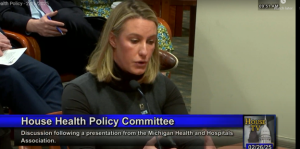
Elizabeth Kutter, senior director, government and political affairs, MHA testimony provided an overview of the 340B program in the House Health Policy Committee Feb. 26. 

The House Health Policy Committee also heard testimony on the importance of the 340B program in the state Feb. 26. Elizabeth Kutter, senior director, government and political affairs, MHA, provided an overview of the program, including examples of how the program benefits patients and communities across the state. Wilson and Frederick also testified, sharing how the program works for their hospital systems. The educational hearing enabled House Health Policy members to ask questions and engage in a constructive dialogue around the topic. The MHA continues to advocate for the 340B program and support Michigan hospitals’ efforts to expand access to quality, community-based care. Members are encouraged to use the MHA 340B Action Alert to contact their lawmakers in support of this legislation.

Lastly, Gov. Whitmer outlined her upcoming priorities to a joint convention of the Michigan Legislature in her State of the State address Feb. 26. One key highlight in her address included reducing medical debt for Michiganders. While no specific policies were discussed, she cited 700,000 Michiganders currently have medical debt and that legislators should work to find solutions for this issue going forward. In addition to this, the governor discussed working in a bipartisan fashion on issues like road funding, building affordable housing and lowering costs in the state.

Members with questions may contact Elizabeth Kutter at the MHA.


Earned Sick Time Act Officially Enacted

The Michigan Legislature held a late-night session Feb. 20 that ultimately led to amending the Earned Sick Time Act (ESTA) set to take effect at 12:01 a.m. on Feb. 21. Multiple amendments were made to House Bill 4002 before it passed the Senate with a bipartisan vote of 26-10 and received a concurrence approval vote from the House. The law is effective now, as it was granted immediate effect by the legislature, signed by Gov. Whitmer the morning of Feb. 21 and officially filed with the Office of the Great Seal.

While the new law may still present implementation challenges for hospitals, many positive changes were made, which include altering how much time must be provided by employers of various sizes and rewriting how employers must administer the law.

Important changes include:

  • Eliminating both the private right of action and the rebuttable presumption for terminated employees.
  • Explicitly allowing employers to provide all sick time hours frontloaded at the start of the year and exempting those employers from tracking accruals.
  • Allowing employers to designate paid time off as a combined paid time off/sick leave bank.
  • Requiring reporting for unforeseeable use of sick time by an employee as soon as practicable or in compliance with an employer’s policy on using sick time, if the employer notifies the employee of their policy in writing and the policy allows employees to provide notice after the employee is aware of the need to use sick time.
  • Refining the employee definition to exempt employees who are subject to policies that “allow the individual to schedule the individuals’ own working hours” and aren’t subject to a minimum number of hours per week.
  • Generally exempts salary and variable hour employees from the accrual methodology, but assumes full work weeks for those employees for the purposes of calculating earned sick time.
  • Clarifying that employers are not required to allow new employees to use their sick time within the first 120 days of employment.
  • Specifying that earned sick time is paid out at the “hourly wage or base wage” and excludes overtime, holiday pay, bonuses, commissions, etc. in the calculation.
  • Allowing employers to require reasonable documentation for earned sick time of more than three consecutive days, as well as requiring provision of the documentation within 15 days of the employer’s request.

All employers with 11 or more employees will now be required to provide 72 hours of paid time, with a 72-hour carryover cap from year to year. While media reports also include an exemption for nonprofits, the MHA is seeking clarity to understand how this may pertain to hospitals.

These positive changes were accomplished through the joint-efforts of a coalition of employers led by the Michigan Chamber of Commerce that included the MHA to support important changes to the ESTA prior to them going into effect on Feb. 21.

Unfortunately, the bill failed to address potential conflicts with federal employment laws, including the Family Medical Leave Act, the Americans with Disabilities Act and the Fair Labor Standards Act.

Members with questions about the legislation should contact Elizabeth Kutter at the MHA. Members with additional feedback about implementation may contact Nancy McKeague at the MHA.

Definitions

For the purposes of this update, important definitions from the bill include:

  • “Earned sick time” means time off from work that is provided by an employer to an employee, whether paid or unpaid, that can be used for the following purposes:
    • The employee’s mental or physical illness, injury or health condition, as well as diagnosis and treatment of such.
    • The employee’s family member’s mental or physical illness, injury or health condition, as well as diagnosis and treatment of such.
    • If the employee or employee’s family member is a victim of domestic violence or sexual assault and any care, services or legal proceedings for such circumstances.
    • Meetings at a child’s school or place of care related to the child’s health, disability or effects of domestic violence or sexual assault.
    • For the closure of an employee’s place of business due to a public health emergency.
  • “Employee” means an individual engaged in service to an employer in the business of the employer. Employee does not include any of the following:
    • An individual employed by the United States government.
    • An individual who works in accordance with the policy of an employer if both of the following conditions are met:
      • The policy allows the individual to schedule the individual’s own working hours.
      • The policy prohibits the employer from taking adverse personnel action against the individual if the individual does not scheduled a minimum number of working hours.
    • An unpaid trainee or unpaid intern.
    • An individual who is employed in accordance with the youth employment standards act.
  • “Employer” means any person, firm, business, educational institution, corporation, limited liability company, government entity or other entity that employs one or more individuals. Employer does not include the United States government.

103rd Legislature Begins With Introduction of Earned Sick Time Bills

The Michigan Legislature officially commenced their 103rd session on Wednesday, Jan. 8, including the introduction of legislation to amend Michigan’s Earned Sick Time Act . The session brings a new partisan divide with the Senate remaining under Democratic control, while the House Majority now shifts to Republican control.

Both chambers introduced legislation amending Michigan’s Earned Sick Time Act. House Bill 4002, introduced by Rep. Jay DeBoyer (R-Clay), and Senate Bill (SB) 6, introduced by Sen. Kevin Hertel (D-Saint Clair Shores), make separate clarifications to the voter initiative petition on earned sick time that is scheduled to go into effect Feb. 21, 2025.

The Earned Sick Time Act, as enacted PA 338 of 2018, applies to all employers and requires that an employee be provided one (1) hour of earned sick time for every 30 hours worked. That sick time may carry over year-to-year and allows increased usage of paid earned sick time for an employee of up to 72 hours per year. The MHA joined in a coalition of other business, employer and healthcare groups to call for legislative clarifications to the Earned Sick Time Act. The MHA will advocate for swift action to clarify the earned sick time policy through this legislation.

Legislation was also reintroduced in the Senate to establish a Prescription Drug Affordability Board in Michigan. SBs 3-5, led by Sen. Darrin Camilleri (D-Brownstown Township), would create the Prescription Drug Advisory Board (PDAB) and stakeholder council. The PDAB is charged with and intended to review drug costs, assess cost impacts on consumers and ultimately create opportunities for reducing consumer expenditures on drugs through the creation of upper payment limits (UPLs).

If the PDAB were to institute a UPL on a drug based on a review of the drug’s increased cost and impact on consumer access, a purchaser or payer would be prohibited from purchasing, billing or reimbursing above the set UPL. The MHA is reviewing and monitoring the legislation.

Members with questions may contact Elizabeth Kutter at the MHA.

MHA Monday Report Dec. 16, 2024

340B Hospital Protections Advance, Medical Liability Blocked During Busy Lame Duck

Various healthcare bills, including increased 340B protections for healthcare providers, received attention by the Michigan Legislature during the week of Dec. 9. Senate Bill 1179, sponsored by Sen. Sam Singh (D-East Lansing) and which …


mha advancing safe care awardNominations Open for 2025 Advancing Safe Care Award

The MHA is accepting nominations for its annual Advancing Safe Care Award to recognize Michigan hospitals that are tackling issues daily to make care safer and more dependable. Eligible nominees include teams from hospitals across the state …


MHA Keystone Center PSO to Host Structured Communications Safe Table

The MHA Keystone Center Patient Safety Organization (PSO) is facilitating a virtual safe table from 9:30 to 11 a.m., Thursday, Jan. 23. The Structured Communication Safe Table will be led by I-PASS Patient Safety Institute. …


MHA and Partners Host Section 1557 Webinar Addressing Language Services

The MHA hosted the Section 1557 Readiness Workshop Dec. 10 with MHA Endorsed Business Partner (EBP) AMN Language Services as part of the ongoing effort to advance the health of individuals and communities. This session …


Upcoming Opportunities to Learn, Network and Grow in 2025

In 2025, the MHA will host the second Human Resources Conference and welcome back the MHA Keystone Center’s Safety & Quality Symposium for the first time since 2019. Both events have been developed alongside MHA …


2025 MHA Healthcare Leadership Academy Approved for More Than 30 Credit Hours

The MHA is pleased to offer its popular Healthcare Leadership Academy in 2025. 32 credit hours are available for physicians, nurses and healthcare executives. In partnership with Executive Core and Grand Valley State University, two …


Keckley Report

In Healthcare, Most think We’re Shrewd and They’re Screwed

“The majority accept that operators in every sector of healthcare apply business practices intended to optimize their organization’s finances. Best practices for every insurer, hospital, drug/device manufacturer and medical practice include processes and procedures to maximize revenues, minimize costs and secure capital for growth/innovation. But in healthcare, the notion of profit remains problematic: how much is too much? and how an organization compensates its leaders for results beyond short-term revenue/margin improvement are questions of growing concern to a large and growing majority of consumers. …

The bottom line: the public is paying attention to business practices in healthcare. The death of Brian Thompson opened the floodgate for criticism of health insurers and the U.S. healthcare industry overall. It cannot be ignored. The public thinks industry folks are shrewd operators and they’re inclined to conclude they’re screwed as a result.”

Paul Keckley, Dec. 9, 2024


MHA CEO Brian Peters

MHA in the News

The MHA received media coverage the week of Dec. 9 on Senate Bill 1179, which would protect access to affordable prescription drugs and healthcare services through the 340B Prescription Drug Pricing Program. The bill was …

340B Hospital Protections Advance, Medical Liability Blocked During Busy Lame Duck

Various healthcare bills, including increased 340B protections for healthcare providers, received attention by the Michigan Legislature during the week of Dec. 9.

Senate Bill (SB) 1179, sponsored by Sen. Sam Singh (D-East Lansing) and which protects the 340B program in Michigan, saw extensive action during the week. It began with two MHA members providing testimony to the Senate Oversight Committee in support: Ben Frederick, associate vice president of advocacy and government relations, Memorial Healthcare; and Deidra Wilson, senior vice president, government relations and public policy, McLaren Health Care. The bill is vital for hospitals that serve vulnerable populations, helping them stretch scarce resources to care for more patients. SB 1179 safeguards the program, ensuring cost savings and preserving access to affordable healthcare services in both urban and rural Michigan communities. Further, this legislation adds first of its kind pharmaceutical manufacturer transparency requirements, making Michigan’s legislation the strongest in the nation.

During testimony, Frederick emphasized the impact the 340B program has in rural communities and shared a personal story of how 340B helped his father access palliative care following a terminal cancer diagnosis. Wilson highlighted how the 340B program supports cancer patients across the state by helping cover copays and providing access to essential transportation services. She also addressed how current restrictions hinder access to care for vulnerable populations, emphasizing that the program is centered on community, service and resource provision. She concluded her testimony by stating that the bill prioritizes the needs of Michigan patients and communities over the profits of pharmaceutical manufacturers.

Following successful reporting from committee, the full Senate took action on SB 1179. The MHA-supported legislation passed the full Senate 30-3 with overwhelming bipartisan support, reflecting the Senate’s commitment to protecting access to care and the 340B program.  The Senate opted to pair this legislation with SB 952, sponsored by Sen. Jonathan Lindsey (R-Allen), which requires hospital compliance with federal cost transparency laws

The bill now heads to the House of Representatives for approval before it can be sent to Gov. Whitmer’s desk. The MHA continues to advocate for the 340B program and support Michigan hospitals’ efforts to expand access to quality, community-based care. Members are encouraged to use the MHA 340B Action Alert to contact their lawmakers in support of the bill.

In other action this week, MHA-supported HB 5964, sponsored by Rep. Jennifer Conlin (D-Ann Arbor), overwhelmingly passed the House. This bill ensures Michigan’s continued membership in the Interstate Medical Licensure Compact, supporting the recruitment and retention of physicians. This MHA supported bill now heads to the Senate for approval.

House Bills (HBs) 5371 and 5372, sponsored by Rep. Felicia Brabec (D-Pittsfield Township) and Rep. Phil Green (R-Watertown Township), also passed the House and now head to the Senate for approval. HBs 5371 and 5372 add Certified Community Behavioral Health Clinics to the Social Welfare Act, enhancing access to behavioral health services in Michigan and aligning provider funding with federal payment policies.

The House also passed HB 4833, sponsored by Rep. Ranjeev Puri (D-Canton), which eliminates duplicative licensure requirements, reducing administrative burdens for hospitals, psychiatric hospitals, and licensed substance use disorder treatment providers. The MHA-supported bill now awaits action in the Senate.

HB 5833, sponsored by Rep. Kelly Breen (D-Novi), passed the House as well. This bill adds Michigan to the numerous other states that allow family members to step in and make medical decisions in alignment with a loved one’s wishes, if they are incapable. The MHA supports this bill, which will allow patients to receive timely care in the most appropriate setting.

The Michigan House, following an organized walkout by members of the Republican caucus, passed HB 5999, sponsored by Rep. Stephanie Young (D-Detroit). The legislation broadly prohibits the use of mandatory overtime for registered nurses in Michigan, with certain exceptions related to declarations of emergency, mass casualty events and ongoing patient procedures. The MHA, facing significant political headwinds, was able to secure several meaningful amendments related to staffing during unexpected and unpredicted staff absences and public health emergencies, and will continue to work with the Senate to ensure protection of both hospital team members and the patients they serve.

Lastly, SB 1158 (S-1) and HB 6085, which would reform Michigan’s medical liability laws, did not see any action by the full House or Senate. These bills would increase healthcare costs and hinder physician recruitment and retention in Michigan, worsening the critical shortages in primary care, obstetrics and gynecology, and behavioral and mental health providers. Creating a less supportive environment for physicians could further compromise patient care and access to essential healthcare services. The MHA strongly opposes these bills.

Members with questions should contact Elizabeth Kutter at the MHA.

Workforce Bills Highlight Healthcare Legislation Advanced in the State Legislature

Advocacy image tileSeveral workforce bills highlighted the healthcare legislation that advanced in the state legislature during the week of Nov. 11.

The Senate Appropriations Committee approved Senate Bills (SBs) 406 and 407, led by Sen. Sarah Anthony (D-Lansing). The bills provide the statutory changes to continue expanded eligibility for the Michigan Reconnect program. The legislation amends the Michigan Reconnect Grant Recipient Act to reduce the age of eligibility to receive Michigan Reconnect from 25 to 21. The MHA supports this legislation, as it will make it easier for Michigan residents to access high-demand healthcare credentials through the program. The legislation now awaits a vote from the full Senate.

The Michigan House passed House Bill 4224, sponsored by Rep. Julie Rogers (D-Kalamazoo). This legislation would repeal the onerous Medicaid work requirements that have been in statute for the last several years, although not officially enforced. The MHA supports the bill to clean up Michigan’s Medicaid statute to ensure that the program remains a sustainable safety net for those in need of health insurance. The legislation now advances to the Senate for their likely consideration by the Health Policy Committee.

The Senate Local Government committee also advanced SB 660, sponsored by Sen. Rosemary Bayer (D-Keego Harbor). The legislation would establish a process to allow local units of government to levy taxes on certain impermeable surfaces to fund projects related to stormwater control and runoff. The MHA opposes the legislation, as it removes the current requirement that such taxes must be approved by a vote of the people in the community and could increase costs for healthcare. The bill now advances to the full Senate.

Members with questions can reach out to Elizabeth Kutter.