
MHA Keystone Center PSO Launches SAFER Webinar Series

The MHA Keystone Center Patient Safety Organization (PSO), in partnership with EisnerAmper, is launching a new webinar series focused on the 2025 Safety Assurance Factors for Electronic Health Record Resilience (SAFER) guidelines. The free series will help healthcare professionals strengthen patient safety practices and implement artificial intelligence (AI) responsibly within clinical systems.

Participants must register in advance and will receive a Zoom link via email upon confirmation.

The three-part series includes the following sessions:

  • Navigating the Updated 2025 SAFER Assessment scheduled from 3 to 4 p.m. May 29. Dean Sittig, co-author of the SAFER Guides will highlight recent changes to the 2025 SAFER guidelines, including new recommendations for improving the safety and responsible use of AI in healthcare.
  • Deploying a Guided Risk and Safety Program to Protect Your Patients and Providers scheduled from 3 to 4 p.m. June 16. Presenters will outline how to leverage tools such as electronic health records and AI to mitigate risks in clinical workflows. The session will cover strategies for implementing effective governance structures, including control design, testing and continuous surveillance.
  • Adopting Safe AI scheduled from 1 to 2 p.m. July 24. This session will focus on managing the AI lifecycle in healthcare. Speakers will explore how to identify potential risks and opportunities, implement AI responsibly, and maintain oversight through governance and monitoring frameworks.

The series is designed to help participants understand the 2025 SAFER Assessment updates, identify and mitigate patient safety risks, and establish safeguards to support safe AI integration.

Series participants will gain an understanding of what the 2025 SAFER Assessment updates entail and how to run a program that identifies patient safety risk, mitigates controls and implements AI with the appropriate governance structure in place.

Arvid Kumar, managing director, EisenAmper, and Dean F. Sittig, PhD, co-author of the SAFER Guides Professor Emeritus at UTHealth School of Biomedical Informatics (SBMI), will facilitate this interactive event series.

Members with questions may contact the MHA Keystone Center.

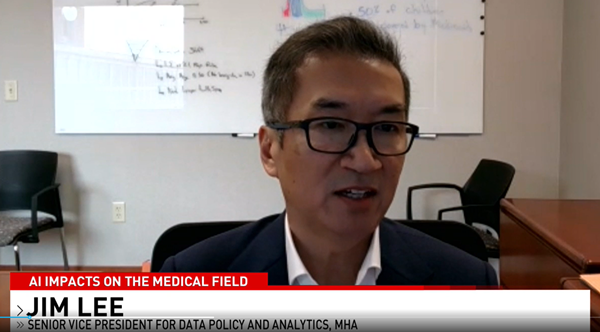
Lee Discusses AI in Healthcare

Jim Lee speaks with Mid-Michigan NOW about AI.

Jim Lee, senior vice president, data policy & analytics, MHA, appeared in a story about artificial intelligence (AI) in healthcare aired by Mid-Michigan NOW on April 23.

Lee discussed how AI is being used by hospitals and providers to assist with medical data and information and to reduce administrative burden.

“AI and healthcare is sort of like having a super smart assistant that helps doctors and nurses by quickly sorting through mountains of data and medical information,” said Lee.

Lansing political news outlet Gongwer also published two articles on April 23 that quote MHA representatives.

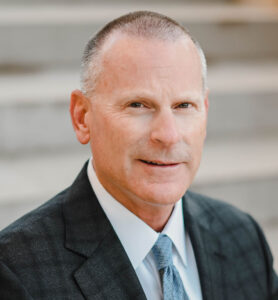
MHA CEO Brian Peters appeared in a story covering the newly launch Protect MI Care coalition to protect against Medicaid funding cuts.

“[Medicaid is] the financial lifeline that keeps hospitals, mental health providers and nursing homes open,” said Peters. “Cuts at this scale would lead to facility closures, creating health care deserts that hurt everyone, regardless of how they’re insured.”

MHA Chief Nursing Officer Amy Brown also appeared in an article following her testimony in the House Health Policy Committee in support of House Bill 4246, which would add Michigan to the nurse licensure compact.

“An important tactic to improve our ability as a state to attract talent and make it easy for nurses to choose Michigan to practice is to join the nurse license compact,” said Brown. “Hospitals continue to prioritize recruitment and retention efforts, but with the aging demographics of our state and the lack of participation in the compact hinder our ability to recruit younger nurses to replace the many nurses nearing and entering retirement.”

Members with any questions regarding media requests should contact John Karasinski at the MHA.

MHA Monday Report Nov. 4, 2024

Behavioral Health Bills Advance, Other Bills Discussed in State Legislature

Several bills impacting healthcare and hospitals were advanced through committees in the state Senate during the week of Oct. 28. The Senate Health Policy Committee unanimously approved Senate Bills (SB) 916 – 918, led by Sen. …


First Legislative Policy Panel Meeting of New Program Year

The MHA Legislative Policy Panel held their first meeting of the MHA program year at the MHA Capital Advocacy Center Oct. 30 to develop recommendations on legislative issues impacting Michigan hospitals. Chad Tuttle, SVP, clinical …


Strategic Planning Session Update with MHA Service Corporation Board

The MHA Service Corporation (MHASC) board met Oct. 24 to discuss healthcare market strategies to identify, diversify and grow solutions for MHA members and clients. The board retreat focused on how the MHASC can support …


Webinar Recap: Special Pathogen Response Systems of Care

The MHA hosted a webinar Oct. 23 overviewing the National Special Pathogen System (NSPS) of care. The NSPS is a tiered system with four facility levels that have increasing capabilities to care for suspected …


MHA Shares September Medicare and Medicaid Enrollment Analysis

The MHA updated its analysis of Medicaid and Medicare enrollment based on September 2024 data. The analysis includes program enrollment as a percentage of each county’s total population and the split between fee-for-service and …


Webinar Explores AI Policy and Strategy for Boards and Leaders

The MHA will host the webinar How Boards and Leaders Can Deploy AI Responsibly and Ethically, scheduled 4:30 – 6 p.m. ET, Dec. 3. The webinar will cover a framework to govern the approach, policies and procedures …


Keckley Report

Looking to 2025: The Stop-Gap Actions likely on Healthcare’s 8 Most Urgent Issues

“Last week, I wrote about three predictions for healthcare regardless of next week’s the election results:

  1. States will be the epicenter for healthcare legislation and regulation; federal initiatives will be substantially fewer.
  2. Large employers will take direct action to control their health costs.
  3. Private equity and strategic investors will capitalize on healthcare market conditions.

As these play out, eight major issues will get attention vis a vis stop-gap measures reflecting regulator and elected officials’ responsiveness to industry pressure and voter sentiment …

These issues are not new to healthcare: they’ve prompted endless symposia, sponsored white papers and discussion by trade associations, special interests and think tanks offering solutions beneficial to preserving their view of what’s needed. What’s new is the public’s distaste for the status quo in healthcare: in every major poll conducted since the pandemic, trust and confidence in the health system has been low and majorities have said the status quo is unsatisfactory.

Thus, stop-gap measures serve two purposes: they enable elected officials and government agency personnel to demonstrate responsiveness to important issues and they provide foundations for additional rules, laws and actions downstream. They’re a start.”

Paul Keckley, Oct. 28, 2024


News to Know

The general election is Tuesday, Nov. 5. Polls open at 7 a.m. and close at 8 p.m. Voters in line at 8 p.m. can still cast ballots. The MHA strongly encourages voter participation, knowing those …


MHA CEO Brian Peters

MHA in the News

Becker’s Hospital Review published an article Oct. 31 that includes responses from MHA CEO Brian Peters and other MHA members. Becker’s asked C-suite executives from hospitals and health systems across the U.S. to share their …

Webinar Explores AI Policy and Strategy for Boards and Leaders

The MHA will host the webinar How Boards and Leaders Can Deploy AI Responsibly and Ethically, scheduled 4:30 – 6 p.m. ET, Dec. 3. The webinar will cover a framework to govern the approach, policies and procedures around the responsible and safe use of AI.

The webinar will examine the importance of creating enterprise objectives, analyzing current infrastructure and budget constraints and establishing comfort in aggressively pursuing AI technology. The webinar will also outline federal and state AI regulations, as well as how a health system is structuring its AI Center for Excellence to guide AI opportunities and ensure guardrails are in place.

CEOs and governing board members are encouraged to attend the webinar, which is free of charge to MHA members. Questions about MHA membership or registration should be directed to Brenda Carr at the MHA.

MHA Webinar Explores Leadership Strategic Planning for AI

The MHA will host the webinar How Boards and Leaders Can Deploy AI Responsibly and Ethically, scheduled 4:30 – 6 p.m. ET, Dec. 3. The webinar will cover a framework to govern the approach, policies and procedures around the responsible and safe use of AI.

National and state experts will outline why anchoring AI strategies around value, risk tolerance and scalability are critical, the importance of monitoring regulatory AI guidance and requirements and being a strong advocate. Attendees will also review the findings of the MHA AI Task Force and its AI Framework for Healthcare.

CEOs and governing board members are encouraged to attend the webinar, which is free of charge to MHA members.

Questions about MHA membership or registration should be directed to Brenda Carr at the MHA.

MHA Monday Report Oct. 7, 2024

MHA Participates in Southwest Michigan Behavioral Health Healthcare Policy Forum
Southwest Michigan Behavioral Health hosted Oct. 4 the ninth annual regional healthcare policy forum in Kalamazoo. Moderated by Dr. Colleen Allen, CEO, Autism Alliance of Michigan, the forum focused on the theme of “Working Together” …


MHA Webinar Explores How Boards and Leaders Can Deploy AI Responsibly and Ethically

The MHA is hosting the webinar How Boards and Leaders Can Deploy AI Responsibly and Ethically, scheduled 4:30 – 6 p.m. ET Dec. 3 which features respected healthcare leaders in artificial intelligence (AI), healthcare operations …


Fall MI AIM Regional Training Events

The Michigan Alliance for Innovation on Maternal Health (MI AIM) is offering training events across Michigan for inpatient maternal healthcare providers. The events, scheduled from late October to November, will focus on using quality improvement …


MDHHS Releases Medicaid Doula Services Proposed Policy

The Michigan Department of Health and Human Services (MDHHS) recently released a proposed policy updating Medicaid coverage for doula services, effective Oct. 1, 2024. Key updates include increasing the number of covered doula visits to …


MHA Highlights Behavioral Health Priorities at Michigan Children and Families Summit

Lauren LaPine, senior director, legislative and public policy, MHA, participated in a discussion Oct. 3 in Grand Rapids during the Michigan Children and Families Summit hosted by the Steelcase Foundation. The summit explored the results …


MHA Race of the Week – U.S. Senate

The MHA’s Race of the Week series highlights the most pivotal statewide races for the 2024 General Election. The series will provide hospitals and healthcare advocates with the resources they …


MHA Rounds graphic of Brian PetersMHA CEO Report — Protecting Access to Care Through 340B

Protecting access to high quality, affordable healthcare for all Michiganders is a key tenet of the MHA. Stated simply, the 340B drug pricing program, created by Congress in 1992, is absolutely crucial to our member …


Keckley Report

Tax Exemptions for Not-for-Profit Hospitals: Are they Worth it?

It’s a question lots of folks inside and outside of healthcare are asking these days. …

The JAMA study did not focus on a ratio; instead, it focused on quantifying the amount of state and local exemptions that should be considered by policymakers in addition to their federal exemptions.  Notably, this study quantifies wide variation in which hospitals benefit most when local, state and federal exemptions are included and proposes that policies around NFP hospital tax exemptions be delegated in part to state and local determinations (as is already the case in at least 3 states). …

The Boards and leaders in each not-for-profit hospitals must account for the tax exemptions they currently enjoy and anticipate changes that limit them in the future. These studies point clearly to that inevitability. And each must answer this question for their organization objectively: are our tax exemptions truly worth it to the communities we serve, or simply a financial maneuver to use our money elsewhere?

Paul Keckley, Sept. 30, 2024


News to Know

Members looking to support hospitals impacted by Hurricane Helene can contribute to relief efforts through the North Carolina Disaster Relief Fund and the Tennessee Hospital Association Disaster Relief Fund.

MHA Webinar Explores How Boards and Leaders Can Deploy AI Responsibly and Ethically

The MHA is hosting the webinar How Boards and Leaders Can Deploy AI Responsibly and Ethically, scheduled 4:30 – 6 p.m. ET, Dec. 3 which features respected healthcare leaders in artificial intelligence (AI), healthcare operations and national and state policy. Registrants will learn about the importance of enterprise objectives, current infrastructure and budget constraints in pursuing AI technology, review an example of how to structure AI policies and ensure guardrails are in place. The webinar will also help attendees understand the importance of monitoring regulatory AI guidance and requirements, and being a strong advocate.

The webinar is being offered as traditional AI, such as robotic process automation, has already made its way into hospital operations. However, the speed of AI innovation will bring transformative changes, making it essential for leaders and governing board members to understand AI’s potential value, capabilities, limitations, risks and the outcomes it can drive.

CEOs and governing board members are encouraged to attend the webinar, which is free of charge to MHA members. Questions about MHA membership or registration should contact Brenda Carr at the MHA.

MHA Podcast Explores the Role of Artificial Intelligence (AI) in Healthcare

MiCare Champion Cast graphic featuring an episode focused on the role of Artificial Intelligence (AI) in Healthcare

The MHA released a new episode of the MiCare Champion Cast exploring the role artificial intelligence (AI) plays in healthcare today and what it will look like in the future. The episode features Bruce Brandes, president of Care.ai and Monica Holmes, a PhD candidate in bioinformatics at the University of Michigan and current member of the MHA AI Task Force.

Early in the discussion, Brandes and Holmes highlighted the ways smart technologies have been used for years when it comes to data analysis, disease diagnosis, radiology, clinical documentation, language processing and more.

“For the first time – maybe in my career in healthcare – it’s obvious that the status quo is no longer an acceptable option,” said Brandes, who has over 30 years of experience in executive management and entrepreneurial thought leadership. “This is real – you need to understand it, you need to be intentional and deliberate and have a strategic plan.”

Both Brandes and Holmes emphasized throughout the episode that AI cannot replace the essential role humans play in healthcare. The goal, in most cases, is to optimize a more efficient workflow, improve healthcare quality, advance diagnostics and enhance medical research.

“On the academic side, it’s improving our ability to do better research, which leads to better insights and ultimately better health outcomes for patients when it’s translated over to the bedside,” said Holmes, who also serves on the board of Trinity Health’s Chelsea Hospital as chair of patient quality and safety.

Listeners can expect to learn more about how patients and providers are responding to AI tools (including virtual nursing) and get answers to commonly asked questions related to transparency, health equity, regulation and cybersecurity.

Care.ai, an MHA endorsed business partner, powers more human care through the first and only AI-enabled Smart Care Facility Operating Platform, which deploys smart sensors throughout care facilities. These sensors continuously and ambiently monitor clinical and operational workflows, learning from them to predict, prevent and protect; alerting and engaging care teams in real-time and improving common challenges such as fall prevention, pressure injury prevention, hand hygiene compliance, rounding adherence, automated documentation, virtual rounding, virtual sitting and more.

The episode is available to stream on Spotify, Apple Podcasts, SoundCloud and YouTube. Those interested in learning more about Care.ai or the MHA EBP program can visit the business services webpage or contact Rob Wood at the MHA. Questions or idea submissions for future MiCare Champion Cast episodes can be sent to Lucy Ciaramitaro at the MHA.

Public Relations Professionals Gather at MHA Communications Retreat

MHA Events
Sue Tetzlaff, co-founder, Capstone Leadership Solutions; Emily R. Sexton, communications coordinator, Holland Hospital; Hannan Deep, director of strategic communications operations, Henry Ford Health; and Lauren Zakalik, director, public & media relations strategy, Henry Ford Health, during a panel discussion. 

The 2024 MHA Communications Retreat brought together nearly 100 communications, marketing and public relations professionals from MHA-member facilities May 7 to network and learn from peers across the state. Topics on the agenda included artificial intelligence (AI), behavioral health, the healthcare workforce and internal communications.

The event began with several speakers presenting on how they are using communications tools to assist in reacting to the behavioral health crisis. Speakers included Kara Gavin, lead public relations representative, Michigan Medicine; and research & policy media relations manager, U-M Institute for Healthcare Policy and Innovation; Jim Rose, director of marketing and communications, Pine Rest Christian Mental Health services; Dallas Rau, executive director, Great Lakes Bay Region Mental Health Partnership; and Tera Szeliga, director of marketing, communications and Institute for Leaders, Great Lakes Bay Regional Alliance.

A panel discussion was conducted discussing communications strategies to address the healthcare workforce and the importance of engaging with government relations and advocacy efforts. Angela Minicuci, APR, partner, Martin Waymire, moderated the panel comprised of Laura Appel, executive vice president of government relations and public policy, MHA, and Megan Brown, chief marketing and communications officer, Munson Healthcare. MHA CEO Brian Peters followed the panel with an update on the MHA strategic action priorities.

AI industry experts Joshua Wilda, chief digital and information officer, University of Michigan Health – Regional Network; and Tony Lambert chief technology officer, TechSmith, presented on the AI trends in healthcare and hospitals and how its impacting communications and marketing.

The event concluded with a topic focused on internal communications strategies hospitals can implement to celebrate their workforce and tactics they can use to address employee morale, support recruiting and improve brand perception. Each speaker shared strategies for different sized hospitals. Those speakers included Sue Tetzlaff, co-founder, Capstone Leadership Solutions; Emily R. Sexton, communications coordinator, Holland Hospital; Hannan Deep, director of strategic communications operations, Henry Ford Health; and Lauren Zakalik, director, public & media relations strategy, Henry Ford Health.

The event was sponsored by Martin Waymire and MHA Data Services, who attended the event and provided resources about their products and services. Photos from the event are available on the MHA Facebook page. For more information and resources from the event, contact John Karasinski at the MHA.

MHA Panelists Featured During 2024 State of Reform Health Policy Conference

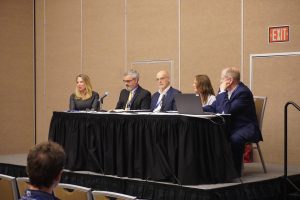
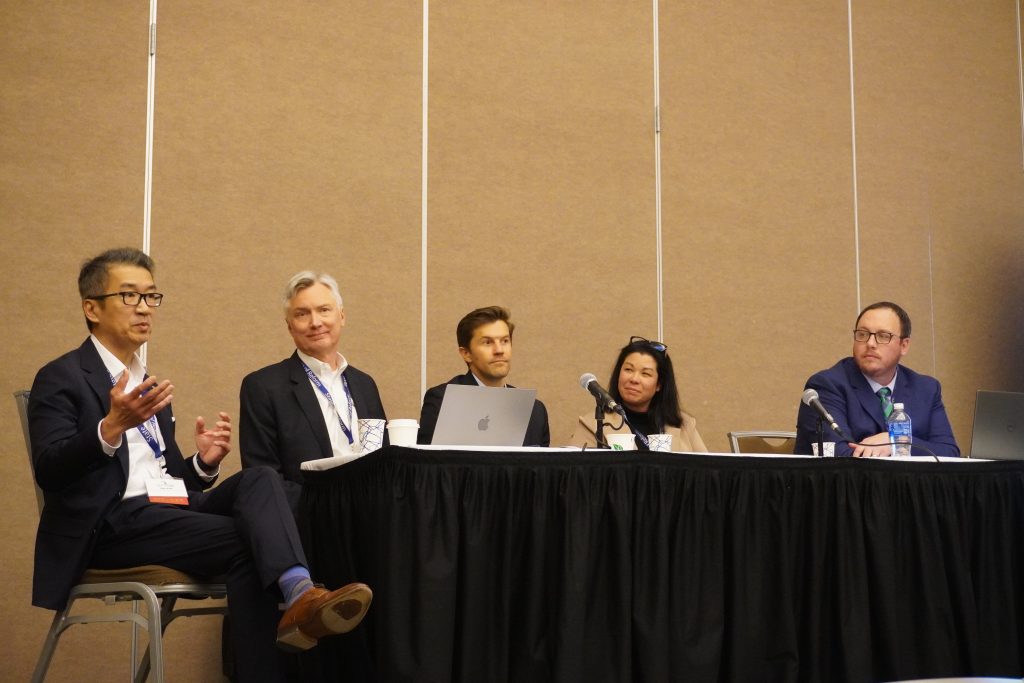
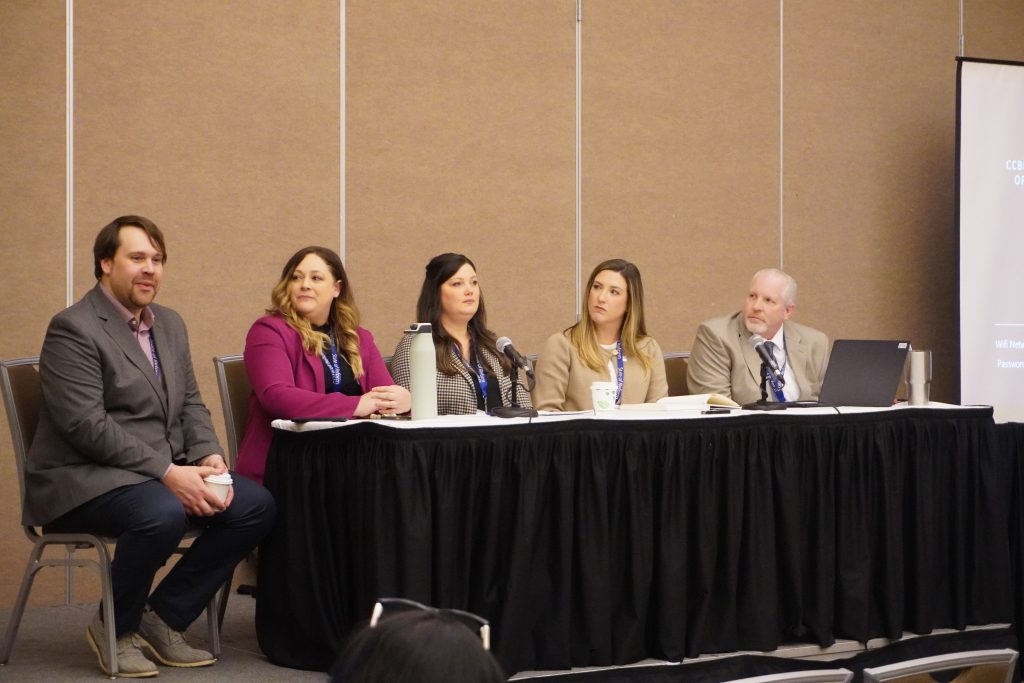
MHA staff participated in panel discussions April 4 during the 2024 State of Reform Health Policy Conference in Lansing, MI. MHA speakers included Laura Appel, executive vice president of government relations and public policy; Jim Lee, senior vice president, data policy & analytics; Adam Carlson, senior vice president, advocacy; and Lauren LaPine, senior director, legislative and public policy. Each provided valuable insight on the issues important to hospitals and the role of public policy in identifying solutions.

Topics of discussion included workforce shortages, artificial intelligence, depleted American Rescue Plan Act funding and certified community behavioral health clinics.

Other MHA members participating in the event included Tawana Nettles-Robinson, executive director, Detroit market, Trinity Health Michigan and Michelle Pena, MSN, RN, NEA-BC, chief nursing officer, Trinity Health Grand Rapids. Nettles-Robinson discussed health disparities while Pena focused on workplace violence. Seth Karnes, senior director of risk, consulting and training at HSS, an MHA Endorsed Business Partner, was a guest speaker on the workplace violence panel to share national insights and perspectives. Members may contact HSS to learn more about active violence training, risk assessments, de-escalation training and more.

Members with questions may contact John Karasinski at the MHA.