Continued Coverage on Baxter IV Solutions Shortage

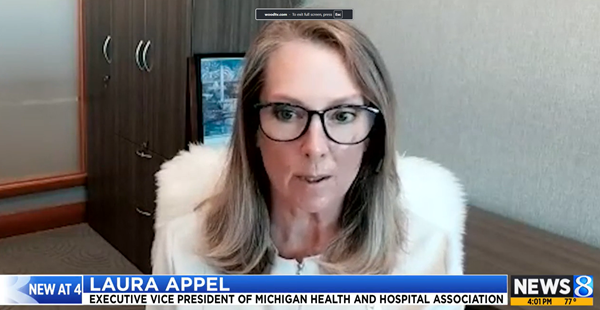
Laura Appel speaks with NBC25 about the Baxter IV solutions shortage.

The MHA continued to engage with media requests on the Baxter IV solutions shortage during the week of Oct. 14.

NBC25/Fox66 in Flint aired a story Oct. 16 on the shortage, which includes an interview with MHA Executive Vice President Laura Appel. She spoke to the current situation regarding reduced allocations from Baxter to hospitals and how hospitals are managing the shortage.

“Hospitals that use their services would get a smaller allocation than usual,” said Appel. “Many organizations sent out information on how to conserve solutions, how to use less of them all altogether and how to use them differently.”

Michigan Public also published a story Oct. 17 on the topic. The reporting includes sourcing to the MHA and quotes from an association spokesperson.

Members with any questions regarding media requests should contact John Karasinski at the MHA.

Headline Roundup: IV Solutions Shortage, Physician Retention & More

Laura Appel
Laura Appel
MHA EVP Laura Appel spoke with WJR, Michigan Public and WILX during the week of Oct. 7, 2024.

The MHA received media coverage the week of Oct. 7 that includes coverage on a potential national shortage of IV solutions products, physician retention and rural hospital funding.

The closure of a Baxter manufacturing facility in North Carolina due to Hurricane Helene led to several media stories, as the plant manufactures approximately 60% of the IV solutions used every day in the U.S.

Meanwhile, Bridge Michigan published a story looking at physician retention while Michigan Radio published a story on the recently signed Senate Bill 701, which eliminates the definition of “critical access hospital” and modifies the definition of “rural hospital.” It also raises the population limit to be considered a “rural hospital” to include counties with 195,000 people or less for the rural hospital funding pool.

Several MHA representatives participated in the news coverage, including Brian Peters, CEO; Laura Appel, executive vice president, government relations & public policy; Elizabeth Kutter, senior director, government & political affairs; and John Karasinski, senior director, communications.

Friday, Oct. 11

Thursday, Oct. 10

Wednesday, Oct. 9

Tuesday, Oct. 8

Monday, Oct. 7

Members with any questions regarding media requests should contact John Karasinski at the MHA.

MHA CEO Report — Protecting Access to Care Through 340B

MHA Rounds image of Brian Peters

“I alone cannot change the world, but I can cast a stone across the water to create many ripples.” Mother Teresa

MHA Rounds image of Brian PetersProtecting access to high quality, affordable healthcare for all Michiganders is a key tenet of the MHA. Stated simply, the 340B drug pricing program, created by Congress in 1992, is absolutely crucial to our member hospitals’ ability to maintain this access. And remarkably, since its inception to the current day, it has never required any state or federal taxpayer dollars.

One of my favorite elements of my MHA job is the opportunity to travel around the state and visit with the executives, clinicians and other important employees of our Michigan hospitals. I always ask the question: “What are your highest priorities and how can we help?” One of the most consistent answers for years has been: “We need to protect 340B.” Erosion or elimination of the program would quite literally mean the closure of key service lines, or even the hospital itself, in some cases.

At a time when drug prices are the most rapidly growing expense for hospitals, the 340B program has never been more important. It acts as a force multiplier, allowing hospitals to stretch incredibly scarce resources to provide high quality care for more patients in their communities, including our most vulnerable residents. The savings created from the ability to purchase certain prescription drugs at a discount enables hospitals to keep care in the community in various ways. Examples include funding free or heavily discounted prescription drugs for patients, trauma care, care for people with HIV/AIDs, behavioral health services, oncology clinics, nursing homes and treatment for substance use disorder.

It allows qualifying hospitals, particularly rural hospitals and those serving low-income patients, to deliver care and programming based on the needs of their individual communities. Many larger 340B hospitals are academic medical centers that care for the sickest and most complex patients. They establish arrangements with pharmacies outside of their immediate geographic area so patients who travel long distances to the hospital for specialized care can still access needed drugs at pharmacies near the patient’s home.

Unfortunately, prescription drug manufacturers are working to put arbitrary limits on the 340B program at the state and federal level and Michigan hospitals are at risk of losing their ability to provide affordable, accessible care to those in need. This comes at the same time when costs for new drugs launched by pharmaceutical companies rose by 35% from 2022 to 2023 and for the first time in history, the median price of a new drug is $300,000 – more than four times the median annual household income in the U.S. These attacks will make it more difficult to administer the 340B program and unnecessarily cut needed savings that could be invested in the community. These restrictions threaten access to care by risking the closure of birthing units, nursing homes and even critical access hospitals.

The MHA and Michigan hospitals are currently advocating for the passage of House Bill 5350 to counteract these attacks. The proposed legislation would help protect the 340B drug pricing program at the state level and the healthcare cost-savings generated for hospitals and the communities they serve. We highly encourage you to use our action alert to express the importance of the program to your lawmakers as the bill currently awaits passage out of the House Insurance and Financial Services committee.

Other harmful actions by manufacturers include Johnson & Johnson’s recent attempt to institute an unapproved rebate requirement for two drugs. The MHA opposed that proposal and we’re pleased to see that our advocacy with the Health Resources and Services Administration (HRSA) and our Congressional delegation, along with other hospitals and state hospital associations from across the country, influenced Johnson &  Johnson into discontinuing their pursuit of this unauthorized plan, after multiple HRSA notices of opposition.

This specific work is just the latest example of the MHA’s long-time strident advocacy at the state and federal level related to 340B. We have engaged in the state legislature, Congress, the courts and with our MHA Service Corporation Endorsed Business Partners, demonstrating just how impactful we know this program is.

The 340B program has helped to improve the health and wellness of individuals and communities for 30 years. It operates without any taxpayer-funded support and has positively impacted millions of lives. Attempts at eroding the program would not only harm hospitals, but more importantly patients and communities. As I have often said, the healthcare ecosystem is incredibly complex and there is rarely if ever a single silver bullet solution to any aspect of our challenges. But there is no doubt that the 340B program is one of those critically important stones that creates many positive ripples.

As always, I welcome your thoughts.

WJR’s Capital Report Focuses on Healthcare

MHA CEO Brian Peters

Detroit’s WJR 760 AM interviewed MHA CEO Brian Peters Sept. 22 for a segment on healthcare as part of “The Capital Report,” a new show focused on exploring issues happening within state politics and Michigan’s legislative landscape.

Peters spoke with host Guy Gordon on a variety of topics, including the 340B drug pricing program, proposed government mandated nurse staffing ratio legislation and maternal and infant health.

“We have always been supportive of public policy at both the state and federal level that limits the individual’s exposure to the high cost of healthcare,” said Peters. “If there are policies that can help ensure access to care, whether that be inpatient or outpatient hospital care, or access to prescription drugs, we support that.”

The 12-minute interview begins at the 10-minute mark of the show.

Members with any questions regarding media requests should contact John Karasinski at the MHA.

Media Recap: Michigan Healthcare Careers, Digital Health Trends

Laura Appel

Laura AppelThe MHA received media coverage the week of Sept. 16 regarding Michigan healthcare careers and what’s next for digital health.

Second Wave Michigan published a story Sept. 17 on healthcare careers and the existing healthcare workforce shortage. The story includes quotes from Laura Appel, executive vice president and government relations and public policy, MHA, about how shortages impact hospitals, the impact of state funding and the results of the MHA’s annual hospital workforce survey.

“We’re bouncing back. We’re on the rebound for sure,” said Appel. “But it’s going to require a lot of work and staying on top of things. It’s not a one-and-done situation where you work at it for one year and then it will all be fixed. Workforce shortage is a long-term situation, and it’s going to require long-term commitment.”

The story is part of the Yours, Mine, and Ours — Public Health series from Second Wave Media that highlights how Michigan’s public health agencies keep individuals healthy, safe and informed about issues impacting physical and mental health in communities, homes, workplaces and schools.

Becker’s Hospital Review published a story Sept. 20 featuring insight from hospital and health system executives across the U.S. on the future of new technology in healthcare.

“Advancements in artificial intelligence (AI) present many opportunities to improve the delivery of healthcare and reduce administrative burden,” said MHA CEO Brian Peters. “Our association created a member-wide task force to develop a framework for Michigan hospitals focused on the safe, ethical and equitable application of AI within healthcare. This framework includes clear guidance and model policies to help hospital policy makers manage the evolving impact of AI. While hospitals will vary in the implementation of AI and the resources they have available, this framework should help to ensure consistent application across the state so patients can continue to receive quality, accessible healthcare.”

Members with any questions regarding media requests should contact John Karasinski at the MHA.

MHA CEO Report — Site-Neutral Payment Policies: The Latest Threat to Patient Access

MHA Rounds graphic of Brian Peters

The worst form of inequality is to try to make unequal things equal.” Aristotle

MHA Rounds graphic of Brian PetersOperating a hospital has never been more challenging than it is today. At the most fundamental level, hospitals are small towns that operate 24/7, year-round, built around expert clinicians, as well as a wide variety of highly skilled employees in multiple disciplines. Collectively, they are tasked with the awesome responsibility of delivering a broad spectrum of high-quality healthcare services to everyone in their respective communities, regardless of their health or socio-economic status.

Our MHA Chief Medical Officer, Gary Roth, DO, often says “healthcare is everyone’s destiny.” He’s right: at some point, all of us – or our loved ones – will require the assistance of our healthcare system. And when that day comes, we as patients can and should expect that we have ready access to care. Michigan hospitals take that expectation very seriously, whether that comes in the form of physician recruitment, retention and call coverage, drug acquisition, facilities maintenance and expansion, or ensuring that the latest diagnostic and treatment technology is on-site.

Here is an economic reality: being prepared to care for anyone, for any diagnosis, at any time, creates high fixed costs. In classic business terminology, hospitals are “price takers” when it comes to government payers, because Medicaid and Medicare effectively tell hospitals what they will receive in reimbursement.

Against this backdrop, our field is currently facing a strong push at the federal level to prevent hospitals from receiving Medicare reimbursement at a level that appropriately recognizes the higher fixed and operational costs referenced above. Referred to as “site-neutral payments,” this policy would force hospitals to accept the same rates as those paid at other sites of care. This ignores the fact that the cost structures between the two settings are very different because hospitals go to great lengths to have the infrastructure in place to save lives every day. Non-hospital settings serve a very valuable but different role, and the reimbursement they receive today reflects those differences. In addition to being open 24/7/365 to all patients – including those with multiple comorbidities, and little or no health insurance coverage, hospitals must have redundant systems for energy and water so surgeries and other patient care can continue uninterrupted when the power goes out or other systems are compromised. Physician offices have no such requirements and don’t bear these costs.

Hospital outpatient departments also provide convenient access to care for the most vulnerable and medically complex patients. These settings are more likely to treat Medicare patients who have more chronic and severe conditions, have been recently hospitalized or in an emergency department and are dually eligible for Medicare and Medicaid. These patients are more expensive to care for and rely on hospital outpatient departments for their increased healthcare needs.

Implementing site-neutral payment policies would be detrimental to access to care for patients across Michigan and the country. If reimbursement is slashed across the board, hospitals will be forced to reduce their costs, which will come in the form of reduced hospital beds, service lines or even potentially hospital closures. This plan for inadequate payment can be particularly harmful for hospitals serving a high percentage of vulnerable patients, including rural hospitals. When a hospital closes services due to site-neutral payment policy, they will close to everyone, not just people covered under Medicare.

I was recently honored to be appointed to the American Hospital Association Board of Trustees and this issue is clearly a key focus of their advocacy work on Capitol Hill. The MHA is joining that effort by advocating with Michigan’s members of Congress, and our message is unambiguous: comparing hospitals with other sites of care is not comparing apples and oranges – it’s comparing apples and space shuttles. More importantly, reducing healthcare costs can’t come at the expense of reduced access to care.

As always, I welcome your thoughts.

Congresswoman Slotkin Introduces American Made Pharmaceuticals Act

MHA CEO Brian Peters

U.S. Representative Elissa Slotkin (D-MI) issued a press release Aug. 8 highlighting her introduction of the American Made Pharmaceuticals Acts that included a quote of support from MHA CEO Brian Peters. The bipartisan bill, introduced with U.S. Rep. Don Bacon (R-NE), would incentivize domestic production of critical medicines and help prevent drug shortages by securing the pharmaceutical supply chain. Its Senate companion is led by Sens. Tina Smith (D-MN) and Tom Cotton (R-AR).

“Drug shortages severely hamper a hospital’s ability to provide every patient with the best treatment,” said Peters. “We applaud Rep. Slotkin for leading on this important issue and introducing legislation that should increase domestic pharmaceutical manufacturing, strengthen our pharmaceutical supply chain and prevent future drug shortages.”

Members with any questions regarding media requests should contact John Karasinski at the MHA.

MHA CEO Report — A Program Year in Review

MHA Rounds graphic of Brian Peters

“Winning is not a sometime thing, it is an all the time thing. You don’t do things right once in a while…you do them right all the time.”  — Vince Lombardi

MHA Rounds image of Brian PetersI am pleased to share we just completed a successful MHA Annual Meeting, continuing a long-standing June tradition whereby we celebrate the conclusion of one MHA program year, and prepare for the next. Each program year is unique with the different challenges it presents. At this point five years ago, no one could have predicted how the emergence of COVID-19 would flip healthcare on its head and drastically alter the tactical objectives of our association. However, there is a constant: the MHA continues to rise to any challenge presented to us and we deliver results for our membership to improve the health and wellness of individuals and communities.

The 2023-2024 program year focused intensely on workforce, viability and behavioral health, while addressing the various “wildcard” issues that always come up. We were led with great wisdom and compassion by Shannon Striebich, president and CEO, Trinity Health Michigan, as our board chair. Due to Shannon’s commitment and leadership, the MHA accomplished numerous highly successful and impactful outcomes on behalf of our members.

One of the most significant challenges in this past year was the threat posed by government-mandated nurse staffing ratio legislation. This proposed policy had the potential to dramatically reduce access to care for individuals throughout the state. Our advocacy on the issue lasted throughout the entire year but was highlighted by an Advocacy Day we hosted in September that featured more than 150 hospital representatives, primarily consisting of nurse leaders, who came to the Capitol and conducted 118 meetings with lawmakers that day. Later in the year, the MHA successfully advocated our position at a committee hearing, where more than 60 supporters attended on very short notice to push back on false narratives and to support alternative nurse staffing solutions. As a result of our efforts, no committee votes have been scheduled, and momentum on this harmful legislation has been effectively stalled.

While we had to play defense against this harmful proposed legislation, the MHA spent the program year actively engaged in workforce development and efforts to grow the healthcare talent pipeline. The MHA worked with stakeholders to implement new funding designed to expand access to Bachelor of Science in Nursing degrees through partnerships between community colleges and four-year universities, while also engaged in partnerships with other organizations to promote healthcare careers, increase clinical faculty and nurse preceptors, address high turnover rates in rural areas and promote healthcare career options. We continued our award-winning healthcare career marketing campaign designed to attract future workers and also redeployed our annual hospital workforce survey that shows the efforts of Michigan hospitals to recruit, retain and train healthcare workers is making a real difference. Finally, we hired our first-ever chief nursing officer at the MHA, which is already strengthening our ties to the nursing community throughout the state.

The viability of hospitals was another key focus and was largely supported through our legislative advocacy work. MHA funding priorities continued to be protected in the state budget, which includes $163 million for graduate medical education, $45 million for traditional disproportionate share hospitals, $15 million through the rural access pool and an additional $8 million for the obstetrical stabilization fund. The fiscal year 2024 budget also included $60 million annually to support hospitals with Level I and II trauma centers and $34 million annually to support hospitals that provide inpatient psychiatric care. Besides state funding, the MHA protected Medicaid funding, medical liability, the 340B drug pricing program and certificate of need.

The MHA is also intricately involved in in addressing the behavioral health crisis plaguing our state and country. Expanding access to care is a key focus, which included the MHA administrating a $50 million grant program to expand access to pediatric inpatient behavioral health services. The Michigan Department of Health and Human Services (MDHHS) is a close partner in this work and the MHA participated in the MDHHS Advisory Committee on the creation of a psychiatric bed registry. The MHA launched a new member ED boarding survey to quantify the number of patients struggling with behavioral health access in the emergency department and the MHA is using this data when engaging with lawmakers, stakeholders and the public to explain the scope of the program. These learnings informed the creation of a four-bill package of legislation to address board-identified issues in the behavioral and mental health system, such as coverage parity and community mental health shortcomings.

Much of the work in the past year has focused on maternal and infant health and improving maternal health and birth outcomes. And I am pleased to share that our MHA Board of Trustees just approved the full slate of recommendations emanating from the MHA Community Access to Health Task Force, giving us the support to continue this important journey together.

And as usual, we effectively dealt with a long list of “wildcard” issues that emerged during the program year, including drug shortages, guardianship, infection control, patient transport, population growth and safety and quality. We also continued to strengthen our efforts related to the growing cybersecurity threat. Indeed, the Change Healthcare cyberattack was one of the largest and most impactful attacks ever seen and served as a clear reminder of the importance of our work in this space.

At our Annual Meeting, I spoke to our attendees about “the power of zero.” In the 2023-2024 program year, the following were true:

  • The number of Michigan acute care community hospitals and health systems that are not members of our association is zero. We have everyone at the table, which allows us to speak with one powerful, united voice.
  • We passed 39 MHA-supported bills through the state legislature that were enacted into law, with five more on their way to the governor for her signature. The number of MHA-opposed bills that made their way to the finish line was zero.
  • The MHA now has a full-time chief medical officer and a full-time chief nursing officer (as noted above). How many other state hospital associations can say this? Zero.
  • And most importantly, how many other associations – in any sector – are as relevant, as impactful, as mission-driven and successful as the MHA? I believe that number is zero.

I would like to recognize and thank our outstanding MHA Board of Trustees, our members, sponsors and business partners, but most of all, our incredible MHA staff for coming together to achieve such tremendous results for the patients and communities we collectively serve. I hope you will take the opportunity to celebrate these results with us.

As always, I welcome your thoughts.

Michigan Legislature Champions Healthcare Funding

The following statement can be attributed to Brian Peters, CEO of the Michigan Health & Hospital Association.

MHA CEO Brian PetersThe Michigan Legislature passed a state budget that champions crucial healthcare funding and protects access to vital healthcare services across Michigan communities.

The fiscal year 2025 state budget and fiscal year 2024 supplemental proposals continue funding pools that support rural and critical access hospitals, obstetrical services, the Healthy Michigan Plan and Michigan’s Medicaid populations. Each of these pools help maintain access to care for underserved populations throughout the state.

The budget also includes new funding to support peer recovery coaches in hospitals to enhance substance use disorder services. These individuals are specifically trained to provide advanced peer recovery support services and are proven to help patients overcome obstacles in their substance use disorder recovery. Michigan joins the more than 38 other states in supporting this model of providing needed care.

We look forward to Gov. Whitmer signing this budget, which protects access to care and ensures hospitals can continue to advance the health of individuals and communities.

340B and Mackinac Policy Conference Media Coverage

The MHA received media coverage the week of June 3 that includes coverage on the 340B drug pricing program and from the Mackinac Policy Conference on the healthcare workforce.

Michigan Advance published an article June 6 recapping the Michigan House Insurance and Financial Services Committee meeting June 5 on House Bill 5350, which would protect access to affordable prescription drugs and healthcare services through the 340B Prescription Drug Pricing Program. The article specifically references an infographic submitted to the committee by the MHA, which describes the value of the 340B program and how it supports vulnerable patients and the providers that care for them.

“[MHA] says the program allows hospitals flexibility to invest savings back into local healthcare needs through programs such as mobile health clinics, financial assistance programs for low-income patients, supporting high-cost lines of service needed within a community, or providing access to low-cost drugs.”

In addition, the article references the additional MHA-members who testified in support of the bill. MIRS and Gongwer also published stories on the testimony.

Ruthanne Sudderth, senior vice president and chief strategy officer, MHA.

Ruthanne Sudderth, senior vice president and chief strategy officer, MHA, also appeared in two podcast episodes published the week of June 3 that were recorded at the Detroit Regional Chamber’s Mackinac Policy Conference.

Sudderth joined Blue Cross Blue Shield of Michigan’s A Healthier Michigan podcast to speak about the long-standing partnership between BCBSM and the MHA on a variety of issues, including the history of the MHA Keystone Center and addressing healthcare workforce needs.

Sudderth appeared on The Michigan Opportunity as well, a podcast produced by the Michigan Economic Development Corporation, to discuss the healthcare workforce. Also appearing in the episode is Gov. Whitmer.

Members with any questions regarding media requests should contact John Karasinski at the MHA.