New PwC Report Warns of Rising Hospital Costs and Mounting Financial Pressure on U.S. Healthcare System

The Michigan Health & Hospital Association (MHA) is drawing attention to a new national report from PricewaterhouseCoopers (PwC) that outlines the severe financial challenges facing hospitals across the country that could soon jeopardize patient care if urgent policy action is not taken.

The report, Inflator: Hospital Costs, from Wages to Hospital Gowns, highlights the mounting pressures on hospitals due to surging costs, workforce shortages and skyrocketing demand for behavioral health services, all while proposed tax cuts and Medicaid funding reductions threaten to widen the gap between costs and revenue.

“This report confirms what hospitals in Michigan and across the country are living every day: skyrocketing costs, growing demand and shrinking margins,” said MHA CEO Brian Peters. “We cannot afford policies that slash Medicaid funding or shift more financial burden to hospitals and patients. Without sustainable support, hospitals – especially those in rural and underserved areas – face real threats of closure.”

Key findings from the PwC report include:

  • Hospital margins have plummeted, dropping from an average of 7% in 2019 to just 2.1% in 2024, with additional declines reported in early 2025.
  • Drug spending surged by $50 billion (11.4%) in 2024, more than double the increase seen in 2023, largely driven by high-cost therapeutics in chronic disease areas like oncology, obesity and diabetes.
  • Behavioral health claims soared, with inpatient claims increasing by 80% and outpatient claims by 40% over a two-year span, reflecting the intensifying behavioral health crisis.
  • Tariffs and supply chain challenges continue to drive up the cost of everyday medical supplies, compounding inflationary pressures.
  • Medicaid cuts and federal tax policies could force the closure of service lines at facilities that rely heavily on government payers, impacting access to care for all residents.

The report also outlines how hospitals are working to offset financial pressures by investing in revenue cycle improvements and value-based payment models. Still, the report emphasizes that system-wide stability will require collaboration between payers, providers, policymakers and employers, especially as rural hospitals face ongoing threats of closure.

The MHA is supporting Michigan hospitals facing these mounting challenges through the following actions:

  • Advocating to preserve and strengthen the federal 340B program, which enables hospitals to purchase outpatient medications at discounted rates, freeing up resources to serve low-income and uninsured patients.
  • Working with state policymakers to expand access to mental health and substance use treatment, reduce emergency department (ED) strain and support hospitals’ efforts to meet growing behavioral health needs. This includes Senate Bill 806, which expands the three-hour assessment responsibility by allowing clinically-qualified staff to conduct pre-admission screenings for behavioral health patients seeking care in the ED.
  • Leading efforts to expand the healthcare workforce pipeline through partnerships with post-secondary educators, awareness campaigns and recruitment and retention initiatives to help hospitals manage staffing costs while maintaining high-quality care.
  • Working to add Michigan to the Nurse Licensure Compact, allowing nurses to practice across state lines without the burden of obtaining additional licenses.
  • Advocating against Medicaid cuts and pushing for reimbursement rates that reflect the true cost of care, especially for safety net and rural hospitals that disproportionately rely on public payers.

The full report is available on the PwC website.
MHA Monday Report June 16, 2025

Nurse Licensure Compact Legislation Clears House, Next of Kin Bills Advance

Legislation on the Nurse Licensure Compact and next of kin designations advanced in the Michigan House during the week of June 9. House Bill 4246, sponsored by Rep. Phil Green (R-Millington), passed the full …


MHA Testifies on Hospital Cost Drivers in House Insurance Committee

The MHA testified before the Michigan House Insurance Committee June 11 on healthcare cost issues affecting hospitals and communities across the state. Laura Appel, executive vice president, government relations & public policy, MHA and Elizabeth …


MHA Testifies on IMLC in House Health Policy

The MHA testified in support of Senate Bill 303 during a hearing in the Michigan Senate Health Policy Committee June 11. The legislation would reinstate Michigan’s participation in the Interstate Medical Licensure Compact (IMLC). …


MDHHS Launches New Mental Health Framework

The Michigan Department of Health and Human Services (MDHHS) is launching a new approach to mental healthcare under Medicaid as part of its MIHealthyLife initiative. The “Mental Health Framework” is designed to make care …


MHA Keystone Center to Support CMS’ Quality Improvement Program

Superior Health Quality Alliance (Superior Health) has been selected as the Great Lakes Region’s Quality Improvement Organization (QIO) to support the Centers for Medicare & Medicaid Services’ (CMS) 13th Scope of Work. As a member …


MiHIN in Negotiations to Sell Velatura Stake, Refocus Efforts on Michigan

The Michigan Health Information Network Shared Services (MiHIN), the state’s health information exchange, recently announced it is in negotiations to sell its interest in Velatura Public Benefit Corporation to Capernaum Investments. Velatura was established by MiHIN …


HHS Replaces ACIP Members, Future Vaccine Policy Unclear

The U.S. Department of Health and Human Services (HHS) Secretary Robert F. Kennedy Jr. announced June 9 the removal of all 17 members of the Advisory Committee on Immunization Practices (ACIP). This independent body is comprised …


MHA Keystone Center PSO Hosts Cybersecurity and Regulatory Inspection Safe Table Events

The MHA Keystone Center Patient Safety Organization (PSO) hosted a safe table focused on Adapting Clinical Risk Management for Cybersecurity June 4 at the MHA Headquarters in Okemos. In partnership with MHA Endorsed Business Partner CyberForce|Q, the …


MHA Cybersecurity Communications Toolkit Available

A new MHA-member cybersecurity communications toolkit is now available to assist hospitals and health systems in preparing for and responding to a cyber incident. The available resources are focused on providing guidance in communicating with …


Keckley Report

The Hourly Workforce in Healthcare Deserves Attention

“Two government reports this week point to a familiar theme: healthcare employment is the backbone of the U.S. civilian workforce …

Arguably, their questions aren’t unique to hourly workers in healthcare: lower- and low-middle income employee cohorts in other industries feel the same. What’s unique to healthcare is the context: new technologies, new regulations, new transparency requirements, new ways of staffing and constant pressure to do more with less. Tension between workers and leaders in provider organizations is palpable—arguably more widespread than other industries in the economy. And human resource functions in these settings are understaffed and underfunded despite the mounting urgency of workforce issues since the pandemic. …

The hourly workforce in healthcare is important to its future. But most are worried about how to pay their bills at home and do a job with an uncertain future. These issues deserve attention.”

Paul Keckley, June 9, 2025


News to Know

MHA offices will be closed and no formal meetings will be scheduled June 19 in honor of Juneteenth.


MHA in the News

The MHA received news coverage during the week of June 9 that included local TV news stories on the Michigan House of Representatives passing a bill that would have the state join the National Nurse …

Nurse Licensure Compact Legislation Clears House, Next of Kin Bills Advance

Legislation on the Nurse Licensure Compact and next of kin designations advanced in the Michigan House during the week of June 9.

House Bill (HB) 4246, sponsored by Rep. Phil Green (R-Millington), passed the full House by a vote of 57-52 June 11. The bill would add Michigan to the Nurse Licensure Compact, allowing nurses to practice across state lines without the burden of obtaining additional licenses. For Michigan, joining the compact will help increase access to care, especially through telehealth services and support nurse recruitment and retention efforts. The MHA supports the legislation, which now heads to the Michigan Senate Regulatory Affairs Committee for consideration.

The House Judiciary Committee also approved HBs 4418 – 4419 June 11. The legislation, introduced by Reps. Jamie Thompson (R-Brownstown Township) and Angela Witwer (D-Delta Township), aims to reduce barriers in the process of designating a next of kin for patients who are unable to make their own medical decisions.

Lastly, Senate Bill (SB) 371, sponsored by Sen. Erika Geiss (D-Taylor), was introduced during the week of June 9. SB 371 prohibits commercial insurers from placing a cap on coverage provided for inpatient psychiatric stays for those experiencing a behavioral health crisis. The MHA is supportive of this legislation.

Members with additional questions should contact Elizabeth Kutter at the MHA.

MHA Testifies on Next of Kin Bills, Healthcare Legislation Advances

The MHA provided testimony to the House Judiciary Committee in support of next of kin care bills and healthcare legislation advanced during the week of June 2.

House Bills (HB) 4418 4419, introduced by Representatives Jamie Thompson (R-Brownstown Township) and Angela Witwer (D-Delta Township), seek to reduce barriers in the process of designating a next of kin to inform medical decisions for a patient who is unable to make those decisions themselves.

Image
Elizabeth Kutter, senior director, government & political affairs, MHA, provided testimony to the House Judiciary Committee in support of next of kin care legislation.

Currently, the process requires significant legal pursuit to obtain guardianship, which can be lengthy and places additional burdens on families during stressful scenarios. Elizabeth Kutter, senior director, government and political affairs, testified in support on behalf of the MHA. The bills now await a full vote in the House Judiciary Committee before advancing further.

HB 4277, sponsored by Rep. Matthew Bierlein (R-Vassar), unanimously passed the House Health Policy Committee June 4. HB 4277 removes certain questions pertaining to mental health for physicians applying and/or renewing their license. The MHA is supportive of the bill, which has moved to the House floor for a full chamber vote.

Lastly, HB 4246, sponsored by Rep. Phil Green (R-Millington), passed through the House Rules Committee June 5. HB 4246 adds Michigan to the Nurse Licensure Compact agreement and allows for nurses to practice in multiple states without the burden of applying for additional licenses. For Michigan, joining the compact will help increase access to care, especially through telehealth services and support nurse recruitment and retention efforts. The MHA continues to support this legislation as it advances in the legislature.

Members with additional questions should contact Elizabeth Kutter at the MHA.

Healthcare Legislation Advances in House, Senate

Numerous healthcare bills including the Nurse Licensure Compact, Interstate Medical Licensure Compact and the Michigan Department of Health & Human Services (MDHHS) budget advanced in the Michigan Legislature during the week of May 12.

House Bill (HB) 4246, sponsored by Rep. Phil Green (R-Millington), passed out of the House Health Policy Committee this week and will now move to the House Rules Committee for further consideration. HB 4246 adds Michigan to the Nurse Licensure Compact agreement and allows for nurses to practice in multiple states without the burden of applying for additional licenses. For Michigan, joining the Compact will help increase access to care, especially through telehealth services and support nurse recruitment and retention efforts. The MHA continues to support this legislation as it advances in the legislature.

Additionally, a bill to add Michigan back into the Interstate Medical Licensure Compact was introduced this week by Sen. Roger Hauck (R-Mount Pleasant). After formal introduction, Senate Bill (SB) 303 was sent to the Senate Health Policy Committee for further consideration. The MHA fully supports the re-enactment of Michigan in the Interstate Medical Licensure Compact agreement.

Lastly, the MDHHS Appropriations Budget for fiscal year 2025-26 passed through the full Senate chamber. No significant hospital changes were made in this final Senate budget iteration after the bill was previously reported out of its subcommittee. The MHA’s priorities, including funding for Medicaid, the rural and obstetrical stabilization pools, peer recovery coaches and maternal health, were maintained. The MHA will continue to support these funding proposals and advocate for more resources dedicated to behavioral health and access.

Members with questions should contact Elizabeth Kutter at the MHA.

Medicaid Remains Focus of Healthcare News Coverage

The MHA was successful in placing several news stories during the week of April 28 related to potential federal Medicaid funding cuts.

The Lansing State Journal published an op-ed from MHA CEO Brian Peters that was shared as part of the MHA’s participation in the Protect MI Care coalition that is urging members of Congress to protect Medicaid. The op-ed expressed the importance of Medicaid to Michigan’s healthcare system and the consequences to access to care for all Michiganders if significant funding cuts are implemented.

“The effects would ripple far beyond those who rely on Medicaid — every hospital, mental health clinic and nursing home that depends on Medicaid funding would feel the impact,” said Peters. “When facilities close, it’s not just Medicaid patients who lose out — it’s everyone in the community, regardless of what kind of insurance they have.”

MHA Executive Vice President Laura Appel also sat down with WILX News 10 on April 30 to discuss the potential funding cuts and appeared in a story published by Bridge on May 1 about the impact to rural providers.

“When we close intensive care for newborns, when we close labor and delivery units, they are closing for everyone,” said Appel to Bridge.

In other news, Crain’s Detroit Business published an article April 30 committee testimony on legislation that would have Michigan join the nurse licensure compact. MHA Chief Nursing Officer Amy Brown testified in support of the legislation and is quoted in the article.

“In addition to recruitment and coordination of care in our state’s border areas, joining the compact would positively benefit telehealth access,” said Brown. “Compact licensure means residents in Michigan can access more telehealth professionals in other compact states, increasing access points for our state’s residents.”

Appel also appeared on 760 WJR’s All Talk With Kevin Dietz on May 1 to discuss the compact.

Members with any questions regarding media requests should contact John Karasinski at the MHA.

MHA Monday Report April 28, 2025

MHA Testifies on Nurse Licensure Compact Bills, Senate Passes Prescription Drug Affordability Board and Momnibus Legislation

The House Health Policy heard testimony from the MHA in support of creating a nurse licensure compact and the Senate voted to establish a Prescription Drug Affordability Board in the state of Michigan during the …


GME Capitol Day Approaches May 21

The MHA is hosting the 2025 MHA Graduate Medical Education (GME) Capitol Day from 9 a.m. to 3:30 p.m. May 21 in Lansing. The event is an opportunity for Michigan’s physician residents from teaching hospitals and academic …


CMS Releases FY 2026 Proposed Rule for Inpatient Psychiatric Facilities

The Centers for Medicare & Medicaid Services (CMS) recently released a proposed rule to update the Medicare fee-for-service prospective payment system for inpatient psychiatric facilities for fiscal year (FY) 2026. Key provisions of the proposed rule include: Increasing the …


MHA Unemployment Compensation Program Receives Award for Outstanding Performance

The MHA Unemployment Compensation Program (UCP) was recognized by the National Association of State Workforce Agencies (NASWA) April 24 for the MHA UCP’s commitment to utilizing the NASWA’s nationwide, web-based system SIDES for receiving new claims and responding to …


CMS Releases FY 2026 Proposed Rule for Skilled Nursing Facilities

The CMS recently released a proposed rule to update the Medicare fee-for-service prospective payment system for skilled nursing facilities for fiscal year (FY) 2026. Key provisions of the proposed rule include: Increasing the per-diem …


Celebrate Patient Experience Week with Upcoming Webinars
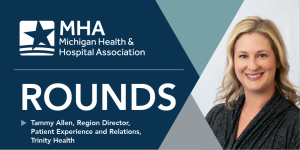
The MHA is offering ways for hospital staff to engage during Patient Experience Week (April 28-May 2), to support and amplify patient-centered care. The upcoming Patient and Family Engagement Improvement Sprint webinar series, hosted …


CMS Releases FY 2026 Proposed Rule for Inpatient Rehabilitation Facilities

The CMS recently released a proposed rule to update the Medicare fee-for-service prospective payment system for inpatient rehabilitation facilities for fiscal year (FY) 2026. Key provisions of the proposed rule include: Increasing the …


MHA Virtual Member Forum Focuses on Cyberattack Response

The MHA, in conjunction with its statewide Health Information Technology Strategy Committee, is hosting a cybersecurity and cyberattack response virtual member forum from 9:30 to 11 a.m. May 9. This free, members-only event features six …


The Power of Patient-Centered Care

It’s no secret that patient experience within hospitals and health systems has evolved over the years – especially following the COVID-19 pandemic. With Patient Experience Week (PX Week) around the corner, it’s a good time to recognize the …


Keckley Report

Tax Exempt Status for Not-for-Profit Hospitals: The Debate Ahead

“Tax exemptions for hospitals are not a new topic inside healthcare, but lately they’ve drawn outside attention from regulators and in media. They seem to be asking ‘Do not-for-profit hospitals deserve their tax breaks?’ …

Hospitals face a headwind, especially those that are tax-exempt. Every U.S. hospital is reeling from the uncertainty surrounding the Kennedy (HHS)-Oz (CMS)-Makary (FDA) trifecta that will regulate hospital affairs in the next few months. Every hospital is feeling heat from disgruntled physicians and worn-out frontline caregivers. Every hospital is worried about how tariffs will impact supply chain costs and all are taking a cautious approach to major capital projects. And all face increased pushback from state legislators who think price controls on hospitals might be the answer.

For Rick Pollack and team at the American Hospital Association, it’s not business as usual. The hospital big tent is under duress. And NFP tax exempt hospitals might be where it’s hottest. Large employers have targeted large NFP systems for cost reduction and Congress appears poised to impose restrictions on NFPs intended to rein-in what some consider excesses under the protection of tax-exempt status. …

Spending in healthcare at current levels is not sustainable. NFP system say the health of the communities they serve is their highest priority, though many limit their attention to lucrative services while neglecting others that might pay longer-term dividends in public health.

Utopian? Yes, but necessary. Actions not taken by NFP systems to demonstrate they deserve their tax exemptions is risky. And lack of will to adopt minimal standards will ultimately mean exemptions are linked to charity-care only.

In 2025 and beyond, tax exemptions for not-for-profit hospitals will garner attention. They’re not guaranteed and they’re under attack.”

Paul Keckley, April 21, 2025


New to KnowNews to Know

  • The MHA is issuing a request for proposal for a $2.5 million competitive grant program for Michigan healthcare entities to expand access to hospital-based peer recovery coach services.
  • Registration is now open for the MHA Annual Membership Meeting June 25 through 27 at the Grand Hotel on Mackinac Island. Members are encouraged to register by May 23 to attend this memorable event

Jim Lee speaks with Mid-Michigan NOW about AI.

MHA in the News

Jim Lee, senior vice president, data policy & analytics, MHA, appeared in a story about artificial intelligence (AI) in healthcare aired by Mid-Michigan NOW on April 23. Lee discussed how AI is being used by …

Lee Discusses AI in Healthcare

Jim Lee speaks with Mid-Michigan NOW about AI.

Jim Lee, senior vice president, data policy & analytics, MHA, appeared in a story about artificial intelligence (AI) in healthcare aired by Mid-Michigan NOW on April 23.

Lee discussed how AI is being used by hospitals and providers to assist with medical data and information and to reduce administrative burden.

“AI and healthcare is sort of like having a super smart assistant that helps doctors and nurses by quickly sorting through mountains of data and medical information,” said Lee.

Lansing political news outlet Gongwer also published two articles on April 23 that quote MHA representatives.

MHA CEO Brian Peters appeared in a story covering the newly launch Protect MI Care coalition to protect against Medicaid funding cuts.

“[Medicaid is] the financial lifeline that keeps hospitals, mental health providers and nursing homes open,” said Peters. “Cuts at this scale would lead to facility closures, creating health care deserts that hurt everyone, regardless of how they’re insured.”

MHA Chief Nursing Officer Amy Brown also appeared in an article following her testimony in the House Health Policy Committee in support of House Bill 4246, which would add Michigan to the nurse licensure compact.

“An important tactic to improve our ability as a state to attract talent and make it easy for nurses to choose Michigan to practice is to join the nurse license compact,” said Brown. “Hospitals continue to prioritize recruitment and retention efforts, but with the aging demographics of our state and the lack of participation in the compact hinder our ability to recruit younger nurses to replace the many nurses nearing and entering retirement.”

Members with any questions regarding media requests should contact John Karasinski at the MHA.