LaPine Discusses the Role of Hospitals in Crisis Care

Lauren LaPine

Lauren LaPineSecond Wave Michigan published a story Jan. 7 on how state officials, healthcare providers and community organizations are focusing on expanding the continuum of care for people experiencing a mental health crisis.

Lauren LaPine, senior director of legislative and public policy at the MHA, was interviewed in the story to share the role hospitals place in crisis care. She mentioned the high utilization of hospital emergency departments for people in a behavioral health crisis and the long wait times involved in finding the appropriate placement for the patient. LaPine also mentioned how the MHA is advocating for more resources that can support crisis intervention before hospitalization becomes necessary.

“We are working to build partnerships that can offer more specialized crisis care options,” said LaPine. “Similar to community paramedics initiatives, MDHHS [Michigan Department of Health and Human Services] has been committed to expanding access to mobile crisis units so when an individual is in some type of behavioral health crisis, there are mobile crisis units you can call through local community mental health agencies.”

Members with any questions regarding media requests should contact John Karasinski at the MHA.
Capitol News Outlets Cover 340B Legislation

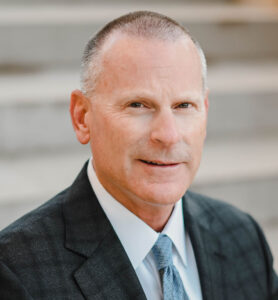
MHA CEO Brian Peters

The MHA received media coverage the week of Dec. 9 on Senate Bill 1179, which would protect access to affordable prescription drugs and healthcare services through the 340B Prescription Drug Pricing Program. The bill was reported out of the Senate Oversight Committee Dec. 11 and passed the full Senate Dec. 13.

Lansing political outlets MIRS and Gongwer both published stories Dec. 11 that included portions of a media statement issued by the MHA after SB 1179 moved out of committee. Additional stories were published by MIRS Dec. 12, Gongwer Dec. 13 and 340B Report Dec. 13 following the passage of SB 1179 by the full Senate.

“Michigan’s senators stood up to the out-of-state pharmaceutical interest groups and we applaud them for their efforts,” said Peters. “We now call on the Michigan House of Representatives to follow the Senate’s lead and get this bill over the finish line. Michiganders can’t afford to continue to have their healthcare services attacked to pad PhRMA balance sheets.

Outside of this week’s activity on 340B, the Becker’s Healthcare Podcast published an episode Dec. 12 with Peters that was recorded at the Becker’s Healthcare 12th Annual CEO + CFO Roundtable. Peters discusses the evolving challenges and opportunities in healthcare, including cybersecurity, the role of AI, workforce issues and the importance of community partnerships to address health equity.

Members with any questions regarding media requests should contact John Karasinski at the MHA.

MHA Continues to Offer Workplace Safety Posters

The MHA continues to offer workplace safety posters to MHA members at no cost to help hospitals comply with the requirement from Public Acts 271 and 272 of 2023 that hospitals display signage informing individuals they may be subject to higher financial penalties if they assault a healthcare worker or volunteer. Gov. Whitmer signed into law these MHA-supported public acts one year ago, which have been a positive step towards ensuring violence against healthcare workers is not tolerated.

Members can order the posters through an online order form on the MHA website. With the help of MHA Endorsed Business Partner AMN Healthcare Language Services, translated versions in Spanish and Arabic are also available.

The MHA continues to work on more opportunities to protect healthcare workers from violence in the workplace and improving the recruitment, retention and training of healthcare workers. Adding further protections for healthcare workers into statute will be a priority for the MHA during the next legislative session.

Members with questions about ordering workplace posters may contact John Karasinski at the MHA. Members with questions about legislative activity should contact Adam Carlson

MHA Opposes Staffing Ratios on WJR

MHA CEO Brian PetersMHA executives appeared on WJR 760 AM during the weeks of Nov. 25 and Dec. 2 to discuss the association’s opposition to government mandated nurse staffing ratios.

MHA CEO Brian Peters appeared on Focus with Paul W. Smith Nov. 26 while MHA Executive Vice President Laura Appel joined Guy Gordon, Lloyd Jackson and Jamie Edmonds Dec. 4 during the weekly Capital Report segment of WJR’s morning show.

Both Peters and Appel focused on House Bills 4550 – 4552, which would mandate one-size-fits-all nurse staffing ratios for all Michigan hospitals. The bills received a committee hearing Nov. 9 in the House Health Policy Committee and the interviews addressed how these bills remain the MHA’s top priority during the state’s legislative lame-duck session.

Laura AppelIf the bills did become law, Michigan communities would face the loss of important access to healthcare services, as up to 5,100 hospitals beds throughout the state would close.

More information about the proposed legislation is available on the Think it Through website.

Members with any questions regarding media requests should contact John Karasinski at the MHA.

Media Recap: Healthcare Workplace Violence Research & Community Mental Health

The MHA received media coverage the week of Nov. 21 on healthcare workplace violence research and the relationship between hospitals and community mental health organizations.

The Oakland Press published a story Nov. 18 on the new Healthcare Violence Reduction Center at Lawrence Technological University in Southfield, MI. The MHA Keystone Center is a founding partner of the center as it seeks to develop strategies to reduce violence, enhance safety and improve patient care.

MHA CEO Brian PetersMHA CEO Brian Peters was interviewed for the story, highlighting the importance of increased penalties for individuals who assault a healthcare worker.

“It occurs in small rural hospitals in the UP to big medical centers and everything in between,” said Peters. “We haven’t signaled to the public that it is not OK,” he said.

Second Wave Media also published an article Nov. 20 on the benefits of collaboration between Michigan hospitals and community mental health agencies.

Lauren LaPine“In Michigan, our hospital members work with community mental health agencies on a daily basis all the time to make sure that patients that come to the emergency department for behavioral health care are getting the care that they need, where and when they need it,” said Lauren LaPine, senior director of legislative and public policy, MHA.

LaPine discussed a state grant to expand inpatient site capacity statewide and provided examples from several hospitals across the state about how they’re using the funds. She also mentioned Senate Bill 806, which expands the three-hour assessment responsibility by allowing clinically qualified staff to conduct pre-admission screenings for a patient presenting in an emergency department.

Members with any questions regarding media requests should contact John Karasinski at the MHA.

Peters & Other Members Appear in Becker’s Hospital Review

MHA CEO Brian Peters

Becker’s Hospital Review published an article Oct. 31 that includes responses from MHA CEO Brian Peters and other MHA members.

Becker’s asked C-suite executives from hospitals and health systems across the U.S. to share their most beneficial partnerships in 2024.

Peters focused on the close partnerships established between the MHA, higher education and state government to address healthcare workforce job openings.

“Understanding the significant workforce challenges confronted by our member hospitals and health systems, we have partnered closely with the higher education community and state government to lift up healthcare as a career path for young people and mid-careerists, and to provide new programming and support for their educational journey,” said Peters. “We launched a new state-wide campaign featuring billboard, radio, and digital advertising, as well as a new website. These efforts have led to our hospitals’ success in filling over 60,000 open positions over the course of the last year.”

Additional MHA members who contributed to the article include:

  • Aiesha Ahmed, MD, vice president of population health, vice president and chief of neuroscience, Corewell Health West
  • Matthew E. Cox, CFO, Corewell Health
  • Theresa Dawson, DNP, MSN, RN, chief nursing officer, Oaklawn Hospital
  • Marschall S. Runge, MD, PhD., CEO, Michigan Medicine; executive vice president of Medical Affairs, University of Michigan

Members with any questions regarding media requests should contact John Karasinski at the MHA.

Media Recap: IV Solutions Shortage & Community Impact

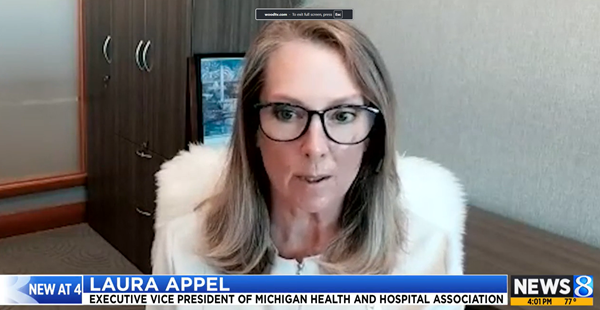
MHA EVP Laura Appel speaks with WOOD TV about the Baxter IV solutions shortage.

The MHA received media coverage the week of Oct. 21 regarding the Baxter IV solutions shortage and the impact hospitals have in their local communities.

WOOD TV aired a story Oct. 21 about the impact the Baxter IV solutions shortage is having on Michigan hospitals. The story includes quotes from Laura Appel, executive vice president and government relations and public policy, MHA, sharing updates on the situation and how hospitals are managing supply.

“I would say with few exceptions, I believe just about every health system in the state is doing what are called conservation measures,” said Appel.

The MHA is also featured in the October issue of FOCUS Magazine, the Lansing Regional Chamber of Commerce’s monthly business publication. The article, located on page 16, focuses on the role healthcare plays in the community, particularly as an employer, and includes quotes from MHA CEO Brian Peters.

“There’s no single answer,” said Peters about issues the MHA is focused on, including workforce shortages, greater behavioral health demands, workplace violence, health equity concerns and hospital viability. “These are obviously very complex issues, so the answers are multiple.”

Members with any questions regarding media requests should contact John Karasinski at the MHA.

Continued Coverage on Baxter IV Solutions Shortage

Laura Appel speaks with NBC25 about the Baxter IV solutions shortage.

The MHA continued to engage with media requests on the Baxter IV solutions shortage during the week of Oct. 14.

NBC25/Fox66 in Flint aired a story Oct. 16 on the shortage, which includes an interview with MHA Executive Vice President Laura Appel. She spoke to the current situation regarding reduced allocations from Baxter to hospitals and how hospitals are managing the shortage.

“Hospitals that use their services would get a smaller allocation than usual,” said Appel. “Many organizations sent out information on how to conserve solutions, how to use less of them all altogether and how to use them differently.”

Michigan Public also published a story Oct. 17 on the topic. The reporting includes sourcing to the MHA and quotes from an association spokesperson.

Members with any questions regarding media requests should contact John Karasinski at the MHA.

Headline Roundup: IV Solutions Shortage, Physician Retention & More

Laura Appel
Laura Appel
MHA EVP Laura Appel spoke with WJR, Michigan Public and WILX during the week of Oct. 7, 2024.

The MHA received media coverage the week of Oct. 7 that includes coverage on a potential national shortage of IV solutions products, physician retention and rural hospital funding.

The closure of a Baxter manufacturing facility in North Carolina due to Hurricane Helene led to several media stories, as the plant manufactures approximately 60% of the IV solutions used every day in the U.S.

Meanwhile, Bridge Michigan published a story looking at physician retention while Michigan Radio published a story on the recently signed Senate Bill 701, which eliminates the definition of “critical access hospital” and modifies the definition of “rural hospital.” It also raises the population limit to be considered a “rural hospital” to include counties with 195,000 people or less for the rural hospital funding pool.

Several MHA representatives participated in the news coverage, including Brian Peters, CEO; Laura Appel, executive vice president, government relations & public policy; Elizabeth Kutter, senior director, government & political affairs; and John Karasinski, senior director, communications.

Friday, Oct. 11

Thursday, Oct. 10

Wednesday, Oct. 9

Tuesday, Oct. 8

Monday, Oct. 7

Members with any questions regarding media requests should contact John Karasinski at the MHA.
WJR’s Capital Report Focuses on Healthcare

MHA CEO Brian Peters

Detroit’s WJR 760 AM interviewed MHA CEO Brian Peters Sept. 22 for a segment on healthcare as part of “The Capital Report,” a new show focused on exploring issues happening within state politics and Michigan’s legislative landscape.

Peters spoke with host Guy Gordon on a variety of topics, including the 340B drug pricing program, proposed government mandated nurse staffing ratio legislation and maternal and infant health.

“We have always been supportive of public policy at both the state and federal level that limits the individual’s exposure to the high cost of healthcare,” said Peters. “If there are policies that can help ensure access to care, whether that be inpatient or outpatient hospital care, or access to prescription drugs, we support that.”

The 12-minute interview begins at the 10-minute mark of the show.

Members with any questions regarding media requests should contact John Karasinski at the MHA.