News to Know – Oct. 28, 2024

New to Know
  • The general election is Tuesday, Nov. 5. Polls open at 7 a.m. and close at 8 p.m. Voters in line at 8 p.m. can still cast ballots. The MHA strongly encourages voter participation, knowing those elected will set the stage for critical healthcare policy decisions for Michigan and the nation in the years ahead. For more information, candidate info or election resources, visit the MHA Elections webpage.
  • MHA endorsed business partner HSS has officially rebranded as Tarian, following its acquisition in 2022. This change reflects Tarian’s commitment to enhancing its services and support for healthcare facilities across Michigan. The MHA assures members that Tarian’s Risk, Consulting, and Training (RCT) division will continue to provide essential services, including workplace violence training, active shooter training and risk assessments. These programs are vital in ensuring the safety and security of hospitals and their staff. Members interested in more information about offerings may contact Seth Karnes, senior director of RCT at Tarian. Members with questions about the Endorsed Business Partner program should visit the MHA’s Business Services page or contact Rob Wood at the MHA.

MHA CEO Report — Protecting Access to Care Through 340B

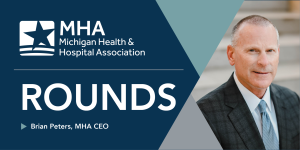
MHA Rounds image of Brian Peters

“I alone cannot change the world, but I can cast a stone across the water to create many ripples.” Mother Teresa

MHA Rounds image of Brian PetersProtecting access to high quality, affordable healthcare for all Michiganders is a key tenet of the MHA. Stated simply, the 340B drug pricing program, created by Congress in 1992, is absolutely crucial to our member hospitals’ ability to maintain this access. And remarkably, since its inception to the current day, it has never required any state or federal taxpayer dollars.

One of my favorite elements of my MHA job is the opportunity to travel around the state and visit with the executives, clinicians and other important employees of our Michigan hospitals. I always ask the question: “What are your highest priorities and how can we help?” One of the most consistent answers for years has been: “We need to protect 340B.” Erosion or elimination of the program would quite literally mean the closure of key service lines, or even the hospital itself, in some cases.

At a time when drug prices are the most rapidly growing expense for hospitals, the 340B program has never been more important. It acts as a force multiplier, allowing hospitals to stretch incredibly scarce resources to provide high quality care for more patients in their communities, including our most vulnerable residents. The savings created from the ability to purchase certain prescription drugs at a discount enables hospitals to keep care in the community in various ways. Examples include funding free or heavily discounted prescription drugs for patients, trauma care, care for people with HIV/AIDs, behavioral health services, oncology clinics, nursing homes and treatment for substance use disorder.

It allows qualifying hospitals, particularly rural hospitals and those serving low-income patients, to deliver care and programming based on the needs of their individual communities. Many larger 340B hospitals are academic medical centers that care for the sickest and most complex patients. They establish arrangements with pharmacies outside of their immediate geographic area so patients who travel long distances to the hospital for specialized care can still access needed drugs at pharmacies near the patient’s home.

Unfortunately, prescription drug manufacturers are working to put arbitrary limits on the 340B program at the state and federal level and Michigan hospitals are at risk of losing their ability to provide affordable, accessible care to those in need. This comes at the same time when costs for new drugs launched by pharmaceutical companies rose by 35% from 2022 to 2023 and for the first time in history, the median price of a new drug is $300,000 – more than four times the median annual household income in the U.S. These attacks will make it more difficult to administer the 340B program and unnecessarily cut needed savings that could be invested in the community. These restrictions threaten access to care by risking the closure of birthing units, nursing homes and even critical access hospitals.

The MHA and Michigan hospitals are currently advocating for the passage of House Bill 5350 to counteract these attacks. The proposed legislation would help protect the 340B drug pricing program at the state level and the healthcare cost-savings generated for hospitals and the communities they serve. We highly encourage you to use our action alert to express the importance of the program to your lawmakers as the bill currently awaits passage out of the House Insurance and Financial Services committee.

Other harmful actions by manufacturers include Johnson & Johnson’s recent attempt to institute an unapproved rebate requirement for two drugs. The MHA opposed that proposal and we’re pleased to see that our advocacy with the Health Resources and Services Administration (HRSA) and our Congressional delegation, along with other hospitals and state hospital associations from across the country, influenced Johnson &  Johnson into discontinuing their pursuit of this unauthorized plan, after multiple HRSA notices of opposition.

This specific work is just the latest example of the MHA’s long-time strident advocacy at the state and federal level related to 340B. We have engaged in the state legislature, Congress, the courts and with our MHA Service Corporation Endorsed Business Partners, demonstrating just how impactful we know this program is.

The 340B program has helped to improve the health and wellness of individuals and communities for 30 years. It operates without any taxpayer-funded support and has positively impacted millions of lives. Attempts at eroding the program would not only harm hospitals, but more importantly patients and communities. As I have often said, the healthcare ecosystem is incredibly complex and there is rarely if ever a single silver bullet solution to any aspect of our challenges. But there is no doubt that the 340B program is one of those critically important stones that creates many positive ripples.

As always, I welcome your thoughts.

Engaging Providers and Transforming Revenue and Quality Performance Simultaneously

The MHA’s Endorsed Business Partner (EBP) program promotes industry-leading firms and connects member hospitals to solutions that alleviate pain points. The MHA recently endorsed ModusOne Health, which is the only physician-founded and operated clinical diagnosis improvement company (CDxI®).

Providers play a critical role in documenting patient care, which directly impacts accurate reimbursement rates for healthcare organizations. However, many health systems have not fully appreciated the degree to which their quality scores can soar through physician-led provider engagement and improvement.

A CDI Executive Director for a major health system in the southeast recognized, high quality scores can be achieved with a dedicated focus upon educating providers, providing standards, and monitoring improvement. “Congrats [to ModusOne] because the work that you do helped get us here!”

This health system – spanning 17 inpatient hospitals and dozens of outpatient clinics – scored top marks on national quality ratings (including a nearly 70% reduction in the excess Length of Stay “LOS” days), while achieving its best financial performance.

The idea that health systems must choose financial gain or quality scores is a false paradigm. With an intelligent and targeted approach, financial success and quality optimization go hand-in-hand.  A physician leader in the Northwest, “I just wasn’t really sure you could engage [the providers], but we have now been consistently generating more revenue. We are very appreciative of the great work you all have done for us.” stated after seeing the combination of lower sepsis mortality and higher revenues.

For more information about ModusOne Health, members may contact Stephanie Patsalis at ModusOne. Members seeking information about the MHA’s EBP program may contact Rob Wood at the MHA.

MHA Podcast Explores the Role of Artificial Intelligence (AI) in Healthcare

MiCare Champion Cast graphic featuring an episode focused on the role of Artificial Intelligence (AI) in Healthcare

The MHA released a new episode of the MiCare Champion Cast exploring the role artificial intelligence (AI) plays in healthcare today and what it will look like in the future. The episode features Bruce Brandes, president of Care.ai and Monica Holmes, a PhD candidate in bioinformatics at the University of Michigan and current member of the MHA AI Task Force.

Early in the discussion, Brandes and Holmes highlighted the ways smart technologies have been used for years when it comes to data analysis, disease diagnosis, radiology, clinical documentation, language processing and more.

“For the first time – maybe in my career in healthcare – it’s obvious that the status quo is no longer an acceptable option,” said Brandes, who has over 30 years of experience in executive management and entrepreneurial thought leadership. “This is real – you need to understand it, you need to be intentional and deliberate and have a strategic plan.”

Both Brandes and Holmes emphasized throughout the episode that AI cannot replace the essential role humans play in healthcare. The goal, in most cases, is to optimize a more efficient workflow, improve healthcare quality, advance diagnostics and enhance medical research.

“On the academic side, it’s improving our ability to do better research, which leads to better insights and ultimately better health outcomes for patients when it’s translated over to the bedside,” said Holmes, who also serves on the board of Trinity Health’s Chelsea Hospital as chair of patient quality and safety.

Listeners can expect to learn more about how patients and providers are responding to AI tools (including virtual nursing) and get answers to commonly asked questions related to transparency, health equity, regulation and cybersecurity.

Care.ai, an MHA endorsed business partner, powers more human care through the first and only AI-enabled Smart Care Facility Operating Platform, which deploys smart sensors throughout care facilities. These sensors continuously and ambiently monitor clinical and operational workflows, learning from them to predict, prevent and protect; alerting and engaging care teams in real-time and improving common challenges such as fall prevention, pressure injury prevention, hand hygiene compliance, rounding adherence, automated documentation, virtual rounding, virtual sitting and more.

The episode is available to stream on Spotify, Apple Podcasts, SoundCloud and YouTube. Those interested in learning more about Care.ai or the MHA EBP program can visit the business services webpage or contact Rob Wood at the MHA. Questions or idea submissions for future MiCare Champion Cast episodes can be sent to Lucy Ciaramitaro at the MHA.

MHA Monday Report June 17, 2024

Cybersecurity Resources Available to Assist Rural Hospitals

The White House announced collaborative efforts June 10 aimed at strengthening cybersecurity for rural hospitals across the United States. Through this collaboration, Microsoft and Google announced a series of initiatives to provide free or discounted …


New Drug Linked to Overdose Deaths Across Michigan

The Michigan Department of Health and Human Services is warning Michigan residents and healthcare providers about medetomidine, a new drug identified in overdose deaths across the state. Medetomidine is a veterinary tranquilizer, similar to …


New Endorsed Business Partner Vault Verify Provides HR Data Solutions

The MHA’s Endorsed Business Partner (EBP) program promotes industry-leading firms. The EBP program connects member hospitals to solutions that alleviate pain points. The MHA recently endorsed Vault Verify, which is a leader in automated employment …


COMPACT Act Expands Emergent Suicide Care to Veterans

Effective January 2023, section 201 of the Veterans Comprehensive Prevention, Access to Care and Treatment (COMPACT) Act of 2020 allows eligible veterans to receive emergent suicide care in any Veterans Affairs (VA) or non-VA facility …


Protecting Community-based Care Through 340BMHA Rounds graphic, indicating thought leadership blog style post. Featuring Elizabeth Kutter pictured, woman with blonde hair smiling on the right.

Right now, a low-income patient in Northern Michigan is picking up a drug at a discounted price that they wouldn’t otherwise have access to. In another corner of the state, a cancer patient is receiving lifesaving treatment …


The Keckley Report

Can Medical Schools be Part of the Physician Discontent Solution?

“Friday, the House of Delegates of the American Medical Association began their Annual Meeting in Chicago where payment reforms will headline the meeting and resolutions to strengthen the profession voted on by the 1000 attendees. This meeting falls on the heels of welcome attention from Congress which seems sympathetic to physician pay issues as documented most recently in the Senate Finance Committee’s White Paper on Physician payment reforms. …

Modernizing medical school training to better prepare physicians for practice in the 21 century is needed in medical schools. As Deans are reducing lectures, implementing collaborative instructional methods, incorporating technology-enabled clinical decision support tools, expanding team-based learning experiences and expanding student exposure to non-hospital-based practice environments, resources should also be invested to prepare students to operate effectively as leaders and managers. …”

Paul Keckley, June 10, 2024


News to Know

  • MHA offices will be closed and no formal meetings will be scheduled June 19 in honor of Juneteenth.
  • The MHA is hosting office hours virtually from 2 to 3 p.m. every Thursday through June 27 to assist hospitals in completing an application for The Joint Commission’s Maternal Levels of Care  Verification.
  • MHA Endorsed Business Partner CorroHealth will host two free webinars for members to register.

MHA CEO Report — Moving the Workforce Needle

MHA Rounds image of Brian Peters

“Luck is not chance, it’s toil; fortune’s expensive smile is earned.” — Emily Dickinson

The healthcare workforce has been one of the MHA’s strategic action priorities for the past several years. As we near completion of our 2023-2024 program year, I’m extremely pleased to see the results of the MHA’s second annual hospital workforce survey, which shows Michigan hospitals are making real progress in reducing staffing shortages. Michigan hospitals hired more than 61,000 employees in 2023, including 13,000 nurses. Overall job vacancies were reduced by 29%, while nursing vacancies dropped by 44%. These gains are seen across nearly all job categories and they’re significant, with double-digit decreases for many of them. I can tell you with certainty: our “luck” in this regard has been earned through extremely hard work.

Michigan hospitals still have 19,000 job openings, including 4,700 for nurses, so more work and investment needs to be done. However, the accomplishments of Michigan hospitals in this area shows the recruitment, retention and training tactics implemented throughout the state are working.

It starts with retaining the existing workforce, which leads to improved morale and reduced recruiting expenses. Michigan hospitals are outperforming hospitals across the country when it comes to registered nurse retention. Michigan’s turnover rate is 3.7 percentage points lower than the national average. Offering better pay, improved benefits, flexible scheduling and integration of technology to improve patient monitoring and reduce the administrative burden on nurses are examples of tactics implemented by Michigan hospitals that are making a difference.

Michigan remains an aging state, and as more people become eligible for Medicare, the demand for healthcare services will continue to grow. In response, our hospitals are very serious about expanding the talent pipeline and increasing awareness of hospital careers to students. Hospitals are expanding educational opportunities and partnerships with higher education institutions to attract more students to healthcare, including clinical positions like nursing. The MHA is assisting by leading the MI Hospital Careers public awareness campaign that targets students and professionals considering a career change to consider healthcare as a great option.

The MHA also recently published the latest results from the Economic Impact of Healthcare in Michigan report, which shows the important role hospitals have in Michigan’s workforce and economy. Healthcare remains Michigan’s largest employer of direct, private-sector jobs. Hospitals provide the largest percentage of healthcare jobs in the state, employing 217,000 full-and part-time employees. Not only are these good-paying, stable jobs, but many offer career pathways that allow employees to further develop their skills and move up the job ladder with additional certifications and/or degrees. Many of Michigan’s communities also depend on their local hospital as one of, if not their very largest, employer.

These results led our conversations last week while a team of MHA staff attended the Detroit Regional Chamber’s annual Mackinac Policy Conference, connecting with business, higher education and political leaders throughout Michigan. In addition to this public announcement, we also produced a palm card and video for event attendees to highlight our work. Our goal is to increase the awareness of the large role hospitals play in the economy and the success they’re having in welcoming new talent to their organizations.

Reducing job vacancies and staffing shortages is a marathon and not a sprint. The Michigan Legislature has played a large part in assisting hospitals, whether it be through direct worker funding or new policies, such as increased penalties for violence committed against healthcare workers or allowing community colleges to offer Bachelor of Science in Nursing degree programs in collaboration with a four-year institution. The MHA is proud to help lead many of these discussions with policymakers to find more ways to reduce barriers to healthcare careers.

Public policy, advocacy and communications are key – but we are using every tool in our toolbox to address our workforce challenges. The MHA Endorsed Business Partner (EBP) program promotes industry-leading firms, carefully vetted by the MHA, that can meet the most pressing needs of our member hospitals and health systems, and we just announced a new endorsement of AMN Healthcare as a national leader in workforce solutions. The MHA has endorsed several of AMN’s legacy brands, including Merritt Hawkins, a physician search division, for many years. As AMN brings its solutions under one brand, we proudly continue this partnership with AMN Healthcare. They are the largest workforce solutions company in the market, which allows them to serve clients more effectively across all levels of healthcare.

Economic development and workforce are not just a one-year strategy. This will continue to remain a priority for hospitals and health systems, and we’re encouraged that at this time next year, we will have a similar story to tell in the reduced number of healthcare vacancies in the state. Until then, please join us and encourage as many people as you can to consider a job in healthcare. Make no mistake: whether clinical or non-clinical, healthcare is hard work; but it truly is one of the most rewarding, mission-driven careers you can pursue.

As always, I welcome your thoughts.

MHA Monday Report May 13, 2024

House Advancing Medicaid Budget Highlights Legislative Work

The Michigan House of Representatives advanced its state fiscal year 2025 Michigan Department of Health and Human Services budget recommendations during the week of May 5. Importantly, the chamber’s budget recommendation continues vital …


MHA EventsMHA Annual Membership Meeting Registration Deadline Approaching
The registration deadline is May 24 for the MHA Annual Membership Meeting June 26 through 28 at the Grand Hotel on Mackinac Island. The MHA Annual Membership Meeting is an opportunity to learn, network and …


Highly Pathogenic Avian Influenza Preparedness and Resources

News of Highly Pathogenic Avian Influenza H5N1, commonly referred to as bird flu, is spreading across the country with concerns for animal-to-human transmission. The MHA and its partners are monitoring the situation closely with …


Registration Open for Caregiver Engagement Webinar

The MHA Keystone Center is hosting the Identifying and Engaging Family Caregivers Webinar at 1 p.m., Thursday, June 6. The event, facilitated by RUSH University’s Center for Excellence in Aging, is free to MHA members. …


MHA EventsMHA and CyberForce|Q In-Person Cybersecurity Workshop

The MHA is partnering with Endorsed Business Partner CyberForce|Q to offer the in-person workshop Enhancing Your Cybersecurity: Tabletop Training and Incident Response Workshop from 9:00 a.m. to noon, May 22 at the MHA headquarters …


MHA EventsPublic Relations Professionals Gather at MHA Communications Retreat

The 2024 MHA Communications Retreat brought together nearly 100 communications, marketing and public relations professionals from MHA-member facilities May 7 to network and learn from peers across the state. Topics on the agenda included artificial …


MHA Hosts Successful Virtual Care Models Webinar

The MHA hosted nearly 100 healthcare staff in patient experience, nursing, quality and human resources roles May 2 during the webinar Virtual Care Models that Improve Engagement and Support Staff. Representatives from Henry Ford Health …


The Keckley Report

Is the Health System the Next Target for Campus Unrest?

“In my 4Q 2023 Keckley Poll, distinctions between the views of the college-age population and older adults about the health system were surprising: though college age adults use the health system less than others, they share a widespread belief it’s flawed and in need of fundamental change. They believe the profit in healthcare is more important than its caring and they’re open to government policies that might rein in its corporatization. …

The U.S. system is an unlikely target for campus unrest today but a likely target tomorrow. College student interaction with the health system is episodic: student health is a backstop for their bouts with depression, substance abuse, STIs, chronic conditions and accidents. Insurance and payment are concerns, and impressions from childhood household circumstances flavor their impressions of how the system operates. But what they’re seeing is key: the most heralded organizations in healthcare are associated with their size, financial success and the personal wealth of their executives. In college circles, Wall Street success seems more important than Main Street authenticity, transparency, environmental consciousness, fairness and humility. Like the majority of Americans, their views about the health system are anecdotal and regretfully negative. …”

Paul Keckley, May 6, 2024


News to Know

  • MHA Endorsed Business Partner Managed Care Advisory Group, Inc. provided an update on the Visa Mastercard class action settlement.
  • The MHA Keystone Center is partnering with the Michigan Regional Perinatal Quality Collaborative to offer an additional networking opportunity for members attending the Michigan Maternal & Infant Health Summit.
  • In partnership with the Michigan Department of Health and Human Services, the MHA Keystone Center developed a series of online learning modules for infection control and prevention education.

MHA CEO Brian PetersMHA in the News

U.S. Representative Haley Stevens (D-MI) issued a press release May 9 highlighting her introduction of the Stop Nurse Shortages Act that included a quote of support from MHA CEO Brian Peters. The bipartisan bill, introduced …

MHA and CyberForce|Q In-Person Cybersecurity Workshop

MHA Events

MHA EventsThe MHA is partnering with Endorsed Business Partner (EBP) CyberForce|Q to offer the in-person workshop Enhancing Your Cybersecurity: Tabletop Training and Incident Response Workshop from 9:00 a.m. to noon, May 22 at the MHA headquarters in Okemos. Led by Alex Sabin, participant success leader, CyberForce|Q , the workshop will guide participants through an engaging, informative and interactive Incident Response Tabletop Exercise.

Throughout the workshop, attendees will explore three critical phases of a simulated cyber-attack:

  1. Intricacies of social engineering aimed at the IT Help Desk.
  2. Complexities of living-off-the-land attacks.
  3. Challenges of detecting and preventing data exfiltration techniques.

By attending this workshop, attendees will:

  • Experience a sense of challenge during tabletop exercises, leading to the identification of potential unnoticed gaps in an Incident Response Plan.
  • Engage in hands-on group activities that will provide a tangible understanding of potential cyber-attacks, enabling collaborative discussions within teams to refine decision-making processes and procedures.
  • Gain a profound understanding of the critical significance of roles, responsibilities and communication protocols in effective incident response.

With over 25 years of experience in providing cybersecurity services, CyberForce|Q has developed and implemented quantifiable programs that assess and execute safety measures for organizations of all sizes, with proven results. Providing a wide range of services to a diverse group of industries, including hospitals and healthcare, CyberForce|Q meets organizations where they are in their cybersecurity journey. Its goal is to enhance the current capabilities of its partners, utilizing technology-agnostic solutions that can be integrated with an organization’s current technologies and systems.

The event is free of charge and open only to MHA member organizations and invitees. Members are encouraged to register, as this event will only be held in-person and seating is limited. Light breakfast and refreshments will be provided. Registrations will be accepted up to one day before the event date, if space is available.

Members with questions should Rob Wood at the MHA. To learn more about CyberForce|Q, contact John Kelley, regional sales director – Midwest, CyberForce|Q.

MHA Monday Report May 6 2024


Medical Residents Converge for GME Capitol Day
The MHA Graduate Medical Education (GME) Capitol Day welcomed more than 40 physician residents from a dozen member hospitals to the MHA Capitol Advocacy Center offices May 1 for a day of meetings with members …


Medicaid Budget Bills Advance, Other Health Issues Move Forward

The House and Senate appropriations committees advanced recommendations during the week of April 28 for the Department of Health and Human Services as a part of the state fiscal year 2025 budget. The MHA is …


The Rural 340B Access Act of 2024 Introduced in the U.S. House

The bipartisan Rural 340B Access Act of 2024 was introduced April 29 in the U.S. House of Representatives. Introduced by Reps. Jack Bergman (MI-01) and Debbie Dingell (MI-06), the legislation aims to enhance the Rural …


speak upCorewell Health William Beaumont University Hospital Nurse Receives Q1 MHA Keystone Center Speak-up! Award
The Michigan Health & Hospital Association Keystone Center celebrated Jennie Lynn, RN, at Corewell Health William Beaumont University Hospital, April 30 as its quarterly MHA Keystone Center Speak-up! Award recipient. The quarterly MHA Keystone …


Registration Open for Safe Table on Structured Communication Models

The MHA Keystone Center Patient Safety Organization is hosting the Structured Communication Hand-Off Safe Table from 12:30 to 4 p.m., Wednesday, June 12 at the MHA headquarters in Okemos, MI. The peer-led discussion about …


MHA Keystone Center Offers Infection Control & Prevention Online Courses

The MHA Keystone Center partnered with the Michigan Department of Health and Human Services to create a series of online learning modules for infection control and prevention education. The modules cater to the needs …


MHA Podcast Explores Healthcare Cybersecurity with Michigan Medicine

The MHA released a new episode of the MiCare Champion Cast exploring what happens when a hospital or health system experiences a cyberattack featuring Jack Kufahl, chief information security officer at Michigan Medicine. In his …


MHA CEO Report — Implementing Behavioral Health Solutions

Behavioral health is one of the four key strategic pillars for the MHA this program year. The MHA Board of Trustees tasked our association with prioritizing the issue and to identify solutions that can make a meaningful difference for patients and …


The Keckley Report

Four Implicit Messages to Healthcare in the FTC Non-Compete Rule

“Last Tuesday (April 23), the Federal Trade Commission (FTC) issued a 570-page final rule in a partisan 3-2 vote prohibiting employers from binding most American workers to post-employment non-competition agreements (the “Final Rule”): …

Odds are this rule will not become law anytime soon allowing healthcare organizations to consider alternatives to the non-competes they use. Work-arounds for protection of intellectual property, talent acquisition, employment agreements are likely as HR professionals, benefits and compensation consultancies huddle to consider what’s next. …

What’s clear is that the FTC and regulators in DC and many states are watching the industry closely and many aren’t buying what we’re selling.”

Paul Keckley, April 29, 2024


News to Know

The Michigan Department of Licensing and Regulatory Affairs, Bureau of Professional Licensing is seeking new expert witnesses to review standard of care investigation cases.


MHA CEO Brian PetersMHA in the News

The MHA received media coverage the week of April 28 that includes coverage on the national shortage of radiologists and radiology technicians, recently introduced bills at the federal level and rural hospital challenges. Below is …

MHA Monday Report April 26, 2024

MHA Member Testifies on Healthcare Legislation, Staffing Agency Bill Introduced

Hills and Dales Hospital President and CEO Andrew Daniels testified April 25 in the House Health Policy Committee on legislation removing timelines on disposal of sharps containers. Senate Bill 482, which was initiated by …


MDHHS Announces $10 Million Maternal Health Reimbursement Opportunity

The Michigan Department of Health and Human Services (MDHHS) announced April 22 its intention to reimburse Michigan birthing hospitals for committing to participate in The Joint Commission Maternal Levels of Care Verification Program and …


CMS Seeks Comments on Proposed Transforming Episode Accountability Model

The Centers for Medicare & Medicaid Services (CMS) included a proposal to create a new mandatory alternative payment model, the Transforming Episode Accountability Model, in the fiscal year 2025 hospital inpatient prospective payment system …


LEO Launches Second Round of Going Pro Talent Fund Grants

The Michigan Department of Labor and Economic Opportunities (LEO) recently opened the second round of Going Pro Talent Fund grants, which will distribute a portion of the $11 million remaining from the first round of …


MHA EventsFinal Reminder: Register Now for the 2024 Communications Retreat

It is not too late to register for the 2024 MHA Communications Retreat, scheduled from 8:30 a.m. to 4 p.m. May 7 at the Henry Center for Executive Development in Lansing. Members are encouraged to …


Requests for Information Required for SLCGP Grant

The Michigan Cybersecurity Planning Committee is requesting additional information from applicants who previously expressed an interest in participating in the Fiscal Year 2022 State and Local Cybersecurity Grant Program Funds (SLCGP). This program aims to …


CMS Releases FY 2025 LTCH PPS Proposed Rule

The Centers for Medicare & Medicaid Services (CMS) recently released a proposed rule to update the Medicare fee-for-service long-term care hospital (LTCH) prospective payment system (PPS) for fiscal year 2025. Specifically, the rule proposes: …


The Keckley Report

Hospitals declare War on Corporate Insurance: Handicapping the Players

“At the Annual Meeting of the American Hospital Association in DC last week, its all-out attack on “corporate insurance” was a prominent theme. In the meeting recap, AHA CEO Rick Pollack made the influential organization’s case:

“This year, there was special focus on educating policymakers that our health care system is suffering from multiple chronic conditions. These include continued government underpayment, cyberattacks, workforce shortages, broken supply chains, access to behavioral health, and irresponsible behavior by corporate commercial health insurance companies, among others — that put access to services in serious jeopardy.” …

This war has been simmering. It’s now a blaze. The outcome is uncertain despite the considerable resources both will spend to win.”

Paul Keckley, April 22, 2024


News to Know

MHA Endorsed Business Partner Medical Solutions is hosting a free webinar Empowering Rural Care: Dynamic Staffing Solutions and Retention Methods from noon – 1 p.m. ET May 8 with special guest, Patti Artley, chief nursing officer at Medical Solutions.