First Legislative Policy Panel Meeting of New Program Year

The MHA Legislative Policy Panel held its first meeting of the 2025-26 MHA program year at the MHA Capital Advocacy Center on Oct. 29 to develop recommendations on legislative issues impacting Michigan hospitals.

The meeting featured presentations from Tom George, MD and Pam Coffeey, MD, with the Michigan State Medical Society (MSMS), followed by Naila Russell, Michigan Council of Nurse Practitioners, and Bel Martin, American Association of Nurse Practitioners. The presenters discussed House Bill (HB) 4399 and Senate Bill 268, introduced by Rep. Dave Prestin and Sen. Jeff Irwin, respectively. The bills aim to update nurse practitioners’ scope of practice in the state.

Taylor Alpert, manager, government relations, MHA, led a discussion around HB 4920, which aims to reduce continuing education (CE) requirements for physicians licensed in Michigan.

The panel chose to act on two issues, making recommendations related to scope of practice and CE requirements. The first recommendation directs the MHA to remain an engaged participant and resource in ongoing scope of practice discussions, with a focus on ensuring access and quality of care for patients remains the highest priority. The second recommendation supports legislation that would reduce CE requirements in Michigan.

The panel also received updates on the federal government shutdown, state budget and the Rural Health Transformation Program.

For more information on the MHA Legislative Policy Panel, contact Adam Carlson at the MHA.

Media Recap: State Budget & Vaccines

The MHA received media coverage the week of Sept. 1 on the state budget and COVID-19 vaccines.

Several news outlets published stories related to the harmful impacts to healthcare found in the state budget bill passed by the Michigan House of Representatives.

Adam Carlson9&10 News aired a story Sept. 2 that includes an interview with Adam Carlson, senior vice president, advocacy, MHA, explaining the cuts found in the bill.

“It includes billions of dollars in cuts that impact things like maternal health care payments to physicians and all sorts of other healthcare related cuts that are completely unnecessary,” said Carlson.

The MHA issued a press release Sept. 3 sharing the House version of the budget endangers 20,000 hospital jobs and a $4.9 billion economic loss to the state. This led to a critical reaction from the House Speaker, resulting in stories from The Detroit News and Gongwer. A MHA media statement shared responding to the Speaker’s criticism was released that evening.

“We will not be bullied away from defending our patients. We remain steadfast in our commitment to protecting healthcare access throughout Michigan,” said Peters in the statement, that was included in the Gongwer story.

Lastly, Bridge published an article Sept. 4 providing information on how to access the COVID-19 vaccine. The MHA provided a comment for the story from Gary Roth, DO, chief medical officer, MHA.

“Our role is to support hospitals in their efforts to increase overall vaccination uptake and avoid the spread of vaccine preventable diseases, as the evidence is indisputable that vaccines are the best tool available to prevent severe illness and save lives,” said Roth.

Members with any questions regarding media requests should contact John Karasinski at the MHA.

MHA Monday Report June 16, 2025

Nurse Licensure Compact Legislation Clears House, Next of Kin Bills Advance

Legislation on the Nurse Licensure Compact and next of kin designations advanced in the Michigan House during the week of June 9. House Bill 4246, sponsored by Rep. Phil Green (R-Millington), passed the full …


MHA Testifies on Hospital Cost Drivers in House Insurance Committee

The MHA testified before the Michigan House Insurance Committee June 11 on healthcare cost issues affecting hospitals and communities across the state. Laura Appel, executive vice president, government relations & public policy, MHA and Elizabeth …


MHA Testifies on IMLC in House Health Policy

The MHA testified in support of Senate Bill 303 during a hearing in the Michigan Senate Health Policy Committee June 11. The legislation would reinstate Michigan’s participation in the Interstate Medical Licensure Compact (IMLC). …


MDHHS Launches New Mental Health Framework

The Michigan Department of Health and Human Services (MDHHS) is launching a new approach to mental healthcare under Medicaid as part of its MIHealthyLife initiative. The “Mental Health Framework” is designed to make care …


MHA Keystone Center to Support CMS’ Quality Improvement Program

Superior Health Quality Alliance (Superior Health) has been selected as the Great Lakes Region’s Quality Improvement Organization (QIO) to support the Centers for Medicare & Medicaid Services’ (CMS) 13th Scope of Work. As a member …


MiHIN in Negotiations to Sell Velatura Stake, Refocus Efforts on Michigan

The Michigan Health Information Network Shared Services (MiHIN), the state’s health information exchange, recently announced it is in negotiations to sell its interest in Velatura Public Benefit Corporation to Capernaum Investments. Velatura was established by MiHIN …


HHS Replaces ACIP Members, Future Vaccine Policy Unclear

The U.S. Department of Health and Human Services (HHS) Secretary Robert F. Kennedy Jr. announced June 9 the removal of all 17 members of the Advisory Committee on Immunization Practices (ACIP). This independent body is comprised …


MHA Keystone Center PSO Hosts Cybersecurity and Regulatory Inspection Safe Table Events

The MHA Keystone Center Patient Safety Organization (PSO) hosted a safe table focused on Adapting Clinical Risk Management for Cybersecurity June 4 at the MHA Headquarters in Okemos. In partnership with MHA Endorsed Business Partner CyberForce|Q, the …


MHA Cybersecurity Communications Toolkit Available

A new MHA-member cybersecurity communications toolkit is now available to assist hospitals and health systems in preparing for and responding to a cyber incident. The available resources are focused on providing guidance in communicating with …


Keckley Report

The Hourly Workforce in Healthcare Deserves Attention

“Two government reports this week point to a familiar theme: healthcare employment is the backbone of the U.S. civilian workforce …

Arguably, their questions aren’t unique to hourly workers in healthcare: lower- and low-middle income employee cohorts in other industries feel the same. What’s unique to healthcare is the context: new technologies, new regulations, new transparency requirements, new ways of staffing and constant pressure to do more with less. Tension between workers and leaders in provider organizations is palpable—arguably more widespread than other industries in the economy. And human resource functions in these settings are understaffed and underfunded despite the mounting urgency of workforce issues since the pandemic. …

The hourly workforce in healthcare is important to its future. But most are worried about how to pay their bills at home and do a job with an uncertain future. These issues deserve attention.”

Paul Keckley, June 9, 2025


News to Know

MHA offices will be closed and no formal meetings will be scheduled June 19 in honor of Juneteenth.


MHA in the News

The MHA received news coverage during the week of June 9 that included local TV news stories on the Michigan House of Representatives passing a bill that would have the state join the National Nurse …

MHA Testifies on IMLC in House Health Policy

The MHA testified in support of Senate Bill (SB) 303 during a hearing in the Michigan House Health Policy Committee June 11. The legislation would reinstate Michigan’s participation in the Interstate Medical Licensure Compact (IMLC).

Adam Carlson, senior vice president, advocacy, MHA, and Taylor Alpert, government relations manager, MHA, spoke to the importance of rejoining the compact, which allows physicians to more easily obtain licenses to practice across 40 other participating states. Carlson explained to the committee that Michigan has fallen out of the compact as of March 28, 2025, and urged lawmakers to act quickly to pass SB 303, sponsored by Sen. Roger Hauck (R-Mount Pleasant).

Alpert emphasized that without this legislation, Michigan physicians will lose the ability to efficiently obtain licensure in other compact states. This could limit their capacity to provide essential care through telehealth and in rural or border communities that serve patients across state lines. The MHA looks forward to the House Health Policy Committee voting on this legislation in the coming weeks.

Members with additional questions should contact Adam Carlson at the MHA.

Local TV News Coverage Focus on Nurse Compact & Medicaid Funding

The MHA received news coverage during the week of June 9 that included local TV news stories on the Michigan House of Representatives passing a bill that would have the state join the National Nurse Licensure Compact and how federal funding cuts to Medicaid would impact northern Michigan, while the MHA also responded to a hospital drug pricing study story by the Lansing State Journal.

Adam Carlson, senior vice president, advocacy, MHA, speaks with WILX News 10 about the current nurse shortage.

WILX News 10 aired a story June 12 following the 57-52 vote by the Michigan House to have Michigan join more than 40 other states in the nursing compact. Adam Carlson, senior vice president, advocacy, MHA, was interviewed for the story, discussing the current shortage of nurses in hospitals, despite Michigan outperforming the national average retention rate for nurses.

“14% of Michigan nurses are turning over, which is lower than the national average, so Michigan is already doing an above-average job and doing a better job than most other states,” said Carlson. “It’s about trying to find those new ones and bring those new ones in.”

9&10 News also aired a story June 9 about how proposed Medicaid cuts could result in the loss of OB/GYN services in northern Michigan. MHA Executive Vice President Laura Appel spoke to 9&10 News about how having to travel to access healthcare services can impact long-term health.

“You’re traveling a greater distance for any problems you have, and the further that people have to travel, especially people with limited means, the less likely they are to be able to adhere to the best care plan that we might have for them,” said Appel.

The Lansing State Journal also published an article June 9 on a study released by the Michigan Health Purchasers Coalition (MIHPC) related to hospital drug pricing. The MIHPC published their report despite published studies by KFF that conclude price transparency data should not be used to draw broad conclusions about hospital pricing. Appel was interviewed for the piece, expressing the inability to verify the information from the MIHPC, the flaws associated with how they present inpatient drug prices for drugs predominantly administered in an outpatient setting and the lengths hospitals are going to minimize costs.

“Payers are trying to do what they can to keep costs down,” said Appel. “Hospitals are trying to do what they can to keep costs down. Patients are trying to do what they can to keep their out-of-pocket costs down. Everybody’s trying to pull the boat in the same direction, but there are just outside pressures that make our healthcare system somewhat costly and growing. And hopefully we can keep the growth at a minimum, but it takes a lot of effort.”

Lastly, Gongwer published an article June 13 following a press release issued by Gov. Whitmer on a memo from the Michigan Department of Insurance and Financial Services sharing 120,000 Michiganders could lose healthcare access if the Federal budget reconciliation legislation passed by U.S. House of Representatives is signed into law. MHA CEO Brian Peters is quoted in the press release and story.

“These proposed changes will cut healthcare coverage for countless individuals, making Michigan unhealthier and leading to worse outcomes and higher rates of uncompensated care,” said Peters. “Increasing health care costs and reducing access is a bad deal that Michigan hospitals uniformly oppose.”

Members with any questions regarding media requests should contact John Karasinski at the MHA.

MHA Provides Powerful Testimony on Federal Threats to Medicaid

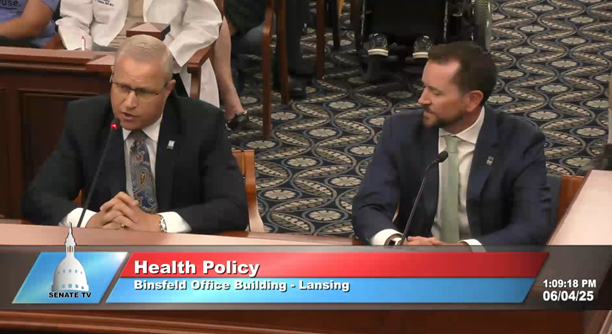
The Senate Health Policy Committee held a nearly two-hour hearing June 4 on federal threats to Medicaid.

The Senate Health Policy Committee heard from several healthcare stakeholders and members of the Protect MI Care Coalition on the potential impacts of federal Medicaid cuts. Adam Carlson, senior vice president, advocacy, MHA and JJ Hodshire, president and CEO, Hillsdale Hospital, testified on behalf of the MHA to discuss key impacts for hospitals and communities if currently proposed cuts to Medicaid are fully passed by Congress.

Image
Adam Carlson, senior vice president, advocacy, MHA, and JJ Hodshire, president and CEO, Hillsdale Hospital, testified on behalf of the MHA to discuss key impacts of federal Medicaid cuts.

Carlson shared how the reconciliation package passed by the U.S. House of Representatives will result in more than 13 million people losing their healthcare coverage. Other restrictions in the legislation will reduce state revenues that help fund Medicaid and have been in place for years. Carlson noted that Medicaid is vital for continued access to healthcare for all Michiganders, not just those covered by Medicaid.

Hodshire spoke about the impact to rural communities. Medicaid recipients in rural counties are essential to keeping hospital doors open because they make up nearly 40% of patient volume. Hodshire spoke about how Medicaid helps enrollees get and keep jobs and how the state’s Healthy Michigan program reduces the uninsured rate and supports economic stability. Hospitals are often the largest employer in rural areas, as it was emphasized that cuts to Medicaid could result in hospitals closing units like labor and delivery or psychiatric, or in some cases – closing their doors completely. Hodshire made it clear that making cuts to Medicaid at the federal level would be devastating for rural patients, hospitals and communities.

Members with questions regarding Medicaid may contact Adam Carlson at the MHA.

Mental Health Awareness Month Highlights Week of Media Coverage

Lauren LaPine

The MHA received news coverage during the week of May 19 highlighted by stories related to Mental Health Awareness Month and the need to expand state psychiatric bed capacity.

Lauren LaPine, senior director, legislative and public policy, MHA, speaks during a May 21 press conference on Mental Health Awareness Month, addressing long emergency department waits for psychiatric beds among Medicaid patients.

Lauren LaPine, senior director, legislative and public policy, MHA, joined state lawmakers and University of Michigan Health-Sparrow clinicians during a press conference May 21 about Mental Health Awareness Month. LaPine focused her comments on the high number of patients waiting in emergency departments across the state for an inpatient psychiatric bed. Many of these patients are Medicaid beneficiaries and experience further delays awaiting a clinical assessment.

WILX News 10 and WLNS 6 News attended the press event and aired stories during their evening news broadcasts.

“Last year, for over 18 months, we collected data from our hospitals and health systems that told us that on any given day, there are more than 155 patients that are stuck in emergency departments across the state that are looking for behavioral health services,” said LaPine.

Other speakers included:

  • Chandu Vemuri, MD, chief medical officer, University of Michigan Health-Sparrow
  • Dominic Barberio, MD, psychiatrist, University of Michigan Health-Sparrow
  • Rep. Angela Witwer (D-Delta Township)
  • Rep. Matthew Bierlein (R-Vassar)

The MHA also provided comment to several stories related to a hospital drug pricing study released by the Michigan Health Purchasers Coalition. The study uses a limited data set of claims data in an attempt to show pricing variances across hospitals for three prescription drugs. MHA Executive Vice President spoke with Crain’s Grand Rapids and WLNS News 6, explaining the differences between hospital charges and what hospitals actually receive as reimbursement, as well as the myriad of factors that determine hospital financing, including legacy contract agreements, mergers and acquisitions, the presence of group purchasing agreements, patient acuity, and labor and overhead costs.

“There are a lot of drugs out there. Picking and choosing a few of them probably doesn’t tell the whole story about the expensive pharmaceuticals in our health care system,” said Appel to Crain’s. “Everybody in the system is trying to do their best. There’s lots of room for improvement, but I don’t think identifying a few items and saying, ‘look at this’ is a way to get us to solving some of the affordability needs that we have for our system for patients.”

Adam Carlson speaks at a Protect MI Care press conference.

Adam Carlson, senior vice president, advocacy, MHA, also spoke at a Protect MI Care coalition press conference May 21 in Lansing about federal Medicaid cuts. Carlson was quoted in an article by Gongwer discussing how the cuts will impact all Michigan residents.

“It’s going to lead to millions of people losing their health insurance coverage, and these funding cuts to Medicaid, they’ll impact access to care for all Michiganders, not just those with Medicaid as their insurance coverage,” said Carlson. “It’s an important program across all state hospitals, but especially for the 65 rural hospitals that depend on it to keep their doors open.”

Members with any questions regarding media requests should contact John Karasinski at the MHA.


MHA Testifies in House Oversight Subcommittee, IMLC and AOT Legislation Passes Senate

The MHA provided testimony May 21 to the House Oversight Subcommittee on Public Health & Food Security on certain challenges related to behavioral health patients and the need for inpatient psychiatric beds across the state.

The House Oversight Subcommittee on Public Health & Food Security heard about patients facing behavioral health crises and their experiences with emergency department boarding based on insurance status. Taylor Alpert, government relations manager, advocacy, MHA shared data the association began collecting in 2023 on emergency department length of stay for patients with a behavioral health diagnosis. The data revealed more than 155 patients with a behavioral health diagnosis waiting in a hospital emergency department daily. Patients with Medicaid coverage experience longer wait times than those with commercial insurance, with one in three Medicaid patients spending more than 48 hours in the emergency department before being admitted or discharged.

Adam Carlson, senior vice president, advocacy, MHA outlined the process of the current preadmission screening assessment completed by providers for patients with a behavioral health diagnosis and illustrated for the committee how the process is unnecessarily complicated for those with Medicaid coverage. Carlson provided information on how member hospitals in the state are actively trying to expand or undergo capacity improvement projects to address this growing issue, but federal Medicaid threats, staffing gaps and state behavioral health beds per capita remain a challenge.

The MHA has been exploring opportunities to address this issue at the state level and has been working with the legislature on changing the statutory requirements for preadmissions screening timelines. Senate Bill (SB) 316, sponsored by Sen. Roger Hauck (R-Mount Pleasant), enforces a three week timeline for completing a preadmission screening requirement for patients covered by Medicaid and was introduced earlier this week. The MHA will continue to educate legislators on this issue and support SB 316 to expand the assessment responsibility to improve the delivery of care for behavioral health patients in Michigan.

Additional behavioral health legislation advanced in the Senate this week:

  • SB 303, also sponsored by Sen. Roger Hauck, renews Michigan’s participation in the Interstate Medical Licensure Compact. It passed unanimously in the Senate and now moves to the House Health Policy Committee.
  • SBs 219–222, introduced by Sen. Kevin Hertel (D-St. Clair Shores), update procedures for Assisted Outpatient Treatment to improve care for individuals experiencing behavioral health crises.

In the House, the Rules Committee passed House Bill 4246, sponsored by Rep. Phil Green (R-Millington), which would establish a nurse licensure compact agreement in Michigan. The MHA has expressed support for each of these legislative efforts.

Members with additional questions should contact Elizabeth Kutter at the MHA.

MHA Monday Report May 19, 2025

Healthcare Legislation Advances in House, Senate

Numerous healthcare bills including the Nurse Licensure Compact, Interstate Medical Licensure Compact and the Michigan Department of Health & Human Services (MDHHS) budget advanced in the Michigan Legislature during the week of May 12. …


Legislative Policy Panel Acts on Advocacy Priorities for Michigan Hospitals

The MHA Legislative Policy Panel met May 14 at the MHA Capital Advocacy Center to develop recommendations for the MHA Board of Trustees on legislative initiatives impacting Michigan hospitals. MHA Capitol Advocacy Center staff provided …


Healthcare Makes $100+ Billion Impact to Michigan’s Economy

The MHA published results from the 2025 Economic Impact of Healthcare in Michigan report as part of National Hospital Week (May 11-17), demonstrating a $106 billion total economic impact healthcare had in fiscal year 2023, the most recent data available. …


Deadline Approaching to Register for MHA Annual Membership Meeting

The deadline to register for the 2025 MHA Annual Membership Meeting is Friday, May 23. The event will be held June 25 through 27 at the Grand Hotel on Mackinac Island. The annual meeting offers …


LARA Finalizes Osteopathic Licensing and Practice Rules

The Department of Licensing and Regulatory Affairs (LARA) recently finalized administrative rules that update licensing and practice standards for osteopathic medicine and surgery in Michigan, effective May 8, 2025. The revised rules, issued through the …


Members Discuss Cyberattack Preparedness in MHA Virtual Forum

More than 80 information systems, clinical and administrative leaders joined the MHA’s virtual member forum May 9 to discuss strategies for preparing for and responding to cyberattacks. Leaders shared insights and lessons learned from real-world …


MDHHS Updates MMR Vaccine Guidance Amid Measles Outbreaks

The Michigan Department of Health and Human Services (MDHHS) updated guidance May 9 on the administration and reimbursement of the Measles, Mumps and Rubella (MMR) vaccine. The bulletin outlines how providers may administer and receive …


Latest AHA Trustee Insights Outlines Fundraising as a Growth Strategy

The May edition of Trustee Insights, a monthly digital publication from the American Hospital Association, explores how fundraising can serve as a low-risk growth strategy for hospitals and health systems. One article focuses on the …


Nurses Share Insights on Balance, Technology and the Future of the Profession in New Survey

The MHA has endorsed AMN Healthcare as a national leader in workforce solutions. AMN Healthcare’s 2025 Survey of Registered Nurses measures the insights and direction of the nursing profession using responses from more than 12,000 nurses. MHA …


The Reality for Medicaid Patients Entering the ED With a Behavioral Health Crisis

Imagine this: You enter a hospital emergency department for chest pain. The clinicians onsite confirm you’re having a heart attack, but before can receive lifesaving care, you must wait for a second pre-admission screening from an agency outside of the hospital. …


Keckley Report

The Value-based Care Agenda in Trump 2.0 Healthcare

“Central to both efforts is the administration’s mandate to reduce federal spending which it deems achievable, in part, by replacing fee for services with value-based payments to providers from the government’s Medicare and Medicaid programs. The CMS Center for Medicare and Medicaid Innovation (CMMI) is the government’s primary vehicle to test and implement alternative payment programs that reduce federal spending and improve the quality and effectiveness of services simultaneously. ….

Recent efforts by the Trump Healthcare 2.0 team and its leadership appointments in CMS and CMMI point to a value-agenda will change significantly. Alternative payment models will be fewer and participation by provider groups will be mandated for several. Measures of quality and savings will be fewer, more easily measured and and standardized across more episodes of care. Financial risks and shared savings will be higher and regulatory compliance will be simplified in tandem with restructuring in HHS, CMS and CMMI to improve responsiveness and consistency across federal agencies and programs. …

Trump Healthcare 2.0 value-based care is a take-no prisoners strategy in which private insurers in Medicare Advantage have a seat at their table alongside hospitals that sponsor ACOs and distribute the majority of shared savings to the practicing physicians. But the agenda will be set, and re-set by the administration and link-minded physician organizations like America’s Physician Groups and others that welcome financial risk-sharing with Medicare and beyond.”

Paul Keckley, May 12, 2025


New to KnowNews to Know

MHA Endorsed Business Partner Medical Solutions, will host the free webinar Workforce Wellness: Effective Approaches to Foster Well-being and Retention in Healthcare from 1 to 2 p.m. ET May 19.


MHA in the News

Laura Appel

The MHA received news coverage during the week of May 12 related to federal Medicaid funding cuts and the release of the hospital economic and workforce impact data. …

Legislative Policy Panel Acts on Advocacy Priorities for Michigan Hospitals

The MHA Legislative Policy Panel met May 14 at the MHA Capital Advocacy Center to develop recommendations for the MHA Board of Trustees on legislative initiatives impacting Michigan hospitals. MHA Capitol Advocacy Center staff provided important updates to the panel on healthcare activities at both the federal and state levels.

Adam Carlson, senior vice president, advocacy, provided a federal update covering a range of topics, including federal funding, tariffs, the 340B program and more. John Karasinski, senior director, communications, shared updates on the association’s Medicaid communications strategies, highlighting efforts to promote the vitality of the program in Michigan. Karasinski also detailed MHA activities related to media engagement, action alerts, advocacy campaigns and recent public polling released by the Protect MI Care Coalition.

In addition, the panel received presentations on nurse practitioner scope of practice legislation and insurance coverage for annual mental health exams.

The panel acted on one issue, making the recommendation that the MHA to firmly oppose any site-neutral payment policies proposed in Michigan.

For more information on the MHA Legislative Policy Panel, contact Adam Carlson at the MHA.