Report: Access, Affordability & Community Health Improved by Hospital Programming, Investments

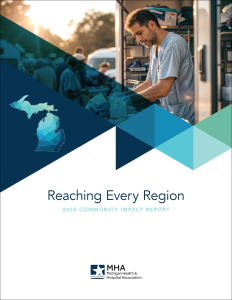
2025 MHA Community Impact Report

The Michigan Health & Hospital Association (MHA) released today its 2025 Community Impact Report highlighting community programming and investments from Michigan hospitals that are improving access to care, addressing affordability and advancing the health of communities across every region of the state.

The report showcases 12 hospital-led programs that go beyond the traditional care setting to address community health needs across the state. It also outlines investments totaling more than $4.5 billion in community benefit activities in fiscal year (FY) 2023, from education and prevention services to clinical research, healthcare workforce support and more.

“Michigan hospitals continue to redefine care delivery and create new, innovative access points across the state,” said MHA CEO Brian Peters. “The MHA Community Impact Report is a strong reminder that our hospitals are committed to listening – and responding – to the needs of their communities.”

Programs featured in the report include University of Michigan Health-Sparrow’s mobile health clinic; Henry Ford Health’s hospital-based doula program; Corewell Health Gerber Hospital’s vaping cessation initiative; Mackinac Straits Health System’s retail pharmacy; and efforts by Bronson Battle Creek Hospital to address food insecurity; among many others. This work is a result of strategic investments, local partnerships and support from state and federal healthcare champions.

“Improving community health goes beyond the bedside,” said MHA Board Chair Bill Manns, president and CEO, Bronson Healthcare. “When we invest in programs that address socioeconomic challenges like food insecurity, we’re helping people overcome the barriers that stand between them and a healthier life.”

The full report and community impact stories from hospitals across the state can be accessed on the MHA website.

Based in Greater Lansing, the MHA is the statewide leader representing all community hospitals in Michigan. Established in 1919, the MHA represents the interests of its member hospitals and health systems in both the legislative and regulatory arenas on key issues and supports their efforts to provide quality, cost-effective and accessible care. The MHA’s mission is to advance the health of individuals and communities.

Michigan Hospital Collaboratives Launch to Improve Community Health

More than 50 Michigan hospitals are coming together to improve outcomes in maternal health, behavioral health and chronic disease across the state through new community benefit collaboratives launched by the Michigan Health & Hospital Association (MHA). The goal is to leverage community impact programming to maximize statewide improvements in these three areas.

The MHA will lead participating hospitals in implementing multi-year, scalable projects focused on enhancing group prenatal care, improving perinatal mood disorder screening and support, preventing postpartum depression and expanding food access and nutrition education. The collaborative topics were selected based on a review of all Community Health Needs Assessments completed by Michigan hospitals. Each collaborative is modeled after existing programs at Michigan hospitals and healthcare organizations designed to address healthcare barriers and improve health outcomes.

“This work reflects Michigan hospitals’ commitment to investing in their communities far beyond their four walls to improve population health,” said MHA CEO Brian Peters. “These collaboratives are designed to scale local success into making a statewide impact that advances the health and well-being of Michiganders where they live, work and grow.”

Each collaborative has various components that can be tailored to meet the unique needs of a hospital, depending on size, available resources and patient populations. The implementation of the collaboratives is supported by funding from the Michigan Health Endowment Fund. Public Policy Associates will facilitate program evaluations.

The list of participating hospitals for each collaborative is available below.

Behavioral Health Collaborative  

  • Henry Ford Health
  • MyMichigan Medical Center Alma
  • MyMichigan Medical Center Clare
  • MyMichigan Medical Center Gladwin
  • MyMichigan Medical Center Midland
  • MyMichigan Medical Center Mt. Pleasant
  • MyMichigan Medical Center Saginaw
  • MyMichigan Medical Center Sault
  • MyMichigan Medical Center Standish
  • MyMichigan Medical Center Tawas
  • MyMichigan Medical Center West Branch
  • ProMedica Monroe Regional Hospital
  • ProMedica Charles and Virginia Hickman Hospital
  • Trinity Health Ann Arbor
  • University of Michigan Health-Sparrow Lansing
  • University of Michigan Health-West

Chronic Disease Collaborative

  • Aspirus Iron River Hospital & Clinics
  • Aspirus Keweenaw Hospital & Clinics
  • Aspire Rural Health System Deckerville Community Hospital
  • Aspire Rural Health System Hills & Dales Healthcare
  • Aspire Rural Health System
  • Beacon Kalamazoo (formerly Borgess Hospital)
  • Bronson Battle Creek Hospital
  • Henry Ford Health
  • Kalkaska Memorial Health Center
  • Munson Medical Center
  • MyMichigan Medical Center Alma
  • MyMichigan Medical Center Clare
  • MyMichigan Medical Center Gladwin
  • MyMichigan Medical Center Midland
  • MyMichigan Medical Center Mt. Pleasant
  • MyMichigan Medical Center Saginaw
  • MyMichigan Medical Center Sault
  • MyMichigan Medical Center Standish
  • MyMichigan Medical Center Tawas
  • MyMichigan Medical Center West Branch
  • Scheurer Health
  • Schoolcraft Memorial Hospital

Maternal Health Collaborative  

  • Bronson Methodist Hospital
  • Corewell Health Lakeland Hospitals – St. Joseph Hospital
  • Henry Ford Health
  • MyMichigan Medical Center Alma
  • MyMichigan Medical Center Clare
  • MyMichigan Medical Center Gladwin
  • MyMichigan Medical Center Midland
  • MyMichigan Medical Center Mt. Pleasant
  • MyMichigan Medical Center Saginaw
  • MyMichigan Medical Center Sault
  • MyMichigan Medical Center Standish
  • MyMichigan Medical Center Tawas
  • MyMichigan Medical Center West Branch
  • Three Rivers Health Hospital (Beacon Health System)

To learn more about community benefit efforts across the state, visit the MHA Community Benefit webpage.

Based in Greater Lansing, the MHA is the statewide leader representing all community hospitals in Michigan. Established in 1919, the MHA represents the interests of its member hospitals and health systems in both the legislative and regulatory arenas on key issues and supports their efforts to provide quality, cost-effective and accessible care. The MHA’s mission is to advance the health of individuals and communities.

Veiled Attacks on Hospitals by Secretive Special Interests are Growing Tired

The following statement can be attributed to Brian Peters, CEO of the Michigan Health & Hospital Association.

Today’s Michigan Healthcare Purchaser’s Coalition publication on hospital margins is just another attempt by a secretive special interest group, hiding behind the veil of claiming to represent the employer community at large, to smear hospitals for being able to keep their doors open. Hospitals are committed to providing safe, high quality, affordable care in every community they serve. Hospitals save lives and put patients first – not profits. Hospitals have and continue to welcome conversations with actual employers, large and small, community members and legitimate business groups about healthcare pricing, access and quality so that they can work together on solutions, rather than spending time responding to blatantly misleading reports like this one.

Not only is this report published by a group that does not disclose on its website who is funding it or who it claims as members (or what their profit margins are), but its methodology based on the National Academy for State Health Policy’s Hospital Cost Tool is flawed. This report does not use the industry-standard method for calculating operating margins; it fails to account for costs associated with running a hospital. In the latest RAND Hospital Price Transparency study, Michigan has the third lowest average commercial price relative to Medicare in the entire country and one of just five states with case mix-adjusted hospital prices below 200% of Medicare prices. Lastly, the Kaiser Family Foundation in December 2024 published a study which found Michigan was one of only four states in the country where hospitals had, on average, a negative margin.

As always, we welcome open and transparent conversations about what is driving hospitals’ cost structures, such as:

  • Good workers who can take care of you and save your life demand, and deserve, high wages. According to Lightcast data, advertised salaries for registered nurses have grown 26.6% faster than the rate of inflation over the past four years.
  • People are sicker and need more care. Emergency department visits related to heart failure increased 126.7% per capita between 2010 and 2019, with associated spending growing 177.2%.
  • Medicare reimbursement continues to lag behind inflation — covering just 83 cents for every dollar spent by hospitals in 2023, resulting in over $100 billion in underpayments, according to the American Hospital Association (AHA) analysis of AHA Annual Survey data. Comparing commercial prices to government reimbursement, which has almost never even come close to covering what it costs a hospital to deliver that care, is irresponsible and misleading.

If the Michigan Healthcare Purchaser’s Coalition wants a transparent conversation about the price of healthcare, we again extend an invitation to their leadership and members, whoever they are, to have a solutions-focused dialogue together. Unfortunately, their continued public attacks using bad information indicates their true intention isn’t more affordable healthcare; it’s to bash community hospitals and the 220,000 workers taking care of Michigan patients.

NAIC Meeting Evaluates Impact of Pharmaceutical Costs on Rural Hospitals

Laura Appel, executive vice president of government relations and public policy, MHA (middle) pictured during a presentation at the Midwest Zone meeting of NAIC.

Michigan Department of Insurance and Financial Services Director Anita Fox invited the MHA and Munson Healthcare to present to the Midwest Zone meeting of the National Association of Insurance Commissioners (NAIC) held Sept. 25. The topic was the impact of pharmaceutical costs and complexities on rural hospitals.

Bradley Beaman, clinical utilization pharmacist at Munson Healthcare, shared specific examples of the pharmacy overhead costs confronting all hospitals and how small, rural hospitals have fewer financial resources to manage these costs. The insurance commissioners also heard from Kelly Anderson, Ph.D., MPP, about the patient impact of reducing access to pharmacy services. Kelly Edmiston, policy research manager at the NAIC Center for Insurance Policy and Research, presented on the financial risks facing rural hospitals and the past and current rates of rural hospital closures.

The NAIC Midwest Zone is made up of insurance commissioners and department directors from 13 states. The Commissioners engaged in a lengthy discussion about the fixed costs of hospital pharmacy operations and the role of insurance coverage in assuring access to care for prescription drugs and other services in rural areas of their states. Recommendations from the NAIC Zones become part of the full NAIC policy-making discussion. The MHA is committed to growing its involvement with the NAIC and other national policy-making organizations to influence decision-making that impacts Michigan hospitals.

For more information about this recent meeting and the NAIC, members may contact Laura Appel at the MHA.