
MHA Monday Report Dec. 8, 2025

Stop the Bleed Legislation Advances, Preadmission Screening Bill Introduced

Legislation protecting good Samaritans who apply bleeding-control techniques passed the Senate Civil Rights, Judiciary and Public Safety Committee, while a bill modifying timeline requirements for preadmission screening assessments of Medicaid patients was introduced during the …


CMS Releases 2026 Home Health PPS Final Rule

The Centers for Medicare & Medicaid Services (CMS) recently released a final rule updating the home health prospective payment system (PPS) for calendar year 2026. Highlights of the rule include: An updated 30-day …


MDHHS Launches RHTP Listserv to Share Program Updates

The Michigan Department of Health and Human Services (MDHHS) recently launched a Rural Health Transformation Program (RHTP) listserv to provide timely updates, announcements and resources related to the state’s implementation of the program. Hospitals, health …


Health Access & Community Impact Office Hours Launch

The MHA Health Access & Community Impact Office Hours series kicked off Nov. 24 with a session highlighting 211 and its role in addressing food access amid ongoing challenges related to food insecurity. Sarah Kile, …


Nominations Open for 2026 Michigan Hometown Health Hero Awards

The Michigan Public Health Week Partnership, a coalition of 13 statewide organizations that include the MHA, is seeking nominations by Friday, Dec. 19, for individuals and organizations that have contributed to improving the health and …


MHA Rounds graphic of Brian PetersMHA CEO Report — Dedicated to Care Every Day of the Year

During the holiday season, we look forward to annual traditions and time spent with loved ones. While many of us gather around our tables this season, we are all aware of individuals who sacrifice this special time …


Centering Lived Experiences to Improve Maternal Care: Reflections from the Birth Experience Project

Over the past year, I supported the Birth Experience Project, a mixed-methods study examining how Black women across Michigan experience pregnancy, labor and delivery, and postpartum care. As part of this effort, I assisted in analyzing …


Keckley Report

The 10 Healthcare Headlines you Might See in 2026

“2026 is a mid-term election year. In 2016 (Trump 45 Year One), Republicans controlled 31 governorships and 68 legislative chambers. This January, the GOP will control 26 governorships and 57 legislative chambers– a 15% reduction on both. Politics is divided, affordability matters most to voters and healthcare is a high-profile target for campaigns so humility, thoughtful messaging backed by demonstrable actions will be an imperative for every healthcare organization.

2026 is a HUGE year for U.S. healthcare. The outcome is unknown.”

Paul Keckley, Nov. 23, 2025

MHA Shares Recent Medicare and Medicaid Enrollment Analysis

The MHA recently updated its analysis of Medicaid and Medicare enrollment based on September 2025 data. The analysis includes program enrollment as a percentage of each county’s total population and the split between fee-for-service and managed care organizations. Just over 26% of Michigan’s total population is enrolled in Medicaid and 23% is enrolled in Medicare.

Roughly two-thirds of Michigan’s 2.6 million Medicaid beneficiaries are enrolled in one of nine managed care plans.

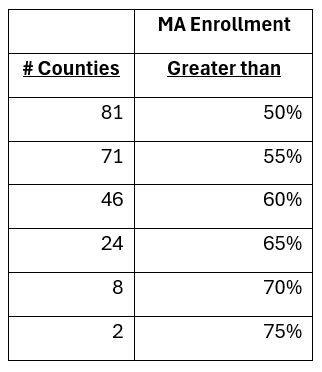
Total Medicare enrollment is 2.28 million with 63% of beneficiaries enrolled in a Medicaid Advantage (MA) plan with only two counties having less than 50% of total Medicare enrollment in MA plans. MA enrollment by county ranges from 46% to 79%, with 73 counties having 55% or more of their Medicare population enrolled in an MA plan as highlighted below.


September enrollment is spread across 45 MA plans with up to 29 plans covering beneficiaries in several Michigan counties, with a minimum of five plans available in each county.

Members with enrollment questions should contact the health finance team at the MHA.

CMS Releases Updated Guidance During Federal Government Shutdown

The Centers for Medicare & Medicaid Services (CMS) recently instructed all Medicare Administrative Contractors (MACs) to lift the hold and begin processing fee-for-service claims dated Oct. 1 and after. The action follows the hold on services impacted by select expired Medicare legislative payment provisions, including those paid under the Medicare physician fee schedule, ground ambulance transport claims and Federally Qualified Health Center claims.

The updated guidance also instructs MACs to process telehealth claims that the CMS can confirm are for behavioral and mental health services. The CMS directed all MACs to continue holding claims for other telehealth services (non-behavioral/mental health claims) due to the Sept. 30 expiration of telehealth flexibilities put in place during the COVID-19 public health emergency and for the acute Hospital Care at Home Program, which also expired Sept. 30.

CMS also released an updated FAQ document Oct. 15 to provide additional guidance to providers.

Members with questions may contact Vickie Kunz at the MHA.

News Coverage Continues Focus on Medicaid

Laura Appel

The MHA received media coverage during the week of July 28 that continued to focus on the impact the One Big Beautiful Bill Act (OBBBA) will have on Medicaid.

Bridge published an op-ed Aug. 1 from MHA CEO Brian Peters refuting public claims defending Medicaid funding cuts in the OBBBA. Peters describes how the cuts will have real consequences for real people, spanning all populations.

“When hospitals lose Medicaid dollars, the burden shifts to other patients, including those with employer-sponsored insurance,” said Peters. “Costs go up. Wait times increase. Local access to specialty care dries up. Employers and families alike will feel the ripple effects, both in their insurance premiums and at the distance they must travel for care.”

WZZM 13 published a story July 30 on the 60th anniversary of Medicare and Medicaid being established by President Lyndon B. Johnson. The story references a media statement published by the MHA on the subject.

Laura AppelA story also aired July 30 during the FOX 47 evening news broadcast about how Medicaid changes in the One Big Beautiful Bill Act (OBBBA) will impact rural healthcare providers. MHA Executive Vice President Laura Appel was interviewed as part of the story.

Appel also appears in a Crain’s Detroit Business article about healthcare affordability that was sponsored by Blue Cross Blue Shield of Michigan (BCBSM). Representatives from various Michigan businesses and healthcare groups were invited to join BCBSM and Crain’s in the executive roundtable.

Appel spoke to the cost pressures impacting hospitals and the role hospitals have in addressing rising healthcare costs.

“Most hospitals across our state are looking for those partnerships because they can’t afford to do it on their own,” said Appel in relation to hospitals pursuing mergers, acquisitions and joint ventures.

Members with any questions regarding media requests should contact John Karasinski at the MHA.

Medicare & Medicaid Improve Michigan’s Health for 60 Years

The following statement can be attributed to Brian Peters, CEO of the Michigan Health & Hospital Association.

Today marks the 60th anniversary of Medicare and Medicaid making a monumental difference in improving the health of Michiganders and supporting healthcare providers.

This anniversary reminds all of us about the value these programs bring to the health of our citizens and access to care throughout Michigan. At a time when the federal government has taken steps to limit these programs that will result in Michigan hospitals losing $6 billion over the next ten years, healthcare providers will continue to do everything in our power to protect these vital programs and the people they serve.

Nearly half of Michigan residents receive health coverage from these two insurance programs, and 40% of all babies born in the state every year are covered by Medicaid, demonstrating the reliance our state has on publicly available health insurance coverage. These programs help vulnerable Michiganders receive preventative care, cancer treatment, and important hospital and post-acute services during their time of need.

Our message to lawmakers is clear: act now to protect these programs before it is too late. If the harmful policies signed into law earlier this month come to pass, we will see less healthcare services offered in all areas of the state, more uninsured and sicker patients, and longer wait times in emergency departments.

The creation of these programs was a huge step forward for the health of our country. We can’t afford to go backwards by undermining Medicare and Medicaid and what they do for millions of Michiganders.

MHA Monday Report July 28, 2025

MHA Shares Recent Medicare and Medicaid Enrollment Analysis

The MHA recently updated its analysis of Medicaid and Medicare enrollment based on June 2025 data. The analysis includes program enrollment as a percentage of each county’s total population and the split between fee-for-service and …


Registration Open for 2025 Communications Retreat

Registration is open for the 2025 MHA Communications Retreat from 8 a.m. to 4 p.m. on Wednesday, Oct. 1 at the Henry Center for Executive Development in Lansing. The daylong event offers hospital communicators a …


New PwC Report Warns of Rising Hospital Costs and Mounting Financial Pressure on U.S. Healthcare System

The MHA is drawing attention to a new national report from PricewaterhouseCoopers (PwC) that outlines the severe financial challenges facing hospitals across the country that could soon jeopardize patient care …


MI AIM Hosting Regional Quality Improvement Training Sessions in the Fall

The Michigan Alliance for Innovation on Maternal Health (MI AIM) is inviting inpatient clinicians from birthing units across Michigan to its fall regional training sessions. The half-day trainings will be facilitated by maternal health experts …


Keckley Report

Gut Punches for Healthcare and Hospitals: The One Big Beautiful Bill Act and the CMS Proposed Rule

“The healthcare industry is still licking its wounds from $1 trillion in federal funding cuts included in the One Big Beautiful Bill Act (OBBBA) signed into law July 4. Adding insult to injury, the Center for Medicare and Medicaid services issued a 913-page proposed rule last Tuesday that includes unwelcome changes especially troublesome for hospitals i.e. adoption of site neutral payments, expansion of hospital price transparency requirements, reduction of inpatient-only services, acceleration of hospital 340B discount repayment obligations and more. …

The antipathy toward the healthcare industry among the public  and in Congress played a key role in passage of the OBBBA and regulatory changes likely to follow. Polls show three-fourths of likely voters want to see transformational change to healthcare and two-thirds think the industry is more concerned with its profit over their care: these views lend to hostile regulatory changes. The public and the majority of elected officials think the industry prioritizes protection of the status quo over obligations to serve communities and the greater good. The result: winners and losers in each sector, lack of continuity and interoperability, runaway costs and poor outcomes. No sector in healthcare stands as the surrogate for the health and wellbeing of the population. There are well-intended players in each sector who seek the moral high ground for healthcare, but their boards and leaders put short-term sustainability above long-term systemness and purpose. That void needs to be filled.”

Paul Keckley, July 20, 2025


New to KnowNews to Know

  • Join MHA Endorsed Business Partner CyberForce|Q for the in-person Coffee & Collab for Cybersecurity Leaders Aug. 19 from 9:30 – 11 a.m. ET at the MHA headquarters in Okemos.
  • MHA Endorsed Business Partner CorroHealth recently hosted the webinar Price Transparency in 2025: What’s Required, What’s Coming, What to do Now and a recording is now available on the CorroHealth On-Demand platform along with additional resources.


MHA in the News

The MHA received media coverage during the week of July 21 that focused on setting the record straight about the impacts of the One Big Beautiful Bill Act on hospitals. The Detroit News published …

MHA Shares Recent Medicare and Medicaid Enrollment Analysis

The MHA recently updated its analysis of Medicaid and Medicare enrollment based on June 2025 data. The analysis includes program enrollment as a percentage of each county’s total population and the split between fee-for-service and managed care organizations. More than 26% of Michigan’s total population is enrolled in Medicaid and 23% is enrolled in Medicare.

Roughly two-thirds of Michigan’s 2.63 million Medicaid beneficiaries are enrolled in one of nine managed care plans.

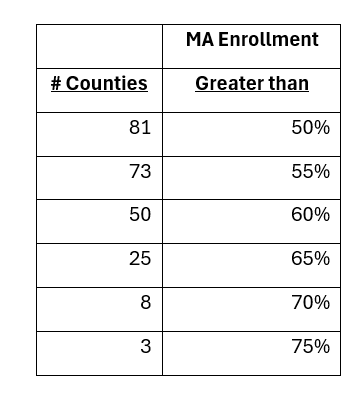
Total Medicare enrollment is 2.27 million, with 63% of beneficiaries enrolled in a Medicaid Advantage (MA) plans, and only two counties having less than 50% of total Medicare enrollment in MA plans. MA enrollment by county ranges from 46% to 79%, and 73 counties having 55% or more of their Medicare population enrolled in an MA plan as highlighted below.


June enrollment is spread across 46 MA plans with up to 29 plans covering beneficiaries in several Michigan counties and a minimum of five plans available in each county.

Members with enrollment questions should contact the Health Finance team at the MHA.

CMS Releases Medicare 2026 Outpatient Prospective Payment System Proposed Rule

The Centers for Medicare & Medicaid Services (CMS) recently released a proposed rule to update the Medicare fee-for-service outpatient prospective payment system (OPPS) effective Jan. 1, 2026.

The proposed rule:

  • Provides a net 0.9% increase to the OPPS conversion factor from $89.17 to $89.96 for hospitals enrolled in Medicare before Jan. 1, 2018. The update includes a 3.2% market basket update, mandated 0.8 percentage point productivity adjustment, other budget neutrality adjustments and a 2% reduction for the 340B remedy offset (described below). Hospitals that fail to meet outpatient quality reporting program requirements are subject to an additional two-percentage point reduction.
  • Shortens the timeline for OPPS hospitals to repay the $7.8 billion received through higher payments for non-drug services in 2018-2022 due to the CMS’ budget-neutral policy that cut payments to 340B hospitals. The CMS proposes a 2% annual reduction to the OPPS conversion factor to repay the full $7.8 billion by 2031, up from the initially proposed 0.5% annual reduction over 16 years.
  • Implements a site neutral payment policy for drug administration services provided in grandfathered off-campus hospital outpatient departments. The CMS proposed to pay a physician fee schedule equivalent rate for 61 HCPCS codes assigned to drug administration ambulatory payment classifications, which equates to roughly 40% of the OPPS rate. Rural sole community hospitals are exempt from this cut.
  • Includes a new drug acquisition cost survey for all OPPS hospitals in late 2025 or early 2026 for separately payable drugs, with survey results to be used to set 2027 rates for separately payable drugs.
  • Eliminates the inpatient only (IPO) list over three years, beginning with the removal of 285 mostly musculoskeletal services in 2026, making these procedures payable in outpatient settings.
  • Decreases the outlier fixed-dollar threshold by 11.2% from the current $7,175 to $6,450.
  • Updates the Outpatient, Rural Emergency Hospital (REH) and Ambulatory Surgical Center (ASC) Quality Reporting Programs, including removing four measures related to COVID-19 vaccination of health care personnel and health equity. For the Outpatient and REH programs, the CMS proposes a new e-measure on timeliness of emergency department care and establishing requirements for REHs to report e-measures. The CMS also proposes updates to the methodology used to calculate the Overall Hospital Star Ratings that would limit any hospital in the bottom safety quartile to a maximum of four stars and in 2027, drop such hospitals one full star.
  • Updates the ASC covered procedures list to add 276 procedures plus an additional 271 procedures proposed for removal from the 2026 IPO list.
  • Requires hospitals to report payer-specific Medicare Advantage payment rates on their Medicare cost report for periods ending on or after Jan. 1, 2026. The CMS plans to use this data for a proposed fiscal year 2029 methodology change in calculating inpatient Medicare severity diagnosis related group (MS-DRG) relative weights to reflect relative market-based pricing.
  • Requires hospital to disclose detailed ranges of rates negotiated with health insurance plans (known as allowed amounts) by updating hospital price transparency regulations beginning Jan. 1, 2026, to require four new data elements. Hospitals must publish 10th-percentile, median and 90th-percentile allowed amounts (plus counts) instead of a single estimated allowed amount.
  • Revises the definition of direct supervision for cardiac rehabilitation, intensive cardiac rehabilitation and pulmonary rehabilitation services and diagnostic services (excluding service with a global surgery indicator of 010 or 090) provided to hospital outpatients to permanently allow virtual direct supervision.

The MHA will provide a hospital-specific impact analysis within the next few weeks and encourages hospitals to contact Vickie Kunz by Sept. 2, regarding issues identified. Hospitals are encouraged to review the proposed rule and its impact on operations and submit comments to the CMS by Sept. 15. The CMS is expected to release a final rule in early November for the Jan. 1, 2026 effective date. Members with questions may contact Vickie Kunz at the MHA.

Recording and Materials Available from Medicare Quality Based Program Webinars

The MHA recently partnered with DataGen to host two webinars focused on the three Medicare fee-for-service (FFS) quality-based programs. These programs, mandated by the Affordable Care Act of 2010, can reduce hospital inpatient FFS payments by up to 6% based on performance.

The Medicare value-based purchasing (VBP) program is funded by a 2% contribution from inpatient operating payments of eligible prospective payment system hospitals with these funds, totaling approximately $1.7 billion, redistributed among hospitals nationally. Each hospital’s total performance score is determined based on four program domains, comprised of various measures. Materials and the recording of the June 11 webinar are available.

The second webinar, focusing on the Hospital Readmissions Reduction Program (RRP) and Hospital-Acquired Conditions (HAC) Reduction Programs, was also held. The RRP evaluates Medicare FFS patients with six medical conditions and penalizes hospitals for exceeding expected readmission rates. The HAC program evaluates performance on six measures and penalizes hospitals in the worst performing quartile compared to all other eligible hospitals nationally. For these two programs, hospitals can remain whole or be subject to payment penalties of up to 3% for the RRP and 1% for the HAC program, with all penalties benefiting the Centers for Medicare & Medicaid Services. Materials and the recording from the June 17 webinar are also available.

The MHA recently provided prospective payment system hospitals with the latest VBP and HAC program estimates through the hospital association reporting portal.

Members with questions should contact Vickie Kunz at the MHA.

MHA Testifies on Hospital Cost Drivers in House Insurance Committee

The MHA testified before the Michigan House Insurance Committee June 11 on healthcare cost issues affecting hospitals and communities across the state.

Laura Appel, executive vice president, government relations & public policy, MHA and Elizabeth Kutter, senior director, government and political affairs, MHA, testified in front of the House Insurance Committee on hospital cost drivers and their impact on hospitals and patients.

Laura Appel, executive vice president, government relations & public policy, MHA and Elizabeth Kutter, senior director, government and political affairs, MHA, testified in front of the House Insurance Committee on hospital cost drivers and their impact on hospitals and patients. Kutter shared that Michigan’s hospitals are more than healthcare providers, serve as economic anchors, stewards of public health and major contributors to community investment. Additionally, Kutter shared data collected by the MHA that Michigan hospitals contributed more than $4.5 billion last year to funding community impact projects like mobile clinics, transportation and housing support, food pharmacies and behavioral health programs.

The testimony also highlighted that hospital expenses are rising nationwide, increasing 5.1 percent in 2024 and outpacing the overall inflation rate of 2.9 percent. These increases are largely driven by labor, prescription drug and supply costs.

Appel provided a detailed explanation on workforce and talent, prescription drugs and supplies as significant cost drivers for hospitals and patients seeking care. Data shared with the committee showed that healthcare is the largest private sector employer in the state, with hospitals employing 222,000 people who provide $10.7 billion a year in tax revenue, and that labor costs typically represent 56% of total expenses for hospitals. In addition, prescription drugs are constantly increasing for hospitals and of the $449 billion spent annually on prescription drugs in the United States, hospitals account for roughly 25 percent of the total. Appel made it clear that hospitals do not set the price of drugs but are subject to the whims of drug manufacturers. It was also shared that supply chain disruptions and inflation continue to affect hospitals’ ability to deliver care. National data shows that per-patient supply costs increased 18.5 percent from 2019 to 2022.

Lastly, Kutter and Appel provided an overview on hospital pricing and reimbursement from commercial insurance. According to the Rand Hospital Price Transparency Study, Michigan had the third lowest average commercial payments relative to Medicare in 2024 and is one of just five states with hospital payments averaging below 200% of Medicare prices. The presentation concluded with a call for working with the legislature to address administrative burdens that impact healthcare access and affordability, and focusing on solutions that keep Michigan a high-quality, lower-cost healthcare state.

Members with additional questions should contact Elizabeth Kutter at the MHA.