U.S. Senate Approves SUPPORT Act Reauthorization to Address Opioid and Mental Health Crisis

The U.S. Senate passed the SUPPORT for Patients and Communities Reauthorization Act of 2025 on Sept. 18. The bill would provide more resources for preventing and treating addiction and mental illness. It passed the U.S. House on June 4 with bipartisan support and now advances to President Trump to be signed into law.

The SUPPORT Act was first enacted in 2018 but expired in 2023, putting at risk key prevention, treatment and recovery programs. The 2025 reauthorization would ensure that those programs continue through 2030, keeping critical funding in place.

Among its provisions, the bill:

  • Expands access to treatment programs for pregnant and postpartum women and their families.
  • Protects the 9-8-8 Suicide Prevention Lifeline from cybersecurity threats.
  • Supports comprehensive opioid recovery centers and workforce training for addiction medicine providers.
  • Training for first responders in overdose reversal medication.

Members with questions may contact Lauren LaPine at the MHA.

Media Recap: Hospital Cost Pressures and Behavioral Health Partnerships

Lauren LaPine

The MHA received media coverage the week of Aug. 4 on hospital cost pressures, behavioral health partnerships and the impact of Medicaid cuts.

Gongwer published a story Aug. 4 about a PricewaterhouseCoopers report that reviews the trends in the medical sector that are continuing to result in higher costs for services that are placing growing pressure on hospitals. The report shows that factors that include growth in drug spending and reductions in federal funding are leading to decreased hospital margins.

“This report confirms what hospitals in Michigan and across the country are living every day: skyrocketing costs, growing demand and shrinking margins,” said MHA CEO Brian Peters. “We cannot afford policies that slash Medicaid funding or shift more financial burden to hospitals and patients. Without sustainable support, hospitals – especially those in rural and underserved areas – face real threats of closure.”

Second Wave Michigan also published an article Aug. 5 about behavioral health partnerships that hospitals have in the state. The story looks at both policy solutions such as Senate Bill 316, as well as the partnership between Network180 and Trinity Health Grand Rapids in establishing The Behavioral Health Crisis Center to divert patients in crisis from emergency departments and jails.

Lauren LaPine“If you come to a hospital emergency department and you’re in some level of a behavioral health crisis, that hospital has to work with the CMH in the area where the patient lives,” said Lauren LaPine, senior director of legislative and public policy, MHA. “That takes a lot of time and a lot of coordination.”

MLive and Michigan Public also published stories that include mentions of the MHA following U.S. Sen. Elissa Slotkin’s visit to Helen DeVos Childre’s Hospital. The stories reference the MHA’s estimate that Michigan hospitals will lose $6 billion over the next ten years from the One Big Beautiful Bill Act.

Members with any questions regarding media requests should contact John Karasinski at the MHA.

MDHHS Launches New Mental Health Framework

The Michigan Department of Health and Human Services (MDHHS) is launching a new approach to mental health care under Medicaid as part of its MIHealthyLife initiative.

The “Mental Health Framework” is designed to make care more person-centered and better coordinated by clearly outlining whether a Medicaid Health Plan or a Prepaid Inpatient Health Plan is responsible for an individual’s care, based on their level of mental health need.

To support implementation, all qualified mental health providers contracted with Medicaid Health Plans (MHPs) or Prepaid Inpatient Health Plans (PHPs) must use these standardized assessment tools and follow the new referral protocols beginning in October 2025. Additionally, providers offering services such as inpatient psychiatric care, crisis residentials and partial hospitalization for individuals with lower-level needs will need to contract with MHPs to ensure coverage by 2026.

MHPs will begin covering most mental health services for enrollees with lower levels of mental health need in October 2026, while PIHPs will continue serving those with higher acuity. A state standardized assessment tool, MichCANs for children and LOCUS for adults, will guide this determination. A streamlined referral process and shared platform will also be introduced to help providers and enrollees navigate between systems.

MDHHS is offering free training, eligible for CME/CEU credit, on these tools and processes. Providers are encouraged to complete a form to receive updates and register for training.

Members with questions may contact Lauren LaPine at the MHA.

Mental Health Awareness Month Highlights Week of Media Coverage

Lauren LaPine

The MHA received news coverage during the week of May 19 highlighted by stories related to Mental Health Awareness Month and the need to expand state psychiatric bed capacity.

Lauren LaPine, senior director, legislative and public policy, MHA, speaks during a May 21 press conference on Mental Health Awareness Month, addressing long emergency department waits for psychiatric beds among Medicaid patients.

Lauren LaPine, senior director, legislative and public policy, MHA, joined state lawmakers and University of Michigan Health-Sparrow clinicians during a press conference May 21 about Mental Health Awareness Month. LaPine focused her comments on the high number of patients waiting in emergency departments across the state for an inpatient psychiatric bed. Many of these patients are Medicaid beneficiaries and experience further delays awaiting a clinical assessment.

WILX News 10 and WLNS 6 News attended the press event and aired stories during their evening news broadcasts.

“Last year, for over 18 months, we collected data from our hospitals and health systems that told us that on any given day, there are more than 155 patients that are stuck in emergency departments across the state that are looking for behavioral health services,” said LaPine.

Other speakers included:

  • Chandu Vemuri, MD, chief medical officer, University of Michigan Health-Sparrow
  • Dominic Barberio, MD, psychiatrist, University of Michigan Health-Sparrow
  • Rep. Angela Witwer (D-Delta Township)
  • Rep. Matthew Bierlein (R-Vassar)

The MHA also provided comment to several stories related to a hospital drug pricing study released by the Michigan Health Purchasers Coalition. The study uses a limited data set of claims data in an attempt to show pricing variances across hospitals for three prescription drugs. MHA Executive Vice President spoke with Crain’s Grand Rapids and WLNS News 6, explaining the differences between hospital charges and what hospitals actually receive as reimbursement, as well as the myriad of factors that determine hospital financing, including legacy contract agreements, mergers and acquisitions, the presence of group purchasing agreements, patient acuity, and labor and overhead costs.

“There are a lot of drugs out there. Picking and choosing a few of them probably doesn’t tell the whole story about the expensive pharmaceuticals in our health care system,” said Appel to Crain’s. “Everybody in the system is trying to do their best. There’s lots of room for improvement, but I don’t think identifying a few items and saying, ‘look at this’ is a way to get us to solving some of the affordability needs that we have for our system for patients.”

Adam Carlson speaks at a Protect MI Care press conference.

Adam Carlson, senior vice president, advocacy, MHA, also spoke at a Protect MI Care coalition press conference May 21 in Lansing about federal Medicaid cuts. Carlson was quoted in an article by Gongwer discussing how the cuts will impact all Michigan residents.

“It’s going to lead to millions of people losing their health insurance coverage, and these funding cuts to Medicaid, they’ll impact access to care for all Michiganders, not just those with Medicaid as their insurance coverage,” said Carlson. “It’s an important program across all state hospitals, but especially for the 65 rural hospitals that depend on it to keep their doors open.”

Members with any questions regarding media requests should contact John Karasinski at the MHA.


Medicaid Cuts and Hospital Economic & Workforce Impact News Coverage

Laura Appel

Laura AppelThe MHA received news coverage during the week of May 12 related to federal Medicaid funding cuts and the release of the hospital economic and workforce impact data.

Crain’s Detroit Business published an article May 13 following the release of draft bill language from the House Energy and Commerce Committee as part of the budget reconciliation process, which calls for imposing federal work requirements and freezing state directed payment programs for healthcare providers.

MHA Executive Vice President Laura Appel spoke with Crain’s, expressing the MHA’s concerns on the draft language.

“We of course remain deeply concerned about things like doing redetermination of folks’ eligibility for the coverage on less than an annual basis and things like work requirements or community benefit requirements for certain folks who currently qualify for coverage,” said Appel. “All of those things are barriers to folks.”

Second Wave Michigan also published a story May 13 about potential Medicaid funding cuts, as part of their MI Mental Health Series. Lauren LaPine, senior director, legislative and public policy, MHA, is quoted in the piece discussing what impact the cuts would have to hospitals.

“A real consequence of Medicaid cuts will be closures of service lines and even hospitals,” said LaPine. “When hospitals have to cut services because Medicaid is cut, those services are lost for all patients and not just those who receive health care coverage through Medicaid. Medicaid is the single largest payer for long-term care, maternity care, and mental health services. It is a cornerstone of our health care system and keeps people healthy at every stage of life.”

The MHA also received news coverage from Gongwer and dBusiness following the release May 12 of the association’s annual Economic Impact of Healthcare report and hospital workforce survey results.

Lastly, MHA CEO Brian Peters provided a quote of support in a press release issued by U.S. Sen. Gary Peters (D-MI) following introduction of the Mapping America’s Pharmaceutical Supply (MAPS) Act.

Members with any questions regarding media requests should contact John Karasinski at the MHA.

Michigan Senate Hears MHA Testimony on ED Boarding Challenges, MHA Opposes Introduced MCPA Bill

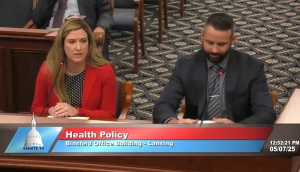
The MHA provided testimony May 7 to the Senate Health Policy Committee on certain challenges related to hospital emergency department boarding for behavioral health patients.

The Senate Health Policy Committee heard about patients facing behavioral health crises and their experiences with emergency department boarding based on insurance status. Lauren LaPine, senior director, legislative & public policy, MHA  discussed how the association collected data, starting in 2023, from hospital emergency departments on length of stay for patients with a behavioral health diagnosis. Initial findings within this data showed there were over 150 patients with a behavioral health diagnosis waiting in a hospital emergency department daily. Furthermore, behavioral health-related patients with Medicaid coverage spent longer time in hospital emergency departments than their counterparts with commercial insurance and one of every three patients with Medicaid spent more than 48 hours in a hospital emergency department waiting to be accepted for inpatient hospitalization or discharged.

Lauren LaPine, senior director, legislative & public policy, MHA and Kyle Hoffmaster, director, patient access, Pine Rest Christian Mental Health Services provided testimony May 7 on patients facing behavioral health crises and their experiences with emergency department boarding based on insurance status.

LaPine explained the process of the pre-admission screening assessment completed by providers for these patients with a behavioral health diagnosis and illustrated for the committee how the process is unnecessarily complicated for those with Medicaid coverage.

Kyle Hoffmaster, director, patient access, Pine Rest Christian Mental Health Services also provided testimony on the challenges faced by their organization in helping serve behavioral health patients seeking care. He shared how waiting for another provider from the community mental health (CMH) organizations to complete a pre-admission assessment for patients covered by Medicaid can cause significant delays in these patients receiving the care they need. Patients covered through Medicaid are forced to go to a hospital emergency department per guidelines from the CMHs to receive the assessment in that specific setting, causing more unnecessary stress and costs for families and providers alike. Sharing personal experiences from Pine Rest Christian Mental Health Services illuminated the need for serious change on this issue. The MHA will continue to educate lawmakers on this challenge and work to expand the assessment responsibility to improve the delivery of care for behavioral health patients in Michigan.

In addition, the Senate Finance, Insurance and Consumer Protection Committee took testimony on Senate Bill (SB) 134, sponsored by Sen. Sam Singh (D-East Lansing), which repeals the regulatory compliance exemption under the Michigan Consumer Protection Act (MCPA). If signed into law, this legislation would significantly increase the potential for class-action lawsuits under the MCPA purview against the hospital industry in the state without protecting consumers. The MHA, along with several other businesses and industries stands opposes to this harmful legislation.

Members with additional questions should contact Elizabeth Kutter at the MHA.

Addressing Hurdles for Behavioral Health Patients Seeking Care in the ED

The MHA released a new episode of the MiCare Champion Cast exploring the need to expand the pre-admission screening assessment for behavioral health providers.

Lauren LaPine, senior director of legislative & public policy, MHA, joined to provide insight on how Michigan continues to experience issues with timely access to behavioral health services. More specifically, LaPine shared how and why Medicaid patients experiencing a behavioral health crisis are often stuck in emergency departments (EDs) longer than those who are commercially insured.

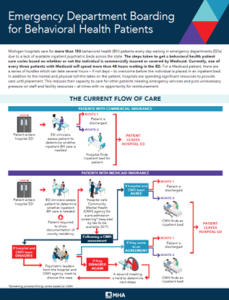
Infographic illustrating the differing processes that commercially insured patients go through to be assessed for a behavioral health need compared to a Medicaid beneficiary.
Infographic illustrating the differing processes that a Medicaid beneficiary goes through to be assessed for a behavioral health need compared to a commercially insured patient.

Under the current guidelines, LaPine explained, there are a series of arduous steps needed in order to get patients with Medicaid coverage inpatient behavioral healthcare. One of the biggest hurdles is that following an assessment by ED clinicians, a patient with Medicaid must receive a secondary pre-admission screening from a community mental health (CMH) agency.

This process can take hours – if not days – to complete. Meanwhile, a patient needing the same level of care who is commercially insured is not required to have the pre-admission screening by a CMH.

Last year, there were more than 1.2 million emergency room visits where behavioral health was one of the reasons for care. LaPine noted that pediatric and geriatric patients board for the longest periods of time.

One proposed solution to alleviate the process is to expand the three-hour assessment responsibility to allow clinically qualified staff to conduct pre-admission screenings in order to improve the delivery of care for behavioral health patients in Michigan hospital EDs.

“Emergency departments across the state are well-equipped to complete the pre-admission screening to determine if someone needs inpatient psychiatric care,” said LaPine. “Implementing this change will really help us to expand the number of available healthcare personnel that are able and available to conduct that pre-admission screening…it also allows Medicaid patients to be assessed in a similar manner as patients that have commercial insurance.”

According to recent survey data, there are more than 155 patients waiting in a hospital emergency department for access to behavioral health services; Whether that is an assessment through a CMH agency, an inpatient bed or a transfer to a short-term, residential setting.

The episode is available to stream on Apple PodcastsSpotifySoundCloud and YouTube.

MW-TEC to Host Informational Webinar on Social Work Apprenticeship Opportunities

The Michigan Workforce Training & Education Collaborative (MW-TEC) will host an informational webinar at 10 a.m. April 23 discussing social work apprenticeship opportunities.

With a growing demand for behavioral health workers, apprenticeship programs can serve as part of the solution. Apprenticeship programs help employers build skilled talent pipelines, while supporting workers in their professional growth. They aid in filling crucial roles related to the Medicaid program by employing those with lived experience. The Michigan Works! program follows an “earn while you learn” model, which reduces financial barriers for participants wanting to enter the social work profession.

An apprenticeship program has been effectively established through the MW-TEC, with opportunities for expansion. MHA members are encouraged to join the webinar, which will provide more information on creating a registered apprenticeship with the Michigan Works! agency and finding funding resources for apprenticeships.

Members with questions may contact Lauren LaPine at the MHA.

Medicaid & Pediatric Behavioral Health Media Coverage

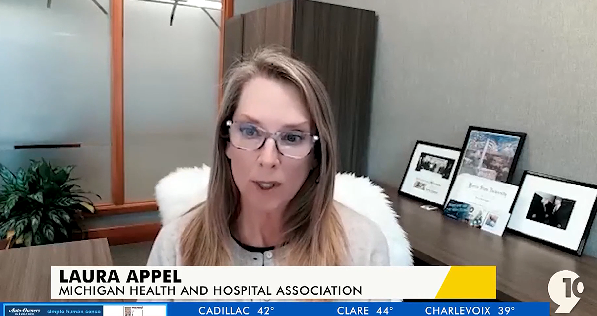
Laura Appel speaks with 9&10 News.

The MHA received media coverage the week of April 7 on potential Medicaid funding cuts, pediatric behavioral health and healthcare costs.

9&10 News aired a story April 9 on potential federal Medicaid funding cuts. MHA Executive Vice President Laura Appel spoke with 9&10 News, explaining how the cuts would specifically impact rural healthcare. Representatives from McLaren Health Care and Munson Healthcare also appeared in the story.

“In our rural areas, we have small populations, and some of them are also shrinking, which makes it that much harder to sustain certain services because of the fixed costs being spread over so few people,” said Appel. “When we lose a labor and delivery unit, we lose it for that entire population.”

Lauren LaPineSecond Wave Michigan published a story April 8 about how Michigan hospitals are improving pediatric behavioral healthcare. Lauren LaPine, MHA senior director of legislative and public policy, spoke with Second Wave Michigan about the MHA’s behavioral health work, focusing particularly on the $50 million state grant the MHA served as the fiduciary for to expand inpatient pediatric behavioral health capacity in the state. LaPine also highlighted the data the MHA collected regarding emergency department boarding, which shows at least 155 people at any point, including 17 children, are in an emergency department awaiting behavioral health care.

“Our data in Michigan reflects some of the trends that we see nationally in terms of the increasing need for behavioral health services for children and youth,” said LaPine. “So, we are paying really close attention to that need and want to make sure that our member hospitals and health systems are able to address the need when pediatric patients and their families come to the hospital in a behavioral health crisis.”

Lastly, Crain’s published a story April 9 about the role of hospitals regarding rising healthcare costs. MHA CEO Brian Peters is quoted in the story, explaining how the majority of rising costs are due to responding to market trends for labor, as well as rising costs for facilities, drugs and supplies.

“The largest expense for hospitals is labor … A large component to increased healthcare costs for hospitals is making sure healthcare workers are appropriately and competitively compensated so they can provide care to patients when and where they need it,” said Peters.

Members with any questions regarding media requests should contact John Karasinski at the MHA.

MHA CEO Report — Prioritizing Rural Health

MHA Rounds graphic of Brian Peters

“Be sure you put your feet in the right place, then stand firm.” – Abraham Lincoln

MHA Rounds graphic of Brian PetersWhile snow continues to fall in northern Michigan, spring is officially here, and for many, that means our weekend travel plans shift from skiing and snowmobiling to camping, hiking and boating. Rural Michigan is an amazing travel destination for many, but it also is home year-round to 20% of our state’s population, and access to affordable, high-quality healthcare remains absolutely crucial. Rural hospitals are an integral part of the local fabric of their communities, treating the ill and improving the health and well-being of their residents. They work extremely hard to make sure they’re able to provide the best quality of care, while operating on a budget with slim to nonexistent margins. In a small town, there is nowhere to hide when the hospital is experiencing challenges of any kind. This is especially true when the hospital is the largest employer in the community and a vital economic engine, which is very often the case in rural Michigan.

I recently had the opportunity to attend the annual American Hospital Association (AHA) Rural Health Care Leadership Conference, along with a number of MHA senior staff and Michigan rural healthcare leaders, including Tina Freese Decker, CEO of Corewell Health and current chair of the AHA Board of Trustees; Julie Yaroch, DO, CEO of ProMedica Charles and Virginia Hickman Hospital and current chair of the MHA Board of Trustees; and JJ Hodshire, CEO of Hillsdale Hospital, current MHA Board member and host of the Rural Health Today podcast. We focused on the latest rural health challenges and innovations, as well as our shared federal advocacy priorities. Key topics included rural obstetrical care, cybersecurity, long-term care transformation and strategic partnerships.

According to the latest U.S. census and other demographic resources, rural Americans are notably older, sicker and poorer than their urban and suburban counterparts. While rural areas currently cover 97% of the nation’s land, they are home to only 19.3% of the total population. Demographers believe that we are moving toward a future state in which an even higher concentration of the population will be in non-rural settings – and that in the next five years, more than 40% of Michigan counties will have more than a quarter of their population older than 65, with nearly all of those counties being rural. As we have learned – especially during the COVID pandemic – traditional volume-based healthcare reimbursement methods do not adequately address the fixed costs inherent in healthcare delivery, a reality that is exacerbated for rural hospitals with smaller patient volumes and more constricted resources and economies of scale.

Although Medicaid expansion (a major accomplishment resulting from MHA advocacy) improved the viability of rural hospitals – a fact that is borne out when benchmarking Michigan to non-expansion states – that funding is currently in severe jeopardy given the current state of play in Washington, D.C., as discussed at length in last month’s CEO Report. In addition, the 340B program is another critically important part of the rural healthcare ecosystem, as the cost savings from the program are used by healthcare providers to offer critically important services to everyone in their respective communities, regardless of their socioeconomic status. The MHA continues to advocate at the state and federal level, in the legislative arena and in the courts, to protect and defend the 340B program.

With guidance from the MHA Council on Small or Rural Hospitals, currently chaired by Peter Marinoff, CEO of Munson Healthcare Southern Region (see Peter’s recent insights on rural healthcare), and staffed by Lauren LaPine, MHA senior director of Legislative and Public Policy, the MHA is also advocating for continuation of the rural access pool and obstetrical stabilization fund in the state budget, and promoting good public policy with respect to critical access hospitals, rural emergency hospitals and a host of other key issues.

Our rural healthcare leaders continue to prove they are exceptional at delivering extraordinary value, despite challenging circumstances. I know from first-hand experience that our rural hospitals provide high quality care and deserve to be fully supported. And we absolutely must support them, as the fragility of the current environment is real: there have been some 151 rural hospitals that have closed across the country since 2010 due to financial variables that make it extremely difficult to maintain hospital facilities in rural areas.

Now more than ever, we need to think about our rural hospitals, stand firm and do all we can to protect these vital institutions.

As always, I welcome your thoughts.