Medical Residents Highlight Workforce Needs During 2025 GME Capitol Day

Trinity physician residents pictured in the Anderson House Office Building.
Trinity Health physician residents pictured in the Anderson House Office Building.

The MHA Graduate Medical Education (GME) Capitol Day welcomed more than 40 physician residents from a dozen member hospitals to the MHA Capitol Advocacy Center offices May 21 for a day of meetings with members of the Michigan Legislature and their staffs. Each group of residents met with a combination of lawmakers and legislative staff throughout the day, with conversations focusing on the importance of graduate medical education, physician residents in the healthcare continuum and Michigan’s future physician healthcare workforce talent pipeline. Residents also urged legislators to support bipartisan bills that protects healthcare workers from violence, to accompany Public Acts 271 and 272 of 2023.

Meetings were held in the Michigan Capitol, the Anderson House Office Building and the Senate Binsfeld Office Building.

Participating lawmaker offices included:

  • Senator Kevin Hertel (D-St. Clair Shores), Chair, Health Policy Committee
  • Representative Rachelle Smit (R-Martin), Speaker Pro Tempore
  • Senator Sam Singh (D-East Lansing), Senate Majority Floor Leader
  • Representative Joe Aragona (R-Clinton Twp.), Chair, Regulatory Reform Committee

Residents used and shared with lawmakers an infographic that provides facts regarding GME.

Members with questions on GME and state legislation related to the healthcare workforce may contact Elizabeth Kutter at the MHA.

GME Capitol Day Approaches May 21

The MHA is hosting the 2025 MHA Graduate Medical Education (GME) Capitol Day from 9 a.m. to 3:30 p.m. May 21 in Lansing. The event is an opportunity for Michigan’s physician residents from teaching hospitals and academic medical centers to meet with legislators to discuss the vital role GME health professionals play in the healthcare continuum and other legislative issues facing physician residents and medical students in Michigan.

Physician residents, GME program administrators and directors are encouraged to register by May 9. Due to legislative schedules and meeting space limitations, each participating group is encouraged to register no more than three physician residents per hospital.

Members with questions may contact Elizabeth Kutter at the MHA.

MHA to host GME Capitol Day May 21

The MHA is hosting the 2025 MHA Graduate Medical Education (GME) Capitol Day from 9 a.m. – 3:30 p.m. May 21 in Lansing. The event is an opportunity for Michigan’s physician residents from teaching hospitals and academic medical centers to meet with legislators to discuss the vital importance of GME health professionals and other legislative issues facing physician residents and medical students in the state.

Physician residents, GME program administrators and directors are encouraged to register by May 9. Due to legislative schedules and meeting space limitations, each participating group is encouraged to register no more than three physician residents per hospital.

Members with questions may contact Elizabeth Kutter at the MHA.

MHA CEO Report — A Program Year in Review

MHA Rounds graphic of Brian Peters

“Winning is not a sometime thing, it is an all the time thing. You don’t do things right once in a while…you do them right all the time.”  — Vince Lombardi

MHA Rounds image of Brian PetersI am pleased to share we just completed a successful MHA Annual Meeting, continuing a long-standing June tradition whereby we celebrate the conclusion of one MHA program year, and prepare for the next. Each program year is unique with the different challenges it presents. At this point five years ago, no one could have predicted how the emergence of COVID-19 would flip healthcare on its head and drastically alter the tactical objectives of our association. However, there is a constant: the MHA continues to rise to any challenge presented to us and we deliver results for our membership to improve the health and wellness of individuals and communities.

The 2023-2024 program year focused intensely on workforce, viability and behavioral health, while addressing the various “wildcard” issues that always come up. We were led with great wisdom and compassion by Shannon Striebich, president and CEO, Trinity Health Michigan, as our board chair. Due to Shannon’s commitment and leadership, the MHA accomplished numerous highly successful and impactful outcomes on behalf of our members.

One of the most significant challenges in this past year was the threat posed by government-mandated nurse staffing ratio legislation. This proposed policy had the potential to dramatically reduce access to care for individuals throughout the state. Our advocacy on the issue lasted throughout the entire year but was highlighted by an Advocacy Day we hosted in September that featured more than 150 hospital representatives, primarily consisting of nurse leaders, who came to the Capitol and conducted 118 meetings with lawmakers that day. Later in the year, the MHA successfully advocated our position at a committee hearing, where more than 60 supporters attended on very short notice to push back on false narratives and to support alternative nurse staffing solutions. As a result of our efforts, no committee votes have been scheduled, and momentum on this harmful legislation has been effectively stalled.

While we had to play defense against this harmful proposed legislation, the MHA spent the program year actively engaged in workforce development and efforts to grow the healthcare talent pipeline. The MHA worked with stakeholders to implement new funding designed to expand access to Bachelor of Science in Nursing degrees through partnerships between community colleges and four-year universities, while also engaged in partnerships with other organizations to promote healthcare careers, increase clinical faculty and nurse preceptors, address high turnover rates in rural areas and promote healthcare career options. We continued our award-winning healthcare career marketing campaign designed to attract future workers and also redeployed our annual hospital workforce survey that shows the efforts of Michigan hospitals to recruit, retain and train healthcare workers is making a real difference. Finally, we hired our first-ever chief nursing officer at the MHA, which is already strengthening our ties to the nursing community throughout the state.

The viability of hospitals was another key focus and was largely supported through our legislative advocacy work. MHA funding priorities continued to be protected in the state budget, which includes $163 million for graduate medical education, $45 million for traditional disproportionate share hospitals, $15 million through the rural access pool and an additional $8 million for the obstetrical stabilization fund. The fiscal year 2024 budget also included $60 million annually to support hospitals with Level I and II trauma centers and $34 million annually to support hospitals that provide inpatient psychiatric care. Besides state funding, the MHA protected Medicaid funding, medical liability, the 340B drug pricing program and certificate of need.

The MHA is also intricately involved in in addressing the behavioral health crisis plaguing our state and country. Expanding access to care is a key focus, which included the MHA administrating a $50 million grant program to expand access to pediatric inpatient behavioral health services. The Michigan Department of Health and Human Services (MDHHS) is a close partner in this work and the MHA participated in the MDHHS Advisory Committee on the creation of a psychiatric bed registry. The MHA launched a new member ED boarding survey to quantify the number of patients struggling with behavioral health access in the emergency department and the MHA is using this data when engaging with lawmakers, stakeholders and the public to explain the scope of the program. These learnings informed the creation of a four-bill package of legislation to address board-identified issues in the behavioral and mental health system, such as coverage parity and community mental health shortcomings.

Much of the work in the past year has focused on maternal and infant health and improving maternal health and birth outcomes. And I am pleased to share that our MHA Board of Trustees just approved the full slate of recommendations emanating from the MHA Community Access to Health Task Force, giving us the support to continue this important journey together.

And as usual, we effectively dealt with a long list of “wildcard” issues that emerged during the program year, including drug shortages, guardianship, infection control, patient transport, population growth and safety and quality. We also continued to strengthen our efforts related to the growing cybersecurity threat. Indeed, the Change Healthcare cyberattack was one of the largest and most impactful attacks ever seen and served as a clear reminder of the importance of our work in this space.

At our Annual Meeting, I spoke to our attendees about “the power of zero.” In the 2023-2024 program year, the following were true:

  • The number of Michigan acute care community hospitals and health systems that are not members of our association is zero. We have everyone at the table, which allows us to speak with one powerful, united voice.
  • We passed 39 MHA-supported bills through the state legislature that were enacted into law, with five more on their way to the governor for her signature. The number of MHA-opposed bills that made their way to the finish line was zero.
  • The MHA now has a full-time chief medical officer and a full-time chief nursing officer (as noted above). How many other state hospital associations can say this? Zero.
  • And most importantly, how many other associations – in any sector – are as relevant, as impactful, as mission-driven and successful as the MHA? I believe that number is zero.

I would like to recognize and thank our outstanding MHA Board of Trustees, our members, sponsors and business partners, but most of all, our incredible MHA staff for coming together to achieve such tremendous results for the patients and communities we collectively serve. I hope you will take the opportunity to celebrate these results with us.

As always, I welcome your thoughts.

Healthcare Advocates Honored with MHA Special Recognition Award

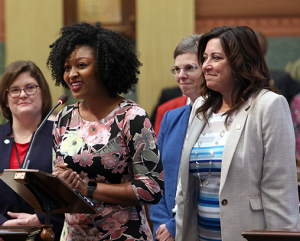
Sen. Anthony and Rep. Witwer

The MHA announced two winners of its Special Recognition Award during the Annual Membership Meeting June 27, recognizing them for extensive contributions to healthcare. Each of the winners has uniquely influenced healthcare in Michigan. The winners include Sen. Sarah Anthony (D-Lansing) and Rep. Angela Witwer (D-Delta Township).

The lawmakers each chair their chamber’s appropriations committee, with Anthony the first Black woman to ever chair the Senate Appropriations Committee. These committees are responsible for determining the annual state budget, covering important healthcare areas including Medicaid, the Healthy Michigan Plan, graduate medical education, the rural access pool and obstetrical stabilization fund, and critical access hospital reimbursement rates. Both lawmakers were strong supporters of Public Act 5 of 2023, sponsored by Witwer, which provided $75 million for hospital workforce recruitment, retention and training in the fiscal year 2023 state budget. In addition, they each fought to include enhanced funding for ongoing Level I and Level II trauma centers, inpatient psychiatric payment rates and maternal health in the fiscal year 2024 budget. Both Anthony and Witwer are strong supporters of funding Medicaid appropriately to ensure adequate reimbursement rates for providers and protect access to healthcare services.

Sen. Sarah Anthony (D-Lansing)

In addition to her committee role, Anthony prioritizes expanding access to healthcare. She sponsored Michigan’s first mental health parity law, signed into law May 21 by Gov. Whitmer. Public Act 41 of 2024 requires insurance coverage for mental health and substance use disorder treatments at the same level as physical health services. This new law eliminates existing disparities and ensure equal access to necessary care for all Michiganders. Anthony also co-sponsored key legislation last session to support the healthcare talent pipeline signed into law by Gov. Whitmer Dec. 22, 2022. Public Acts 251 and 252 of 2022 expanded the Michigan Reconnect program, allowing for several additional certifications to qualify for the post-secondary scholarship program including high-demand healthcare credentials. Other healthcare legislation Anthony sponsors includes Senate Bill 531, which is part of a package of bills supported by the MHA that would improve Michigan’s amended auto no-fault laws. The package would simplify and increase Medicare hospital reimbursements, clarify the definition of Medicare and create a new post-acute care provider fee schedule. The bills passed the Senate in a bipartisan vote and await consideration by the House.

Rep. Angela Witwer (D-Delta Township)

Witwer’s role as a healthcare champion is inspired by more than the 22 years she spent working in healthcare to begin her career. She first started as a clinician, working in University of Michigan Health – Sparrow Lansing’s burn unit and later as the manager of pediatric rehabilitation. She later became manager of the hospital’s community relations and marketing department, before leaving the organization to co-found her own public relations, marketing and advocacy firm. These life experiences inspired Witwer’s support for Public Acts 271 and 272 of 2023, which increase the penalties for assaulting a healthcare worker or volunteer by doubling the financial fines for those found guilty of such a crime.

Medical Residents Converge for GME Capitol Day

Three physician residents and a Michigan state house representative posing for a photo in a hallway.
Henry Ford Health physician residents pictured with Representative Kimberly Edwards (D-Eastpointe).

The MHA Graduate Medical Education (GME) Capitol Day welcomed more than 40 physician residents from a dozen member hospitals to the MHA Capitol Advocacy Center offices May 1 for a day of meetings with members of the Michigan Legislature and their staffs. Each group of residents met with a combination of lawmakers and legislative staff throughout the day, with conversations focusing on the importance of graduate medical education, physician residents in the healthcare continuum and Michigan’s future physician healthcare workforce talent pipeline.

Meetings were held in the Michigan Capitol, the Anderson House Office Building and the Senate Binsfeld Office Building.

Participating lawmaker offices included:

  • House Speaker Joe Tate (D-Detroit)
  • House Minority Leader Matt Hall (R-Richland Township)
  • Senate Minority Leader Aric Nesbitt (R-Porter Township)
  • Senate Healthy Policy Chair Kevin Hertel (D-Saint Clair Shores)
  • Senate Health Policy Vice Chair Sylvia Santana (D-Detroit)
  • House Appropriations Chair Angela Witwer (D-Delta Township)
  • House Speaker Pro Tempore Laurie Pohutsky (D-Livonia)
  • House Majority Floor Leader Abraham Aiyash (D-Hamtramck)

Residents used and shared with lawmakers an infographic that provides facts regarding GME.

Members with questions on GME and state legislation related to the healthcare workforce should contact Elizabeth Kutter at the MHA.

Healthcare Remains Key Piece of Executive Budget Recommendation

The following statement can be attributed to Brian Peters, CEO of the Michigan Health & Hospital Association.

MHA CEO Brian PetersHealthcare access is vital for the physical and economic health of our local economies. This budget proposal presented by the Whitmer administration checks the boxes hospitals and health systems need when it comes to crucial state funding. It includes new funding that can make significant impacts on maternal and infant health, behavioral health and the healthcare workforce, while maintaining existing support for a variety of needed healthcare programs.

Hospitals and health systems are focused on addressing health disparities. Supporting additional maternal health services can help reduce the disparity in maternal health outcomes among non-white women. Expanded Medicaid reimbursement for behavioral health services will improve access across the state and benefit the workforce. We’re encouraged to see funding for tuition-free community college pathways for Michiganders. This can increase the number of students pursuing healthcare pathways and address workforce shortages. Continuing funding pools to support rural and critical access hospitals, obstetrical services, graduate medical education, the Healthy Michigan Plan and Michigan’s Medicaid populations will help maintain access to care for underserved populations throughout Michigan.

Gov. Whitmer is clearly a healthcare champion. We look forward to working with other legislative healthcare champions during the budget process to make sure Michigan healthcare providers have the necessary funding support to advance the health and wellness of Michiganders and communities.

Hospitals Urged to Apply for GME Full-Time Equivalent Slots

Hospitals are urged to apply for additional graduate medical education (GME) full-time equivalent (FTE) resident cap slots for fiscal year (FY) 2025 by March 31. Section 126 of the Consolidated Appropriations Act, 2021, made available an additional 1,000 GME FTE slots, phased in over five years, beginning in FY 2023. 10% of slots must go to hospitals in rural areas, but only two geographically rural hospitals received slots in the most recent round of slot distribution.

Hospitals must qualify in at least one category:

  • Located in a rural area.
  • Train residents in excess of their GME cap.
  • Located in states with new medical schools.
  • Serve areas designated as health professional shortage areas (HPSAs) – geographic HPSAs only and not population HPSAs.

Section 125 requires at least 10% of the cap slots go to hospitals in each of the four categories, and no single hospital can receive more than 25 additional FTE resident cap slots. Hospitals can apply for FTE resident cap slots under Section 126 by accessing the online application system.

The Rural Residency Program Development Technical Assistance Center is hosting a webinar Jan. 17 at 12 p.m. ET, titled Expand GME Training at Your Hospital: How to Apply for Section 126 Positions. The session will provide a background on Section 126 GME slots and discuss the application process for round 3 (e.g., timeline, eligibility, requirements, etc.). Members are encouraged to register in advance.

Additional information on the application submission process and application questions can be found on the Direct Graduate Medical Education webpage.

Members with questions should contact Lauren LaPine at the MHA.