
MHA CEO Report — The Realities of the Earned Sick Time Act

MHA Rounds image of Brian Peters

MHA Rounds image of Brian Peters“Train people well enough so they can leave. Treat them well enough so they don’t have to.” – Sir Richard Branson

Healthcare continues to be the leading private-sector employer in Michigan. Our latest Economic Impact of Healthcare in Michigan report shows healthcare provided nearly 572,000 direct jobs in Michigan in 2022, with roughly 217,000 of those jobs in hospitals. Whether in our largest urban cities or our smallest rural towns, hospitals are often one of – if not the – largest employers in their communities.

In a sense, hospitals operate as their own small towns, open 24/7/365, requiring a multitude of different professions to not only make sure patients receive the right care, but that they’re fed appropriately, receive the correct medications, have clean rooms, gowns and a litany of other tasks. Thus, the environment that hospitals operate in as employers is extremely critical. Hospitals go to great lengths to not only identify and hire the right people, but to offer strong compensation and benefit packages, training and career development, and flexibility that will retain them. With this heavy reliance on labor, it is no wonder that hospital human resources departments have been paying particular attention to a new state law set to go into effect Feb. 21 known as the Earned Sick Time Act.

The soon-to-be-implemented laws were established after the Michigan Supreme Court upheld voter initiative petitions last July on paid sick leave and minimum wage following a legal challenge to the Michigan Legislature “adopting-and amending” these petitions in 2018. Unfortunately, the Earned Sick Time Act presents many challenges to employers that need to be addressed in advance of the Feb. 21 deadline. With hospitals responsible for implementing and complying with required sick time allocations for their employees, they need state laws and policies that contemplate how hospitals operate.

To advocate on our hospitals’ behalf, the MHA joined a coalition of employers led by the Michigan Chamber of Commerce calling for action by the legislature to address the practical challenges and conflicts created by the revised law. Hospitals are firmly committed to ensuring employees have the benefits and flexibility needed to care for themselves and their families. Our participation is simply to establish an environment that allows hospitals to continue to operate and provide benefits to the more than 200,000 hospital workers in the state.

The changes that need to occur include refining the definition of an eligible employee; recognizing annually allocated sick time, as opposed to accrued sick time, as well as other paid leave offered by an employer; addressing conflicts with existing federal employment law; and limiting the incentive for increased legal action.

The current law is overly broad in the definition of an eligible employee, creating situations where variable time employees and exempt employees, including employed physicians, would be due earned sick time and adding liabilities for hospitals. The law as written also prevents employers from providing the full allotment of sick time at the beginning of the year, instead requiring sick time to be accrued. This reduces employee flexibility and increases record-keeping requirements for the employer. In addition, employers vary in how they offer paid leave, whether it is through one Paid Time Off bank, or through a combination of vacation, sick and personal and/or paid leave. Once again, this harms the types of benefits offered to healthcare workers and the flexibility a hospital has in creating a benefits package that best matches their employees.

The revived law also creates several conflicts with several prominent federal laws, including the Family and Medical Leave Act, the Fair Labor Standards Act and the Americans with Disability Act. Hospitals need clarity and laws that are congruent with each other. We as a state can not implement laws that put all employers at odds with federal requirements. The demand for workforce talent is too high for Michigan to afford to implement barriers that make our state less attractive to employers.

Lastly, the revived act creates a private right of action, allowing an employee to sue an employer for violating the act. The MHA is supportive of state enforcement and a complaint and investigation process overseen by the state that dictates enforcement far before parties need to engage with the legal process. Failing to address the private right of action will lead to increased administrative and legal costs for all employers.

Thankfully, amending the Earned Sick Time Act is a priority for both chambers of the Michigan Legislature. This issue was the second bill introduced by new state House leadership in the form of House Bill 4002, which has already passed the chamber. The Senate introduced their own version, establishing a framework necessary for legislative negotiations between the two separate chambers and their opposing partisan leaders.

The MHA and the other members of the coalition will continue to advocate on behalf of our members and their employees to make sure changes are made in the best interests of both employees and employers. Hospitals have always prided themselves on the benefits they offer to their healthcare workers, and we should not risk lowering the quality of those benefits to accommodate the Earned Sick Time Act as written. The time exists to get something done and we will use every lever at our disposal to make sure our concerns are heard by all in Lansing.

As always, I welcome your thoughts.
MHA CEO Report — Moving the Workforce Needle

MHA Rounds image of Brian Peters

“Luck is not chance, it’s toil; fortune’s expensive smile is earned.” — Emily Dickinson

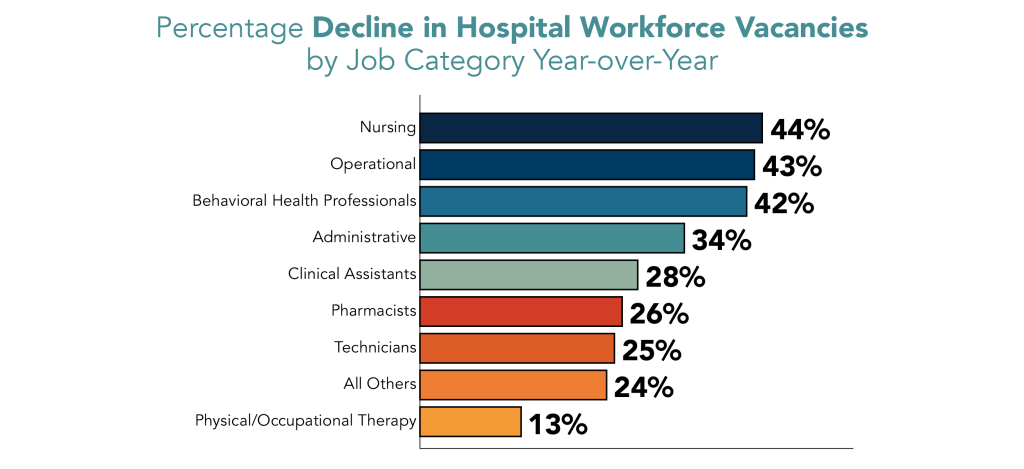
The healthcare workforce has been one of the MHA’s strategic action priorities for the past several years. As we near completion of our 2023-2024 program year, I’m extremely pleased to see the results of the MHA’s second annual hospital workforce survey, which shows Michigan hospitals are making real progress in reducing staffing shortages. Michigan hospitals hired more than 61,000 employees in 2023, including 13,000 nurses. Overall job vacancies were reduced by 29%, while nursing vacancies dropped by 44%. These gains are seen across nearly all job categories and they’re significant, with double-digit decreases for many of them. I can tell you with certainty: our “luck” in this regard has been earned through extremely hard work.

Michigan hospitals still have 19,000 job openings, including 4,700 for nurses, so more work and investment needs to be done. However, the accomplishments of Michigan hospitals in this area shows the recruitment, retention and training tactics implemented throughout the state are working.

It starts with retaining the existing workforce, which leads to improved morale and reduced recruiting expenses. Michigan hospitals are outperforming hospitals across the country when it comes to registered nurse retention. Michigan’s turnover rate is 3.7 percentage points lower than the national average. Offering better pay, improved benefits, flexible scheduling and integration of technology to improve patient monitoring and reduce the administrative burden on nurses are examples of tactics implemented by Michigan hospitals that are making a difference.

Michigan remains an aging state, and as more people become eligible for Medicare, the demand for healthcare services will continue to grow. In response, our hospitals are very serious about expanding the talent pipeline and increasing awareness of hospital careers to students. Hospitals are expanding educational opportunities and partnerships with higher education institutions to attract more students to healthcare, including clinical positions like nursing. The MHA is assisting by leading the MI Hospital Careers public awareness campaign that targets students and professionals considering a career change to consider healthcare as a great option.

The MHA also recently published the latest results from the Economic Impact of Healthcare in Michigan report, which shows the important role hospitals have in Michigan’s workforce and economy. Healthcare remains Michigan’s largest employer of direct, private-sector jobs. Hospitals provide the largest percentage of healthcare jobs in the state, employing 217,000 full-and part-time employees. Not only are these good-paying, stable jobs, but many offer career pathways that allow employees to further develop their skills and move up the job ladder with additional certifications and/or degrees. Many of Michigan’s communities also depend on their local hospital as one of, if not their very largest, employer.

These results led our conversations last week while a team of MHA staff attended the Detroit Regional Chamber’s annual Mackinac Policy Conference, connecting with business, higher education and political leaders throughout Michigan. In addition to this public announcement, we also produced a palm card and video for event attendees to highlight our work. Our goal is to increase the awareness of the large role hospitals play in the economy and the success they’re having in welcoming new talent to their organizations.

Reducing job vacancies and staffing shortages is a marathon and not a sprint. The Michigan Legislature has played a large part in assisting hospitals, whether it be through direct worker funding or new policies, such as increased penalties for violence committed against healthcare workers or allowing community colleges to offer Bachelor of Science in Nursing degree programs in collaboration with a four-year institution. The MHA is proud to help lead many of these discussions with policymakers to find more ways to reduce barriers to healthcare careers.

Public policy, advocacy and communications are key – but we are using every tool in our toolbox to address our workforce challenges. The MHA Endorsed Business Partner (EBP) program promotes industry-leading firms, carefully vetted by the MHA, that can meet the most pressing needs of our member hospitals and health systems, and we just announced a new endorsement of AMN Healthcare as a national leader in workforce solutions. The MHA has endorsed several of AMN’s legacy brands, including Merritt Hawkins, a physician search division, for many years. As AMN brings its solutions under one brand, we proudly continue this partnership with AMN Healthcare. They are the largest workforce solutions company in the market, which allows them to serve clients more effectively across all levels of healthcare.

Economic development and workforce are not just a one-year strategy. This will continue to remain a priority for hospitals and health systems, and we’re encouraged that at this time next year, we will have a similar story to tell in the reduced number of healthcare vacancies in the state. Until then, please join us and encourage as many people as you can to consider a job in healthcare. Make no mistake: whether clinical or non-clinical, healthcare is hard work; but it truly is one of the most rewarding, mission-driven careers you can pursue.

As always, I welcome your thoughts.

Michigan Hospitals Fill 61,000 Jobs in 2023

Healthcare Remains the Largest
Private-Sector Employer in Michigan

The Michigan Health & Hospital Association (MHA) published results from their second annual Michigan hospital workforce survey that shows hospital recruitment, retention and training efforts in 2023 helped fill 61,000 total positions in 2023, reducing job vacancies by 29% to a total of 19,000 statewide. More than 13,000 nurses were hired during that time, decreasing the number of nursing vacancies by 44%. The survey includes responses from more than 95% of all Michigan acute-care inpatient hospitals.

Nearly all job categories in the survey experienced double-digit percentage decreases in vacancies year-over-year. Hospitals successfully reduced vacancies in the following job categories:

  • Nursing – 44% decrease
  • Operations – 43% decrease
  • Behavioral health – 42% decrease
  • Administration – 34% decrease
  • Clinical assistants – 28% decrease
  • Pharmacists – 26% decrease
  • Technicians – 25% decrease

Bar graph of decline in hospital job vacancy by category.

Amidst a national nursing shortage, the results show Michigan hospitals are outperforming national nurse retention rates. The registered nurse (RN) turnover rate for Michigan hospitals is 3.7 percentage points lower than the national average of 18.4%. Examples of how Michigan hospitals are retaining and recruiting nurses include offering better and faster pay, improved benefits and employee support, and expanding educational opportunities for students to consider a nursing career. State funding obtained through Public Act 9 of 2022 and Public Act 5 of 2023 contributed to these efforts and have directly benefitted at least 69,000 healthcare workers.

To complement the efforts of individual hospitals, the MHA launched the statewide MI Hospital Careers public awareness campaign in 2023 targeting students and professionals considering a career change to express the value of healthcare careers. The MHA also engaged in efforts that ultimately led to four-year Bachelor of Science in Nursing programs at community colleges, expansion of the Michigan Reconnect program to allow funds to support Michiganders accessing healthcare credentials for technician and nursing careers, and new state law that increases the penalties for individuals who commit acts of violence against healthcare workers.

Michigan hospitals remain focused on solutions that build the healthcare workforce that patients need now, and in the future, to fill the remaining 19,000 open hospital positions, including 4,700 in nursing.

These efforts will strengthen healthcare in Michigan, which remains the state’s largest employer of direct, private-sector jobs according to 2024 Economic Impact of Healthcare in Michigan data. More than one million jobs in Michigan were directly or indirectly related to or induced by healthcare in fiscal year 2022, the most recent data available. Hospitals collectively employ 217,000 full- and part-time employees, remaining one of the largest employers in many Michigan communities. In addition, direct healthcare workers in Michigan earned nearly $47 billion in wages, salaries and benefits.

“Retaining and growing the workforce is a top priority shared by hospitals throughout the state,” said Michigan Health & Hospital Association CEO Brian Peters. “We’re extremely encouraged by the data demonstrating the success of hospitals over the past year in increasing the talent pipeline to care for patients and strengthening the healthcare workforce. Hospitals provide Michigan communities with good jobs that help drive our state’s economy and keep residents healthy.”

The 19th edition of The Economic Impact of Healthcare in Michigan was compiled using IMPLAN® cloud software to quantify healthcare’s significant economic impact in the state. The data represents direct, indirect[1] and induced[2] healthcare jobs; taxes paid by those workers and their employers; and salaries, wages and benefits earned. The report is an online, interactive tool that allows users to examine these economic impacts from a statewide perspective and by region, county or congressional district. It is available at www.economicimpact.org.

[1] Indirect jobs are those created to support a larger employer or industry (for example, a laundry that cleans linens for a hospital).

[2] Induced jobs are those created by the spending of people who work in the indirect jobs (for example, a restaurant waiter who serves the laundry workers).

MHA CEO Report — Prioritizing our Workforce

MHA Rounds image of Brian Peters

“When people are financially invested, they want a return. When people are emotionally invested, they want to contribute.” – Simon Sinek 

Workforce Support and Innovation is the top priority for the MHA this program year, as identified by our board of trustees and echoed by every member hospital and health system throughout the state. This should come as no surprise, as few sectors of our Michigan economy have been more challenged in this regard. I am proud to say the MHA has tackled this challenge head-on, using every tool in our increasingly diverse association toolbox.

For our members, we know delivering exceptional care begins with hiring, developing and retaining quality talent. We also know that the demographic realities of an aging population and the associated retirements, rising stress and burnout, and increased rates of violence against healthcare workers are all contributing to retention challenges and staffing shortages. Finally, as with any daunting issue, we know the best way for us to be helpful to our members is to first tap their expertise, letting them share the details of their day-to-day experience so we can identify the most impactful solutions both inside and outside of the public policy domain. In short, we listen.

Through our MHA Human Resources & Workforce Council, we convene our HR professionals to discuss issues such as workforce development, the education and training pipeline, diversity, equity and inclusion efforts, workplace safety, and emerging technologies that can aid in the completion of clinical and non-clinical tasks. The council generates robust information sharing on best practices, as well as discussion on HR-related legislative and regulatory proposals at the state and federal level.

Our work with this council does not occur in a vacuum but is instead complemented by our continual engagement with MHA committees, councils and task forces that include chief medical officers, chief nursing officers, hospital and health system attorneys and government affairs leaders. So, what have we accomplished to date? The list is long and impressive. Just a few examples:

  • Over the past two state budget cycles, we secured $300 million in new funding for our member hospitals for the specific purpose of workforce recruitment and retention.
  • We launched the new MI Hospital Careers campaign, which has helped to shine a light on hospitals and healthcare as a viable career path for Michiganders. We also continue to partner with state universities and community colleges to ramp up health-related training programs.
  • We successfully advocated for Public Acts 271 and 272 of 2023, recently signed by Gov. Whitmer, which increase the penalties for violence committed towards healthcare workers or volunteers.
  • Our MHA Keystone Center launched the Well-B workforce well-being initiative, which has now reached thousands of hospital workers and is contributing to enhanced resiliency of our front-line caregivers.
  • Our MHA Graphic Services division designed and produced workplace safety posters, which are now prominently displayed in hospitals throughout Michigan.
  • The MHA is hosting our annual Human Resources Conference this month, which brings together chief human resource officers and leaders to collaborate, strategize and network. The conference is headlined by Kerry Ebersole Singh, the chief talent solutions & engagement officer at the Michigan Economic Development Corporation. Her presence confirms the MEDC’s recognition of the significant role healthcare plays in our state’s labor force and economic success – a fact we annually lift up in our Economic Impact of Healthcare report.
  • The MHA Service Corporation (MHASC) plays a vital role in this realm. Our HR Conference is sponsored by MHA Endorsed Business Partners AMN Healthcare and Salary.com (as well as MHA members Executive Core and HPS, and event sponsor Vault Verify), who are all involved in the workforce solutions space. The MHASC is working with partners who assist hospitals with de-escalation training and staff safety, virtual nursing programs and other emerging technologies, and more.
  • The MHASC is crucial to our work here in yet another way. The MHA Unemployment Compensation Program has a decades-long track record of success, saving millions of dollars every year for their more than 700 clients.

Everything listed is an example of proactive, positive activity. In other words, “playing offense.” Of course, one of our most significant activities in the workforce realm is an example of “playing defense” by ensuring government mandated nurse staffing ratio legislation that would significantly jeopardize patient access to care is not advanced by the state legislature. As discussed at length in a recent CEO Report, the MHA has worked very effectively to explain the complexity associated with hospital staffing and the tangible solutions that will actually address workforce shortages.

There is no silver bullet to solving healthcare’s workforce challenges. Michigan’s population is not growing and there are many market forces at play unique to healthcare. However, I’m extremely pleased by the work our own MHA staff has put forth to best position our members to achieve our workforce goals. And it couldn’t be done without the engagement from our colleagues in hospitals throughout the state who are doing all they can to ensure access to high quality care 24/7/365. Collectively, these are people who are clearly emotionally invested and making significant contributions to this worthy cause.

As always, I welcome your thoughts.