Report: Access, Affordability & Community Health Improved by Hospital Programming, Investments

2025 MHA Community Impact Report

The Michigan Health & Hospital Association (MHA) released today its 2025 Community Impact Report highlighting community programming and investments from Michigan hospitals that are improving access to care, addressing affordability and advancing the health of communities across every region of the state.

The report showcases 12 hospital-led programs that go beyond the traditional care setting to address community health needs across the state. It also outlines investments totaling more than $4.5 billion in community benefit activities in fiscal year (FY) 2023, from education and prevention services to clinical research, healthcare workforce support and more.

“Michigan hospitals continue to redefine care delivery and create new, innovative access points across the state,” said MHA CEO Brian Peters. “The MHA Community Impact Report is a strong reminder that our hospitals are committed to listening – and responding – to the needs of their communities.”

Programs featured in the report include University of Michigan Health-Sparrow’s mobile health clinic; Henry Ford Health’s hospital-based doula program; Corewell Health Gerber Hospital’s vaping cessation initiative; Mackinac Straits Health System’s retail pharmacy; and efforts by Bronson Battle Creek Hospital to address food insecurity; among many others. This work is a result of strategic investments, local partnerships and support from state and federal healthcare champions.

“Improving community health goes beyond the bedside,” said MHA Board Chair Bill Manns, president and CEO, Bronson Healthcare. “When we invest in programs that address socioeconomic challenges like food insecurity, we’re helping people overcome the barriers that stand between them and a healthier life.”

The full report and community impact stories from hospitals across the state can be accessed on the MHA website.

Based in Greater Lansing, the MHA is the statewide leader representing all community hospitals in Michigan. Established in 1919, the MHA represents the interests of its member hospitals and health systems in both the legislative and regulatory arenas on key issues and supports their efforts to provide quality, cost-effective and accessible care. The MHA’s mission is to advance the health of individuals and communities.

House Health Policy Hears Testimony on 340B Legislation

The House Health Policy Committee took up recently introduced legislation addressing 340B contract pharmacy arrangements during the week of Sept. 22.

House Bill (HB) 4878, sponsored by Rep. Curt VanderWall (R-Ludington), was recently introduced and referred to the House Health Policy Committee for further consideration. HB 4878 contains necessary language that protects hospitals’ contract pharmacy arrangements under the federal 340B program and includes drug price transparency requirements at the state-level. In addition to this, the bill contains hospital community benefit reporting requirements. The legislation ensures that eligible, participating 340B hospitals can continue to stretch scarce resources to support healthcare providers serving vulnerable patients and communities across the state – without using state or federal taxpayer dollars.

The committee met Sept. 24 to discuss the legislation and heard from various experts and stakeholders. MHA members had the opportunity to testify in support of the legislation and answer committee questions. James (Chip) Falahee, senior vice president of legal and legislative affairs, Bronson Healthcare, shared important background information on the program and why it is vital to protect it long-term at the state-level. Stephanie Field, director of pharmacy business services, Corewell Health West and South, spoke to the technical side of the 340B program and answered specific lawmaker questions on the processes involved in managing the program from a hospital entity perspective.

The MHA will continue to work with its members and state lawmakers on protecting this critical program that supports access to affordable, community-based care across the state.

Members with any questions related to the legislation may contact the advocacy team at the MHA.


MHA Podcast Explores Healthcare Priorities with 2025-2026 Board Chair Bill Manns

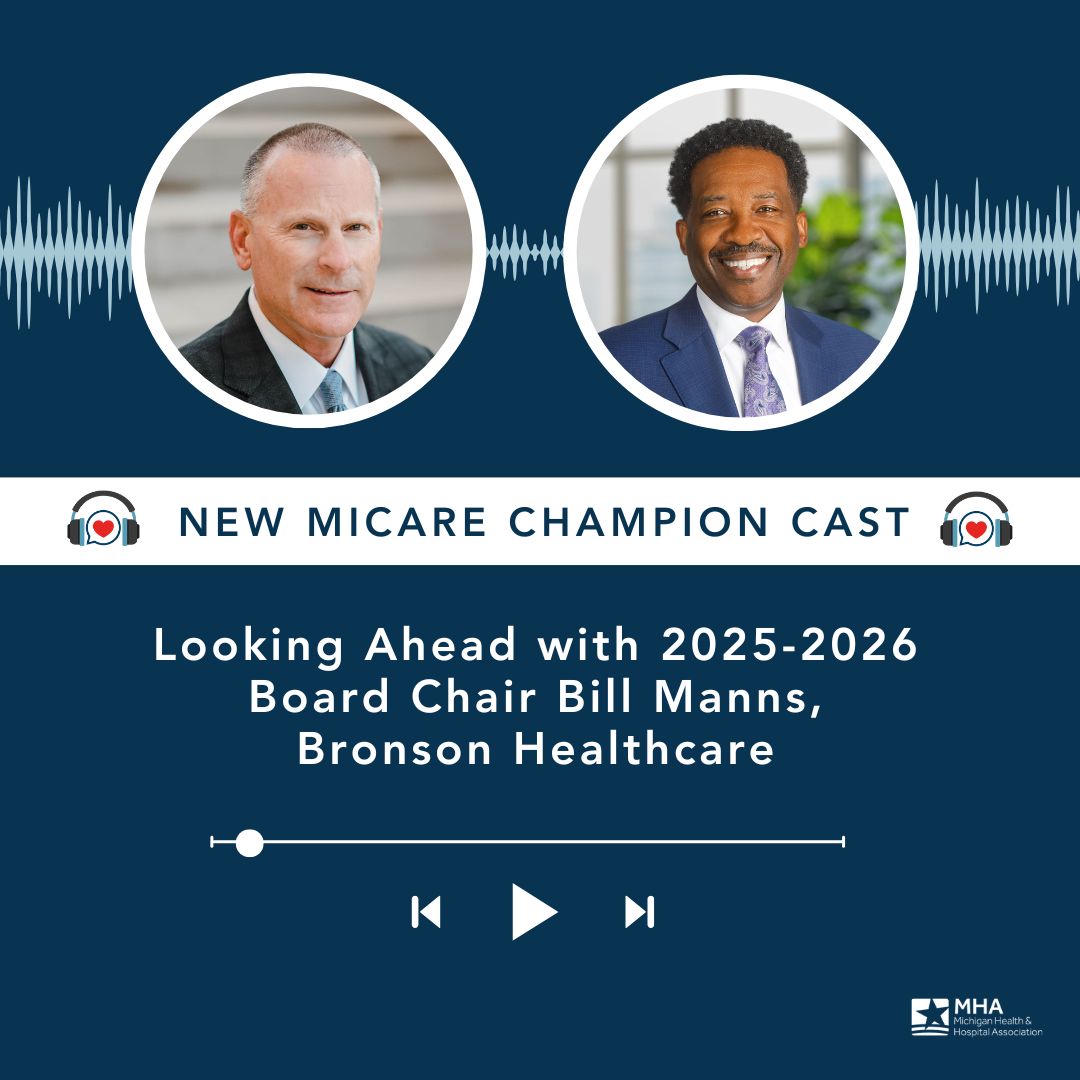
The MHA released a new episode of the MiCare Champion Cast exploring what’s top of mind in healthcare as the 2025-2026 program year kicks off.

The episode, hosted by MHA CEO Brian Peters, features MHA Board Chair Bill Manns, president and CEO, Bronson Healthcare. Manns shares more about his journey to healthcare leadership, current priorities at Bronson and what work lies ahead for hospital leaders given recent activity at the state and federal level.

Since joining Bronson in 2020, Manns oversees a full range of services from primary care to critical care across more than 100 locations. Fellow officers of the 2025-2026 MHA Board of Trustees include Brittany Lavis, chair-elect; and Kent Riddle, treasurer, among many other hospital leaders across Michigan.

Manns noted during the discussion that addressing infant mortality and improving maternal health across the state remain key areas of focus for his team at Bronson Healthcare and hospital leaders across the state.

“Women of color have mortality rates during birth that is, at times, double or triple that of their white counterparts,” said Manns. “As soon as we’re born – without bias or prejudice – if we can get equality there, I think that’s a great footing to build and grow as a community and I think as a nation, quite frankly.”

Over the course of the interview, Peters and Manns discuss the impact of the “One Big Beautiful Bill Act (OBBBA)” on hospitals and patient access to care given cuts to Medicaid funding.

“One, we’ve got to do a better job of educating the public about just what’s coming,” said Manns when discussing how to approach the negative impacts of the OBBBA. “Two, we really have to advocate – even stronger – with our legislators…and three, I think we’ve really got to continue to be optimistic and not panic.”

They also explore the importance of 340B, efforts to address workplace violence and more.

The episode is available to stream on Apple PodcastsSpotifySoundCloud and YouTube. Questions or idea submissions for future MiCare Champion Cast episodes can be sent to Lucy Ciaramitaro at the MHA.

MHA Awards Peer Recovery Coach Grants

The MHA has granted funding to seven institutions to support development or expansion of hospital-based peer recovery coach (PRC) programs. The funding will support the addition of 18 new hospital-based PRCs and expand treatment options for patients with a substance use disorder (SUD).

The MHA recently issued a request for proposals for a competitive grant program for Michigan healthcare entities aimed at developing or expanding hospital-based peer recovery coach programs. Funding for this effort was made available by the Michigan Legislature as part of the state fiscal year 2025 budget to expand access to hospital-based PRC services.

The MHA received nine applications from organizations in seven distinct regions of the state, encompassing many innovative approaches to provide high-quality care for individuals experiencing substance use disorders.

These seven organizations, which were granted funding, are as follows:

The MHA appreciates the time and effort that went into developing applications and looks forward to partnering to expand access to SUD services across the state.

Members with questions may contact Kelsey Ostergren at the MHA.

Bronson Battle Creek Hospital Nurse Honored with Q1 MHA Keystone Center Speak-up! Award

speak up
Brian Peters, CEO, MHA pictured with Season Willi, RN, Pre-Operative Nurse, Bronson Battle Creek Hospital and Gary L. Roth, DO, MBA, FACOS, Chief Medical Officer, MHA.

The Michigan Health & Hospital Association (MHA) Keystone Center recognized Season Willi, RN at Bronson Battle Creek Hospital, as its quarterly MHA Keystone Center Speak-up! Award recipient May 8.

The Speak-up! Award honors individuals or teams in Michigan hospitals who demonstrate an exceptional commitment to preventing harm to patients or staff. Willi was honored for speaking up when she noticed a patient’s guardian needed medical intervention during a pre-operative admissions call.

Willi noticed irregularities in the guardian’s speech before their call was disconnected. After attempting to reconnect multiple times, Willi contacted local authorities to conduct a welfare check. First responders brought the individual to the hospital to be treated for a stroke following Willi’s request.

“I’m relieved that the individual I spoke to over the phone received the medical attention they needed,” said Willi. “We are trained to remain vigilant for life-threatening symptoms, such as changes in speech patterns, and we hold a responsibility to intervene — even when the individual is not directly under our care.”

It was later learned that the individual was home alone and would have been for several more hours had Willi not intervened.

“Season’s critical thinking, life-saving instincts and deep compassion are at the core of who she is as a nurse. Her proactive intervention ensured that the patient received timely, emergent care — ultimately saving his life, “said Lindsey Wyman, Director of Nursing, Bronson Battle Creek Hospital. “Because of her swift action, he was able to return home to his family and resume the hobbies that he loves. We are all incredibly grateful for her expertise and decisive action, and thankful that this patient is now on the path to recovery.

Additional Speak-up! finalists for the first quarter of 2025 included:

  • Gabe Pierce, RN, University of Michigan Health-Sparrow
  • Kevin Komara, Corewell Health Farmington Hills Hospital

“It’s a privilege to celebrate nurses like Season that go above and beyond,” said MHA CEO Brian Peters. “”Her quick action reflects Bronson Healthcare’s commitment to the safety of the communities it serves, extending beyond the walls of its facilities.

More information about the MHA Keystone Center Speak-up! Award, including criteria and a nomination form, are available online.

Peters Discusses Healthcare Infrastructure with Crain’s Grand Rapids

Crain’s Grand Rapids published a story Feb. 22 about the decision by the Kalamazoo-based cooperative air ambulance program between Bronson Healthcare and Ascension Borgess Hospital to end flights later this year. MHA CEO Brian Peters is quoted in the story, speaking to the general industry trend of hospitals and health systems reviewing infrastructure to evaluate what service lines can remain viable into the future.

“Globally speaking, this is really an extension of this broader issue of what is the appropriate infrastructure that we need to serve the public going forward,” said Peters.

Members with any questions regarding media requests should contact John Karasinski at the MHA.