MHA Podcast Explores Healthcare Priorities with 2025-2026 Board Chair Bill Manns

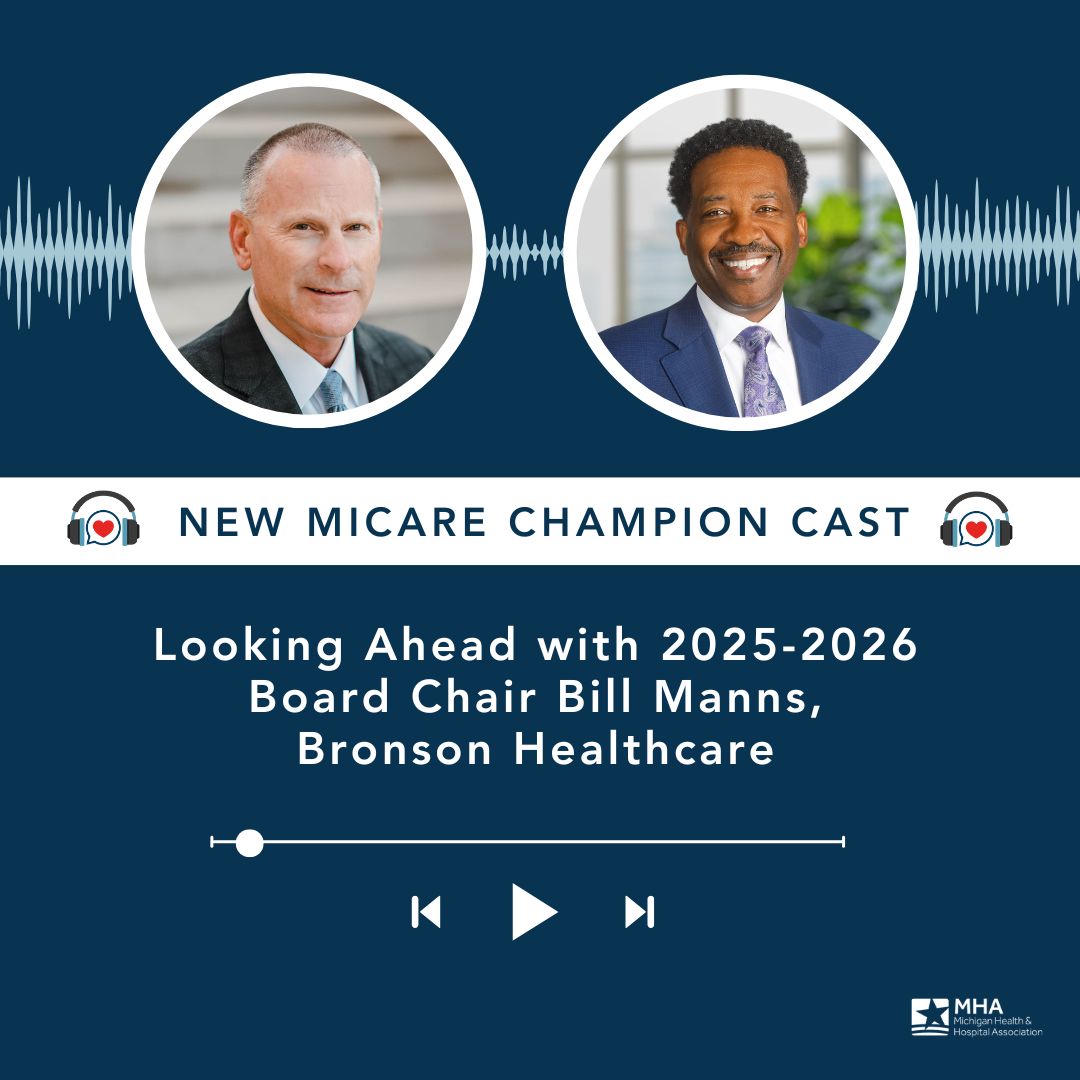
The MHA released a new episode of the MiCare Champion Cast exploring what’s top of mind in healthcare as the 2025-2026 program year kicks off.

The episode, hosted by MHA CEO Brian Peters, features MHA Board Chair Bill Manns, president and CEO, Bronson Healthcare. Manns shares more about his journey to healthcare leadership, current priorities at Bronson and what work lies ahead for hospital leaders given recent activity at the state and federal level.

Since joining Bronson in 2020, Manns oversees a full range of services from primary care to critical care across more than 100 locations. Fellow officers of the 2025-2026 MHA Board of Trustees include Brittany Lavis, chair-elect; and Kent Riddle, treasurer, among many other hospital leaders across Michigan.

Manns noted during the discussion that addressing infant mortality and improving maternal health across the state remain key areas of focus for his team at Bronson Healthcare and hospital leaders across the state.

“Women of color have mortality rates during birth that is, at times, double or triple that of their white counterparts,” said Manns. “As soon as we’re born – without bias or prejudice – if we can get equality there, I think that’s a great footing to build and grow as a community and I think as a nation, quite frankly.”

Over the course of the interview, Peters and Manns discuss the impact of the “One Big Beautiful Bill Act (OBBBA)” on hospitals and patient access to care given cuts to Medicaid funding.

“One, we’ve got to do a better job of educating the public about just what’s coming,” said Manns when discussing how to approach the negative impacts of the OBBBA. “Two, we really have to advocate – even stronger – with our legislators…and three, I think we’ve really got to continue to be optimistic and not panic.”

They also explore the importance of 340B, efforts to address workplace violence and more.

The episode is available to stream on Apple PodcastsSpotifySoundCloud and YouTube. Questions or idea submissions for future MiCare Champion Cast episodes can be sent to Lucy Ciaramitaro at the MHA.

MHA Monday Report Aug. 4, 2025

HRSA Announces 340B Rebate Pilot; President Trump Pens Letter on Most Favored Nation Pricing

The Health Resources and Services Administration (HRSA) issued guidance July 31 on a proposal to shift a portion of the 340B drug pricing program away from an upfront discount model to a rebate model. HRSA …


MDHHS to Discuss 2026 Draft Rates for MichiCANS and LOCUS Assessments

The Michigan Department of Health and Human Services (MDHHS) invites qualified mental health providers to attend a MichiCANS Screener and Level of Care Utilization System (LOCUS) All Provider Draft Rate meeting scheduled from 1 – 2 p.m. …


CMS Releases CY 26 PFS Proposed Rule

The Centers for Medicare & Medicaid Services (CMS) recently released a proposed rule to update the physician fee schedule (PFS) for calendar year (CY) 2026. Highlights of the proposal include: Implementing the one-time 2.5% statutory …


MHA Rounds graphic of Brian PetersMHA CEO Report — Hospitals Are Focused on Saving Both Lives and Costs

Hospitals exist to save lives and improve health. Every day, across every ZIP code in Michigan, our community hospitals are the place where babies are born, cancer is fought, lives are saved and families turn in their most vulnerable moments for hope, help and healing. …


Keckley Report

Medicare Report Card on its 60th Birthday: Incomplete

“Wednesday marks the 60th anniversary of Medicare. On July 30, 1965, President Lyndon Johnson signed the Social Security Act (HR 6675) at the Harry S. Truman Presidential Library in Independence, MO issuing the first Medicare card to “Give ‘em hell Harry” who had proposed universal coverage in 1945 against fierce opposition from the American Medical Association who labelled it socialized medicine.

The program began in January 1966 enrolling 19 million in its Part A (hospital) and Part B (ambulatory, physicians) programs. The country was divided over the contentious war in Vietnam and civil rights at home. In the six decades since, the Medicare program has expanded to become the industry’s most important program and society’s most valued safety net. …

So, on Medicare’s 60th birthday, its legacy is a mixed bag: it has provided needed health services to three generations of seniors, but its costs and failure to hardwire an appropriate balance between preventive, chronic and acute and long-term care services remain work not completed.”

Paul Keckley, July 27, 2025


New to KnowNews to Know

  • Registration is open for the 2025 MHA Communications Retreat from 8 a.m. to 4 p.m. on Wednesday, Oct. 1 at the Henry Center for Executive Development in Lansing.
  • The AHA is accepting applications through Sept. 9 for the Quest for Quality Prize, an annual award that honors hospitals and health systems committed to leadership and innovation in improving quality and advancing health.

Laura AppelMHA in the News

The MHA received media coverage during the week of July 28 that continued to focus on the impact the One Big Beautiful Bill Act (OBBBA) will have on Medicaid. WZZM 13 published a story July …

News to Know – Aug. 4, 2025

New to Know
  • New to KnowRegistration is open for the 2025 MHA Communications Retreat from 8 a.m. to 4 p.m. on Wednesday, Oct. 1 at the Henry Center for Executive Development in Lansing. The daylong event offers hospital communicators a chance to connect with peers across the state and participate in sessions that provide valuable skills and insights for both emerging and experienced professionals. The registration fee is $35 per person. Breakfast, refreshments and lunch will be provided. Please register by Sept. 19 to attend the retreat. Members with questions regarding registration should contact Kennedy Walters at the MHA. Questions regarding the retreat should be directed to John Karasinski at the MHA.
  • The AHA is accepting applications through Sept. 9 for the Quest for Quality Prize, an annual award that honors hospitals and health systems committed to leadership and innovation in improving quality and advancing health. Applicants should provide access to exceptional quality, safe and patient- and family-centered care; partner with community organizations and agencies to improve the health status of their communities and develop new and innovative models of care. One winner and up to two finalists will be presented awards at the 2026 AHA Leadership Summit, July 12-14 in Denver. Members may learn more about the 2025 winners or contact the AHA with questions.

HRSA Announces 340B Rebate Pilot; President Trump Pens Letter on Most Favored Nation Pricing

The Health Resources and Services Administration (HRSA) issued guidance July 31 on a proposal to shift a portion of the 340B drug pricing program away from an upfront discount model to a rebate model. HRSA guidance indicates permission for certain drugmakers to participate in a rebate model for certain drugs starting January 1, 2026 and allowing the rebate pilot to run for at least one year.

The specific drugs selected for the pilot include those subject to negotiation under the Medicare Drug Price Negotiation for initial price applicability year 2026. The guidance issued outlines pilot program criteria including requirements that any plan submitted by a manufacturer include a platform for data submission paid for by drug manufacturers, and a specific prohibition on passing that cost on to covered entities; requiring 60 days notice to covered entities before implementation of a rebate model; allowance for covered entities to purchase pilot covered drugs through existing distribution mechanisms; requirements for technical assistance and good faith engagements and requirements on data security. Importantly, HRSA reiterates the requirement that manufacturers may not implement rebate plans without prior approval.

From a reporting perspective, the guidance indicates that any plan submitted limit data submission requirements from covered entities to several readily available fields and allows covered entities to submit and report data for up to 45 calendar days from date of dispense or potentially longer if extenuating circumstances arise. Finally, the guidance requires that manufacturers pay rebates, or alternatively deny them with documentation, within 10 calendar days of data submission.

The MHA remains concerned about the implications of significantly altering the foundation of the 340B program. Given the program’s intent to stretch scarce federal resources for safety net healthcare providers, the proposed pilot does not appear to align with Congressional intent at this time.

The MHA continues to review this guidance and encourages members to submit comments through the Federal eRulemaking Portal.

Also on July 31, President Trump sent letters to drug manufacturers reiterating his expectations that American families and patients see the impact of Most-Favored-Nation prescription drug pricing. In the letter, the President emphasized that within 60 days, manufacturers doing business in the United States should take several actions:

  • Extend Most-Favored-Nation pricing to Medicaid.
  • Guarantee Most-Favored-Nation pricing for newly launched drugs.
  • Return increased revenues abroad to American patients and taxpayers.
  • Provide for direct purchasing at most-favored-nation pricing.

As major purchasers and consumers of prescription drugs, hospitals and patients continue to seek relief from rising costs. The MHA will continue to monitor the president’s prioritization of lowering drug prices and its potential impact on healthcare affordability and access.

Members with additional questions should contact Elizabeth Kutter at the MHA.

MHA CEO Report — Hospitals Are Focused on Saving Both Lives and Costs

MHA Rounds graphic of Brian Peters

MHA Rounds graphic of Brian Peters“Persistence and resilience only come from having been given the chance to work through difficult problems.” — Gever Tulley

Hospitals exist to save lives and improve health. Every day, across every ZIP code in Michigan, our community hospitals are the place where babies are born, cancer is fought, lives are saved and families turn in their most vulnerable moments for hope, help and healing.

Nearly every Michigander has a story about a provider, nurse or physician whose care brought them peace and support during one of their most difficult moments. Which is why it’s so disheartening to see recent headlines that cast hospitals as profiteers rather than what they truly are — the lifeblood of our communities, doing everything possible to ensure access to high-quality, compassionate care.

Healthcare providers use every option to make sure patients receive the care they need in the right setting, regardless of their ability to pay. While public dialogue about healthcare affordability is vital, we cannot disregard the complexity of drug pricing, payment models and hospital care itself in these conversations.

One of the most common misconceptions about healthcare costs is that hospitals are profiting by inflating prescription drug prices, but hospitals do not manufacture drugs nor set their list prices. They purchase and administer these drugs, often under the most difficult circumstances in intensive care units, cancer infusion centers or operating rooms. A vial of medicine isn’t just handed over: it’s carefully stored, handled, prepared and delivered by an entire team of trained professionals with the expertise to ensure the right drug gets to the right patient at the right time.

That process involves significant investment in safety, staffing, technology and compliance — not to mention the rising labor and supply costs all hospitals across the nation are facing. In fact, labor costs are up 45% since 2014, compared to a 28% increase in inflation. These expenses are especially heavy for hospitals in rural or underserved areas, where resources are stretched thin but commitment to care cannot and will not waver.

It’s also important to note what hospitals charge is completely different from what a hospital is paid, and it’s certainly not what most patients pay. Nearly all Michiganders have health insurance, and insurance plans negotiate rates with hospitals that are often far lower than the list price. In fact, hospitals are price takers, typically collecting only a fraction of the charges listed on publicly posted pricing files: files that are shared in the name of transparency, even if those figures are easily manipulated to be taken out of context.

Moreover, hospital care isn’t one-size-fits-all. Treatment decisions are based on a patient’s specific condition, care setting and coverage. Drug prices can vary based on location, the severity of a patient’s condition, who is covering the cost of care—whether it’s private insurance, Medicare, Medicaid or the patient themselves—as well as dosage and method of administration. A medication delivered through an outpatient clinic may have vastly different requirements (and prices) than one used during an inpatient stay after surgery or trauma. Comparing these prices without explaining that nuance, as well as the frequency of use causes confusion, not clarity.

Despite these challenges, hospitals are actively working to make care more affordable. Michigan hospitals have embraced the use of biosimilars and generics, participate in discount programs and offer financial assistance for uninsured patients. Hospitals actively invest in community health, run outreach clinics and help patients access the medications and services they need to thrive. This is all despite the fact that Michigan is one of only four states in the country where hospitals had, on average, a negative margin, according to the Kaiser Family Foundation.

Every hospital in Michigan is part of a larger effort to strengthen our healthcare system — not just for today’s patients, but for future generations. We are employers, safety nets, disaster responders and anchors of trust. If hospitals close due to financial challenges, where will patients in those communities turn when they need lifesaving care?

Of course, affordability matters. But solutions should be rooted in partnership. We welcome conversations about how to increase transparency, reduce costs and improve care.

Michigan hospitals are essential to the solution and will be the first at the table to offer collaboration, just as we are the first place Michiganders go when they need life-saving care.

As always, I welcome your thoughts.

News Coverage Continues Focus on Medicaid

Laura Appel

The MHA received media coverage during the week of July 28 that continued to focus on the impact the One Big Beautiful Bill Act (OBBBA) will have on Medicaid.

Bridge published an op-ed Aug. 1 from MHA CEO Brian Peters refuting public claims defending Medicaid funding cuts in the OBBBA. Peters describes how the cuts will have real consequences for real people, spanning all populations.

“When hospitals lose Medicaid dollars, the burden shifts to other patients, including those with employer-sponsored insurance,” said Peters. “Costs go up. Wait times increase. Local access to specialty care dries up. Employers and families alike will feel the ripple effects, both in their insurance premiums and at the distance they must travel for care.”

WZZM 13 published a story July 30 on the 60th anniversary of Medicare and Medicaid being established by President Lyndon B. Johnson. The story references a media statement published by the MHA on the subject.

Laura AppelA story also aired July 30 during the FOX 47 evening news broadcast about how Medicaid changes in the One Big Beautiful Bill Act (OBBBA) will impact rural healthcare providers. MHA Executive Vice President Laura Appel was interviewed as part of the story.

Appel also appears in a Crain’s Detroit Business article about healthcare affordability that was sponsored by Blue Cross Blue Shield of Michigan (BCBSM). Representatives from various Michigan businesses and healthcare groups were invited to join BCBSM and Crain’s in the executive roundtable.

Appel spoke to the cost pressures impacting hospitals and the role hospitals have in addressing rising healthcare costs.

“Most hospitals across our state are looking for those partnerships because they can’t afford to do it on their own,” said Appel in relation to hospitals pursuing mergers, acquisitions and joint ventures.

Members with any questions regarding media requests should contact John Karasinski at the MHA.

MDHHS to Discuss 2026 Draft Rates for MichiCANS and LOCUS Assessments

The Michigan Department of Health and Human Services (MDHHS) invites qualified mental health providers to attend a MichiCANS Screener and Level of Care Utilization System (LOCUS) All Provider Draft Rate meeting scheduled from 1 – 2 p.m. ET Aug. 6. The meeting will provide important context for upcoming Medicaid policy changes and explain how draft comparison payment rates were developed for the 2026 fiscal year MichiCANS and LOCUS assessments. Providers will also have the opportunity to share feedback on the proposed rate methodology. Members are encouraged to register and attend the meeting.

Beginning in October 2025, all qualified Medicaid mental health providers contracted with Medicaid health plans (MHPs) and/or prepaid inpatient health plans (PIHPs) must begin using the MichiCANS screener for individuals under 21, or the LOCUS for those 21 and older. Providers must also follow a standardized referral process for mental health services.

Starting in October 2026, MHPs will expand coverage to include additional services for individuals with lower levels of mental health need. These services include inpatient psychiatric care, crisis residential services, partial hospitalization and targeted case management. Providers of these services should prepare to contract with both MHPs and PIHPs.

Members with questions may contact MHA Policy department at the MHA.

CMS Releases CY 26 PFS Proposed Rule

The Centers for Medicare & Medicaid Services (CMS) recently released a proposed rule to update the physician fee schedule (PFS) for calendar year (CY) 2026.

Highlights of the proposal include:

  • Implementing the one-time 2.5% statutory increase included in the One Big Beautiful Bill Act.
  • Establishing two separate conversion factors: one for qualifying alternative payment model participants (QP) and another for non-qualifying physicians and practitioners.
    • The QP conversion factor would increase by 3.8% to $33.59.
    • The non-QP conversion factor would increase by 3.6% to $33.42.
  • Modifying several telehealth waivers, including:
    • Permanently removing the frequency limitations for subsequent inpatient visits, nursing facility visits and critical care consultations.
    • Permanently adopting a definition of direct supervision to include virtual presence via audio/video real-time communications technology.
      • Does not propose to continue allowing virtual supervision of residents when the service is performed virtually across all teaching settings; this would be allowed only for services provided in non-metropolitan statistical areas.
    • Extending the ability for federally qualified health centers and rural health clinics to bill telehealth services through Dec. 31, 2026.
  • Enhancing integration of behavioral health into primary care by:
    • Clarifying that marriage and family therapists and mental health counselors can bill Medicare directly for Community Health Integration and Principal Illness Navigation Services.
    • Creating add-on codes for Advanced Primary Care Management services that complement previously established Behavioral Health Integration or psychiatric Collaborative Care Model services.
    • Proposing deletion of the HCPCS code that describes social determinants of health risk assessment and altering language to refer to “upstream drivers” of health rather than “social determinants.”
  • Using new methodologies to calculate units of Medicare Part D drugs purchased under the 340B drug pricing program that must be excluded from the calculation of Medicare drug inflation rebates beginning Jan. 1, 2026, as required under the Inflation Reduction Act of 2022. The CMS proposes a claims-based methodology that would determine which Part D drug units are 340B eligible for exclusion. The CMS seeks comments on two methodologies: a prescriber-pharmacy methodology and a beneficiary-pharmacy methodology.
  • Implementing the Ambulatory Specialty Model, a mandatory payment model within selected core-based statistical areas, focused on specialists who frequently treat beneficiaries with congestive heart failure and low back pain, to begin Jan. 1, 2027, and run through Dec. 31, 2031.
  • Establishing a MIPS performance threshold of 75 points for the 2026 performance period through the 2028 performance period, as well as adopting six new MIPS Value Pathways (MVPs) and modifying performance categories under the Quality Payment Program. The new MVPs are proposed for the following:
    • Diagnostic radiology
    • Interventional radiology
    • Neuropsychology
    • Pathology
    • Podiatry
    • Vascular surgery
  • The CMS is seeking input on Executive Order 14192, “Unleashing Prosperity Through Deregulation.”

Hospitals are encouraged to contact Vickie Kunz by Sept. 2 regarding issues identified and submit comments to the CMS by Sept. 12. The MHA will provide an impact analysis in the coming weeks. A final rule is expected early November for the Jan. 1, 2026, effective date. Members with questions should contact Vickie Kunz at the MHA.

MHA Monday Report July 28, 2025

MHA Shares Recent Medicare and Medicaid Enrollment Analysis

The MHA recently updated its analysis of Medicaid and Medicare enrollment based on June 2025 data. The analysis includes program enrollment as a percentage of each county’s total population and the split between fee-for-service and …


Registration Open for 2025 Communications Retreat

Registration is open for the 2025 MHA Communications Retreat from 8 a.m. to 4 p.m. on Wednesday, Oct. 1 at the Henry Center for Executive Development in Lansing. The daylong event offers hospital communicators a …


New PwC Report Warns of Rising Hospital Costs and Mounting Financial Pressure on U.S. Healthcare System

The MHA is drawing attention to a new national report from PricewaterhouseCoopers (PwC) that outlines the severe financial challenges facing hospitals across the country that could soon jeopardize patient care …


MI AIM Hosting Regional Quality Improvement Training Sessions in the Fall

The Michigan Alliance for Innovation on Maternal Health (MI AIM) is inviting inpatient clinicians from birthing units across Michigan to its fall regional training sessions. The half-day trainings will be facilitated by maternal health experts …


Keckley Report

Gut Punches for Healthcare and Hospitals: The One Big Beautiful Bill Act and the CMS Proposed Rule

“The healthcare industry is still licking its wounds from $1 trillion in federal funding cuts included in the One Big Beautiful Bill Act (OBBBA) signed into law July 4. Adding insult to injury, the Center for Medicare and Medicaid services issued a 913-page proposed rule last Tuesday that includes unwelcome changes especially troublesome for hospitals i.e. adoption of site neutral payments, expansion of hospital price transparency requirements, reduction of inpatient-only services, acceleration of hospital 340B discount repayment obligations and more. …

The antipathy toward the healthcare industry among the public  and in Congress played a key role in passage of the OBBBA and regulatory changes likely to follow. Polls show three-fourths of likely voters want to see transformational change to healthcare and two-thirds think the industry is more concerned with its profit over their care: these views lend to hostile regulatory changes. The public and the majority of elected officials think the industry prioritizes protection of the status quo over obligations to serve communities and the greater good. The result: winners and losers in each sector, lack of continuity and interoperability, runaway costs and poor outcomes. No sector in healthcare stands as the surrogate for the health and wellbeing of the population. There are well-intended players in each sector who seek the moral high ground for healthcare, but their boards and leaders put short-term sustainability above long-term systemness and purpose. That void needs to be filled.”

Paul Keckley, July 20, 2025


New to KnowNews to Know

  • Join MHA Endorsed Business Partner CyberForce|Q for the in-person Coffee & Collab for Cybersecurity Leaders Aug. 19 from 9:30 – 11 a.m. ET at the MHA headquarters in Okemos.
  • MHA Endorsed Business Partner CorroHealth recently hosted the webinar Price Transparency in 2025: What’s Required, What’s Coming, What to do Now and a recording is now available on the CorroHealth On-Demand platform along with additional resources.


MHA in the News

The MHA received media coverage during the week of July 21 that focused on setting the record straight about the impacts of the One Big Beautiful Bill Act on hospitals. The Detroit News published …

News to Know – July 28, 2025

New to Know
  • New to KnowJoin MHA Endorsed Business Partner CyberForce|Q for the in-person Coffee & Collab for Cybersecurity Leaders Aug. 19 from 9:30 – 11 a.m. ET at the MHA headquarters in Okemos. This session will include insights from Mike Nowak, chief information security officer, MHA, with open dialogue, practical takeaways and shared best practices. The event has limited seating and members interested in cybersecurity trends are encouraged to register by Aug. 18. Members with questions may contact Rob Wood at the MHA.
  • MHA Endorsed Business Partner CorroHealth recently hosted the webinar Price Transparency in 2025: What’s Required, What’s Coming, What to do Now and a recording is now available on the CorroHealth On-Demand platform along with additional resources. CorroHealth On-Demand is a valuable resource to go in-depth with expert clinicians and analysts to get leading industry insights. CorroHealth provides a single source solution for revenue cycle management across CDI, Coding, Chargemaster and Market Based Pricing, AR, Denials and regulatory compliance with Price Transparency. Learn more at the CorroHealth profile page or contact Nick Tingle, director, revenue cycle solutions, CorroHealth. Members with questions may contact Rob Wood at the MHA.