HHS Announces $100M Investment in Substance Use and Mental Health Treatment

U.S. Department of Health and Human Services (HHS) Secretary Robert F. Kennedy Jr. announced a $100 million investment to expand substance use disorder treatment, mental health services and housing-related supports under the administration’s Great American Recovery initiative.

The funding will launch the Safety Through Recovery, Engagement, and Evidence-based Treatment and Supports (STREETS) initiative, which will support targeted outreach, psychiatric care, medical stabilization, crisis intervention and connections to stable housing for individuals experiencing homelessness and substance use disorder.

HHS also announced a $10 million Assisted Outpatient Treatment (AOT) grant program to support adults who have difficulty engaging in traditional outpatient care. The program uses court-ordered, community-based treatment as an alternative to hospitalization, homelessness or involvement with the criminal justice system.

In addition, HHS announced changes allowing states and tribes to receive a 50% federal match to provide medications for opioid use disorder, buprenorphine, methadone and naltrexone, to parents whose children are at risk of entering foster care. The medications are approved by the U.S. Food and Drug Administration and are intended to support recovery and family stability.

Members with questions may contact Lenise Freeman at the MHA.

Hospitals Help: Youth Safety Event Teaches UP Students Emergency Preparedness

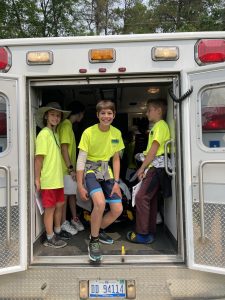
Camp 911 is a hands-on, youth-focused safety event supported by Marshfield Medical Center-Dickinson hospital that is designed to teach school-aged children essential emergency response skills.

Students participating in Camp 911, a program supported by Marshfield Medical Center-Dickinson hospital.

The camp brings together professionals from various fields to demonstrate practical safety techniques and procedures that can be used in everyday situations. Participants learn how to perform CPR, respond to and extinguish stove-top fires and practice safe habits when operating or riding all-terrain vehicles. The camp also covers swimming and watercraft safety, introduces children to the roles and tools of emergency responders and shares other vital safety tips.

Local law enforcement, medical staff, nurses and emergency personnel generously volunteer their time and resources to make Camp 911 a success. Their commitment reflects the community’s shared belief in the importance of preparing children to respond confidently and appropriately in emergency situations.

“Camp 911 is a wonderful resource for our local children, giving them practical experience dealing with emergency situations,” said Mandy Shelast, president, Marshfield Medical Center-Dickinson. “Renee Stanchina, our nursing education coordinator at Marshfield-Dickinson, has embraced and supported the event and continues to be the driving force behind Camp 911’s success. Thank you, Renee!”

To read more positive hospital stories, check out more Hospitals Help webpage and the 2025 Community Impact Report. Members with questions may contact Lucy Ciaramitaro at the MHA.

MHA Monday Report Feb. 2, 2026

State Legislative Weekly Recap: House Appropriations Committee Continues RHTP Testimony

The Michigan House Appropriations Committee continued testimony during the week of Jan. 26 on federal funding awarded through the Rural Health Transformation Program (RHTP) and on legislation related to the 340B program and next-of-kin designations. …


MHA Events2026 MHA Human Resources Conference Registration Open

The 2026 MHA Human Resources Conference, scheduled for March 24 at the Crowne Plaza Lansing, will convene human resources leaders and professionals who are shaping the future of the healthcare workforce. In an evolving healthcare …


MHA Shares Recent Medicare and Medicaid Enrollment Analysis

The MHA recently updated its analysis of Medicaid and Medicare enrollment based on December 2025 data. The analysis includes program enrollment as a percentage of each county’s total population and the split between fee-for-service …


New MHA Infographic Provides Overview of RHTP Program in Michigan

The MHA recently released a new infographic that provides an overview of the RHTP in Michigan. This infographic highlights the scope of the program, Michigan’s rural health landscape and the $173 million awarded to the …


Pediatric Vaccination Guidance: What Michigan Providers Need to Know

The American Academy of Pediatrics recently published its 2026 immunization schedule for children and adolescents, recommending protection against 18 diseases including polio, measles, respiratory syncytial virus and meningococcal disease. This comprehensive schedule draws …


Deadline Approaching for MHA Healthcare Leadership Academy

The enrollment deadline for the MHA Healthcare Leadership Academy is Feb. 6. The cohort meets Feb. 25-27 and May 7-8 at the MHA headquarters in Okemos. The Healthcare Leadership Academy, in partnership with Executive Core, has …


Hospitals Help: Munson Healthcare, Community Partners Offer Free Family Support Program

Healthy Futures is a free family support program that helps answer questions and assists families in finding services and resources in the community. The program, which has no eligibility requirements, is a collaboration between Munson …


MHA Rounds graphic of Brian PetersMHA CEO Report — The Reality Behind a Hospital Ribbon-Cutting

Hospital ribbon-cutting ceremonies tend to spotlight the new and modern elements of a hospital expansion: bright windows, sleek patient rooms or advanced diagnostic technology. But what you don’t see is often more important than what …

New to Know


News to Know

  • The MHA recently created a dedicated newsroom webpage #HospitalsHelp, highlighting stories from member hospitals across Michigan and their community benefit efforts.
  • Stay connected with the MHA for the latest healthcare updates in Michigan across its social media platforms, including Facebook, X, LinkedIn, Instagram, Bluesky and Threads.

MHA in the News

The Detroit News published a story Jan. 29 on two recent House Appropriations Committee hearings on the distribution of RHTP funds. The article details concern from House lawmakers and rural providers …

Media Recap: Rural Health Transformation Project Fund Distribution

The Detroit News published a story Jan. 29 on two recent House Appropriations Committee hearings on the distribution of Rural Health Transformation Program (RHTP) funds.

The article details concern from House lawmakers and rural providers surrounding the program, particularly the designation of Wayne and Oakland counties as partially rural in the Michigan Department of Health and Human Services (MDHHS) RHTP application.

Lauren LaPineLauren LaPine-Ray, DrPH, MPH, vice president, policy and rural health, MHA, is quoted in the story clarifying the department’s commitment expressed to the MHA to ensure rural communities benefit from the funding.

“The state is juggling varying state and federal definitions of rural as it applies for and administers the program,” LaPine-Ray said.

“I can say, very transparently, in our conversations with MDHHS, they did not intend to define a rural community as being one within Wayne or Oakland County,” she said. “They were very specific and intentional in making sure the definition that they used really focused on rural community and rural populations.”

The MHA also received coverage from MIRS and Bridge on 340B and medical debt collection legislation.

Members with questions regarding media requests should contact Elise Gonzales at the MHA.


MHA CEO Report — The Reality Behind a Hospital Ribbon-Cutting

MHA Rounds graphic of Brian Peters

MHA Rounds graphic of Brian Peters

Hospital ribbon-cutting ceremonies tend to spotlight the new and modern elements of a hospital expansion: bright windows, sleek patient rooms or advanced diagnostic technology. But what you don’t see is often more important than what you do.

Behind nearly every new facility is a story of aging infrastructure, outdated equipment and community needs that have outgrown what a hospital’s existing buildings can provide. Many hospitals operate buildings that are decades old – some built long before today’s medical technology, infection control standards or patient-centered design principles even existed.

Aging facilities often have electrical systems that can’t support modern equipment, rooms that limit the physical safety and efficiency of frontline workers, HVAC systems not suitable for infection control, or layouts that slow down emergency response or patient flow. Hospitals replace facilities because community needs can no longer be met with outdated structures, not because they want something new.

Expansion of facilities or technology, also referred to as capital projects, are funded through a mix of sources. These often include donors and philanthropic gifts, grants from foundations or government programs, bond financing, occasional state or federal appropriations and hospital capital budgets, which are built from small operating margins over the course of multiple years. These new facilities are not paid for directly from patient bills.

Even in years when hospitals have positive margins, these average margins are typically around only one to three percent and are reinvested directly back into patient care, safety improvements and facility upgrades. These reinvestments in new construction are about preserving access and modernizing care; not profit.

New buildings or service lines often emerge because patients travel long distances for essential care, equipment is too outdated to repair, demand for services like cancer care, imaging or behavioral health has grown, or because safety standards require major updates. A hospital that upgrades its cancer center or brings 3D digital mammography closer to home is reducing travel burdens, improving outcomes and keeping care local.

Behind Every Ribbon are Years of Work and Analysis

Before any groundbreaking, hospitals spend years evaluating whether renovation is possible or if replacement is more cost-effective. Hospitals also consider how to minimize disruption to patient care and what community health data shows about long-term needs. Finally, with all those factors considered, hospitals and health systems then determine how to secure funding without burdening patients.

The result may look like a brand-new facility, but it represents years of planning, prudent budgeting and community-focused decision-making.

In an era when headlines move fast, communities may question why hospitals announce expansions at the same time they face workforce shortages or reimbursement challenges. The answer is simple: capital investments and operational budgets are not the same.

A hospital can be financially strained day to day while still needing to replace unsafe or outdated infrastructure. So next time you see your local hospital celebrating the grand opening or ribbon cutting of a new facility or technology, you can join in the celebration by knowing that your community, family and friends are receiving high-quality, modern care for decades to come, all close to home.

As always, I welcome your thoughts.

News to Know – Feb. 1, 2026

New to Know

  • The MHA recently created a dedicated newsroom webpage Hospitals Help, highlighting stories from member hospitals across Michigan and their community benefit efforts. The collection showcases how hospitals support patients, families and communities through programs, partnerships and services that advance care, wellness and quality of life statewide. Members with questions or who would like to submit stories may contact Lucy Ciaramitaro at the MHA.
  • Stay connected with the MHA for the latest healthcare updates in Michigan across its social media platforms, including Facebook, X, LinkedIn, Instagram, Bluesky and Threads.


2026 MHA Human Resources Conference Registration Open

MHA Events

The 2026 MHA Human Resources Conference, scheduled for March 24 at the Crowne Plaza Lansing, will convene human resources leaders and professionals who are shaping the future of the healthcare workforce.

In an evolving healthcare environment, people remain hospitals’ most critical resource. From workforce shortages to employee engagement and leadership development, healthcare human resources professionals are navigating complex challenges that require practical strategies and strong peer collaboration. The conference will highlight Michigan hospitals that have taken unique approaches to recruitment and retention in their local communities that have deepened community trust and elevated organizational reputation.

Registration is $259 and members are encouraged to register. Members with questions about registration should contact Ellie Droste at the MHA. Members with questions about the conference should contact Erica Leyko at the MHA.

Deadline Approaching for MHA Healthcare Leadership Academy

The enrollment deadline for the MHA Healthcare Leadership Academy is Feb. 6. The cohort meets Feb. 25-27 and May 7-8 at the MHA headquarters in Okemos.

The Healthcare Leadership Academy, in partnership with Executive Core, has been a staple of the MHA, with more than 150 physicians, nurses and other healthcare professionals completing the academy. The two power-packed modules featured in the coursework provide participants with Leadership 360° feedback with personalized executive coaching, exploration of best practices balanced with patient outcomes, on-camera media and public relations training and intimate discussions with senior healthcare leaders.

Members with questions should contact Erica Leyko at the MHA.

New MHA Infographic Provides Overview of RHTP Program in Michigan

The MHA recently released a new infographic that provides an overview of the Rural Health Transformation Program (RHTP) in Michigan. This infographic highlights the scope of the program, Michigan’s rural health landscape and the $173 million awarded to the Michigan Department of Health and Human Services (MDHHS) to support rural health initiatives across the state.  

The infographic also provides demographic and access-related data to help contextualize the need for targeted rural health investment, including information on rural population distribution, Medicaid coverage, distance to care, workforce shortages and the reliance of rural communities on local hospitals as critical access points. 

Timely updates, resources and additional information about the program are available on the MHA RHTP webpage. Members with questions may contact the MHA policy team. 

MHA Shares Recent Medicare and Medicaid Enrollment Analysis

The MHA recently updated its analysis of Medicaid and Medicare enrollment based on December 2025 data. The analysis includes program enrollment as a percentage of each county’s total population and the split between fee-for-service and managed care organization. Just over 25% of Michigan’s total population is enrolled in Medicaid and 23% is enrolled in Medicare.

Roughly two-thirds of Michigan’s 2.5 million Medicaid beneficiaries are enrolled in one of nine managed care plans.

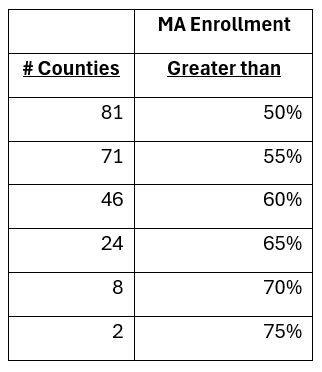
Total Medicare enrollment is 2.3 million, with 63% of beneficiaries enrolled in a Medicaid Advantage (MA) plan and only two counties having less than 50% of total Medicare enrollment in MA plans. MA enrollment by county ranges from 47% to 79%, with 71 counties having 55% or more of their Medicare population enrolled in an MA plan, as highlighted below.


December enrollment is spread across 45 MA plans, with up to 29 covering beneficiaries in several Michigan counties and a minimum of five plans available in each county.

Members with enrollment questions should contact the MHA health finance team.