
Hospitals Help Michigan Students Pursue Healthcare Careers

Healthcare remains the state’s largest employer of direct, private-sector jobs. With this in mind, hospitals are finding innovative ways to give Michigan students the opportunity to gain real-world exposure to clinical and non-clinical healthcare roles. Some examples of these efforts are outlined below.

McKenzie Health System Hosts Healthcare Career Exploration Tours for Local Students

McKenzie Health System hosts an immersive hospital tour for local ninth and tenth grade students.

McKenzie Health System recently welcomed ninth and tenth grade students from all seven Sanilac County school districts for an immersive hospital tour as part of the Thumb Community Health Partnership’s High School Pipeline Program.

The eight-week program provides hands-on exploration of health and human service careers across the Thumb region. During their visit to McKenzie, students gained a behind-the-scenes look at how a rural hospital operates and the many career paths available within healthcare.

The tour itself involved rotating through several departments – pharmacy, dietary, nursing, diagnostic imaging, and cardiopulmonary rehabilitation – and participating in interactive learning experiences designed to bring healthcare careers to life.

“These tours give students a meaningful look at the many career opportunities available in healthcare, right here in their own community,” said Nina Barnett, Public Relations. “We are proud to support the exploration of healthcare careers for local youth and to partner with the Thumb Community Health Partnership in building a strong future workforce.”

By partnering with the Thumb Community Health Partnership and local school districts, McKenzie continues to invest in programs that encourage students to explore rewarding careers in healthcare close to home.

Trinity Health Muskegon Hosts Schools for a “A Day in the Life of an Injured Student”

Educators and students from Muskegon High School and Spring Lake High School recently visited Trinity Health Muskegon to participate in an interactive activity titled, “A Day in the Life of an Injured Student,” where they followed the medical journey of a student athlete hurt during a football game.

From the initial scene with paramedics to the operating room alongside surgical technicians, students observed each step of care and were introduced to roughly 40 different medical and health-related professions along the way.

Trinity Health Muskegon colleagues shared more about their roles, required education, career pathways and practical advice. Representatives from healthcare colleges and Trinity Health Muskegon’s Talent Acquisition team were also present to serve as resources for the students.

“Many of these students have no idea how many career options exist within various healthcare settings,” said Jerry Evans, MD, emergency medicine provider, Lake Michigan Emergency Specialists and immediate past chief of staff, Trinity Health Muskegon. “Athletic trainers, paramedics, physicians, nurses, radiology and lab technicians, emergency department teams, operating room staff, computer support, dietary services, facilities personnel and so many others. Trinity Health Muskegon is devoted to strengthening our community and inspiring our youth to consider careers in healthcare.”

The event supports Trinity Health’s Growing Our Own initiative, a program designed to engage Muskegon students from third through twelfth grade and help them see a future working in health care as attainable for them. The initiative, made possible by partnerships with the Muskegon Area Career Tech Center (CTC), Muskegon Area Intermediate School District (MAISD), Boys and Girls Club of the Muskegon Lakeshore and Michigan Works, will continue outreach to Muskegon County students through additional education, career fairs and more.

Covenant HealthCare Invites Recent Grads to Explore Hospital Careers

Covenant HealthCare created “Discover Covenant” in 2024 to expand knowledge of hospital jobs, grow local talent and help future generations make informed career decisions.

The summer program is a paid opportunity designed for recent high school graduates interested in healthcare. It runs from early June to late August, giving participants the opportunity to explore areas of interest along with those they’re unfamiliar with. Exploration periods are done in three-week rotations from 8 a.m. to noon, Monday through Thursday.

“As I worked through Discover Covenant, my love of helping people and feeling a sense of accomplishment was ignited during the nursing rotation,” said one participant. “I have now willingly changed my college major to nursing, and I am grateful for the time and money saved due to my experience with Discover Covenant.”

Since 2024, hospital employees and volunteers have hosted approximately 30 students – a handful of which have since sought employment or additional learning at Covenant. Those interested in learning more are encouraged to contact the Covenant team.

“This program has given young adults from our community the opportunity to learn more about healthcare careers and engage with our organization,” said Jill Jarvis, BSN, RN, manager, clinical development & education, Covenant HealthCare. “It has been a win-win for both participants seeking knowledge and guidance about their futures and for our organization, which is working to build pipelines for future employees.”

Hillsdale Hospital Awards Up to $50,000 in Educational Support to High School Seniors Pursuing Nursing Careers

Hillsdale Hospital’s Doris Whorley Nursing Scholarship allows eligible high school seniors to apply for tuition assistance of up to $10,000 per year for up to five years for an associate degree in nursing (ADN) or a bachelor of science in nursing (BSN).

“Our hospital depends on nurses across every point of care and our mission with this scholarship program is to support their education, on-the-job training and long-term career development,” said Randy Holland, chief nursing and infection control officer.

The scholarship was named after Doris Whorley, Hillsdale’s longest working nurse who has been in the profession for nearly 58 years.

“Doris Whorley has made such an incredible and enduring impact on our hospital’s staff and patients,” added Holland. “On behalf of Hillsdale Hospital’s nursing staff, we are honored to carry her legacy forward as we train and guide future nurses.”

Program application announcements can be found on Hillsdale Hospital’s website.

Eaton Rapids Medical Center Hosts Themed Hospital Tour

The team at Eaton Rapids Medical Center recently hosted a two-day hospital tour for local second graders. To keep things engaging, the event was pirate-themed and included exploring the “Emergency Deck,” emergency department, a visit to ”Clean Hands Island” to learn more about the importance of handwashing and a trip to “X-Ray Bay” to see the hospital’s radiology equipment.

The tours are designed not only to ease fears associated with medical care, but also educate students on healthy habits and see members of the hospital team in action.

“We are so grateful for the opportunity to partner with our local schools to bring this experience to our second graders every year,” said Eleni Danford, MSN, RN, clinical education, Eaton Rapids Medical Center. “By opening our doors and giving students the chance to explore our departments, meet our care team and have a genuinely fun and memorable experience, we hope to build a sense of familiarity and trust between our hospital and the community we serve.”

MI Hospital Careers Campaign

As a complement to the local efforts of Michigan hospitals, the MHA’s MI Hospital Careers campaign launched in June 2023 to expand interest in Michigan health careers. The campaign targets high school and college students, as well as working professionals looking for a rewarding career. To learn more, contact Katelin Wiersma at the MHA.

Members with questions or content ideas for the Hospitals Help series may contact Lucy Ciaramitaro at the MHA.

Mandatory Overtime, Assisted Outpatient Treatment Legislation Advances

Several key healthcare bills, including mandatory nurse overtime, assisted outpatient treatment (AOT), Certificate of Need (CON) and site-neutral payment policies, saw action in the legislature during the week of March 16.

The Senate Regulatory Affairs Committee advanced Senate Bills (SB) 296 and 297, sponsored by Sen. Stephanie Chang (D-Detroit) and Sen. Ed McBroom (R-Vulcan), to the full Senate floor. This legislation would prohibit mandatory hospital overtime in certain circumstances. The MHA does not support legislation that curtails hospital leaders’ decision-making authority and supports empowering local healthcare professionals to make decisions that best serve patients and reflect clinical expertise. An amendment was adopted in committee to delay the implementation of the bills until June 2027. The MHA continues to work with lawmakers and healthcare stakeholders to ensure care teams have the tools they need and that Michiganders maintain access to timely, high-quality care. 

HB 5709, introduced by Rep. John Roth (R-Interlochen), would remove the requirement for certain imaging services to obtain a CON before establishing at an outpatient center. CON laws helps control healthcare costs, improve quality by integrating specialized services and ensure better access to care in rural and underserved areas. The MHA opposes this bill and is concerned that it will drive up healthcare costs and create service delivery gaps. 

HB 5770, sponsored by Rep. Curt VanderWall (R-Ludington), was also introduced in the House March 19. The bill would prohibit the collection of facility fees from hospital outpatient departments. Facility fees help offset hospitals’ operational costs, including 24/7 emergency and trauma care. Non-hospital outpatient centers treat fewer Medicaid patients, take less severe cases, are not always open and face fewer regulatory requirements. The MHA opposes the bill and “site-neutral” policies that do not recognize the costs of maintaining access to care and the unique patient populations served by hospitals.

The MHA encourages members to contact their lawmakers to oppose changes to facility fees that could jeopardize patient access to care. 

In addition, HB 44124414 would update assisted outpatient treatment processes and expand access to care for patients. This legislation emphasizes early intervention and effective pathways to treatment in the mental and behavioral health space. The bills, supported by the MHA, passed the full House chamber on March 18 and now head to the Senate for further consideration. 

Members with questions may contact the MHA advocacy team. 

Michigan Legislature Announces Commitment to Pass the IMLC Before March 28 Deadline

Following negotiations finalized March 19, Senate Majority Leader Winnie Brinks (D-Grand Rapids) announced plans to pass legislation authorizing Michigan’s continued participation in the Interstate Medical Licensure Compact.

The MHA thanks state lawmakers for their commitment to pass the legislation and transmit it to the Governor before the March 28 deadline to maintain participation in the compact. The MHA also thanks its members and healthcare stakeholders across the state for their advocacy supporting Michigan’s continued participation. 

The compact streamlines the licensing process for qualified physicians, strengthening Michigan’s ability to recruit top talent and fill critical staffing gaps, while maintaining patient safety standards and regulatory oversight. 

For many hospitals, particularly those serving rural or border communities, the compact supports access to care in high-demand specialties such as emergency medicine, psychiatry, obstetrics and primary care. As lawmakers consider next steps, preserving tools that allow for workforce flexibility and protect access to timely care remains a priority. 

The MHA will provide an update following the final Senate vote. 

Members with questions may contact the MHA advocacy team. 

Federal Court Pauses Vaccine Policy Changes and ACIP

A U.S. District Court judge issued a ruling March 16 in American Academy of Pediatrics v. Robert F. Kennedy Jr. that places a hold on several changes to federal vaccine policy made over the past year.

The decision reverses actions taken by the Centers for Disease Control and Prevention’s (CDC) Advisory Committee on Immunization Practices (ACIP) since summer 2025, including updates to the childhood vaccine schedule, changes to COVID-19 vaccine recommendations and a revised hepatitis B recommendation.

The court found that the CDC exceeded its authority by reducing the number of routinely recommended childhood vaccines without consulting ACIP, that newly appointed ACIP members did not meet the expertise requirements outlined in the committee’s charter, and that changes to the vaccine schedule were not supported by evidence. The ruling states that established scientific and legal processes for developing vaccine policy were not followed.

As a result, vaccine recommendations in place prior to June 2025 are reinstated, new policy changes cannot be implemented and recent ACIP decisions are reversed. Previously revised vaccine recommendations return to prior status and insurance coverage at no cost to patients remains in place under federal law.

The ruling is a temporary stay, not a final decision, and the U.S. Department of Health and Human Services has said it will appeal.

Members with questions may contact Kelsey Ostergren at the MHA.

MHA Shares Latest Medicare and Medicaid Enrollment Analysis

The MHA recently updated its analysis of Medicaid and Medicare enrollment based on February 2026 data. The analysis includes program enrollment as a percentage of each county’s total population and the split between fee-for-service and managed care organization. Just over 25% of Michigan’s total population is enrolled in Medicaid and 23% is enrolled in Medicare.

Roughly two-thirds of Michigan’s 2.5 million Medicaid beneficiaries are enrolled in one of nine managed care plans.

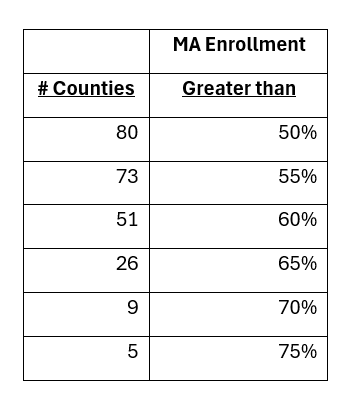
Total Medicare enrollment is 2.3 million with 64% of beneficiaries enrolled in a Medicaid Advantage (MA) plan with only three counties having less than 50% of total Medicare enrollment in MA plans. MA enrollment by county ranges from 44% to 79%, with 73 counties having 55% or more of their Medicare population enrolled in an MA plan as highlighted below.

February enrollment is spread across 45 MA plans with up to 29 plans covering beneficiaries in several Michigan counties, with a minimum of five plans available in each county.

Members with enrollment questions should contact the MHA health finance team.

Health Access & Community Impact Office Hours Highlight 211 Data

The MHA will host the next Health Access & Community Impact Office Hours session on April 29 from noon to 12:45 p.m., featuring Michigan 211.

The session, Understanding Regional Needs: A Data Driven Look at Michigan’s 211 Calls, will highlight regional trends and emerging community needs based on call volumes, caller demographics and service requests 211 receives statewide.

Gustavo Rotondaro, research and learning director, Michigan 211, will share key data insights and observed shifts in community needs to support hospitals and care teams in strengthening local coordination efforts. The discussion will also explore how 211 data can inform resource navigation and support care continuity.

Members are encouraged to register and share this opportunity with colleagues involved in community engagement, social needs screening, care management and navigation, and related efforts.

Members with questions may contact Ewa Panetta at the MHA.

MHA Annual Membership Meeting Offers Learning and Networking

MHA Annual Meeting logoThe MHA membership will convene in person for the MHA Annual Membership Meeting June 24-26 at the Grand Hotel on Mackinac Island.

The MHA Annual Membership Meeting provides an opportunity to learn, network and celebrate the accomplishments of the program year.

Keynote speaker Ginger Zee, chief meteorologist at ABC News’ “Good Morning America,” will share her experiences with mental health, including depression and suicidal ideation and discuss the importance of openness and reducing stigma.

The closing session will feature workplace culture expert Paul J. Long, who will highlight principles of deliberate connection and strategies such as “brain pattern interrupts” to shift attention from problems to possibilities.

The MHA Annual Membership Meeting also includes the popular lawn party with games and entertainment, the ice cream social and many more relationship-building opportunities.

Members are encouraged to register by May 22 to attend this memorable event. Opportunities to sponsor the annual meeting are available through May 5. Members with questions may contact the MHA or call (517) 323-3443.

Applications Open for Governance Fellowship, Current Class Convenes

EIGF

The MHA is now accepting applications for the Excellence in Governance Fellowship, which will be held from October 2026 through June 2027. The fellowship is a comprehensive program designed to support hospital and health system trustees in strengthening governance practices and advancing organizational leadership.

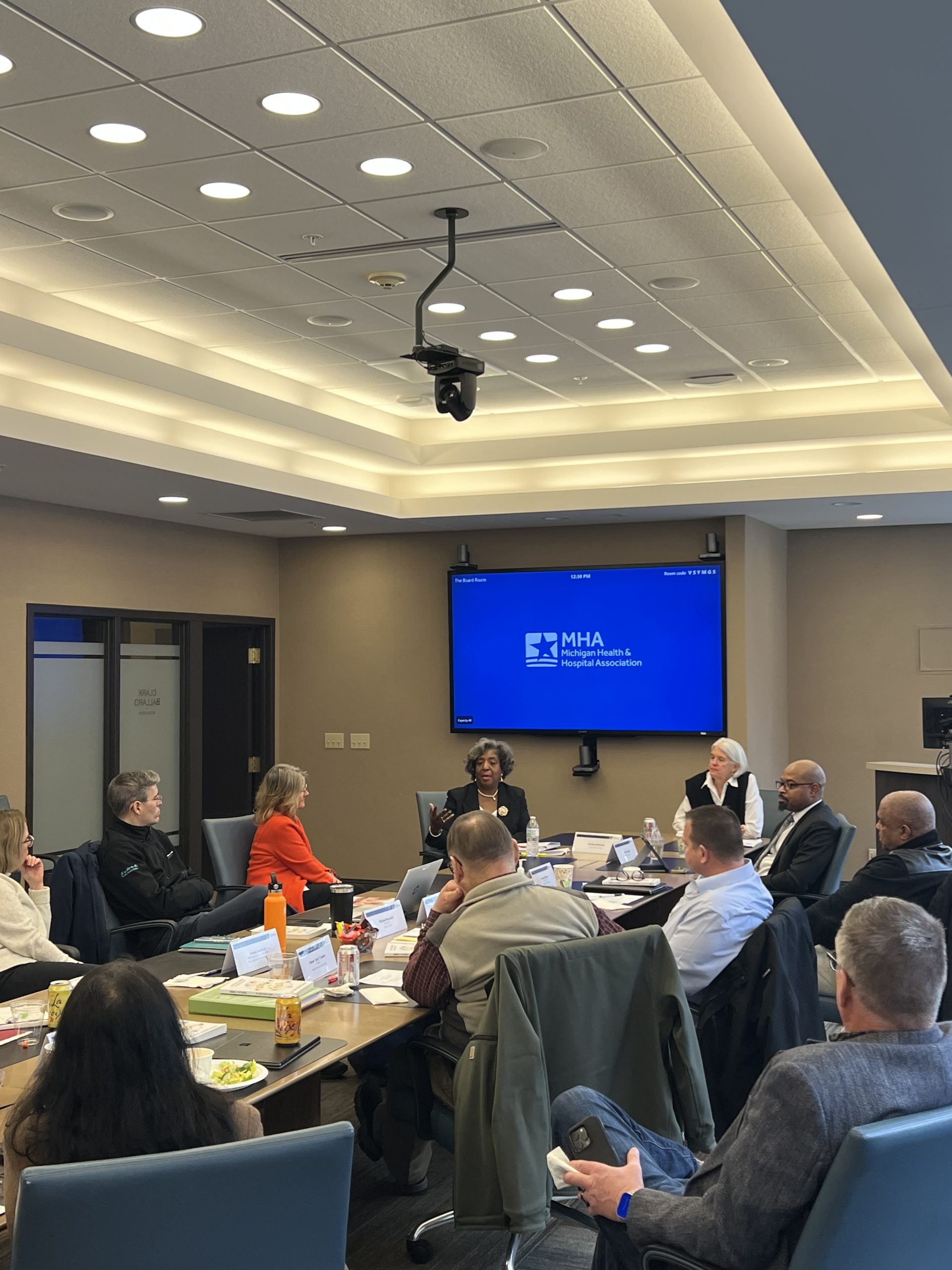
Members of the 2025–26 Excellence in Governance Fellowship cohort participate in a trustee panel discussion during a session at the Michigan Health & Hospital Association.
Members of the 2025-26 Excellence in Governance Fellowship cohort participate in a trustee panel during a fellowship session at the MHA.

Launched more than 20 years ago, the fellowship provides education in key areas including effective governance, quality and patient safety, medical staff partnerships and community engagement. Fellows participate in a combination of in-person and virtual sessions led by healthcare governance experts from October through June.

Current fellows in the 2025-26 class met during the week of March 16 to further their understanding of healthcare and the role of governance in supporting leadership teams. During the session, healthcare experts and leaders from MHA member hospitals and health systems shared strategies on healthcare access, community benefit, affordability, value-based care, patient experience and workforce recruitment and retention.

Members with questions may contact Erin Steward at the MHA.

The State of Healthcare Leadership: Risks, Reality and Readiness

MHA‑Endorsed Business Partner AMN Healthcare and B.E. Smith recently released the Healthcare Leadership Trends for 2026 Report, based on a national survey of more than 700 healthcare executives across hospitals and health systems. The report examines the state of healthcare leadership, highlighting the risks, realities and readiness that will shape the year ahead.

Healthcare Organizations Are Navigating Growing Complexity and Uncertainty. 

While nearly three-quarters of healthcare leaders expect their organization’s performance in 2026 to remain stable or improve, confidence in the broader healthcare industry is declining. In fact, 52% of leaders anticipate a worse year ahead for the industry, driven by financial pressures, reimbursement uncertainty and workforce challenges.

Financial Pressures Are Reshaping Leadership Priorities. 

Despite revenue growth in 2025, rising labor and operating expenses continue to strain margins. Eighty‑four percent of executives cite financial pressures as their greatest threat in the coming year, while 72% say lowering operating costs is their most critical long‑term priority. These realities are forcing organizations to rethink leadership structures, recruiting strategies and succession planning.

Traditional Leadership Pipelines Are Under Strain. 

Attracting quality leadership talent remains a significant challenge, particularly for smaller and mid‑sized organizations. Nearly four in ten leaders say recruiting director‑level and above candidates is extremely or very challenging, with smaller organizations facing the greatest difficulty. Time‑to‑fill for executive roles also remains longer than historical norms, delaying strategic initiatives and increasing operational risk.

Building a Resilient Leadership Workforce Requires a Multifaceted Approach. 

Healthcare organizations that are positioning themselves for success in 2026 are prioritizing several key strategies:

  • Expanded recruiting scope: Broadening geographic reach and considering non‑traditional leadership backgrounds to increase candidate pools.
  • Competitive and flexible compensation models: Adjusting packages to remain competitive while balancing financial constraints.
  • Leadership development and succession planning: Addressing the fact that fewer than half of organizations maintain formal succession plans across leadership levels.
  • Strategic use of interim leadership: Leveraging experienced interim executives to maintain momentum during leadership transitions and reduce burnout among internal teams.
  • Technology and AI readiness: Preparing leaders for a future where artificial intelligence roles and capabilities are rapidly becoming core leadership requirements.

By investing in these strategies, healthcare organizations can strengthen leadership stability, improve retention and remain agile in an increasingly complex environment.

For deeper insights and actionable leadership strategies, MHA members are encouraged to download the full Healthcare Leadership Trends for 2026 report.

For inquiries regarding The Healthcare Trends Report or to obtain further information about AMN Healthcare and B.E. Smith partnerships, please contact Katy Allen, VP, client partnerships.

MHA Monday Report March 16, 2026

Medical Debt Legislation Clears Senate, MHA-Supported Bills Advance in the House

Legislation addressing medical debt collection processes and hospital financial assistance policies passed the Michigan Senate, while the House of Representatives moved MHA-supported bills during the week of March 9.  The Senate voted in support of Senate Bills 449, 450 and 451 as well as …


Healthcare Leadership Award Nominations Due March 27

The MHA is now accepting nominations for the annual Healthcare Leadership Award, which recognizes individuals who have demonstrated exceptional leadership within their healthcare organization and community. Trustees, executives, physicians, nurses and other outstanding leaders are eligible for consideration. …


DEA Final Rule Takes Effect for EMS Controlled Substances

A new Drug Enforcement Administration (DEA) final rule took effect March 9, codifying regulations enacted in 2017 within the Controlled Substances Act related to the handling of controlled substances by Emergency Medical Services (EMS) …


Health Access & Community Impact Council Focuses on Food as Medicine

The MHA Health Access & Community Impact Council convened virtually March 5 to discuss strategies to improve health outcomes through stronger integration of social and clinical care. In recognition of National Nutrition Month, members also explored …


Applications Open for 2027 AHA Foster G. McGaw Prize

The American Hospital Association (AHA) is accepting applications for the annual 2027 AHA Foster G. McGaw Prize now through May 5, 2026. The prize celebrates hospitals and health systems that have demonstrated exceptional commitment to …


Hospitals Help: Bronson Healthcare Guides Patients Through Billing, Benefits and Financial Support

Navigating healthcare billing and out-of-pocket costs can be overwhelming. In order to let patients focus on healing, many hospitals are expanding the role of financial counselors, social workers and patient navigators. For example, financial counselors …


Keckley Report

Healthcare Workforce Modernization Needed

“Last week, the war in Iran intensified and Kristi Noem’s tenure as DHS Secretary came to an unceremonious close. Perhaps lost in the noise was the February jobs report issued Friday by the U.S. Bureau of Labor Statistics. It showed a surprising decline in job growth prompting speculation the economy might have taken a downward turn. …

Healthcare is capital intense: it needs appropriations from government and in-flows from employers and individual taxpayers to pay its bills. Most of that pays for its labor costs. Today, most Board agenda include updates on labor relations, human resource management issues and workforce adequacy—it’s standard fare. And all weigh options to outsource and devour progress reports from HR management on AI-enabled investments anticipated to reduce labor costs. …

If the overall economy is dependent on healthcare to produce an appropriate share of job growth while reducing overall costs, modernizing its workforce is key. It must include unpaid caregivers, licensed and unlicensed providers and technology-enabled solution providers—not just traditional licensed professional groups and their academic partners. That’s not going to happen in the current political environment where each sector’s primary focus is protecting reimbursement and guarding against scope of practice threats.

The health system needs transformation. Workforce modernization is where to start.”

Paul Keckley, March 8, 2026


New to KnowNews to Know

  • The MHA membership will convene in person for the MHA Annual Membership Meeting June 24–26.
  • MHA Endorsed Business Partner CyberForce|Q is hosting the Navigating AI’s Impact on Cyber Hygiene webinar March 25 from noon-1 p.m. ET.

MHA in the News

The MHA partnered with Crain’s Content Studio to facilitate a healthcare affordability discussion, which was highlighted in its Detroit and Grand Rapids publications. Healthcare and business leaders examined the complex factors driving healthcare costs and …