
 The Michigan House Appropriations Committee continued testimony during the week of Jan. 26 on federal funding awarded through the Rural Health Transformation Program (RHTP) and on legislation related to the 340B program and next-of-kin designations.
Michigan hospitals testified before the House Appropriations Committee on funding allocated to the state through the RHTP. Michigan was awarded $173 million in RHTP funding in December 2025 to support rural communities and address access-to-care challenges. MHA members testifying in front of the committee included Tonya Darner, CEO, UP Health System; Andrew Raymond, CEO, Kalkaska Memorial Health Center; and Peter Marinoff, president and CEO, Munson South Region. Lauren LaPine-Ray, DrPH, MPH, vice president of policy and rural health, MHA, and Gabe Schneider, director, government relations, Munson Healthcare, also responded to committee questions and shared feedback in support of rural hospitals and the program.
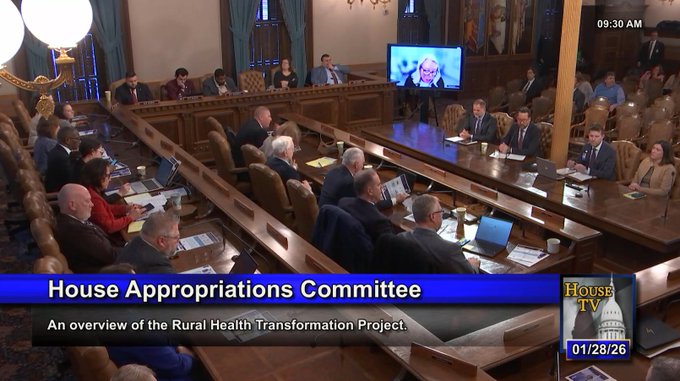
During testimony, members highlighted challenges facing rural healthcare, including access to maternity care, EMS transportation, behavioral health services, and workforce recruitment and retention. Members noted that 22% of counties are considered maternity deserts and at least 11 hospital labor and delivery units have closed since 2010. Testimony also underscored the role rural hospitals play in supporting overextended EMS systems by holding patients when transport is unavailable, coordinating complex transfers and absorbing unreimbursed costs.
Members emphasized that RHTP funding should be targeted toward these challenges to better serve rural communities and maintain access to care.
The House Health Policy Committee voted Jan. 28 to advance House Bill (HB) 4878, sponsored by Rep. Curtis VanderWall (R-Ludington). HB 4878 protects hospitals’ contract pharmacy arrangements under the federal 340B program and includes state-level drug price transparency and hospital community benefit reporting requirements. The legislation allows eligible 340B hospitals to continue stretching limited resources to support care for vulnerable patients and communities across the state, without using state or federal taxpayer dollars. The MHA and its 340B member hospitals support the integral program protections this legislation affords, both for maintaining access to community-based care and improving affordability across Michigan communities. HB 4878 now heads to the House Rules Committee for further consideration.
The Senate Committee on Civil Rights, Judiciary and Public Safety voted in favor of HB 4418 and HB 4419, which update next of kin designations in a healthcare setting. The bills, sponsored by Rep. Jamie Thompson (R-Brownstown Township) and Rep. Angela Witwer (D-Delta Township), seek to reduce barriers in the process of designating a next of kin to inform medical decisions for a patient who is unable to make those decisions themselves. Current law requires families to pursue guardianship, a process that can be lengthy and burdensome during medical emergencies. The MHA worked with bill sponsors and stakeholders to clarify language in HB 4418 based on member hospital feedback. The bills have been referred to the full Senate for further consideration.
Lastly, the Senate Health Policy Committee heard testimony on Senate Bills (SB) 701 and 702, which make changes to medical debt collection processes in the state. The bipartisan legislation, sponsored by Sen. Jonathan Lindsey (R-Coldwater) and Sen. Sarah Anthony (D-Lansing), make changes to how and when medical debt is collected from patients. The MHA is reviewing the legislation and remains committed to working with lawmakers on opportunities to improve healthcare affordability.
Members with questions may contact the MHA advocacy team.