MHA Podcast Explores the Role of Artificial Intelligence (AI) in Healthcare

MiCare Champion Cast graphic featuring an episode focused on the role of Artificial Intelligence (AI) in Healthcare

The MHA released a new episode of the MiCare Champion Cast exploring the role artificial intelligence (AI) plays in healthcare today and what it will look like in the future. The episode features Bruce Brandes, president of Care.ai and Monica Holmes, a PhD candidate in bioinformatics at the University of Michigan and current member of the MHA AI Task Force.

Early in the discussion, Brandes and Holmes highlighted the ways smart technologies have been used for years when it comes to data analysis, disease diagnosis, radiology, clinical documentation, language processing and more.

“For the first time – maybe in my career in healthcare – it’s obvious that the status quo is no longer an acceptable option,” said Brandes, who has over 30 years of experience in executive management and entrepreneurial thought leadership. “This is real – you need to understand it, you need to be intentional and deliberate and have a strategic plan.”

Both Brandes and Holmes emphasized throughout the episode that AI cannot replace the essential role humans play in healthcare. The goal, in most cases, is to optimize a more efficient workflow, improve healthcare quality, advance diagnostics and enhance medical research.

“On the academic side, it’s improving our ability to do better research, which leads to better insights and ultimately better health outcomes for patients when it’s translated over to the bedside,” said Holmes, who also serves on the board of Trinity Health’s Chelsea Hospital as chair of patient quality and safety.

Listeners can expect to learn more about how patients and providers are responding to AI tools (including virtual nursing) and get answers to commonly asked questions related to transparency, health equity, regulation and cybersecurity.

Care.ai, an MHA endorsed business partner, powers more human care through the first and only AI-enabled Smart Care Facility Operating Platform, which deploys smart sensors throughout care facilities. These sensors continuously and ambiently monitor clinical and operational workflows, learning from them to predict, prevent and protect; alerting and engaging care teams in real-time and improving common challenges such as fall prevention, pressure injury prevention, hand hygiene compliance, rounding adherence, automated documentation, virtual rounding, virtual sitting and more.

The episode is available to stream on Spotify, Apple Podcasts, SoundCloud and YouTube. Those interested in learning more about Care.ai or the MHA EBP program can visit the business services webpage or contact Rob Wood at the MHA. Questions or idea submissions for future MiCare Champion Cast episodes can be sent to Lucy Ciaramitaro at the MHA.

Public Relations Professionals Gather at MHA Communications Retreat

MHA Events
Sue Tetzlaff, co-founder, Capstone Leadership Solutions; Emily R. Sexton, communications coordinator, Holland Hospital; Hannan Deep, director of strategic communications operations, Henry Ford Health; and Lauren Zakalik, director, public & media relations strategy, Henry Ford Health, during a panel discussion. 

The 2024 MHA Communications Retreat brought together nearly 100 communications, marketing and public relations professionals from MHA-member facilities May 7 to network and learn from peers across the state. Topics on the agenda included artificial intelligence (AI), behavioral health, the healthcare workforce and internal communications.

The event began with several speakers presenting on how they are using communications tools to assist in reacting to the behavioral health crisis. Speakers included Kara Gavin, lead public relations representative, Michigan Medicine; and research & policy media relations manager, U-M Institute for Healthcare Policy and Innovation; Jim Rose, director of marketing and communications, Pine Rest Christian Mental Health services; Dallas Rau, executive director, Great Lakes Bay Region Mental Health Partnership; and Tera Szeliga, director of marketing, communications and Institute for Leaders, Great Lakes Bay Regional Alliance.

A panel discussion was conducted discussing communications strategies to address the healthcare workforce and the importance of engaging with government relations and advocacy efforts. Angela Minicuci, APR, partner, Martin Waymire, moderated the panel comprised of Laura Appel, executive vice president of government relations and public policy, MHA, and Megan Brown, chief marketing and communications officer, Munson Healthcare. MHA CEO Brian Peters followed the panel with an update on the MHA strategic action priorities.

AI industry experts Joshua Wilda, chief digital and information officer, University of Michigan Health – Regional Network; and Tony Lambert chief technology officer, TechSmith, presented on the AI trends in healthcare and hospitals and how its impacting communications and marketing.

The event concluded with a topic focused on internal communications strategies hospitals can implement to celebrate their workforce and tactics they can use to address employee morale, support recruiting and improve brand perception. Each speaker shared strategies for different sized hospitals. Those speakers included Sue Tetzlaff, co-founder, Capstone Leadership Solutions; Emily R. Sexton, communications coordinator, Holland Hospital; Hannan Deep, director of strategic communications operations, Henry Ford Health; and Lauren Zakalik, director, public & media relations strategy, Henry Ford Health.

The event was sponsored by Martin Waymire and MHA Data Services, who attended the event and provided resources about their products and services. Photos from the event are available on the MHA Facebook page. For more information and resources from the event, contact John Karasinski at the MHA.

MHA Podcast Explores Healthcare Cybersecurity with Michigan Medicine

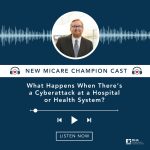
The MHA released a new episode of the MiCare Champion Cast exploring what happens when a hospital or health system experiences a cyberattack featuring Jack Kufahl, chief information security officer at Michigan Medicine.

In his role, Kufahl is responsible for planning, developing, implementing, and maintaining information assurance activities across the academic medical center. Although the health system wasn’t majorly impacted by the Change Healthcare breach, Kufahl shared how his team responded and valuable insight on how to improve cybersecurity measures.

“I think one of the most important things any hospital or healthcare organization can do is start establishing a long-term [cybersecurity] framework so that you can measure improvement over time,” said Kufahl, noting there are many accessible resources that accommodate monetary limitations.

According to the FBI, healthcare organizations are the top target of cybercriminals across the globe and attacks have increased significantly in the last two years. On top of the significant financial burden this can cause for a hospital, many face penalties that further threaten patient access to care – especially among small and rural providers serving vulnerable communities.

“Some companies don’t have the ability to invest in cybersecurity and hard choices have to be made,” said Kufahl, who also serves as one of the incorporating officers and board members of the Michigan Healthcare Cybersecurity Council. “If you penalize the victims of a cybersecurity crime, we’re not leveraging the legislative angle to our benefit.”

Fostering partnerships and collaborating is another way Michigan Medicine stays proactive in their cybersecurity efforts. Kufahl noted that working with CyberForce|Q, an MHA Endorsed Business Partner (EBP), helps his team regularly assess security programming and stay connected with a broad network of experts across industries.

“It is really important to not be alone in cybersecurity in healthcare,” said Kufahl. “The tone and temperature of collaborating across companies has improved dramatically…that is the most meaningful fabric we can reinforce. I would encourage anyone to reach out and engage.”

The MHA is partnering with CyberForce|Q to offer the Enhancing Your Cybersecurity: Tabletop Training and Incident Response Workshop 9 a.m. – Noon May 22. The in-person event is free of charge for MHA member organizations and invitees. Throughout the workshop, attendees will explore three critical phases of a simulated cyberattack.


The episode is available to stream on Spotify, Apple Podcasts, SoundCloud and YouTube. Those interested in learning more about CyberForce|Q or the MHA EBP program can visit the business services webpage or contact Rob Wood at the MHA. Questions or idea submissions for future MiCare Champion Cast episodes can be sent to Lucy Ciaramitaro at the MHA.

Medical Residents Converge for GME Capitol Day

Three physician residents and a Michigan state house representative posing for a photo in a hallway.
Henry Ford Health physician residents pictured with Representative Kimberly Edwards (D-Eastpointe).

The MHA Graduate Medical Education (GME) Capitol Day welcomed more than 40 physician residents from a dozen member hospitals to the MHA Capitol Advocacy Center offices May 1 for a day of meetings with members of the Michigan Legislature and their staffs. Each group of residents met with a combination of lawmakers and legislative staff throughout the day, with conversations focusing on the importance of graduate medical education, physician residents in the healthcare continuum and Michigan’s future physician healthcare workforce talent pipeline.

Meetings were held in the Michigan Capitol, the Anderson House Office Building and the Senate Binsfeld Office Building.

Participating lawmaker offices included:

  • House Speaker Joe Tate (D-Detroit)
  • House Minority Leader Matt Hall (R-Richland Township)
  • Senate Minority Leader Aric Nesbitt (R-Porter Township)
  • Senate Healthy Policy Chair Kevin Hertel (D-Saint Clair Shores)
  • Senate Health Policy Vice Chair Sylvia Santana (D-Detroit)
  • House Appropriations Chair Angela Witwer (D-Delta Township)
  • House Speaker Pro Tempore Laurie Pohutsky (D-Livonia)
  • House Majority Floor Leader Abraham Aiyash (D-Hamtramck)

Residents used and shared with lawmakers an infographic that provides facts regarding GME.

Members with questions on GME and state legislation related to the healthcare workforce should contact Elizabeth Kutter at the MHA.