
MHA Monday Report Sept. 29, 2025

House Health Policy Hears Testimony on 340B Legislation

The House Health Policy Committee took up recently introduced legislation addressing 340B contract pharmacy arrangements during the week of Sept. 22. House Bill 4878, sponsored by Rep. Curt VanderWall (R-Ludington), was recently introduced and …


U.S. Senate Approves SUPPORT Act Reauthorization to Address Opioid and Mental Health Crisis

The U.S. Senate passed the SUPPORT for Patients and Communities Reauthorization Act of 2025 on Sept. 18. The bill would provide more resources for preventing and treating addiction and mental illness. It passed the U.S. …


Vault Verify’s Role in HR Automation Featured in Podcast
MHA Endorsed Business Partner Vault Verify was recently featured on the RPI Tech Connect podcast episode “From Manual to Measurable: How UMMS Streamlined HR with RPI and Vault Verify.” Rebecca Hielke from the University of …


MHA Keystone Center PSO Hosts Human Errors and Design Thinking Safe Table
Registration is open for the MHA Keystone Center Patient Safety Organization (PSO) Human Errors and Design Thinking Safe Table. The event will be held from 10 a.m. to 3 p.m. on Oct. 1 at the …


Catching Up on All Things Healthcare with Tina Freese Decker

The MHA released a new episode of the MiCare Champion Cast exploring state and federal healthcare priorities with Tina Freese Decker, MHA, MSIE, FACHE, president & CEO, Corewell Health and 2025 chair of the American …


Keckley Report

Responding to Trump Healthcare 2.0: Key Takeaways after 8 Months

“The Trump 2.0 administration is 8-months into its MAGA agenda. Summer has passed. Schools are open. Congress is in session. Campaign 2026 is underway. The economy is slowing and public sentiment is dropping.

For U.S. healthcare, it’s more bad news than good. The challenges are unprecedented. Most organizations—hospitals, medical groups, drug and device makers, infomediaries and solution providers, insurers, et al—are defaulting to lower risk bets since the long-term for the health system is unclear.

The good news is that the health system in the U.S. is big, fragmented, complex, expensive (5% CAGR spending increases thru 2034) and slow to change. It is highly regulated at local, state and federal levels, labor intense (20 million) and capital-dependent (government funding, private investment)—a trifecta nightmare for operators and goldmine for private investors who time the system for shareholders effectively. And it operates opaquely: business practices are hidden from everyday users and bona-fide measures of its effectiveness not widely applied or accepted. …

Trump Healthcare 2.0 is not transformational: it is transactional. It aims to simplify the system and facilitate changes certain to disrupt the status quo. Its locus of control, is Main Street USA. not Pennsylvania Ave, in DC.”

Paul Keckley, Sept. 21, 2025


New to Know

News to Know

  • More than 50 Michigan hospitals are coming together to improve outcomes in maternal health, behavioral health and chronic disease through new community benefit collaboratives.
  • The MHA Human Resources (HR) & Workforce Council met Sept. 25 to discuss current HR priorities and review its role in advancing the mission of the MHA and the role of human resource leaders.
  • MHA Endorsed Business Partner (EBP) SunRx is hosting a 340B Regulatory Brief webinar Nov. 4 at 2 p.m. EDT with Bharath Krishnamurthy, health policy & analytics, American Hospital Association.
  • The American Hospital Association (AHA) is accepting applications for the AHA’s 2026 Dick Davidson NOVA Award.


Catching Up on All Things Healthcare with Tina Freese Decker

The MHA released a new episode of the MiCare Champion Cast exploring state and federal healthcare priorities with Tina Freese Decker, MHA, MSIE, FACHE, president & CEO, Corewell Health and 2025 chair of the American Hospital Association (AHA).

The episode, hosted by MHA CEO Brian Peters, explores healthcare innovation, affordability and how institutions like Corewell Health are bracing for the impact of the “One Big Beautiful Bill Act (OBBBA).”

“It’s very important to protect and strengthen our hospitals, but we can also look ahead and say, how do we drive healthcare forward to a future that can be more affordable, more exceptional and simpler?” posed Freese Decker. “We all want what is best for our neighbors. When we put people at the center, we can align around what needs to happen and where we need to go.”

Freese Decker leads more than 60,000 within the integrated health system and oversees Corewell Health’s provider-sponsored health plan, Priority Health, which serves 1.3 million members across Michigan.

During the conversation, Freese Decker noted her biggest concern with changes under the OBBBA will be the loss of access to primary care services for patients without healthcare coverage. She noted that embracing a preventative mindset and being mindful of healthcare costs will be critical.

“Our patients do hard things every day and we help them through that,” said Freese Decker. “We need to make sure we’re disrupting the status quo and challenging conventional wisdom. It’s going to be hard, but it’s also an opportunity to advance care and improve the lives of our teams and our communities…it will require significant change. We will not be able to do it the way we’ve always been able to do it.”

Peters and Freese Decker also explore the future of growing the healthcare workforce talent pipeline, the role technology will continue to play in hospitals and the importance of fostering new partnerships across industries.

The episode is available to stream on Apple PodcastsSpotifySoundCloud and YouTube. Questions or idea submissions for future MiCare Champion Cast episodes can be sent to Lucy Ciaramitaro at the MHA.

MHA Monday Report Aug. 18, 2025

CMS Releases FY 2026 LTCH Prospective Payment System Final Rule

The Centers for Medicare & Medicaid Services (CMS) recently released a final rule to update the Medicare fee-for-service long-term care hospital (LTCH) prospective payment system for fiscal year (FY) 2026. Specifically, the …


MHA Keystone Center and MI AIM Announce Recipients of Maternal Health Education Grant

The MHA Keystone Center, in collaboration with the Michigan Alliance for Innovation on Maternal Health (MI AIM), recently announced a partnership with UnitedHealthcare to offer $25,000 grants to birthing hospitals in Michigan to purchase equipment …


CMS Releases FY 2026 Final Rule for Inpatient Rehabilitation Facilities

The Centers for Medicare & Medicaid Services (CMS) recently released a final rule to update the Medicare fee-for-service prospective payment system for inpatient rehabilitation facilities for fiscal year (FY) 2026. Key provisions include: …


Keckley Report

Health Industry Notoriety is a Two-Edged Sword: Four Considerations as the Mid-Term Elections Near

“Keeping track of all things healthcare is a formidable task.  Last week’s news is no exception: …

These events and actions illustrate the administration’s “flood the zone” strategy and its propensity to dictate news cycles in media coverage. They also reflect the ubiquitous role played by healthcare in our society as an employer and economic engine.

Collectively, they appear to cast the industry in a negative light reinforcing populist’ suspicions about affordability, price transparency, corporatization and cost-containment. And they lend to growing disfavor among lawmakers, employers and critics. …”

Paul Keckley, Aug. 10, 2025


New to KnowNews to Know

  • Registration is open for the 2025 MHA Communications Retreat from 8 a.m. to 4 p.m. on Wednesday, Oct. 1 at the Henry Center for Executive Development in Lansing.
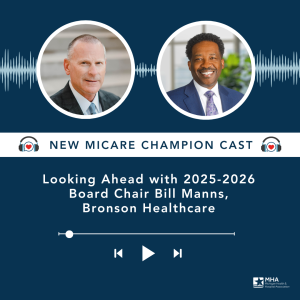
  • In the latest episode of the MiCare Champion Cast, MHA CEO Brian Peters and MHA Board Chair Bill Manns, president and CEO, Bronson Healthcare, explore what’s top of mind in healthcare as the 2025-2026 program year kicks off.

News to Know – Aug. 18, 2025

New to Know
  • New to KnowRegistration is open for the 2025 MHA Communications Retreat from 8 a.m. to 4 p.m. on Wednesday, Oct. 1 at the Henry Center for Executive Development in Lansing. The daylong event offers hospital communicators a chance to connect with peers across the state and participate in sessions that provide valuable skills and insights for both emerging and experienced professionals. The registration fee is $35 per person. Breakfast, refreshments and lunch will be provided. Please register by Sept. 19 to attend the retreat. Members with questions regarding registration should contact Kennedy Walters at the MHA. Questions regarding the retreat should be directed to John Karasinski at the MHA.
  • In the latest episode of the MiCare Champion Cast, MHA CEO Brian Peters and MHA Board Chair Bill Manns, president and CEO of Bronson Healthcare, explore what’s top of mind in healthcare as the 2025-2026 program year kicks off. Manns shares more about his journey to healthcare leadership, current priorities at Bronson and what work lies ahead for hospital leaders given recent activity at the state and federal level. Over the course of the interview, Peters and Manns discuss the impact of the “One Big Beautiful Bill Act (OBBBA)” on hospitals and patient access to care given cuts to Medicaid funding. The episode is available to stream on Apple PodcastsSpotifySoundCloudand YouTube. Questions or idea submissions for future MiCare Champion Cast episodes can be sent to Lucy Ciaramitaro at the MHA.

MHA Podcast Explores Healthcare Priorities with 2025-2026 Board Chair Bill Manns

The MHA released a new episode of the MiCare Champion Cast exploring what’s top of mind in healthcare as the 2025-2026 program year kicks off.

The episode, hosted by MHA CEO Brian Peters, features MHA Board Chair Bill Manns, president and CEO, Bronson Healthcare. Manns shares more about his journey to healthcare leadership, current priorities at Bronson and what work lies ahead for hospital leaders given recent activity at the state and federal level.

Since joining Bronson in 2020, Manns oversees a full range of services from primary care to critical care across more than 100 locations. Fellow officers of the 2025-2026 MHA Board of Trustees include Brittany Lavis, chair-elect; and Kent Riddle, treasurer, among many other hospital leaders across Michigan.

Manns noted during the discussion that addressing infant mortality and improving maternal health across the state remain key areas of focus for his team at Bronson Healthcare and hospital leaders across the state.

“Women of color have mortality rates during birth that is, at times, double or triple that of their white counterparts,” said Manns. “As soon as we’re born – without bias or prejudice – if we can get equality there, I think that’s a great footing to build and grow as a community and I think as a nation, quite frankly.”

Over the course of the interview, Peters and Manns discuss the impact of the “One Big Beautiful Bill Act (OBBBA)” on hospitals and patient access to care given cuts to Medicaid funding.

“One, we’ve got to do a better job of educating the public about just what’s coming,” said Manns when discussing how to approach the negative impacts of the OBBBA. “Two, we really have to advocate – even stronger – with our legislators…and three, I think we’ve really got to continue to be optimistic and not panic.”

They also explore the importance of 340B, efforts to address workplace violence and more.

The episode is available to stream on Apple PodcastsSpotifySoundCloud and YouTube. Questions or idea submissions for future MiCare Champion Cast episodes can be sent to Lucy Ciaramitaro at the MHA.

News to Know – June 2, 2025

New to Know

New to KnowIn the latest episode of the MiCare Champion Cast, Lauren LaPine, senior director of legislative & public policy, MHA, joined to provide insight on how Michigan continues to experience issues with timely access to behavioral health services. Listeners can also expect to learn more about the need to expand the pre-admission screening assessment for behavioral health providers and how and why Medicaid patients experiencing a behavioral health crisis are often stuck in emergency departments (EDs) longer than those who are commercially insured. The episode is available to stream on Apple PodcastsSpotifySoundCloud and YouTube.

Addressing Hurdles for Behavioral Health Patients Seeking Care in the ED

The MHA released a new episode of the MiCare Champion Cast exploring the need to expand the pre-admission screening assessment for behavioral health providers.

Lauren LaPine, senior director of legislative & public policy, MHA, joined to provide insight on how Michigan continues to experience issues with timely access to behavioral health services. More specifically, LaPine shared how and why Medicaid patients experiencing a behavioral health crisis are often stuck in emergency departments (EDs) longer than those who are commercially insured.

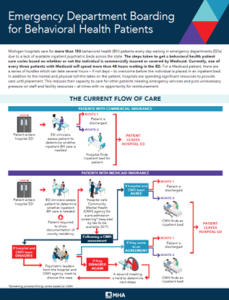
Infographic illustrating the differing processes that commercially insured patients go through to be assessed for a behavioral health need compared to a Medicaid beneficiary.
Infographic illustrating the differing processes that a Medicaid beneficiary goes through to be assessed for a behavioral health need compared to a commercially insured patient.

Under the current guidelines, LaPine explained, there are a series of arduous steps needed in order to get patients with Medicaid coverage inpatient behavioral healthcare. One of the biggest hurdles is that following an assessment by ED clinicians, a patient with Medicaid must receive a secondary pre-admission screening from a community mental health (CMH) agency.

This process can take hours – if not days – to complete. Meanwhile, a patient needing the same level of care who is commercially insured is not required to have the pre-admission screening by a CMH.

Last year, there were more than 1.2 million emergency room visits where behavioral health was one of the reasons for care. LaPine noted that pediatric and geriatric patients board for the longest periods of time.

One proposed solution to alleviate the process is to expand the three-hour assessment responsibility to allow clinically qualified staff to conduct pre-admission screenings in order to improve the delivery of care for behavioral health patients in Michigan hospital EDs.

“Emergency departments across the state are well-equipped to complete the pre-admission screening to determine if someone needs inpatient psychiatric care,” said LaPine. “Implementing this change will really help us to expand the number of available healthcare personnel that are able and available to conduct that pre-admission screening…it also allows Medicaid patients to be assessed in a similar manner as patients that have commercial insurance.”

According to recent survey data, there are more than 155 patients waiting in a hospital emergency department for access to behavioral health services; Whether that is an assessment through a CMH agency, an inpatient bed or a transfer to a short-term, residential setting.

The episode is available to stream on Apple PodcastsSpotifySoundCloud and YouTube.

News to Know – April 21, 2025

New to Know

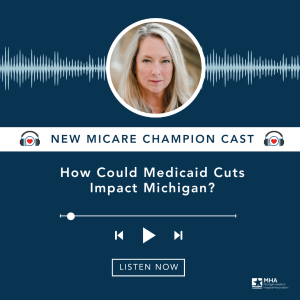
In the latest episode of the MiCare Champion Cast, Laura Appel, executive vice president of government relations & public policy at the MHA, explores how proposed reductions to Medicaid could disrupt access to care and harm Michigan hospitals, patients and communities. Listeners can also expect to learn more about the impact proposed cuts would have on rural healthcare and Michigan’s economy. The episode is available to stream on Apple PodcastsSpotifySoundCloud and YouTube.

How Could Medicaid Cuts Impact Michigan?

MiCare Champion Cast Header Photo

The MHA released a new episode of the MiCare Champion Cast exploring how proposed reductions to Medicaid could disrupt access to care and harm Michigan hospitals, patients and communities.

Laura Appel, executive vice president of government relations & public policy, MHA, first explored the history and purpose of Medicaid and the Healthy Michigan Plan, which has been hailed a success for improving access to care, reducing the uninsured rate and supporting economic stability for families across the state.

Appel explained the potential impact of recent federal proposals, which include instructions to cut Medicaid by at least $880 billion over 10 years. Changes like block grants, per capita caps and reduced federal matching rates could lead to a staggering $1.73 billion shortfall in the state budget, jeopardizing access to healthcare for millions.

“Cutting funding is cutting care,” said Appel. “Not every hospital is on the financial footing it wishes it were and there are a lot of hospitals across the country that are already in difficult financial straits…this could be the reason that they close all together.”

Michigan hospitals are asking members of Congress to protect the Medicaid program and oppose proposed reductions. Appel noted those interested in helping with this effort and reaching members of Congress are encouraged to visit the MHA Legislative Action Center.

Listeners can also expect to learn more about the impact proposed cuts would have on rural healthcare and Michigan’s economy. The episode is available to stream on Apple PodcastsSpotifySoundCloud and YouTube.

Hospitals Help: Learning More About Street Medicine Oakland

The MHA released a new episode of the MiCare Champion Cast featuring Laura Ortiz, MD, Emergency Medicine Provider at Corewell Health William Beaumont University Hospital, exploring a collaborative effort that’s enhancing access to care for all communities.

The program, known as Street Medicine Oakland, is a collaborative effort between Corewell Health William Beaumont University Hospital and Oakland University William Beaumont School of Medicine that delivers free medical care to those experiencing homelessness in Oakland County.  

During the episode, Ortiz explains how the program came to be, how it works and the strong, positive impact it’s having on patients, providers and medical students.

“If you don’t see the barriers and what patients are experiencing, you can’t understand how hard it is to do what seems like a simple thing like calling your doctor or finding transportation,” said Ortiz, who serves as the assistant medical director for the program.

Unsheltered populations face higher rates of chronic illness, mental and behavioral health conditions, substance use disorder and emergency department admissions. With this in mind, Street Medicine Oakland is focused on addressing barriers to care and tackling medical mistrust.

Ortiz, who also serves as the director of faculty development and the hospital’s medical education fellowship, shares how being involved in Street Medicine Oakland has changed her approach to care delivery in the hospital.

“[This work] reminds you why you got into medicine,” said Ortiz. “Getting to help people, learn people stories, see what their life is like…it’s very meaningful and makes me a better doctor.”

Street Medicine Oakland received an MHA Ludwig Community Benefit Award in 2024 and was recently featured in the 2024 MHA Community Impact Report. Those interested in sharing hospital programming in Michigan that is having a strong community impact are encouraged to contact Lucy Ciaramitaro at the MHA.

The episode is available to stream on Apple PodcastsSpotifySoundCloud and YouTube.

Dr. Ortiz received her bachelor’s degree from Kalamazoo College and is a graduate of the charter class of Oakland University William Beaumont School of Medicine. She completed her residency in Emergency Medicine at Indiana University where she served as chief resident in her final year. She completed a medical education fellowship at Corewell Health William Beaumont University Hospital, culminating in a Master of Health Professions Education from the University of Michigan.