Hospitals Help: Learning More About Street Medicine Oakland

The MHA released a new episode of the MiCare Champion Cast featuring Laura Ortiz, MD, Emergency Medicine Provider at Corewell Health William Beaumont University Hospital, exploring a collaborative effort that’s enhancing access to care for all communities.

The program, known as Street Medicine Oakland, is a collaborative effort between Corewell Health William Beaumont University Hospital and Oakland University William Beaumont School of Medicine that delivers free medical care to those experiencing homelessness in Oakland County.  

During the episode, Ortiz explains how the program came to be, how it works and the strong, positive impact it’s having on patients, providers and medical students.

“If you don’t see the barriers and what patients are experiencing, you can’t understand how hard it is to do what seems like a simple thing like calling your doctor or finding transportation,” said Ortiz, who serves as the assistant medical director for the program.

Unsheltered populations face higher rates of chronic illness, mental and behavioral health conditions, substance use disorder and emergency department admissions. With this in mind, Street Medicine Oakland is focused on addressing barriers to care and tackling medical mistrust.

Ortiz, who also serves as the director of faculty development and the hospital’s medical education fellowship, shares how being involved in Street Medicine Oakland has changed her approach to care delivery in the hospital.

“[This work] reminds you why you got into medicine,” said Ortiz. “Getting to help people, learn people stories, see what their life is like…it’s very meaningful and makes me a better doctor.”

Street Medicine Oakland received an MHA Ludwig Community Benefit Award in 2024 and was recently featured in the 2024 MHA Community Impact Report. Those interested in sharing hospital programming in Michigan that is having a strong community impact are encouraged to contact Lucy Ciaramitaro at the MHA.

The episode is available to stream on Apple PodcastsSpotifySoundCloud and YouTube.

Dr. Ortiz received her bachelor’s degree from Kalamazoo College and is a graduate of the charter class of Oakland University William Beaumont School of Medicine. She completed her residency in Emergency Medicine at Indiana University where she served as chief resident in her final year. She completed a medical education fellowship at Corewell Health William Beaumont University Hospital, culminating in a Master of Health Professions Education from the University of Michigan.

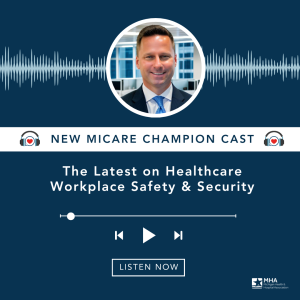
MHA Podcast Explores Strategies to Enhance Workplace Safety, Security

The MHA released a new episode of the MiCare Champion Cast exploring the latest on healthcare workplace safety with Brian Uridge, MPA, CPP, CHPA, CTM, senior director at the University of Michigan Department of Public Safety and Security (DPSS).

Those working in healthcare are five times as likely to suffer a workplace violence injury. With this in mind, the episode covers what safety issues are top of mind and what strategies are enhancing security for patients, visitors and staff at Michigan Medicine.

“In order to keep a healthcare system safe, you really have to use the same philosophies and strategies that you would use to keep a community safe,” said Uridge, who previously served as assistant chief of the Kalamazoo Department of Public Safety for 23 years. “Every hospital is a community, every floor is a neighborhood and every neighborhood is uniquely different.”

Gov. Whitmer signed into law MHA-supported public acts in 2023 which have been a positive step towards ensuring violence against healthcare workers is not tolerated. The association continues to support efforts that address violence committed against healthcare providers and have made anti-violence posters available to members.

As a sworn police officer for the university, Uridge manages over 300 public safety staff members for a system that has 40,000 employees and sees over four million patients a year. In this role, it’s a priority to create a culture of safety beyond moments when Uridge and his team are responding to a security threat.

“The way you keep a healthcare community safe is by building a relationship with the patients, the staff and the visitors,” noted Uridge. “It’s ambassadors first, police officer second. Our job is to reduce risk and reduce anxiety…we do that by building trust.”

The episode explores the integral role of Behavioral Threat Assessment and Management (BTAM) for identifying and managing safety threats, in addition to the ways healthcare security is evolving with advancements in artificial intelligence.

All UM Health resources are available for hospitals and health systems to use to enhance safety and security protocol. Those interested in learning more or collaborating with the UM Health DPSS team are encouraged to contact Uridge.

MHA members are also encouraged to explore resources from MHA Endorsed Business Partner Tarian, which offers a variety of programs and trainings for healthcare organizations to mitigate risk and effectively respond to safety threats. Contact Rob Wood at the MHA to learn more.

The episode is available to stream on Apple PodcastsSpotifySoundCloud and YouTube.

Those interested in learning more about the MiCare Champion Cast can contact Lucy Ciaramitaro at the MHA. For more information on caregiver resources in Michigan, contact the MHA Keystone Center.


MHA Podcast Explores Why Voting Matters to Healthcare in Michigan

The MHA released a new episode of the MiCare Champion Cast featuring Laura Appel, executive vice president of government relations & public policy, MHA, exploring why voting in the 2024 General Election is critical to Michigan’s healthcare future.

Appel kicked off the conversation sharing what health policy issues are top of mind at the MHA and what role the association plays when it comes to advocating for Michigan hospitals, health systems, patients and communities. She noted current priorities include a continued focus on strengthening the healthcare workforce, opposing harmful nurse staffing legislation and protecting the 340B Drug Pricing Program.

Later, Appel spoke about how voting directly influences healthcare at the local level and why eligible voters should get to the polls and engage with elected officials before, during and after the election cycle.

“Regardless of who’s in control, there are always healthcare champions on both sides of the aisle,” said Appel. “Those are the people who carry our message. Those are the people who help us get funding for rural labor and delivery services, those are the folks who help us get the Medicaid budget done every year.”

In addition to choosing our country’s next president, voters in Michigan will have a unique opportunity to decide on seats for the following political contests come Nov. 5, 2024:

  • One member of the U.S. Senate.
  • 13 Michigan members of the U.S. House of Representatives.
  • All 110 seats of the Michigan House of Representatives.
  • Two Michigan Supreme Court seats.

“Michigan is important,” Appel emphasized. “Michigan has a very strong voice…see if you can remove yourself from the hyper-partisan headlines. Your role is electing people who pay attention to healthcare, who care about healthcare, who care about hospitals having the resources that are necessary to take care of folks.”

The MHA is offering election communication materials geared toward hospital staff, volunteers, patients and visitors to encourage voter participation in the 2024 general election. Additionally, the MHA elections webpage offers relevant announcements and Race of the Week spotlights leading up to Election Day. Additional information regarding the 2024 General Election can be found on the Department of the State website.

The episode is available to stream on Apple Podcasts, Spotify, Soundcloud and YouTube.

Those interested in learning more about the MiCare Champion Cast can contact Lucy Ciaramitaro at the MHA. For more information or to request 2024 Election materials, visit the MHA Election webpage or contact the MHA.

What’s Ahead in Healthcare? Insights from the American Hospital Association

The MHA released a new episode of the MiCare Champion Cast featuring Rick Pollack, president and CEO of the American Hospital Association (AHA). Pollack joined MHA CEO Brian Peters to discuss a variety of topics tied to past, present and future healthcare trends.

As the nation’s largest hospital and healthcare system membership organization, the AHA is one of our country’s most respected and effective advocacy organizations. Beyond his strong advocacy leadership, Pollack has been instrumental in addressing historic workforce challenges, expanding healthcare access, improving healthcare quality and safety, eliminating disparities in care and much more.

MHA CEO Brian Peters and Rick Pollack, president and CEO of the AHA, during the recording of the MiCare Champion Cast episode.

After sharing more about his journey to the AHA, Pollack explored the fundamental shifts he has seen within the national healthcare environment and what issues will be at the forefront through 2025, regardless of the outcome of the general election.

“We always work to be a resource to candidates on both sides [of the aisle] and make sure they have the information they need in terms of data and what our positions are,” said Pollack. “Regardless of the election, there are certain issues that are not going to go away,” he added, noting affordability, drug pricing, value-based payment, and insurer accountability as examples of bipartisan issues.

Pollack later shared the important role grassroot efforts play when it comes to healthcare advocacy at the local level.

“People should not be intimidated in terms of engaging their legislators,” said Pollack. “They work for you, and you could be a resource to them. I always used to try to explain to my kids what a lobbyist does – and part of it is being an objective educator on issues where you are the expert and they will look to you for their guidance and counsel…and as a former congressional staffer, don’t forget the staff.”

Peters and Pollack also discussed cybercrime, challenges and opportunities for rural hospitals, the importance of the 340B Prescription Drug Pricing Program and much more. The episode is available to stream on Apple Podcasts, Spotify, Soundcloud and YouTube.

Those interested in learning more about the MiCare Champion Cast can contact Lucy Ciaramitaro at the MHA.

MHA Podcast Explores the Role of Artificial Intelligence (AI) in Healthcare

MiCare Champion Cast graphic featuring an episode focused on the role of Artificial Intelligence (AI) in Healthcare

The MHA released a new episode of the MiCare Champion Cast exploring the role artificial intelligence (AI) plays in healthcare today and what it will look like in the future. The episode features Bruce Brandes, president of Care.ai and Monica Holmes, a PhD candidate in bioinformatics at the University of Michigan and current member of the MHA AI Task Force.

Early in the discussion, Brandes and Holmes highlighted the ways smart technologies have been used for years when it comes to data analysis, disease diagnosis, radiology, clinical documentation, language processing and more.

“For the first time – maybe in my career in healthcare – it’s obvious that the status quo is no longer an acceptable option,” said Brandes, who has over 30 years of experience in executive management and entrepreneurial thought leadership. “This is real – you need to understand it, you need to be intentional and deliberate and have a strategic plan.”

Both Brandes and Holmes emphasized throughout the episode that AI cannot replace the essential role humans play in healthcare. The goal, in most cases, is to optimize a more efficient workflow, improve healthcare quality, advance diagnostics and enhance medical research.

“On the academic side, it’s improving our ability to do better research, which leads to better insights and ultimately better health outcomes for patients when it’s translated over to the bedside,” said Holmes, who also serves on the board of Trinity Health’s Chelsea Hospital as chair of patient quality and safety.

Listeners can expect to learn more about how patients and providers are responding to AI tools (including virtual nursing) and get answers to commonly asked questions related to transparency, health equity, regulation and cybersecurity.

Care.ai, an MHA endorsed business partner, powers more human care through the first and only AI-enabled Smart Care Facility Operating Platform, which deploys smart sensors throughout care facilities. These sensors continuously and ambiently monitor clinical and operational workflows, learning from them to predict, prevent and protect; alerting and engaging care teams in real-time and improving common challenges such as fall prevention, pressure injury prevention, hand hygiene compliance, rounding adherence, automated documentation, virtual rounding, virtual sitting and more.

The episode is available to stream on Spotify, Apple Podcasts, SoundCloud and YouTube. Those interested in learning more about Care.ai or the MHA EBP program can visit the business services webpage or contact Rob Wood at the MHA. Questions or idea submissions for future MiCare Champion Cast episodes can be sent to Lucy Ciaramitaro at the MHA.

MHA Podcast Explores Benefits, Challenges of Virtual Care in Behavioral Health

The MHA released a new episode of the MiCare Champion Cast exploring how clinicians are navigating virtual care in the behavioral health space.

The episode, released during Mental Health Awareness Month, features two providers from Pine Rest Christian Mental Health Services. Dr. Heide Rollings, M.D., child and adolescent psychiatry fellowship director and Dr. Lisa Vroman Stokes, Ph.D., manager of Forest Hills Clinic and child and adolescent project coordinator, joined to share insights about the advantages and challenges of telemedicine in the behavioral health setting.

“We know that for children and adolescents – especially in rural communities – it can be really wonderful to have [telehealth] as an option,” said Dr. Rollings, who also serves as an assistant clinical professor in the division of psychiatry at Michigan State University.

Flexibility plays a big part in the new normal. Although virtual options have helped improve access, both Rollings and Stokes noted that it can’t always substitute in-person screenings and treatment. In many cases, clinicians must communicate expectations to patients early on to develop effective treatment plans within virtual and hybrid formats.

“We’re finding ourselves in a position as providers of re-educating and acclimating our patients to how they can most effectively engage and benefit from treatment,” said Dr. Stokes, who also oversees predoctoral psychology interns at Pine Rest.

As demand for behavioral healthcare services increases, staffing shortages continue to impact the workforce. In an effort to grow the talent pipeline, Pine Rest offers a variety of educational opportunities to those entering the field. This includes:

As the third-largest non-profit mental health care provider in the country, Pine Rest offers a full continuum of care for mental health and substance use disorders in West Michigan. In addition to their outpatient locations and psychiatric urgent care, the health system is also building a pediatric behavioral health center slated to open in 2026. Pine Rest was one of six organizations to receive grant funding following a $50 million appropriation from the Michigan legislature as part of the 2023 State Budget, which aimed at increasing the number of inpatient beds available for pediatric psychiatric patients across the state.


The episode is available to stream on SpotifyApple PodcastsSoundCloud and YouTube. Those interest in learning more about the services, Questions or idea submissions for future MiCare Champion Cast episodes can be sent to Lucy Ciaramitaro at the MHA.