MHA CEO Report — Site-Neutral Payment Policies: The Latest Threat to Patient Access

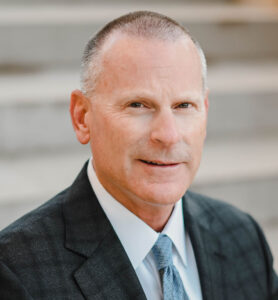
MHA Rounds graphic of Brian Peters

“The worst form of inequality is to try to make unequal things equal.” — Aristotle

MHA Rounds graphic of Brian PetersOperating a hospital has never been more challenging than it is today. At the most fundamental level, hospitals are small towns that operate 24/7, year-round, built around expert clinicians, as well as a wide variety of highly skilled employees in multiple disciplines. Collectively, they are tasked with the awesome responsibility of delivering a broad spectrum of high-quality healthcare services to everyone in their respective communities, regardless of their health or socio-economic status.

Our MHA Chief Medical Officer, Gary Roth, DO, often says “healthcare is everyone’s destiny.” He’s right: at some point, all of us – or our loved ones – will require the assistance of our healthcare system. And when that day comes, we as patients can and should expect that we have ready access to care. Michigan hospitals take that expectation very seriously, whether that comes in the form of physician recruitment, retention and call coverage, drug acquisition, facilities maintenance and expansion, or ensuring that the latest diagnostic and treatment technology is on-site.

Here is an economic reality: being prepared to care for anyone, for any diagnosis, at any time, creates high fixed costs. In classic business terminology, hospitals are “price takers” when it comes to government payers, because Medicaid and Medicare effectively tell hospitals what they will receive in reimbursement.

Against this backdrop, our field is currently facing a strong push at the federal level to prevent hospitals from receiving Medicare reimbursement at a level that appropriately recognizes the higher fixed and operational costs referenced above. Referred to as “site-neutral payments,” this policy would force hospitals to accept the same rates as those paid at other sites of care. This ignores the fact that the cost structures between the two settings are very different because hospitals go to great lengths to have the infrastructure in place to save lives every day. Non-hospital settings serve a very valuable but different role, and the reimbursement they receive today reflects those differences. In addition to being open 24/7/365 to all patients – including those with multiple comorbidities, and little or no health insurance coverage, hospitals must have redundant systems for energy and water so surgeries and other patient care can continue uninterrupted when the power goes out or other systems are compromised. Physician offices have no such requirements and don’t bear these costs.

Hospital outpatient departments also provide convenient access to care for the most vulnerable and medically complex patients. These settings are more likely to treat Medicare patients who have more chronic and severe conditions, have been recently hospitalized or in an emergency department and are dually eligible for Medicare and Medicaid. These patients are more expensive to care for and rely on hospital outpatient departments for their increased healthcare needs.

Implementing site-neutral payment policies would be detrimental to access to care for patients across Michigan and the country. If reimbursement is slashed across the board, hospitals will be forced to reduce their costs, which will come in the form of reduced hospital beds, service lines or even potentially hospital closures. This plan for inadequate payment can be particularly harmful for hospitals serving a high percentage of vulnerable patients, including rural hospitals. When a hospital closes services due to site-neutral payment policy, they will close to everyone, not just people covered under Medicare.

I was recently honored to be appointed to the American Hospital Association Board of Trustees and this issue is clearly a key focus of their advocacy work on Capitol Hill. The MHA is joining that effort by advocating with Michigan’s members of Congress, and our message is unambiguous: comparing hospitals with other sites of care is not comparing apples and oranges – it’s comparing apples and space shuttles. More importantly, reducing healthcare costs can’t come at the expense of reduced access to care.

As always, I welcome your thoughts.
MHA Monday Report Aug. 26, 2024

Register for MHA 2024-25 Strategic Action Plan Webinar
The MHA is hosting a virtual member forum 11 a.m. to noon Oct. 14 to outline the MHA 2024 – 2025 strategic action plan approved by the MHA Board of Trustees. The plan will include …


MHA Submits Comments on Proposed MDHHS Medicaid Behavioral Health Policies

The MHA submitted comments to the Michigan Department of Health and Human Services (MDHHS) regarding two Medicaid proposed policies Aug. 20 pertaining to the establishment of Intensive Care Coordination with Wraparound and the implementation …


Kelley Cawthorne Ad


Guide for Michigan’s Adult Guardianship Process Available Digitally

The MHA published a resource for hospital and healthcare teams to support patients and families navigating the guardianship process. A printable copy as well as digital version are now available. The Guide for Michigan’s Adult Guardianship …


MHA CEO Report — Adding Value for Hospitals

I discussed last month how the MHA continues to create highly successful and impactful outcomes for our members through our outstanding advocacy in the public policy arena, at both the state and federal levels. …


The Keckley Report

The Two Tipping Points prompting Outsider Demand for Health System Transformation

“As Democrats gather in Chicago and Epic users convene in Verona WI this week, the future of the healthcare system will be on the agenda for both gatherings, but with a different focus: …

In Chicago and Verona, opportunities to improve the U.S. system are readily acknowledged. Which flaws deserve attention first, how and how fast reflect contrasting views. But perhaps as never before, the direction of the system is impacted by two convergent realities …

As congregants assemble in Chicago and Verona this week, outsiders hope they’ll look beyond incrementalism and pursue transformational change. They’re tired of waiting. It’s reached its tipping point. …”

Paul Keckley, Aug. 19, 2024


News to Know

  • MHA offices will be closed and no formal meetings will be scheduled Sept. 2 in honor of Labor Day.
  • Due to the holiday, Monday Report will not be published Sept. 2 and will resume its normal schedule Sept. 9.
  • MHA Endorsed Business Partner CorroHealth will host the webinar Investing Wisely in the Healthcare Continuum Aug. 28 to share strategic solutions for integrating utilization management, clinical documentation integrity and denials management into a unified revenue integrity framework.

MHA CEO Brian Peters

MHA in the News

MHA CEO Brian Peters joined The Common Bridge podcast for an episode published Aug. 18 to discuss various healthcare policy topics, particularly those impacting rural Michigan.  Areas of focus include the Affordable Care Act, the impact of Medicaid provider taxes …

MHA Provides Comment on Proposed Medicaid Reimbursement for Group Prenatal Care

The MHA submitted a comment letter to the Michigan Department of Health and Human Services regarding the proposed Medicaid coverage of group prenatal care, set to begin in October 2024. The MHA expressed support for the policy, highlighting its potential to significantly improve maternal and infant health outcomes in Michigan. However, in its comment letter, while supporting the policy, the MHA requested clarification on the reimbursement rate and suggested a higher rate for sessions with larger attendance due to the increased resources required.

Members with questions may contact Lauren LaPine at the MHA.

Michigan Medicaid Facility Rates Increased for Dental Procedures Under General Anesthesia

The Michigan Department of Health and Human Services (MDHHS) issued a final policy to increase Medicaid payment rates for dental services provided to patients under general anesthesia in ambulatory surgical centers (ASCs) and outpatient hospitals, effective Oct. 1, 2022.

MDHHS implemented this policy change to improve access to vital dental services for Michigan’s most vulnerable population. Due to severity of a case or special needs for children and adults with developmental or intellectual disabilities,  some procedures cannot be completed in a clinic or office-based setting. The payment rate increased from $82.16 to $1,495 for ASCs and from $216.07 to $2,300 for outpatient hospitals.

The policy also modified the payment methodology for these settings, converting payment for current procedural terminology code 41899 from the Outpatient Prospective Payment System to a fee schedule based system.

Members with questions about this policy change should contact Jason Jorkasky at the MHA .

Governor Signs FY 25 Budget and FY 24 Supplemental

Gov. Whitmer signed the fiscal year (FY) 2025 state budget on July 24. The budget proposal fully funds the Michigan Medicaid program, including significant increases to provider-funded Medicaid reimbursements in FY 24 and 25. The budget also includes a new, $8.3 million investment to support peer recovery coaches in hospitals to enhance substance use disorder services.

Additionally, the agreement provides necessary resources to assist hospitals in advancing the health of individuals and communities throughout Michigan. This includes:

  • Maintaining funding for the Healthy Michigan Plan.
  • Preserving outpatient Medicaid rate increases achieved during prior budget cycles.
  • Continuing funding for the rural access pool and obstetrical stabilization fund.
  • Investing an additional $10 million in maternal and infant health programs at hospitals.
  • Establishing a new, $9 million nursing loan repayment program.
  • More than $31 million in additional, direct hospital appropriations.

A statement on the passage of the budget was also published by MHA CEO Brian Peters June 27. The MHA will continue to advocate the state use portions of the funding to provide the resources necessary for hospitals and health systems to care for all Michiganders.

Members with questions on the state budget may contact Adam Carlson at the MHA.

June Medicaid and Medicare Enrollment in Michigan

The MHA updated its analysis of Medicaid and Medicare enrollment to reflect June 2024 data. The analysis now includes program enrollment as a percentage of each county’s total population and the split between fee-for-service and managed care organization. Nearly 27% of Michigan’s total population are enrolled in Medicaid and 22% are enrolled in Medicare.

The Michigan Department of Health and Human Services completed the Medicaid redetermination process, as required by the Consolidated Appropriations Act.  June 2024 enrollment, including the Healthy Michigan Plan, is at nearly 2.7 million, which is down approximately 603,000 since July 2023. 67% of Medicaid beneficiaries are enrolled in one of nine managed care plans.

The impact on hospitals is unknown since many enrollees had other coverage and their services were not billed to Medicaid. Many individuals who lost coverage have subsequently reenrolled in the program, have other third-party coverage or have sought coverage on the federal marketplace.

Total Medicare enrollment is 2.26 million, with 62% of beneficiaries enrolled in a Medicaid Advantage (MA) plan and only two counties having less than 50% of total Medicare enrollment in MA plans. MA enrollment by county varies from 45% to 77%, with most counties having 55% or more of their Medicare population enrolled in an MA plan, as highlighted below.

June enrollment is spread across 48 MA plans, with up to 28 plans covering beneficiaries in several Michigan counties.

Members with enrollment questions should contact the Health Finance team at the MHA.

2025 State Budget Supports Key Healthcare Priorities

The Michigan Legislature approved the fiscal year (FY) 2025 state budget the week of June 24 which the governor is expected to sign into law next month. The budget proposal fully funds the Michigan Medicaid program, including significant increases to provider-funded Medicaid reimbursements in FY 24 and 25. The budget also includes a new, $8.3 million investment to support peer recovery coaches in hospitals to enhance substance use disorder services.

Additionally, the agreement provides necessary resources to assist hospitals in advancing the health of individuals and communities throughout our state. This includes:

  • Maintaining funding for the Healthy Michigan Plan.
  • Preserving outpatient Medicaid rate increases achieved during prior budget cycles.
  • Continuing funding for the rural access pool and obstetrical stabilization fund.
  • Investing an additional $10 million in maternal and infant health programs at hospitals.
  • Establishing a new, $9 million nursing loan repayment program.
  • More than $31 million in additional, direct hospital appropriations.

A statement on the passage of the budget was also published by MHA CEO Brian Peters June 27. The MHA will continue to advocate the state use portions of the funding to provide the resources necessary for hospitals and health systems to care for all Michiganders.

Members with questions on the state budget may contact Adam Carlson at the MHA.

Healthcare Advocates Honored with MHA Special Recognition Award

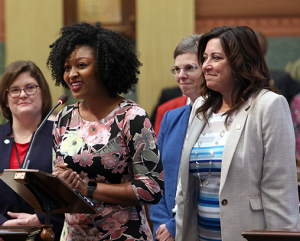
Sen. Anthony and Rep. Witwer

The MHA announced two winners of its Special Recognition Award during the Annual Membership Meeting June 27, recognizing them for extensive contributions to healthcare. Each of the winners has uniquely influenced healthcare in Michigan. The winners include Sen. Sarah Anthony (D-Lansing) and Rep. Angela Witwer (D-Delta Township).

The lawmakers each chair their chamber’s appropriations committee, with Anthony the first Black woman to ever chair the Senate Appropriations Committee. These committees are responsible for determining the annual state budget, covering important healthcare areas including Medicaid, the Healthy Michigan Plan, graduate medical education, the rural access pool and obstetrical stabilization fund, and critical access hospital reimbursement rates. Both lawmakers were strong supporters of Public Act 5 of 2023, sponsored by Witwer, which provided $75 million for hospital workforce recruitment, retention and training in the fiscal year 2023 state budget. In addition, they each fought to include enhanced funding for ongoing Level I and Level II trauma centers, inpatient psychiatric payment rates and maternal health in the fiscal year 2024 budget. Both Anthony and Witwer are strong supporters of funding Medicaid appropriately to ensure adequate reimbursement rates for providers and protect access to healthcare services.

Sen. Sarah Anthony (D-Lansing)

In addition to her committee role, Anthony prioritizes expanding access to healthcare. She sponsored Michigan’s first mental health parity law, signed into law May 21 by Gov. Whitmer. Public Act 41 of 2024 requires insurance coverage for mental health and substance use disorder treatments at the same level as physical health services. This new law eliminates existing disparities and ensure equal access to necessary care for all Michiganders. Anthony also co-sponsored key legislation last session to support the healthcare talent pipeline signed into law by Gov. Whitmer Dec. 22, 2022. Public Acts 251 and 252 of 2022 expanded the Michigan Reconnect program, allowing for several additional certifications to qualify for the post-secondary scholarship program including high-demand healthcare credentials. Other healthcare legislation Anthony sponsors includes Senate Bill 531, which is part of a package of bills supported by the MHA that would improve Michigan’s amended auto no-fault laws. The package would simplify and increase Medicare hospital reimbursements, clarify the definition of Medicare and create a new post-acute care provider fee schedule. The bills passed the Senate in a bipartisan vote and await consideration by the House.

Rep. Angela Witwer (D-Delta Township)

Witwer’s role as a healthcare champion is inspired by more than the 22 years she spent working in healthcare to begin her career. She first started as a clinician, working in University of Michigan Health – Sparrow Lansing’s burn unit and later as the manager of pediatric rehabilitation. She later became manager of the hospital’s community relations and marketing department, before leaving the organization to co-found her own public relations, marketing and advocacy firm. These life experiences inspired Witwer’s support for Public Acts 271 and 272 of 2023, which increase the penalties for assaulting a healthcare worker or volunteer by doubling the financial fines for those found guilty of such a crime.

Michigan Legislature Champions Healthcare Funding

The following statement can be attributed to Brian Peters, CEO of the Michigan Health & Hospital Association.

MHA CEO Brian PetersThe Michigan Legislature passed a state budget that champions crucial healthcare funding and protects access to vital healthcare services across Michigan communities.

The fiscal year 2025 state budget and fiscal year 2024 supplemental proposals continue funding pools that support rural and critical access hospitals, obstetrical services, the Healthy Michigan Plan and Michigan’s Medicaid populations. Each of these pools help maintain access to care for underserved populations throughout the state.

The budget also includes new funding to support peer recovery coaches in hospitals to enhance substance use disorder services. These individuals are specifically trained to provide advanced peer recovery support services and are proven to help patients overcome obstacles in their substance use disorder recovery. Michigan joins the more than 38 other states in supporting this model of providing needed care.

We look forward to Gov. Whitmer signing this budget, which protects access to care and ensures hospitals can continue to advance the health of individuals and communities.

Governor Signs Telehealth Parity & Behavioral Health Licensing Clarification Bills

Gov. Whitmer signed several MHA-supported bills during the week of June 3 related to telehealth services and behavioral health licensing. House Bills 4131, 4213, 4579 and 4580 (now referred to as Public Acts 51 – 53 of 2024) establish payment parity for telehealth services and protections for telemedicine access through Medicaid and state regulated insurance products. The bills support a provider’s ability to serve patients and protect in-person visits that are vital to health outcomes.

Public Act 50 of 2024 (originally Senate Bill 227), sponsored by Sen. Dan Lauwers (R-Brockway), was supported by the MHA and updates the state’s child caring institution licensing laws to align with emergency intervention language used in the Mental Health Code. Specifically, this legislation is important to any facility interested in becoming licensed as a Pediatric Residential Treatment Facility and creates additional alignment between the Mental Health Code and the licensing structure for child caring institutions.

Members with questions may contact Lauren LaPine or Elizabeth Kutter at the MHA.