
2026 is the Year of the ‘No Wrong Door’ Approach

Significant changes to Medicaid are expected to take effect in 2027, bringing new requirements and processes that could increase the risk of coverage loss for eligible individuals if systems are not prepared. While many details are still emerging, one thing is already clear: 2026 will be a critical year for hospitals and health systems to prepare patients and their own organizations for what’s ahead.

Hospitals serve as trusted access points for care and information, especially for Medicaid populations. As changes approach, the concept of a ‘No Wrong Door’ approach offers a practical, patient-centered framework for ensuring individuals receive clear guidance and support to maintain coverage, no matter where they first seek help.

“Hospitals and health systems have a vital role to play in helping patients navigate upcoming Medicaid changes,” said MHA CEO Brian Peters, “Taking steps now will help protect access to care, reduce confusion and support healthier communities when new requirements take effect in 2027.”

The Medicaid changes anticipated for 2027 include more frequent eligibility checks, new administrative requirements and adjustments that could make it easier for coverage to lapse due to missed paperwork or misunderstandings, even among people who remain eligible.

The stakes are high. Coverage disruptions can lead to delayed care, worsening health conditions, increased uncompensated care and greater strain on the healthcare ecosystem. Preparation in 2026 can mitigate reactive problem-solving in 2027.

A ‘No Wrong Door’ approach ensures that wherever a patient interacts with the healthcare or community system, whether that be a hospital, clinic, emergency department, school, pantry or community organization, they receive consistent information and help related to Medicaid coverage. The goal is simple: eligible people stay covered. The process of reaching that goal however is much more complex.

This approach relies on alignment across internal teams and external partners, shared messaging and clear pathways for escalation when patients need additional support.

Key Components of a ‘No Wrong Door’ Strategy

Internal Readiness

Consistency across departments helps ensure patients don’t fall through the cracks. Hospitals can begin by strengthening internal workflows, including:

  • Identifying patients at risk of loss of coverage.
  • Training frontline staff to recognize coverage red flags.
  • Developing standard scripts and referral pathways.
  • Aligning registration, financial counseling, care management and clinical teams.

Tiered Outreach and Escalation

Not all patients need the same level of support. A tiered model ensures resources are used effectively to reach those most in need, and allows hospitals to:

  • Use broad messaging and reminders for most patients.
  • Provide targeted follow-up for higher-risk individuals.
  • Escalate complex cases to financial counselors, navigators or legal support.

Community Partnerships

A ‘No Wrong Door’ strategy also extends beyond hospital walls. Community partners including health centers, local agencies, faith organizations, schools, libraries and managed care plans can serve as trusted messengers and access points for assistance. Strong partnerships expand reach, particularly for patients who may not regularly engage with healthcare.

Shared Tools and Training

Developing shared materials, role-specific training and clear communication protocols helps ensure everyone, from hospital staff to community partners, is delivering accurate, consistent guidance.

2026 can be structured as a year for hospitals and health systems to build internal systems and partnerships, pilot workflows and outreach strategies, refine approaches based on real-world experience and prepare for broader implementation ahead of 2027. This phased approach allows hospitals to adapt as additional state and federal guidance becomes available.

Even with all this preparation, many aspects of the Medicaid changes remain uncertain. The MHA will continue to keep members informed as additional guidance is released by the Michigan Department of Health and Human Services and the federal government.

In the meantime, investing in ‘No Wrong Door’ strategies during 2026 can help hospitals protect patients, preserve access to care and position their organizations for a smoother transition in 2027, no matter how the details evolve.

MHA CEO Report — Streamlining Medicaid Work Requirements

MHA Rounds image of Brian Peters

“Alone we can do so little, together we can do so much.” — Helen Keller

MHA Rounds image of Brian PetersAs states work toward establishing Medicaid work requirements that are a core element of H.R. 1, it’s more important than ever that we reduce the administrative burden associated with verification for beneficiaries. Medicaid work requirements aim to advance accountability, but if not implemented correctly, they can increase costs for everyone and remove safety nets for those who need it most.

When reporting systems are confusing or overly complex, individuals that satisfy the requirements can still lose coverage simply because they can’t navigate the paperwork. When qualified individuals go without coverage, they tend to delay seeking care until a problem has worsened unnecessarily; at the same time, hospitals end up managing more uncompensated care. And when more people go uninsured, healthcare costs rise, affecting affordability for everyone.

The solution lies in intentional implementation. Michigan can successfully streamline the verification process by automating data sharing across agencies, offering multiple reporting options and communicating requirements clearly. In short, we need to follow the lead of some of the most successful and innovative companies in the private sector, such as Amazon and Uber, and make this process as user-friendly as possible.

By focusing on efficiency and simplicity, Michigan can protect taxpayer dollars, support employment and keep healthcare more affordable with an effective Medicaid work requirement program. The MHA is committed to working closely with all parties toward this goal.

As always, I welcome your thoughts.

Speech-Language Pathologist Medicaid Coverage and Critical Incident Stress Management Services Legislation Advances

Legislation improving coverage policies for speech-language pathologists (SLPs) and broadening those included under Critical Incident Stress Management (CISM) services advanced in the Michigan House of Representatives during the week of Oct. 20.

House Bill (HB) 4484, introduced by Rep. Joe Fox (R-Fremont), amends the Social Welfare Act to allow Michigan-licensed SLPs to seek Medicaid reimbursement for audiological rehabilitation and speech-language therapy services. SLPs could seek reimbursement for services regardless of having a certificate of clinical competence and regardless of any Department of Health and Human Services rules or regulations surrounding the issue. The bill passed out of the Michigan House 102-0 on Oct. 22. The MHA-supported bill now heads to the Senate for further consideration.

HB 4857, introduced by Rep. Will Bruck (R-Erie), expands the scope of confidentiality and liability provisions related to CISM services to any individual, rather than just emergency service providers. CISM services means services provided by a CISM team or team member to individuals affected by a critical incident or series of incidents to help manage or reduce stress-related responses. Some of the services provided include critical incident stress debriefings, on-scene support services, consultation and referral services. The MHA supports the legislation, which was unanimously approved by members of the House Health Policy Committee on Oct. 22.

Members with questions may contact the MHA advocacy team.

MHA Shares Recent Medicare and Medicaid Enrollment Analysis

The MHA recently updated its analysis of Medicaid and Medicare enrollment based on September 2025 data. The analysis includes program enrollment as a percentage of each county’s total population and the split between fee-for-service and managed care organizations. Just over 26% of Michigan’s total population is enrolled in Medicaid and 23% is enrolled in Medicare.

Roughly two-thirds of Michigan’s 2.6 million Medicaid beneficiaries are enrolled in one of nine managed care plans.

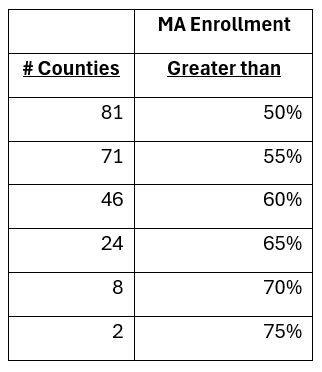
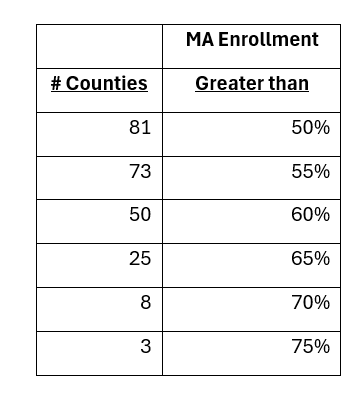
Total Medicare enrollment is 2.28 million with 63% of beneficiaries enrolled in a Medicaid Advantage (MA) plan with only two counties having less than 50% of total Medicare enrollment in MA plans. MA enrollment by county ranges from 46% to 79%, with 73 counties having 55% or more of their Medicare population enrolled in an MA plan as highlighted below.


September enrollment is spread across 45 MA plans with up to 29 plans covering beneficiaries in several Michigan counties, with a minimum of five plans available in each county.

Members with enrollment questions should contact the health finance team at the MHA.

MHA Supports Expanded Medicaid Coverage for Postpartum Mental Health Screenings

The MHA recently submitted comments to the Michigan Department of Health and Human Services in support of the proposal to expand Medicaid coverage for maternal mental health screenings up to 12 months postpartum.

Postpartum depression affects one in eight individuals, with symptoms often appearing months after childbirth. At nine to 10 months postpartum, 7.2% of individuals report depressive symptoms, many for the first time, highlighting the need for extended screening.

The MHA noted the importance of using validated tools like the Edinburgh Postnatal Depression Scale and aligning with recommendations from national medical organizations will help identify and treat more cases of postpartum depression. Extending coverage will close care gaps, improve outcomes for families and strengthen maternal and infant health statewide.

Members with questions may contact Lenise Freeman at the MHA.

MHA CEO Report — Patients Over Politics

MHA Rounds image of Brian Peters

MHA Rounds graphic of Brian Peters“Happy are those who dare courageously to defend what they love.”  — Ovid

Most people will find themselves in a hospital at one point or another, whether it’s to hold a loved one’s hand, welcome a child or receive needed – perhaps even life-saving – care.

I’m no exception. Like many others have done before and since, my wife and I looked to the team at Corewell Health Devos Children’s Hospital to keep our daughter safe and healthy while she was fighting for her life in their neonatal intensive care unit some 19 years ago (a story I recently shared on the MiCare Champion Cast). Needless to say, it’s in those moments that we realize just how personal – and non-partisan – healthcare truly is.

As an association, it’s our job to protect Michigan hospitals and safeguard healthcare services for patients and communities. That’s why in recent months we’ve spoken out against attacks to Medicaid – and why now – we’re ringing the alarm on the devastating impact proposed House budget cuts would have if signed into law.

Political posturing aside, here are the facts: Michigan hospitals stand to lose more than $2.5 billion under House Bill 4706, which would directly impact patient access to care in hospital beds, labor and delivery units, emergency departments, cancer treatment and many other vital service lines across the state. As we stated repeatedly during the debate on “One Big Beautiful Bill Act (OBBBA),” when service lines and hospitals close, access is not only lost for Medicaid recipients – it is lost for everyone.  In addition, this funding keeps our incredibly dedicated healthcare workers employed. The House-proposed budget puts more than 20,000 Michigan hospital jobs at risk and could result in a $4.9 billion loss to the state’s economy.

While some politicians point fingers, Michigan hospitals are focused on patients. It’s time to put egos aside and act as a united front when it comes to protecting access to care, helping our communities thrive and showing up for those who care for us all in times of joy, uncertainty and crisis.

We cannot let partisanship put lives at risk. On behalf of our MHA family, I ask you to show courage in speaking truth to power. I ask you to join me in urging lawmakers on both sides of the aisle to protect essential hospital funding by visiting our MHA Legislative Action Center.

As always, I welcome your thoughts.

MHA Monday Report Aug. 25, 2025

CMS Releases FY 2026 Final Rule for Skilled Nursing Facilities

The Centers for Medicare & Medicaid Services (CMS) recently released a final rule to update the Medicare fee-for-service prospective payment system for skilled nursing facilities for fiscal year (FY) 2026. Key provisions include: Increasing the per-diem federal rate …


MHA Community Benefits Survey for FY 2024 Now Open

The MHA is now accepting submissions for the fiscal year (FY) 2024 Community Benefits Survey. Member hospitals are encouraged to participate, as the survey results are vital to demonstrating the value of hospital community benefit …


Trustee Webinar Outlines the OBBBA Impact

The MHA will host the webinar Understanding the One Big Beautiful Bill Act (OBBBA) and Board Planning for the Impact from 8 to 9 a.m. Sept. 24. The session is designed for trustees and hospital leaders and will highlight considerations …


MHA EBP care.ai Shares Case Study on Virtual Care Expansion

MHA Endorsed Business Partner (EBP) care.ai recently shared an insightful case study on how a 22-bed virtual care pilot with Henry Ford Health is expanding across 13-acute care hospitals, including a chief nursing informatics …


Keckley Report

The Medical Profession at a Crossroad

“When I was a grad student at Ohio State in the ‘70’s, one of the most challenging courses I took was “Primary Research Methods in Analyzing Public Data” –an elective. …

The data show the majority of physicians are unhappy and uncertain about the future of the profession. The data show they’re working harder and doing more with less. The data show they’re concerned about the future of the health system and think it’s heading in the wrong direction. The data show employed physicians are increasingly dissatisfied in their hospital and private equity relationships. The data show that physicians share of the growing health spending pie is shrinking: from 21.1% in 2000, to 20.1% in 2023 and projected to 19.9% in 2025 and 19.5% in 2033. And data show the profession, along with nurses and pharmacists, enjoys the public’s trust to figure things out. …

Might defining a vision for a transformed ‘U.S. System of Health’ be the focus for the medical profession? There’s plenty of data to digest to deliberate objectively. Its willingness and ability to set aside its factionalism for the greater good is the biggest question facing the profession. And the widely-recognized dysfunction of the current U.S. health system presents the urgent opportunity for the profession to step forward. That’s the cross facing the profession.”

Paul Keckley, August 17, 2025


New to KnowNews to Know

The MHA is developing its 2025-2026 events and education calendar, featuring professional development opportunities, networking events and timely, relevant offerings for members.


MHA in the News

The MHA received media coverage during the week of Aug. 18 that continued to focus on the impact the One Big Beautiful Bill Act will have on Medicaid as well as comments related to …

Media Recap: Medicaid and Healthcare Costs

The MHA received media coverage during the week of Aug. 18 that continued to focus on the impact the One Big Beautiful Bill Act (OBBBA) will have on Medicaid as well as comments related to the impact hospital consolidations have on healthcare access.

Gongwer published a story Aug. 20 on the impact hospital consolidations have on healthcare costs and access to care for employees. MHA CEO Brian Peters was quoted in the article disputing the claim that hospitals are profiteers.

“Bashing community hospitals and the 220,000 hospital workers who show up every day of the year to care for Michigan patients is misguided and inflammatory,” said Peters. “Hospitals are focused on providing safe, high-quality, affordable care in every community they serve.”

NPR also published a story following an interview with Peters regarding the impact the OBBBA and new work requirements will have on healthcare in Michigan.

“The state of Michigan Department of Health and Human Services has estimated that as many as 700,000 Michiganders could lose coverage because of the reconciliation bill,” said Peters.

The new work requirements will necessitate that hundreds of thousands of enrollees document their eligibility every six months. Peters noted in the interview that there’s no evidence of widespread waste and abuse in the state’s Medicaid program.

“When you look at the Medicaid population here in the state of Michigan, we know that almost all of those folks are working and working full time,” said Peters.

Members with any questions regarding media requests should contact John Karasinski at the MHA.

MHA Monday Report Aug. 18, 2025

CMS Releases FY 2026 LTCH Prospective Payment System Final Rule

The Centers for Medicare & Medicaid Services (CMS) recently released a final rule to update the Medicare fee-for-service long-term care hospital (LTCH) prospective payment system for fiscal year (FY) 2026. Specifically, the …


MHA Keystone Center and MI AIM Announce Recipients of Maternal Health Education Grant

The MHA Keystone Center, in collaboration with the Michigan Alliance for Innovation on Maternal Health (MI AIM), recently announced a partnership with UnitedHealthcare to offer $25,000 grants to birthing hospitals in Michigan to purchase equipment …


CMS Releases FY 2026 Final Rule for Inpatient Rehabilitation Facilities

The Centers for Medicare & Medicaid Services (CMS) recently released a final rule to update the Medicare fee-for-service prospective payment system for inpatient rehabilitation facilities for fiscal year (FY) 2026. Key provisions include: …


Keckley Report

Health Industry Notoriety is a Two-Edged Sword: Four Considerations as the Mid-Term Elections Near

“Keeping track of all things healthcare is a formidable task.  Last week’s news is no exception: …

These events and actions illustrate the administration’s “flood the zone” strategy and its propensity to dictate news cycles in media coverage. They also reflect the ubiquitous role played by healthcare in our society as an employer and economic engine.

Collectively, they appear to cast the industry in a negative light reinforcing populist’ suspicions about affordability, price transparency, corporatization and cost-containment. And they lend to growing disfavor among lawmakers, employers and critics. …”

Paul Keckley, Aug. 10, 2025


New to KnowNews to Know

  • Registration is open for the 2025 MHA Communications Retreat from 8 a.m. to 4 p.m. on Wednesday, Oct. 1 at the Henry Center for Executive Development in Lansing.
  • In the latest episode of the MiCare Champion Cast, MHA CEO Brian Peters and MHA Board Chair Bill Manns, president and CEO, Bronson Healthcare, explore what’s top of mind in healthcare as the 2025-2026 program year kicks off.

MHA Monday Report Aug. 11, 2025

MHA Trustee Webinar Outlines Information and Planning for the OBBBA

The MHA will host the webinar Understanding the One Big Beautiful Bill Act (OBBBA) and Board Planning for the Impact from 8 to 9 a.m. ET Sept. 24. The session will explore how the OBBBA …


CMS Releases FY 2026 Final Rule for Inpatient Psychiatric Facilities

The Centers for Medicare & Medicaid Services (CMS) recently released a final rule to update the Medicare fee-for-service prospective payment system for inpatient psychiatric facilities for fiscal year (FY) 2026. Key provisions …


CMS Releases FY 2026 Hospital Inpatient Prospective Payment System Final Rule

The Centers for Medicare & Medicaid Services (CMS) recently released a final rule to update the Medicare fee-for-service inpatient prospective payment system for fiscal year (FY) 2026. Highlights of the final rule include: …


MHA Podcast Explores Healthcare Priorities with 2025-2026 Board Chair Bill Manns

The MHA released a new episode of the MiCare Champion Cast exploring what’s top of mind in healthcare as the 2025-2026 program year kicks off. The episode, hosted by MHA CEO Brian Peters, features MHA …


Keckley Report

July 2025 Actions are the Turning Point for U.S. Healthcare

“July 2025 will be the month U.S. healthcare leaders recognize as the industry’s modern turning point. Consider…

Collectively, these actions reflect rejection of the health industry by the GOP-led Congress. It follows 15 years of support vis a vis the Affordable Care Act (2010) and pandemic recovery emergency funding (2020-2021). In that 15-year period, the bigger players got bigger in each sector, investment of private equity in each sector became more prevalent, costs increased, affordability for consumers and employers decreased, and the public’s overall satisfaction with the health system declined precipitously. …

The landscape for U.S. healthcare is fundamentally changed as a result of the July actions noted above. It is compounded by public anxiety about the economy at home and global tensions abroad.

These July actions were a turning point for the industry: responding appropriately will require fresh ideas and statesmanship. Transparency about prices, costs, incentives and performance is table stakes. Leaders dedicated to the greater good will be the difference.”

Paul Keckley, Aug. 3, 2025


New to KnowNews to Know

MHA Endorsed Business Partner Vault Verify is hosting a live webinar on HR’s Growing Role in Data Protection from 1 to 2 p.m. ET Aug. 13.


Lauren LaPineMHA in the News

The MHA received media coverage the week of Aug. 4 on hospital cost pressures, behavioral health partnerships and the impact of Medicaid cuts. Gongwer published a story Aug. 4 about a PricewaterhouseCoopers report that reviews …