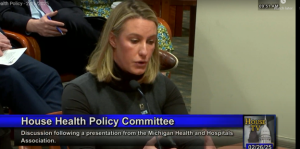
The Michigan House of Representatives voted in support of House Bill 5455, sponsored by Rep. Rylee Linting (R-Grosse Ile Township), which would restore Michigan to the Interstate Medical Licensure Compact (IMLC). The compact supports access to care, particularly in rural areas, by allowing physicians to practice across state lines. The MHA continues to engage with lawmakers and advocate for the timely passage of the legislation to support physician participation in the compact – and encourages members to contact their legislator in support of the IMLC through this action alert. The legislation now heads to the Senate for further consideration.
In addition to this, House Bill 5313, sponsored by Rep. Matthew Bierlein (R-Vassar), was in front of the House Health Policy Committee for testimony on Feb. 4. The bill reduces the number of CME hours required for physicians from the current 150 hours to 75 hours every three years, while also modernizing outdated regulatory structures around physician disciplinary records under these CME guidelines. By reducing administrative burdens in the licensing process and aligning the state’s CME requirements with those of other states, Michigan can improve physician recruitment and retention while maintaining access to timely, high-quality care for patients. Upon review of the legislation with the MHA’s Legislative Policy Panel, the MHA supported House Bill 5313 in committee.
Representatives Julie Rogers (D-Kalamazoo) and Matthew Bierlein (R-Vassar) also introduced House Bills 5512 and 5513.The bills would streamline the process for the insurance credentialing of providers in the state of Michigan by requiring a 60-day timeline for approving an application and requiring the department to make a uniform credentialing application for all insurers and providers. The MHA-backed bills have been referred to the House Insurance Committee for consideration.
Legislation on physician assistant licensure compact agreements, international medical school graduates, hospital price transparency measures and medical debt collection advanced in the Michigan House and Senate during the week of Nov. 10.
In the House Health Policy Committee, lawmakers took testimony on Senate Bill (SB) 95, introduced by Sen. Jonathan Lindsey (R-Coldwater), which would codify federal hospital price transparency requirements into state law. Lawmakers from other states testified virtually to share perspectives on hospital price transparency efforts similar to SB 95. The MHA continues to work with committee members on this issue and supports tying SB 95 to bills that would create state-level protections for the federal 340B drug pricing program.
The committee also voted in support of House Bill (HB) 4925 and HB 4896, introduced by Rep. Phil Green (R-Watertown Township) and Rep. Jason Woolford (R-Howell), which creates a new pathway for certain internationally educated physicians to practice medicine in Michigan. After securing key amendments, the MHA supported this legislation in committee.
Further, the Michigan House voted in favor of HB 4857, introduced by Rep. Will Bruck (R-Erie), which would expand confidentiality and liability protections associated with critical incident stress management (CISM) services to any individual, rather than limiting them to emergency service providers. CISM services include critical incident stress debriefings, on-scene support, consultation and referral services. The MHA applauds the unanimous 108-0 House vote supporting individuals affected by traumatic workplace events.
In the Senate Health Policy Committee, lawmakers voted in support of HB 4309, SB 483, and SBs 449–451. HB 4309, sponsored by Rep. Dave Prestin (R-Cedar River), adds Michigan into the physician assistant licensure compact agreement. SB 483, introduced by Sen. Rosemary Bayer (D-West Bloomfield), creates a palliative care task force in the state. Lastly, SBs 449-451 address medical debt collection efforts and requirements for hospitals and are sponsored by Sen. Sarah Anthony (D-Lansing) and Sen. Jonathan Lindsey (R-Coldwater). The MHA supports HB 4309 and SB 483; and remains neutral on SBs 449-451.
Lastly, the Michigan Senate voted 33-3 in favor of SB 443, sponsored by Sen. Sean McCann (D-Kalamazoo), which requires hospitals and health facilities that provide surgical services to create and implement a surgical smoke plume evacuation system. The bill will now move to the Michigan House for further consideration.
Legislation improving coverage policies for speech-language pathologists (SLPs) and broadening those included under Critical Incident Stress Management (CISM) services advanced in the Michigan House of Representatives during the week of Oct. 20.
House Bill (HB) 4484, introduced by Rep. Joe Fox (R-Fremont), amends the Social Welfare Act to allow Michigan-licensed SLPs to seek Medicaid reimbursement for audiological rehabilitation and speech-language therapy services. SLPs could seek reimbursement for services regardless of having a certificate of clinical competence and regardless of any Department of Health and Human Services rules or regulations surrounding the issue. The bill passed out of the Michigan House 102-0 on Oct. 22. The MHA-supported bill now heads to the Senate for further consideration.
HB 4857, introduced by Rep. Will Bruck (R-Erie), expands the scope of confidentiality and liability provisions related to CISM services to any individual, rather than just emergency service providers. CISM services means services provided by a CISM team or team member to individuals affected by a critical incident or series of incidents to help manage or reduce stress-related responses. Some of the services provided include critical incident stress debriefings, on-scene support services, consultation and referral services. The MHA supports the legislation, which was unanimously approved by members of the House Health Policy Committee on Oct. 22.
The House Health Policy heard testimony from the MHA in support of creating a nurse licensure compact and the Senate voted to establish a Prescription Drug Affordability Board in the state of Michigan during the week of April 20.
House Bill 4246, sponsored by Rep. Phil Green (R-Millington), would create a nurse licensure compact agreement in the state of Michigan.Amy Brown, chief nursing officer, field engagement, MHA and Elizabeth Kutter, senior director, government and political affairs, MHA provided testimony April 23 in support of the bill during the House Health Policy Committee. Brown and Kutter discussed the importance of the compact in terms of nurse recruitment and patient access to care across state lines, especially with border states.
Amy Brown, chief nursing officer, field engagement, MHA and Elizabeth Kutter, senior director, government and political affairs, MHA provided testimony April 23 in support of the bill during the House Health Policy Committee.
“In addition to recruitment and coordination of care in our state’s border areas, joining the Compact would positively benefit telehealth access,” Brown said. “Compact licensure means residents in Michigan can access more telehealth professionals in other compact states, increasing access points for our state’s residents.”
Currently, there are 41 states participating in the compact, putting Michigan at a competitive disadvantage when it comes to attracting and retaining talent in the nursing profession. This legislation awaits further testimony in the House Health Policy Committee before being taken up for a vote.
Additionally, theMichigan Senate passed legislation to create a Prescription Drug Affordability Board (PDAB). Senate Bills (SBs) 3–5 establish the board and require both commercial insurance and Medicaid to adhere to upper payment limits developed for certain prescription drugs being reviewed by the board. The objective of the PDAB is to provide more opportunities for prescription drug affordability for Michigan residents. The MHA worked closely with bill sponsors to secure key amendments that recognize hospitals as entities that face drug affordability challenges. Following the adoption of these important changes, the MHA supported SBs 3-5.
The Michigan Senate passed the Momnibus, a group of bills designed to improve support in prenatal and maternal healthcare during the week of April 13. The legislation includes SBs 29–39, which focus on addressing improving access to care and ensuring better patient outcomes for all birthing individuals.
The Momnibus makes several changes aimed at improving maternal healthcare, including creating opportunities for patients to directly engage in their treatment experience, implementing policies that support patient rights and providing funding to train more doulas to work in both urban and rural areas. The bills also expand midwifery services, improve data transparency about maternal health outcomes and protect patient rights related to pregnancy and childbirth. The MHA worked closely with the bill sponsors to improve access to maternal care and supported SBs 29, 30, 31, 36, 38 and 39. Both Senate bill packages will now move to the Michigan House of Representatives for further consideration. The MHA will continue to report on further action on this legislation.
Members with questions should contact Elizabeth Kutter at the MHA.
Jim Lee, senior vice president, data policy & analytics, MHA, appeared in a story about artificial intelligence (AI) in healthcare aired by Mid-Michigan NOW on April 23.
Lee discussed how AI is being used by hospitals and providers to assist with medical data and information and to reduce administrative burden.
“AI and healthcare is sort of like having a super smart assistant that helps doctors and nurses by quickly sorting through mountains of data and medical information,” said Lee.
Lansing political news outlet Gongwer also published two articles on April 23 that quote MHA representatives.
MHA CEO Brian Peters appeared in a story covering the newly launch Protect MI Care coalition to protect against Medicaid funding cuts.
“[Medicaid is] the financial lifeline that keeps hospitals, mental health providers and nursing homes open,” said Peters. “Cuts at this scale would lead to facility closures, creating health care deserts that hurt everyone, regardless of how they’re insured.”
MHA Chief Nursing Officer Amy Brown also appeared in an article following her testimony in the House Health Policy Committee in support of House Bill 4246, which would add Michigan to the nurse licensure compact.
“An important tactic to improve our ability as a state to attract talent and make it easy for nurses to choose Michigan to practice is to join the nurse license compact,” said Brown. “Hospitals continue to prioritize recruitment and retention efforts, but with the aging demographics of our state and the lack of participation in the compact hinder our ability to recruit younger nurses to replace the many nurses nearing and entering retirement.”
Members with any questions regarding media requests should contact John Karasinski at the MHA.
Legislation that would implement 340B program protections advanced in the Senate Oversight Committee and Gov. Whitmer delivered her seventh annual State of the State address to the Michigan Legislature during the week of Feb. 24.
Deidra Wilson, senior vice president, government relations and public policy, McLaren Health Care; and Ben Frederick, associate vice president of advocacy and government relations, Memorial Healthcare testified Feb. 27 in the Senate Oversight Committee on legislation regarding 340B Protections.
Senate Bill (SB) 94, sponsored by Sen. Sam Singh (D-East Lansing), and SB 95, sponsored by Sen. Jonathan Lindsey (R-Allen), saw extensive action in the Senate Oversight Committee Feb. 27. SB 94 protects the 340B program in Michigan and is paired with SB 95, which requires hospital compliance with federal transparency laws. Two MHA members provided testimony during the committee in support:Deidra Wilson, senior vice president, government relations and public policy, McLaren Health Care; and Ben Frederick, associate vice president of advocacy and government relations, Memorial Healthcare.
SB 94 safeguards the 340B program, ensuring cost savings and preserves access to affordable healthcare services in both urban and rural Michigan communities. Further, this legislation adds first of its kind drug manufacturer transparency requirements, making Michigan’s legislation the strongest in the nation.
During testimony, Wilson first thanked the committee for their swift action on reintroduction of the bills and the importance of expediting this legislation to support communities. She discussed services for cancer patients across the state, such as covering copays, rural OB services and other vital services for vulnerable populations that are impacted when pharmaceutical manufacturers create restrictions around the 340B program. Wilson concluded her testimony by stating that hospitals prioritize the needs of patients and communities over the profits of drug manufacturers. Frederick emphasized the impact the 340B program has in rural communities, especially for independent and community hospitals, and shared how these rural areas can provide essential OB, cancer and family medicine services to preserve and improve access for patients. Following a successful hearing, the Senate Oversight Committee voted 5-0 to report SB 94 and SB 95 to the full Senate. The bills now await a full vote in the Senate before it can be sent to the House of Representatives.
Elizabeth Kutter, senior director, government and political affairs, MHA testimony provided an overview of the 340B program in the House Health Policy Committee Feb. 26.
The House Health Policy Committee also heard testimony on the importance of the 340B program in the state Feb. 26.Elizabeth Kutter, senior director, government and political affairs, MHA, provided an overview of the program, including examples of how the program benefits patients and communities across the state. Wilson and Frederick also testified, sharing how the program works for their hospital systems. The educational hearing enabled House Health Policy members to ask questions and engage in a constructive dialogue around the topic. The MHA continues to advocate for the 340B program and support Michigan hospitals’ efforts to expand access to quality, community-based care. Members are encouraged to use the MHA 340B Action Alert to contact their lawmakers in support of this legislation.
Lastly, Gov. Whitmer outlined her upcoming priorities to a joint convention of the Michigan Legislature in her State of the State address Feb. 26. One key highlight in her address included reducing medical debt for Michiganders. While no specific policies were discussed, she cited 700,000 Michiganders currently have medical debt and that legislators should work to find solutions for this issue going forward. In addition to this, the governor discussed working in a bipartisan fashion on issues like road funding, building affordable housing and lowering costs in the state.
MHA executives appeared on WJR 760 AM during the weeks of Nov. 25 and Dec. 2 to discuss the association’s opposition to government mandated nurse staffing ratios.
Both Peters and Appel focused on House Bills 4550 – 4552, which would mandate one-size-fits-all nurse staffing ratios for all Michigan hospitals. The bills received a committee hearing Nov. 9 in the House Health Policy Committee and the interviews addressed how these bills remain the MHA’s top priority during the state’s legislative lame-duck session.
If the bills did become law, Michigan communities would face the loss of important access to healthcare services, as up to 5,100 hospitals beds throughout the state would close.