MHA CEO Report — Protecting Medicaid Protects Michigan

MHA Rounds graphic of Brian Peters

“Never allow someone to be your priority while allowing yourself to be their option.” – Mark Twain

MHA Rounds graphic of Brian PetersAccessible and affordable healthcare is essential for communities to thrive, yet recent proposals to slash Medicaid funding threaten to destabilize this foundation for nearly three million Michiganders, including 961,000 children whose health and future depend on access to these services.

Medicaid is a cornerstone of our healthcare system and keeps people healthy at every stage of life. It provides coverage for two in five U.S. births, two in five children, one in six non-elderly adults, two in five non-elderly adults with a disability, one in four people with a substance use disorder or mental illness and three in five nursing facility residents.

The Affordable Care Act expanded Medicaid to cover more working Americans who do not make enough to afford other coverage. In Michigan, this expansion is known as the Healthy Michigan Plan, which has been hailed as a success for improving access to care, reducing the uninsured rate and supporting economic stability for families across the state.

Nationwide, 40 states have embraced Medicaid expansion, recognizing its transformative benefits. More than 75% of people approve of Medicaid. However, despite its overwhelming popularity, Medicaid is under threat.

Various proposals aim to cut Medicaid by enacting significant reductions in federal funding that would force states like Michigan to make devastating decisions, directly impacting families and communities. Changes like block grants, per capita caps and reduced federal matching rates could lead to an estimated $1.73 billion funding gap in Michigan, jeopardizing access to healthcare for millions.

Medicaid is the single largest payer for long-term care, maternity care and mental health services. Medicaid expansion under the ACA has saved lives, kept hospitals open and improved the overall well-being of countless individuals.

I know firsthand what Medicaid cuts would do to hospitals, essential services and Michigan’s healthcare industry and the economy as a whole. Medicaid is an important program across all Michigan hospitals, but especially for Michigan’s 65 rural hospitals that depend on it to keep their doors open.

Losing rural hospitals would devastate communities across Michigan, depriving them of access to emergency care, maternity services, mental health treatments, long-term care and other life-saving treatments. It would also eliminate jobs, weaken local economies and force residents to travel longer distances for healthcare, increasing the risk of delayed or missed treatment.

Beyond providing care, rural hospitals are economic anchors in their communities. They create jobs, attract businesses and ensure residents can live and work with the security of accessible healthcare.

Aside from the direct impact that Medicaid funding cuts would have on the functioning of hospitals around Michigan, they would have far-reaching economic consequences that impact the workforce and future health of our state. Healthcare is the largest private-sector employer in Michigan, and Medicaid funding supports thousands of jobs across the state. Hospitals, clinics, nursing homes and home health agencies rely on Medicaid payments to sustain operations and maintain their workforce. If Medicaid funding is reduced, healthcare providers will face difficult choices, including cutting services, laying off staff or even shutting their doors.

Michigan cannot afford cuts to Medicaid funding. Our state budget would face a staggering $1.73 billion shortfall if Medicaid cuts move forward. This funding gap would force the state to make decisions like reducing benefits or removing people from coverage – harming patients, providers and communities alike.

Medicaid is not and should not be a partisan issue, as it serves people in urban and rural Michigan, with no distinction between whether those receiving benefits are Democrats, Republicans or any other political affiliation.

Ensuring access to quality healthcare for all Michiganders should be a shared priority. And supporting the infrastructure to make that possible should not be considered optional.

As always, I welcome your thoughts.
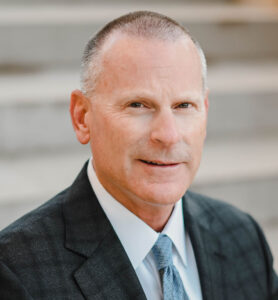
Peters Pens Medicaid Detroit News Op-ed

MHA CEO Brian Peters

The Detroit News published an op-ed Feb. 19 from MHA CEO Brian Peters expressing the importance of protecting the Medicaid program from any potential federal funding cuts.

Peters highlighted the high number of people supported by Medicaid, the value of the Healthy Michigan Plan and the harm cuts would have on healthcare providers, particularly in rural Michigan.

“Medicaid expansion under the ACA has saved lives, kept hospitals open and improved the overall well-being of countless individuals,” said Peters. “As the CEO of the Michigan Health & Hospital Association, I know firsthand what Medicaid cuts would do to hospitals, essential services, Michigan’s healthcare industry and the economy as a whole.”

Members with any questions regarding media requests should contact John Karasinski at the MHA.

Executive Budget Recommendation Maintains Health of Michigan Hospitals

The following statement can be attributed to Brian Peters, CEO of the Michigan Health & Hospital Association.

MHA CEO Brian PetersState funding is critical to the health and viability of Michigan hospitals and their patients. This budget presented by the Whitmer administration today maintains stability for healthcare providers across Michigan. We appreciate the continued protection of funding pools that preserve access to care for Michiganders, whether they require obstetrical services, care at rural and critical access hospitals or coverage from the Healthy Michigan Plan and Michigan’s Medicaid health plans. We are also encouraged to see continued attention towards issues that impact Michigan’s talent pipeline and remove barriers towards pursuing healthcare careers.

Healthcare touches us all, regardless of political affiliation, and we look forward to working with lawmakers from both sides of the aisle during the budget process to make sure Michiganders, their communities and healthcare providers receive the funding support they need.

June Medicaid and Medicare Enrollment in Michigan

The MHA updated its analysis of Medicaid and Medicare enrollment to reflect June 2024 data. The analysis now includes program enrollment as a percentage of each county’s total population and the split between fee-for-service and managed care organization. Nearly 27% of Michigan’s total population are enrolled in Medicaid and 22% are enrolled in Medicare.

The Michigan Department of Health and Human Services completed the Medicaid redetermination process, as required by the Consolidated Appropriations Act.  June 2024 enrollment, including the Healthy Michigan Plan, is at nearly 2.7 million, which is down approximately 603,000 since July 2023. 67% of Medicaid beneficiaries are enrolled in one of nine managed care plans.

The impact on hospitals is unknown since many enrollees had other coverage and their services were not billed to Medicaid. Many individuals who lost coverage have subsequently reenrolled in the program, have other third-party coverage or have sought coverage on the federal marketplace.

Total Medicare enrollment is 2.26 million, with 62% of beneficiaries enrolled in a Medicaid Advantage (MA) plan and only two counties having less than 50% of total Medicare enrollment in MA plans. MA enrollment by county varies from 45% to 77%, with most counties having 55% or more of their Medicare population enrolled in an MA plan, as highlighted below.

June enrollment is spread across 48 MA plans, with up to 28 plans covering beneficiaries in several Michigan counties.

Members with enrollment questions should contact the Health Finance team at the MHA.

2025 State Budget Supports Key Healthcare Priorities

The Michigan Legislature approved the fiscal year (FY) 2025 state budget the week of June 24 which the governor is expected to sign into law next month. The budget proposal fully funds the Michigan Medicaid program, including significant increases to provider-funded Medicaid reimbursements in FY 24 and 25. The budget also includes a new, $8.3 million investment to support peer recovery coaches in hospitals to enhance substance use disorder services.

Additionally, the agreement provides necessary resources to assist hospitals in advancing the health of individuals and communities throughout our state. This includes:

  • Maintaining funding for the Healthy Michigan Plan.
  • Preserving outpatient Medicaid rate increases achieved during prior budget cycles.
  • Continuing funding for the rural access pool and obstetrical stabilization fund.
  • Investing an additional $10 million in maternal and infant health programs at hospitals.
  • Establishing a new, $9 million nursing loan repayment program.
  • More than $31 million in additional, direct hospital appropriations.

A statement on the passage of the budget was also published by MHA CEO Brian Peters June 27. The MHA will continue to advocate the state use portions of the funding to provide the resources necessary for hospitals and health systems to care for all Michiganders.

Members with questions on the state budget may contact Adam Carlson at the MHA.

Healthcare Advocates Honored with MHA Special Recognition Award

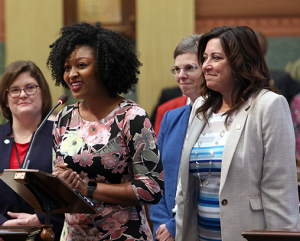
Sen. Anthony and Rep. Witwer

The MHA announced two winners of its Special Recognition Award during the Annual Membership Meeting June 27, recognizing them for extensive contributions to healthcare. Each of the winners has uniquely influenced healthcare in Michigan. The winners include Sen. Sarah Anthony (D-Lansing) and Rep. Angela Witwer (D-Delta Township).

The lawmakers each chair their chamber’s appropriations committee, with Anthony the first Black woman to ever chair the Senate Appropriations Committee. These committees are responsible for determining the annual state budget, covering important healthcare areas including Medicaid, the Healthy Michigan Plan, graduate medical education, the rural access pool and obstetrical stabilization fund, and critical access hospital reimbursement rates. Both lawmakers were strong supporters of Public Act 5 of 2023, sponsored by Witwer, which provided $75 million for hospital workforce recruitment, retention and training in the fiscal year 2023 state budget. In addition, they each fought to include enhanced funding for ongoing Level I and Level II trauma centers, inpatient psychiatric payment rates and maternal health in the fiscal year 2024 budget. Both Anthony and Witwer are strong supporters of funding Medicaid appropriately to ensure adequate reimbursement rates for providers and protect access to healthcare services.

Sen. Sarah Anthony (D-Lansing)

In addition to her committee role, Anthony prioritizes expanding access to healthcare. She sponsored Michigan’s first mental health parity law, signed into law May 21 by Gov. Whitmer. Public Act 41 of 2024 requires insurance coverage for mental health and substance use disorder treatments at the same level as physical health services. This new law eliminates existing disparities and ensure equal access to necessary care for all Michiganders. Anthony also co-sponsored key legislation last session to support the healthcare talent pipeline signed into law by Gov. Whitmer Dec. 22, 2022. Public Acts 251 and 252 of 2022 expanded the Michigan Reconnect program, allowing for several additional certifications to qualify for the post-secondary scholarship program including high-demand healthcare credentials. Other healthcare legislation Anthony sponsors includes Senate Bill 531, which is part of a package of bills supported by the MHA that would improve Michigan’s amended auto no-fault laws. The package would simplify and increase Medicare hospital reimbursements, clarify the definition of Medicare and create a new post-acute care provider fee schedule. The bills passed the Senate in a bipartisan vote and await consideration by the House.

Rep. Angela Witwer (D-Delta Township)

Witwer’s role as a healthcare champion is inspired by more than the 22 years she spent working in healthcare to begin her career. She first started as a clinician, working in University of Michigan Health – Sparrow Lansing’s burn unit and later as the manager of pediatric rehabilitation. She later became manager of the hospital’s community relations and marketing department, before leaving the organization to co-found her own public relations, marketing and advocacy firm. These life experiences inspired Witwer’s support for Public Acts 271 and 272 of 2023, which increase the penalties for assaulting a healthcare worker or volunteer by doubling the financial fines for those found guilty of such a crime.

Michigan Legislature Champions Healthcare Funding

The following statement can be attributed to Brian Peters, CEO of the Michigan Health & Hospital Association.

MHA CEO Brian PetersThe Michigan Legislature passed a state budget that champions crucial healthcare funding and protects access to vital healthcare services across Michigan communities.

The fiscal year 2025 state budget and fiscal year 2024 supplemental proposals continue funding pools that support rural and critical access hospitals, obstetrical services, the Healthy Michigan Plan and Michigan’s Medicaid populations. Each of these pools help maintain access to care for underserved populations throughout the state.

The budget also includes new funding to support peer recovery coaches in hospitals to enhance substance use disorder services. These individuals are specifically trained to provide advanced peer recovery support services and are proven to help patients overcome obstacles in their substance use disorder recovery. Michigan joins the more than 38 other states in supporting this model of providing needed care.

We look forward to Gov. Whitmer signing this budget, which protects access to care and ensures hospitals can continue to advance the health of individuals and communities.

Legislature Advances MHA Supported Policy Bills; Budgets Move Through Senate

The Michigan Senate advanced their chamber budgets for the upcoming fiscal year during the week of May 13. The Senate’s budget recommendations for the Department of Health and Human Services continues vital funding for Medicaid, rural and critical access hospitals, obstetrical services and the Healthy Michigan Plan. Additionally, the Senate passed budget includes funding to provide reimbursement for peer recovery coaches in the hospital setting to enhance substance use disorder services, as well as funding to support hospital achievement of Maternal Levels of Care verification through the Joint Commission.

Several MHA supported bills also moved through the committee process and onward to the governor’s desk. The House Health Policy Committee voted in favor of revising the disposal requirements for appropriately contained sharps. Senate Bill 482, sponsored by Sen. Kristen McDonald Rivet (D-Bay City), allows for sharps containers to remain in use until they are ¾ filled but for no longer than 18 months from the date of first sharps disposal into the container. This is a significant revision from the current law, which requires disposal every 90 days, regardless of if the container is underutilized. The MHA is supportive of this legislation and brought this idea to the legislature following feedback from the MHA membership.

The House Tax Policy Committee voted to report House Bill (HB) 5394, sponsored by Rep. Felcia Brabec (D-Pittsfield Twp.). HB 5394 requires appropriate information sharing to fully effectuate the organ donor registry and implementing new policies allowing for individuals to identify themselves as an organ donor on their tax returns. The MHA supports this legislation and continues to support opportunities to improve Michigan’s organ donation processes.

In addition, the Senate approved HBs 4131, 4213, 4579 and 4580, which provide payment parity for telehealth services and protections for telemedicine access. The bills support a provider’s ability to serve patients and protect in-person visits that are vital to health outcomes. The MHA supported bills are now headed to the governor’s desk to be signed into law.

Members with questions may contact Elizabeth Kutter at the MHA.


House Advancing Medicaid Budget Highlights Legislative Work

The Michigan House of Representatives advanced its state fiscal year (FY) 2025 Michigan Department of Health and Human Services (MDHHS) budget recommendations during the week of May 5.

Importantly, the chamber’s budget recommendation continues vital funding for Medicaid, rural and critical access hospitals, obstetrical services and the Healthy Michigan Plan. Supporting Michigan’s Medicaid program will help maintain access to care for underserved populations throughout Michigan. Additionally, the budget proposal includes funding to provide reimbursement for peer recovery coaches in the hospital setting to enhance substance use disorder services. The Senate is expected to advance its FY 25 MDHHS budget recommendation next week.

The House also gave final approval to two MHA supported bills. House Bill (HB) 5096, sponsored by Rep. Kristian Grant (D-Grand Rapids), makes important changes to the state’s Renaissance Zone Act. These changes allow for more local governments to take advantage of the benefits of a renaissance zone designation and increase flexibility around those designations. Renaissance zones support economic development opportunities and allow for important economic drivers, like hospitals, to thrive in a variety of circumstances. Without these alterations, hospitals who may benefit from their locality being designated as a renaissance zone would be unable to realize significant opportunity to maintain or increase access to care in vulnerable communities. The MHA supported this legislation because of the positive impact this could have on Michigan hospitals and health systems. HB 5096 passed the House and is on its way to Gov. Whitmer’s desk to be signed into law.

The House also gave final approval to Senate Bill (SB) 227, sponsored by Sen. Dan Lauwers (R-Brockway). SB 227 will update the state’s child caring institution licensing laws to align with emergency intervention language used in the Mental Health Code. Specifically, this legislation is important to any facility interested in becoming licensed as a Pediatric Residential Treatment Facility and creates additional alignment between the Mental Health Code and the licensing structure for child caring institutions. SB 227 is now headed to the governor’s desk for her signature.

Members with any questions may contact Elizabeth Kutter at the MHA.

Medicaid Budget Bills Advance, Other Health Issues Move Forward

The House and Senate appropriations committees advanced recommendations during the week of April 28 for the Department of Health and Human Services as a part of the state fiscal year 2025 budget.

The MHA is pleased to see that the appropriations committee’s budget recommendations continue vital funding for Medicaid, rural and critical access hospitals, obstetrical services and the Healthy Michigan Plan. Supporting Michigan’s Medicaid program will help maintain access to care for underserved populations throughout Michigan. Additionally, the budget proposals include funding to provide reimbursement for peer recovery coaches in the hospital setting to enhance substance use disorder services. The budgets now move to the full House and Senate chambers for consideration.

Legislation to create a licensure process for Michigan dietitians was signed into law by Governor Whitmer May 1. HB 4608, introduced by Rep. Laurie Pohutsky (D-Livonia), creates a new license for individuals seeking to provide medical nutrition therapy in Michigan. Establishing the new license ensures access for Michigan patients by increasing opportunities for dietitians to be reimbursed for the services they provide. The MHA continues to support this legislation.

The House approved legislation that would enter Michigan into the Interstate Occupational Therapy and Physical Therapy compacts. HBs 4169, 4170, 4504 and 4505 would have Michigan join 28 other states currently in the occupational therapy compact, and the 30 states currently in the physical therapy compact. The MHA supports legislation that would allow individuals licensed and in good standing in a compact state to practice in any other compact state without first obtaining an individual state license. The bills will now go to the Senate Health Policy Committee for consideration.

Members with questions can reach out to Elizabeth Kutter at the MHA.