Congressman Bergman Co-Sponsors Critical Access Hospital Relief Act

U.S. Rep. Jack Bergman (R-MI) recently co-sponsored HR. 538, the Critical Access Hospital Relief Act of 2025, which would remove the 96-hour physician certification requirement for inpatient services at critical access hospitals.

The bill, introduced in January 2025, would amend Title XVIII of the Social Security Act to eliminate the mandate that a physician certify that a Medicare patient may reasonably be expected to be discharged or transferred to a hospital within 96 hours after admission to the critical access hospital. The proposed change is intended to reduce administrative burden and increase operational flexibility for rural hospitals in managing patient care and staffing, particularly during transfer delays or capacity constraints.

The MHA supports this legislation and will continue to review its potential implications for Michigan’s critical access hospitals, providing updates as the bill advances through Congress.

Members with questions may contact Lauren LaPine-Ray at the MHA.

MHA CEO Report — Prioritizing Rural Health

MHA Rounds graphic of Brian Peters

“Be sure you put your feet in the right place, then stand firm.” – Abraham Lincoln

MHA Rounds graphic of Brian PetersWhile snow continues to fall in northern Michigan, spring is officially here, and for many, that means our weekend travel plans shift from skiing and snowmobiling to camping, hiking and boating. Rural Michigan is an amazing travel destination for many, but it also is home year-round to 20% of our state’s population, and access to affordable, high-quality healthcare remains absolutely crucial. Rural hospitals are an integral part of the local fabric of their communities, treating the ill and improving the health and well-being of their residents. They work extremely hard to make sure they’re able to provide the best quality of care, while operating on a budget with slim to nonexistent margins. In a small town, there is nowhere to hide when the hospital is experiencing challenges of any kind. This is especially true when the hospital is the largest employer in the community and a vital economic engine, which is very often the case in rural Michigan.

I recently had the opportunity to attend the annual American Hospital Association (AHA) Rural Health Care Leadership Conference, along with a number of MHA senior staff and Michigan rural healthcare leaders, including Tina Freese Decker, CEO of Corewell Health and current chair of the AHA Board of Trustees; Julie Yaroch, DO, CEO of ProMedica Charles and Virginia Hickman Hospital and current chair of the MHA Board of Trustees; and JJ Hodshire, CEO of Hillsdale Hospital, current MHA Board member and host of the Rural Health Today podcast. We focused on the latest rural health challenges and innovations, as well as our shared federal advocacy priorities. Key topics included rural obstetrical care, cybersecurity, long-term care transformation and strategic partnerships.

According to the latest U.S. census and other demographic resources, rural Americans are notably older, sicker and poorer than their urban and suburban counterparts. While rural areas currently cover 97% of the nation’s land, they are home to only 19.3% of the total population. Demographers believe that we are moving toward a future state in which an even higher concentration of the population will be in non-rural settings – and that in the next five years, more than 40% of Michigan counties will have more than a quarter of their population older than 65, with nearly all of those counties being rural. As we have learned – especially during the COVID pandemic – traditional volume-based healthcare reimbursement methods do not adequately address the fixed costs inherent in healthcare delivery, a reality that is exacerbated for rural hospitals with smaller patient volumes and more constricted resources and economies of scale.

Although Medicaid expansion (a major accomplishment resulting from MHA advocacy) improved the viability of rural hospitals – a fact that is borne out when benchmarking Michigan to non-expansion states – that funding is currently in severe jeopardy given the current state of play in Washington, D.C., as discussed at length in last month’s CEO Report. In addition, the 340B program is another critically important part of the rural healthcare ecosystem, as the cost savings from the program are used by healthcare providers to offer critically important services to everyone in their respective communities, regardless of their socioeconomic status. The MHA continues to advocate at the state and federal level, in the legislative arena and in the courts, to protect and defend the 340B program.

With guidance from the MHA Council on Small or Rural Hospitals, currently chaired by Peter Marinoff, CEO of Munson Healthcare Southern Region (see Peter’s recent insights on rural healthcare), and staffed by Lauren LaPine, MHA senior director of Legislative and Public Policy, the MHA is also advocating for continuation of the rural access pool and obstetrical stabilization fund in the state budget, and promoting good public policy with respect to critical access hospitals, rural emergency hospitals and a host of other key issues.

Our rural healthcare leaders continue to prove they are exceptional at delivering extraordinary value, despite challenging circumstances. I know from first-hand experience that our rural hospitals provide high quality care and deserve to be fully supported. And we absolutely must support them, as the fragility of the current environment is real: there have been some 151 rural hospitals that have closed across the country since 2010 due to financial variables that make it extremely difficult to maintain hospital facilities in rural areas.

Now more than ever, we need to think about our rural hospitals, stand firm and do all we can to protect these vital institutions.

As always, I welcome your thoughts.

Healthcare Advocates Honored with MHA Special Recognition Award

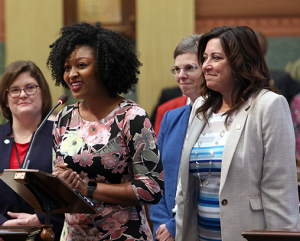
Sen. Anthony and Rep. Witwer

The MHA announced two winners of its Special Recognition Award during the Annual Membership Meeting June 27, recognizing them for extensive contributions to healthcare. Each of the winners has uniquely influenced healthcare in Michigan. The winners include Sen. Sarah Anthony (D-Lansing) and Rep. Angela Witwer (D-Delta Township).

The lawmakers each chair their chamber’s appropriations committee, with Anthony the first Black woman to ever chair the Senate Appropriations Committee. These committees are responsible for determining the annual state budget, covering important healthcare areas including Medicaid, the Healthy Michigan Plan, graduate medical education, the rural access pool and obstetrical stabilization fund, and critical access hospital reimbursement rates. Both lawmakers were strong supporters of Public Act 5 of 2023, sponsored by Witwer, which provided $75 million for hospital workforce recruitment, retention and training in the fiscal year 2023 state budget. In addition, they each fought to include enhanced funding for ongoing Level I and Level II trauma centers, inpatient psychiatric payment rates and maternal health in the fiscal year 2024 budget. Both Anthony and Witwer are strong supporters of funding Medicaid appropriately to ensure adequate reimbursement rates for providers and protect access to healthcare services.

Sen. Sarah Anthony (D-Lansing)

In addition to her committee role, Anthony prioritizes expanding access to healthcare. She sponsored Michigan’s first mental health parity law, signed into law May 21 by Gov. Whitmer. Public Act 41 of 2024 requires insurance coverage for mental health and substance use disorder treatments at the same level as physical health services. This new law eliminates existing disparities and ensure equal access to necessary care for all Michiganders. Anthony also co-sponsored key legislation last session to support the healthcare talent pipeline signed into law by Gov. Whitmer Dec. 22, 2022. Public Acts 251 and 252 of 2022 expanded the Michigan Reconnect program, allowing for several additional certifications to qualify for the post-secondary scholarship program including high-demand healthcare credentials. Other healthcare legislation Anthony sponsors includes Senate Bill 531, which is part of a package of bills supported by the MHA that would improve Michigan’s amended auto no-fault laws. The package would simplify and increase Medicare hospital reimbursements, clarify the definition of Medicare and create a new post-acute care provider fee schedule. The bills passed the Senate in a bipartisan vote and await consideration by the House.

Rep. Angela Witwer (D-Delta Township)

Witwer’s role as a healthcare champion is inspired by more than the 22 years she spent working in healthcare to begin her career. She first started as a clinician, working in University of Michigan Health – Sparrow Lansing’s burn unit and later as the manager of pediatric rehabilitation. She later became manager of the hospital’s community relations and marketing department, before leaving the organization to co-found her own public relations, marketing and advocacy firm. These life experiences inspired Witwer’s support for Public Acts 271 and 272 of 2023, which increase the penalties for assaulting a healthcare worker or volunteer by doubling the financial fines for those found guilty of such a crime.

Michigan Legislature Champions Healthcare Funding

The following statement can be attributed to Brian Peters, CEO of the Michigan Health & Hospital Association.

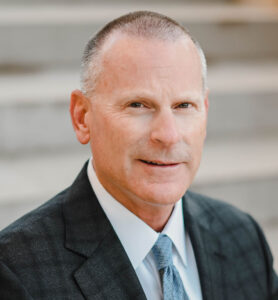
MHA CEO Brian PetersThe Michigan Legislature passed a state budget that champions crucial healthcare funding and protects access to vital healthcare services across Michigan communities.

The fiscal year 2025 state budget and fiscal year 2024 supplemental proposals continue funding pools that support rural and critical access hospitals, obstetrical services, the Healthy Michigan Plan and Michigan’s Medicaid populations. Each of these pools help maintain access to care for underserved populations throughout the state.

The budget also includes new funding to support peer recovery coaches in hospitals to enhance substance use disorder services. These individuals are specifically trained to provide advanced peer recovery support services and are proven to help patients overcome obstacles in their substance use disorder recovery. Michigan joins the more than 38 other states in supporting this model of providing needed care.

We look forward to Gov. Whitmer signing this budget, which protects access to care and ensures hospitals can continue to advance the health of individuals and communities.

Healthcare Remains Key Piece of Executive Budget Recommendation

The following statement can be attributed to Brian Peters, CEO of the Michigan Health & Hospital Association.

MHA CEO Brian PetersHealthcare access is vital for the physical and economic health of our local economies. This budget proposal presented by the Whitmer administration checks the boxes hospitals and health systems need when it comes to crucial state funding. It includes new funding that can make significant impacts on maternal and infant health, behavioral health and the healthcare workforce, while maintaining existing support for a variety of needed healthcare programs.

Hospitals and health systems are focused on addressing health disparities. Supporting additional maternal health services can help reduce the disparity in maternal health outcomes among non-white women. Expanded Medicaid reimbursement for behavioral health services will improve access across the state and benefit the workforce. We’re encouraged to see funding for tuition-free community college pathways for Michiganders. This can increase the number of students pursuing healthcare pathways and address workforce shortages. Continuing funding pools to support rural and critical access hospitals, obstetrical services, graduate medical education, the Healthy Michigan Plan and Michigan’s Medicaid populations will help maintain access to care for underserved populations throughout Michigan.

Gov. Whitmer is clearly a healthcare champion. We look forward to working with other legislative healthcare champions during the budget process to make sure Michigan healthcare providers have the necessary funding support to advance the health and wellness of Michiganders and communities.