MDHHS Seeks Proposals for Children Trust Michigan Primary Prevention Program Grants

The Michigan Department of Health and Human Services (MDHHS) recently released a grant funding opportunity to prevent child abuse and neglect. This funding opportunity aims to prevent child abuse and neglect by developing protective factors that promote healthier and resilient families and communities. Activities include strategies that aim to reach families before allegations of abuse and neglect occur.   

501(c)(3) nonprofits, private and public entities, local health departments, federally recognized tribes or a group of federally recognized Michigan tribes, Urban Indian Health Clinic programs and universities are eligible to applyA total of $97,500 in funding is available. 

The grant period runs from April 1 to Sept. 30. To apply, applicants must register via EGrAMS to request an application by 5 p.m. on Feb 6, with final grant applications due by 3 p.m., Feb. 13.  

To learn more about the opportunities, potential applicants are encouraged to attend a 90-minute pre-application conference scheduled for Jan. 22 at 2 p.m. 

Members with questions may contact the MHA policy team. 

MDHHS Opens Applications for RHT Advisory Council

The Michigan Department of Health and Human Services (MDHHS) is accepting applications to serve on the Rural Health Transformation (RHT) Advisory Council, which will support implementation of Michigan’s RHT Program to improve rural health. The council will convene quarterly, with meetings lasting between 60 to 90 minutes and may hold additional sessions as needed to support program activities.

The Members of the RHT Advisory Council will help:

  • Shape an effective engagement strategy that elevates community and partner voices throughout the program.
  • Offer practical recommendations to MDHHS to support informed decision-making.
  • Ensure that the RHT Program remains responsive and ground in community needs.

Ideal candidates are those who:

  • Work directly with or represent rural communities.
  • Understand rural health challenges, service gaps or barriers to care.
  • Value collaboration and inclusive partnership.
  • Are available to participate in scheduled meetings and advisory activities.

The MDHHS will select a group that reflects Michigan’s rural regions and key sectors, including public and behavioral health, healthcare delivery, community organizations, tribal health, academia, workforce and policy partners. Priority will be given to applicants with a strong awareness of rural challenges and alignment with the goals of the RHT Program.

The MHA encourages rural healthcare providers and leaders to apply to serve on this advisory council.

Members with questions may contact Lauren LaPine-Ray at the MHA.

Registration is Now Open for the 2026 MHA Human Resources Conference

Registration is now open for the upcoming MHA Human Resources Conference scheduled from 8:30 a.m. – 4 p.m. March 24 at the Crowne Plaza, Lansing, a must-attend event for HR leaders, talent professionals and executives shaping the future of healthcare workforces. This dynamic conference will bring together experts from across the healthcare spectrum to explore timely challenges, share best practices and deliver actionable strategies for today’s rapidly evolving HR landscape.

Healthcare organizations continue to face unprecedented workforce pressures—from talent shortages and burnout to regulatory changes and the accelerating role of technology. This conference is designed to equip human resources professionals with the insights and tools needed to attract, retain and support a resilient healthcare workforce while advancing organizational goals.

Registration is $259 per person and members are encouraged to register by March 13.

Members with questions regarding registration should contact Ellie Droste and those with questions about the event should contact Erica Leyko at the MHA.

HHS Updates Childhood Immunization Schedule

Health and Human Services Secretary Robert F. Kennedy Jr. directed Jan. 5 the Centers for Disease Control and Prevention (CDC) to revise the U.S. child and adolescent immunization schedule, reducing the number of universally recommended vaccines from 17 to 11 and shifting several others to high-risk or shared decision-making categories.

Under the updated schedule, vaccines recommended for all children include protection against diseases such as measles, polio, pertussis, pneumococcal disease, human papillomavirus and chickenpox. Other vaccines including influenza, Covid-19, hepatitis A and B, RSV and meningococcal disease, will now be recommended only for certain high-risk populations or based on discussions between families and their healthcare providers. Federal officials stated the changes will not affect insurance coverage and vaccines currently recommended by CDC will remain covered.

The Michigan Department of Health and Human Services (MDHHS) affirms the standing recommendation released Dec. 18, 2025, encouraging providers to continue following the evidence-based childhood immunization schedules developed by the American Academy of Pediatrics and the American Academy of Family Physicians. MDHHS reiterated this guidance Jan. 6, emphasizing its commitment to science-based recommendations to protect Michigan families.

Effective Jan. 1, Michigan Medicaid begun covering stand-alone vaccine counseling visits, allowing providers to be reimbursed for vaccine discussions even when no vaccine is given.

The MHA is supporting efforts to form a statewide immunization coalition aimed at improving coordination, increasing vaccine access and addressing declining childhood vaccination rates. While the association does not provide clinical guidance, the MHA continues to support hospitals in efforts to prevent vaccine-preventable diseases and encourage informed conversations between providers and patients.

Members with questions about vaccine may contact Kelsey Ostergren at the MHA.

Michigan Legislature Resumes Session, International Medical Graduate Bills Clear House Rules

The 103rd Michigan Legislature resumed session for the 2025-26 term during the week of Jan. 12, with the MHA continuing to work with lawmakers on initiatives that prioritize patients, providers, and hospitals and improve the health of communities across the state. 

The House Rules Committee voted in support of House Bill (HB) 4925 and HB 4896 on Jan. 15. The bills, introduced by Rep. Phil Green (R-Watertown Township) and Rep. Jason Woolford (R-Howell) respectively, would create a new pathway for certain internationally educated physicians to practice medicine in Michigan. The MHA supported this legislation in committee after securing key amendments. The bills now move to the full House for consideration. 

Members with questions may contact the MHA advocacy team. 

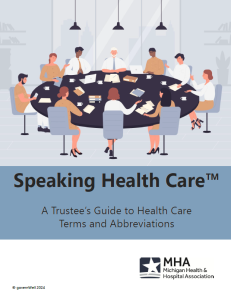
Speaking Health Care™: A Guide to Understanding Healthcare Language

Orienting new trustees extends far beyond a single session. New members usually require months to get fully up-to-speed on strategic priorities and the basic expectations for trustees. A daunting challenge is interpreting language about operations, clinical care, insurance and regulation.

The MHA, other state hospital associations and governWell™ collaborated to create Speaking Health Care™, a guide designed to help hospital and health system trustees better understand the complex and often confusing language used in healthcare. The glossary includes over 1,000 words with acronyms that are often used in briefings, documents and discussions in the boardroom.

The MHA encourages members to share this guide with governing board members, new employees and others who could benefit.

Questions about the guide can be directed to Erin Steward at the MHA.

Hospitals Help: MyMichigan Clinics Improve Access to Timely Care

MyMichigan Health established the Continuing Care Clinics in 2023 to serve residents across its 26-county service region who lack timely access to primary care physicians. These clinics are pivotal during critical health transitions, offering responsive care after hospital discharges, emergency department visits, stays in long-term care facilities or while patients await new primary care providers.

The multidisciplinary team of clinicians at MyMichigan Health create personalized care plans that help patients successfully transition home and reduce the risk of readmission.

Through the Continuing Care Clinics model, MyMichigan Health has demonstrated significant success in reducing poor health outcomes. Patients receiving care exhibit a lower risk of readmission compared to those at other, similar clinics. This achievement is credited to the multidisciplinary team of clinicians who develop personalized care plans, assisting patients in successfully transitioning home while minimizing readmission risks.

Additionally, patients receive referrals for preventive care screenings, further promoting community wellness. The Continuing Care Clinics collaborate with community partners to enhance patients’ access to essential resources including food, transportation and medication. These efforts empower patients to manage their health more effectively and improve recovery.

“Through partnerships with food centers, transportation services and pharmacies, we’ve improved patient access to essential resources like free food, transportation and medication,” said Steve Frazier, MHA, BA, RN, ACN-RN, director of quality and patient safety, MyMichigan Health. “These interventions help patients manage their health, reduce the risk of readmissions and improve overall health outcomes. Additionally, the clinics connect patients without a primary care provider to care, ensuring continuous support and reducing gaps in preventative care.”

For more information and hospital stories, check out the 2025 Community Impact Report. Additionally, this work earned MyMichigan Health a 2025 Ludwig Community Benefit Award. Members with questions may contact Lucy Ciaramitaro at the MHA.

MHA Monday Report Jan. 12, 2026

MHA Healthcare Leadership Academy Applications Due Feb. 6

The enrollment deadline for the MHA Healthcare Leadership Academy is Feb. 6. The cohort meets Feb. 25-27 and May 7-8 at the MHA headquarters in Okemos. HCLA, in partnership with Executive Core, has been …


MHA Joins Coalition Letter Opposing Federal Redefinition of Professional Degrees

The MHA joined a statewide coalition in signing a letter to Michigan’s congressional delegation expressing concern about a proposed federal change that would remove several health professions, including nursing and behavioral health fields, from the …


Webinar to Highlight Effective Cyber Incident Response

MHA Endorsed Business Partner CyberForce|Q is hosting the webinar Proactive Cyber Risk Measures from 11 a.m. to noon ET on Jan. 29. The session will feature speakers from Trinity Health, the Michigan State Cyber …


MHA Rounds image of Brian PetersMHA CEO Report — 2026, A Pivotal Year for Healthcare

As we look toward the year ahead, one thing is clear: healthcare will remain at the forefront of public debate. We’ve seen time and again how healthcare delivery is shaped by policy decisions. …


Keckley Report

Healthcare 2026: Three Realities

“Congress returns to DC this week to debate the merits of extending the advanced premium tax credits that enable coverage for 4 million in a climate of high anxiety about U.S. intervention in Venezuela and heightened tension with Russia and China.

Each sector in healthcare—hospitals, physician services, long-term care, insurers, life science manufacturers, enablers and advisors—is vulnerable. None welcomes unflattering attention and all spend heavily on messaging and advocacy to protect themselves.  All recognize the elephant in the room—large employers that have patiently funded the system’s profitability and value protective regulation that limit disruption. And in all, implementation of AI solutions that lower operating costs and streamline performance is THE immediate priority.

The realities of 2026 for healthcare are foreboding: business as usual is not an option.”

Paul Keckley, Jan. 4, 2026


MHA in the News

The MHA received media coverage during the week of Jan. 5, covering the increasing rate of flu-related hospitalizations in Michigan. Both Bridge and Michigan Public published stories during the week based on interviews with Jim …

Media Covers Increasing Rate of Flu-Related Hospitalizations

The MHA received media coverage during the week of Jan. 5, covering the increasing rate of flu-related hospitalizations in Michigan.

Jim LeeBoth Bridge and Michigan Public published stories during the week based on interviews with Jim Lee, senior vice president, policy & data analytics, MHA.  The stories address the overall growth in influenza cases and compares how the 2025-26 flu season in Michigan started earlier than during the prior year.

“It’s too early to tell when that peak will occur, but we’re definitely experiencing flu season a little bit earlier this year in our hospitals,” said Lee to Michigan Public.

Members with any questions regarding media requests should contact John Karasinski at the MHA.

Webinar to Highlight Effective Cyber Incident Response

MHA Endorsed Business Partner (EBP) CyberForce|Q is hosting the webinar Proactive Cyber Risk Measures from 11 a.m. to noon ET on Jan. 29. The session will feature speakers from Trinity Health, the Michigan State Cyber Command Center and other organizations.

Presenters Adrienne Chase and Sam Khan will walk attendees through a real-world incident, discuss key lessons learned, practical takeaways and the strategies that made the biggest difference when every minute mattered. Michigan State Cyber Command Center leader Tarek Sasy will also provide insights into statewide response efforts and best practices.

Members are encouraged to register for a first-hand look at what happens when a real cyber incident occurs, including proactive steps organizations can take to accelerate recovery and reduce impact. The session is designed for leaders seeking a realistic understanding of incident response, preparation and how proactive defense shapes outcomes when facing real-world attacks.

To learn more about CyberForce|Q, contact Midwest regional sales director, John Kelley. Members interested in solutions offered through the MHA EBP program may contact Rob Wood at the MHA.