
Media Recap: Hospital Cost Pressures and Behavioral Health Partnerships

Lauren LaPine

The MHA received media coverage the week of Aug. 4 on hospital cost pressures, behavioral health partnerships and the impact of Medicaid cuts.

Gongwer published a story Aug. 4 about a PricewaterhouseCoopers report that reviews the trends in the medical sector that are continuing to result in higher costs for services that are placing growing pressure on hospitals. The report shows that factors that include growth in drug spending and reductions in federal funding are leading to decreased hospital margins.

“This report confirms what hospitals in Michigan and across the country are living every day: skyrocketing costs, growing demand and shrinking margins,” said MHA CEO Brian Peters. “We cannot afford policies that slash Medicaid funding or shift more financial burden to hospitals and patients. Without sustainable support, hospitals – especially those in rural and underserved areas – face real threats of closure.”

Second Wave Michigan also published an article Aug. 5 about behavioral health partnerships that hospitals have in the state. The story looks at both policy solutions such as Senate Bill 316, as well as the partnership between Network180 and Trinity Health Grand Rapids in establishing The Behavioral Health Crisis Center to divert patients in crisis from emergency departments and jails.

Lauren LaPine“If you come to a hospital emergency department and you’re in some level of a behavioral health crisis, that hospital has to work with the CMH in the area where the patient lives,” said Lauren LaPine, senior director of legislative and public policy, MHA. “That takes a lot of time and a lot of coordination.”

MLive and Michigan Public also published stories that include mentions of the MHA following U.S. Sen. Elissa Slotkin’s visit to Helen DeVos Childre’s Hospital. The stories reference the MHA’s estimate that Michigan hospitals will lose $6 billion over the next ten years from the One Big Beautiful Bill Act.

Members with any questions regarding media requests should contact John Karasinski at the MHA.

Medicaid Cuts and Hospital Economic & Workforce Impact News Coverage

Laura Appel

Laura AppelThe MHA received news coverage during the week of May 12 related to federal Medicaid funding cuts and the release of the hospital economic and workforce impact data.

Crain’s Detroit Business published an article May 13 following the release of draft bill language from the House Energy and Commerce Committee as part of the budget reconciliation process, which calls for imposing federal work requirements and freezing state directed payment programs for healthcare providers.

MHA Executive Vice President Laura Appel spoke with Crain’s, expressing the MHA’s concerns on the draft language.

“We of course remain deeply concerned about things like doing redetermination of folks’ eligibility for the coverage on less than an annual basis and things like work requirements or community benefit requirements for certain folks who currently qualify for coverage,” said Appel. “All of those things are barriers to folks.”

Second Wave Michigan also published a story May 13 about potential Medicaid funding cuts, as part of their MI Mental Health Series. Lauren LaPine, senior director, legislative and public policy, MHA, is quoted in the piece discussing what impact the cuts would have to hospitals.

“A real consequence of Medicaid cuts will be closures of service lines and even hospitals,” said LaPine. “When hospitals have to cut services because Medicaid is cut, those services are lost for all patients and not just those who receive health care coverage through Medicaid. Medicaid is the single largest payer for long-term care, maternity care, and mental health services. It is a cornerstone of our health care system and keeps people healthy at every stage of life.”

The MHA also received news coverage from Gongwer and dBusiness following the release May 12 of the association’s annual Economic Impact of Healthcare report and hospital workforce survey results.

Lastly, MHA CEO Brian Peters provided a quote of support in a press release issued by U.S. Sen. Gary Peters (D-MI) following introduction of the Mapping America’s Pharmaceutical Supply (MAPS) Act.

Members with any questions regarding media requests should contact John Karasinski at the MHA.

Medicaid & Pediatric Behavioral Health Media Coverage

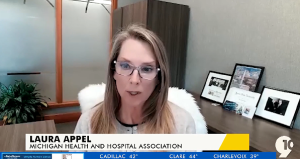
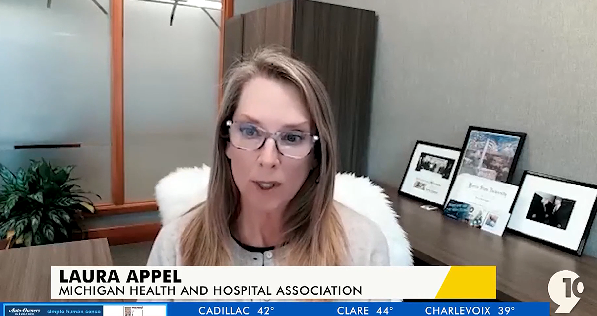
Laura Appel speaks with 9&10 News.

The MHA received media coverage the week of April 7 on potential Medicaid funding cuts, pediatric behavioral health and healthcare costs.

9&10 News aired a story April 9 on potential federal Medicaid funding cuts. MHA Executive Vice President Laura Appel spoke with 9&10 News, explaining how the cuts would specifically impact rural healthcare. Representatives from McLaren Health Care and Munson Healthcare also appeared in the story.

“In our rural areas, we have small populations, and some of them are also shrinking, which makes it that much harder to sustain certain services because of the fixed costs being spread over so few people,” said Appel. “When we lose a labor and delivery unit, we lose it for that entire population.”

Lauren LaPineSecond Wave Michigan published a story April 8 about how Michigan hospitals are improving pediatric behavioral healthcare. Lauren LaPine, MHA senior director of legislative and public policy, spoke with Second Wave Michigan about the MHA’s behavioral health work, focusing particularly on the $50 million state grant the MHA served as the fiduciary for to expand inpatient pediatric behavioral health capacity in the state. LaPine also highlighted the data the MHA collected regarding emergency department boarding, which shows at least 155 people at any point, including 17 children, are in an emergency department awaiting behavioral health care.

“Our data in Michigan reflects some of the trends that we see nationally in terms of the increasing need for behavioral health services for children and youth,” said LaPine. “So, we are paying really close attention to that need and want to make sure that our member hospitals and health systems are able to address the need when pediatric patients and their families come to the hospital in a behavioral health crisis.”

Lastly, Crain’s published a story April 9 about the role of hospitals regarding rising healthcare costs. MHA CEO Brian Peters is quoted in the story, explaining how the majority of rising costs are due to responding to market trends for labor, as well as rising costs for facilities, drugs and supplies.

“The largest expense for hospitals is labor … A large component to increased healthcare costs for hospitals is making sure healthcare workers are appropriately and competitively compensated so they can provide care to patients when and where they need it,” said Peters.

Members with any questions regarding media requests should contact John Karasinski at the MHA.
LaPine Discusses the Role of Hospitals in Crisis Care

Lauren LaPine

Lauren LaPineSecond Wave Michigan published a story Jan. 7 on how state officials, healthcare providers and community organizations are focusing on expanding the continuum of care for people experiencing a mental health crisis.

Lauren LaPine, senior director of legislative and public policy at the MHA, was interviewed in the story to share the role hospitals place in crisis care. She mentioned the high utilization of hospital emergency departments for people in a behavioral health crisis and the long wait times involved in finding the appropriate placement for the patient. LaPine also mentioned how the MHA is advocating for more resources that can support crisis intervention before hospitalization becomes necessary.

“We are working to build partnerships that can offer more specialized crisis care options,” said LaPine. “Similar to community paramedics initiatives, MDHHS [Michigan Department of Health and Human Services] has been committed to expanding access to mobile crisis units so when an individual is in some type of behavioral health crisis, there are mobile crisis units you can call through local community mental health agencies.”

Members with any questions regarding media requests should contact John Karasinski at the MHA.
Media Recap: Michigan Healthcare Careers, Digital Health Trends

Laura Appel

Laura AppelThe MHA received media coverage the week of Sept. 16 regarding Michigan healthcare careers and what’s next for digital health.

Second Wave Michigan published a story Sept. 17 on healthcare careers and the existing healthcare workforce shortage. The story includes quotes from Laura Appel, executive vice president and government relations and public policy, MHA, about how shortages impact hospitals, the impact of state funding and the results of the MHA’s annual hospital workforce survey.

“We’re bouncing back. We’re on the rebound for sure,” said Appel. “But it’s going to require a lot of work and staying on top of things. It’s not a one-and-done situation where you work at it for one year and then it will all be fixed. Workforce shortage is a long-term situation, and it’s going to require long-term commitment.”

The story is part of the Yours, Mine, and Ours — Public Health series from Second Wave Media that highlights how Michigan’s public health agencies keep individuals healthy, safe and informed about issues impacting physical and mental health in communities, homes, workplaces and schools.

Becker’s Hospital Review published a story Sept. 20 featuring insight from hospital and health system executives across the U.S. on the future of new technology in healthcare.

“Advancements in artificial intelligence (AI) present many opportunities to improve the delivery of healthcare and reduce administrative burden,” said MHA CEO Brian Peters. “Our association created a member-wide task force to develop a framework for Michigan hospitals focused on the safe, ethical and equitable application of AI within healthcare. This framework includes clear guidance and model policies to help hospital policy makers manage the evolving impact of AI. While hospitals will vary in the implementation of AI and the resources they have available, this framework should help to ensure consistent application across the state so patients can continue to receive quality, accessible healthcare.”

Members with any questions regarding media requests should contact John Karasinski at the MHA.