Sept. 24 Webinar Outlines the OBBBA Impact

The MHA will host the webinar Understanding the One Big Beautiful Bill Act (OBBBA) and Board Planning for the Impact from 8 to 9 a.m. on Sept. 24. The session is designed for trustees and hospital leaders and will highlight considerations related to the OBBBA, which reduces federal healthcare spending and insurance coverage.

Topics include Medicaid budget reductions, state-directed payments, recipient work requirements, the Rural Health Transformation Program and strategies for messaging and advocacy.

The webinar is free of charge to MHA members. Members with questions may contact Brenda Carr at the MHA.

Catching Up on All Things Healthcare with Tina Freese Decker

The MHA released a new episode of the MiCare Champion Cast exploring state and federal healthcare priorities with Tina Freese Decker, MHA, MSIE, FACHE, president & CEO, Corewell Health and 2025 chair of the American Hospital Association (AHA).

The episode, hosted by MHA CEO Brian Peters, explores healthcare innovation, affordability and how institutions like Corewell Health are bracing for the impact of the “One Big Beautiful Bill Act (OBBBA).”

“It’s very important to protect and strengthen our hospitals, but we can also look ahead and say, how do we drive healthcare forward to a future that can be more affordable, more exceptional and simpler?” posed Freese Decker. “We all want what is best for our neighbors. When we put people at the center, we can align around what needs to happen and where we need to go.”

Freese Decker leads more than 60,000 within the integrated health system and oversees Corewell Health’s provider-sponsored health plan, Priority Health, which serves 1.3 million members across Michigan.

During the conversation, Freese Decker noted her biggest concern with changes under the OBBBA will be the loss of access to primary care services for patients without healthcare coverage. She noted that embracing a preventative mindset and being mindful of healthcare costs will be critical.

“Our patients do hard things every day and we help them through that,” said Freese Decker. “We need to make sure we’re disrupting the status quo and challenging conventional wisdom. It’s going to be hard, but it’s also an opportunity to advance care and improve the lives of our teams and our communities…it will require significant change. We will not be able to do it the way we’ve always been able to do it.”

Peters and Freese Decker also explore the future of growing the healthcare workforce talent pipeline, the role technology will continue to play in hospitals and the importance of fostering new partnerships across industries.

The episode is available to stream on Apple PodcastsSpotifySoundCloud and YouTube. Questions or idea submissions for future MiCare Champion Cast episodes can be sent to Lucy Ciaramitaro at the MHA.

MHA Monday Report Aug. 25, 2025

CMS Releases FY 2026 Final Rule for Skilled Nursing Facilities

The Centers for Medicare & Medicaid Services (CMS) recently released a final rule to update the Medicare fee-for-service prospective payment system for skilled nursing facilities for fiscal year (FY) 2026. Key provisions include: Increasing the per-diem federal rate …


MHA Community Benefits Survey for FY 2024 Now Open

The MHA is now accepting submissions for the fiscal year (FY) 2024 Community Benefits Survey. Member hospitals are encouraged to participate, as the survey results are vital to demonstrating the value of hospital community benefit …


Trustee Webinar Outlines the OBBBA Impact

The MHA will host the webinar Understanding the One Big Beautiful Bill Act (OBBBA) and Board Planning for the Impact from 8 to 9 a.m. Sept. 24. The session is designed for trustees and hospital leaders and will highlight considerations …


MHA EBP care.ai Shares Case Study on Virtual Care Expansion

MHA Endorsed Business Partner (EBP) care.ai recently shared an insightful case study on how a 22-bed virtual care pilot with Henry Ford Health is expanding across 13-acute care hospitals, including a chief nursing informatics …


Keckley Report

The Medical Profession at a Crossroad

“When I was a grad student at Ohio State in the ‘70’s, one of the most challenging courses I took was “Primary Research Methods in Analyzing Public Data” –an elective. …

The data show the majority of physicians are unhappy and uncertain about the future of the profession. The data show they’re working harder and doing more with less. The data show they’re concerned about the future of the health system and think it’s heading in the wrong direction. The data show employed physicians are increasingly dissatisfied in their hospital and private equity relationships. The data show that physicians share of the growing health spending pie is shrinking: from 21.1% in 2000, to 20.1% in 2023 and projected to 19.9% in 2025 and 19.5% in 2033. And data show the profession, along with nurses and pharmacists, enjoys the public’s trust to figure things out. …

Might defining a vision for a transformed ‘U.S. System of Health’ be the focus for the medical profession? There’s plenty of data to digest to deliberate objectively. Its willingness and ability to set aside its factionalism for the greater good is the biggest question facing the profession. And the widely-recognized dysfunction of the current U.S. health system presents the urgent opportunity for the profession to step forward. That’s the cross facing the profession.”

Paul Keckley, August 17, 2025


New to KnowNews to Know

The MHA is developing its 2025-2026 events and education calendar, featuring professional development opportunities, networking events and timely, relevant offerings for members.


MHA in the News

The MHA received media coverage during the week of Aug. 18 that continued to focus on the impact the One Big Beautiful Bill Act will have on Medicaid as well as comments related to …

Media Recap: Medicaid and Healthcare Costs

The MHA received media coverage during the week of Aug. 18 that continued to focus on the impact the One Big Beautiful Bill Act (OBBBA) will have on Medicaid as well as comments related to the impact hospital consolidations have on healthcare access.

Gongwer published a story Aug. 20 on the impact hospital consolidations have on healthcare costs and access to care for employees. MHA CEO Brian Peters was quoted in the article disputing the claim that hospitals are profiteers.

“Bashing community hospitals and the 220,000 hospital workers who show up every day of the year to care for Michigan patients is misguided and inflammatory,” said Peters. “Hospitals are focused on providing safe, high-quality, affordable care in every community they serve.”

NPR also published a story following an interview with Peters regarding the impact the OBBBA and new work requirements will have on healthcare in Michigan.

“The state of Michigan Department of Health and Human Services has estimated that as many as 700,000 Michiganders could lose coverage because of the reconciliation bill,” said Peters.

The new work requirements will necessitate that hundreds of thousands of enrollees document their eligibility every six months. Peters noted in the interview that there’s no evidence of widespread waste and abuse in the state’s Medicaid program.

“When you look at the Medicaid population here in the state of Michigan, we know that almost all of those folks are working and working full time,” said Peters.

Members with any questions regarding media requests should contact John Karasinski at the MHA.

Trustee Webinar Outlines the OBBBA Impact

The MHA will host the webinar Understanding the One Big Beautiful Bill Act (OBBBA) and Board Planning for the Impact from 8 to 9 a.m. on Sept. 24. The session is designed for trustees and hospital leaders and will highlight considerations related to the OBBBA, which reduces federal healthcare spending and insurance coverage.

Topics include Medicaid budget reductions, state-directed payments, recipient work requirements, the Rural Health Transformation Program and strategies for messaging and advocacy.

The webinar is free of charge to MHA members. Members with questions may contact Brenda Carr at the MHA.

MHA Trustee Webinar Outlines Information and Planning for the OBBBA

The MHA will host the webinar Understanding the One Big Beautiful Bill Act (OBBBA) and Board Planning for the Impact, from 8 to 9 a.m. ET Sept. 24. The session will explore how the OBBBA would enact nearly $1 trillion in cuts to the Medicaid program, potentially reducing access to care across the country.

The webinar will cover several board-level considerations, including:

  • The Medicaid provisions within the OBBBA, such as state budgeting reductions, state-directed payments and Medicaid work requirements.
  • The Rural Health Transformation Program and eligible funding activities.
  • Strategies for positive messaging and healthcare policy advocacy.

Hospital board of trustees and other healthcare leaders are encouraged to register. The webinar is free of charge to MHA members.

Questions about MHA membership or registration should be directed to Brenda Carr at the MHA.

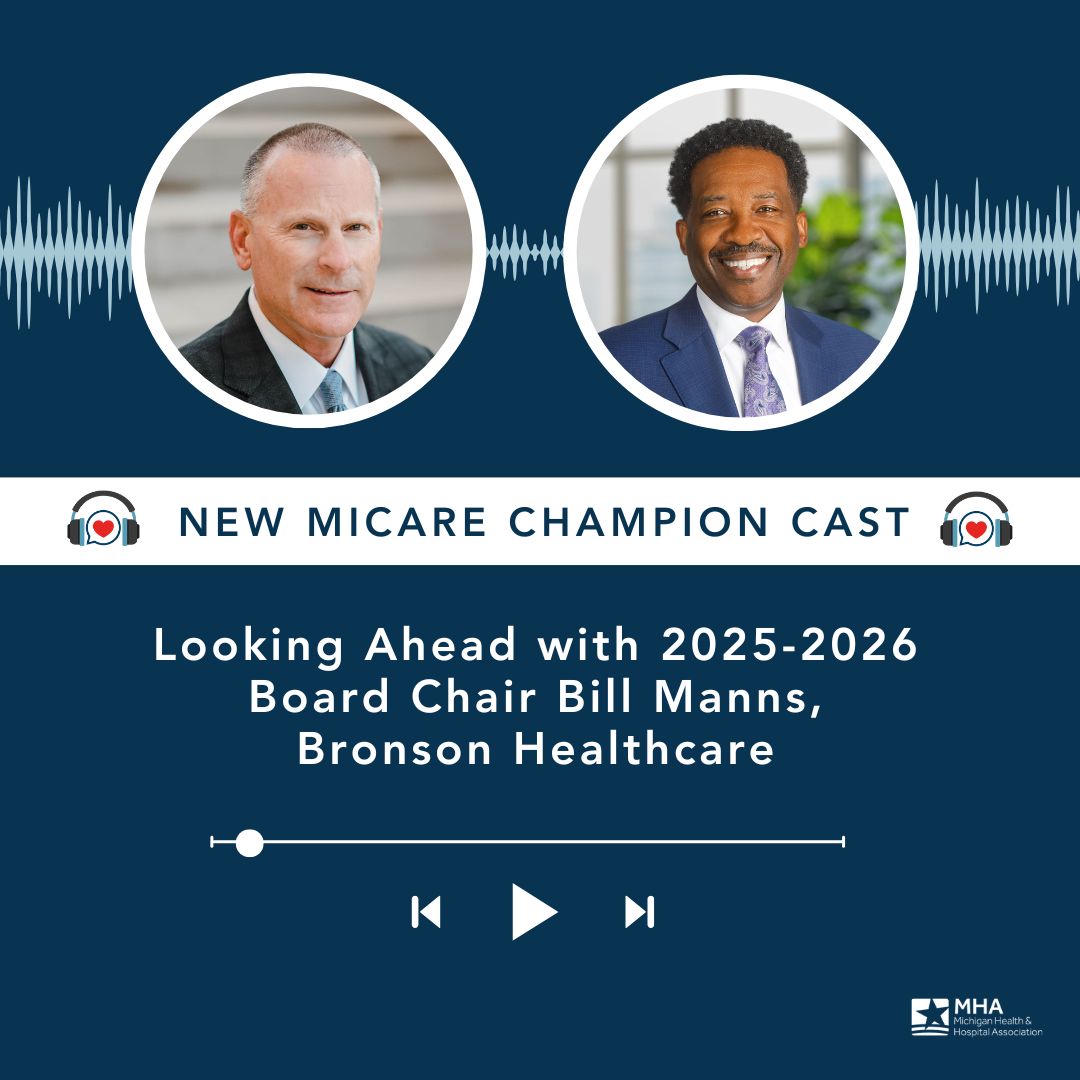
MHA Podcast Explores Healthcare Priorities with 2025-2026 Board Chair Bill Manns

The MHA released a new episode of the MiCare Champion Cast exploring what’s top of mind in healthcare as the 2025-2026 program year kicks off.

The episode, hosted by MHA CEO Brian Peters, features MHA Board Chair Bill Manns, president and CEO, Bronson Healthcare. Manns shares more about his journey to healthcare leadership, current priorities at Bronson and what work lies ahead for hospital leaders given recent activity at the state and federal level.

Since joining Bronson in 2020, Manns oversees a full range of services from primary care to critical care across more than 100 locations. Fellow officers of the 2025-2026 MHA Board of Trustees include Brittany Lavis, chair-elect; and Kent Riddle, treasurer, among many other hospital leaders across Michigan.

Manns noted during the discussion that addressing infant mortality and improving maternal health across the state remain key areas of focus for his team at Bronson Healthcare and hospital leaders across the state.

“Women of color have mortality rates during birth that is, at times, double or triple that of their white counterparts,” said Manns. “As soon as we’re born – without bias or prejudice – if we can get equality there, I think that’s a great footing to build and grow as a community and I think as a nation, quite frankly.”

Over the course of the interview, Peters and Manns discuss the impact of the “One Big Beautiful Bill Act (OBBBA)” on hospitals and patient access to care given cuts to Medicaid funding.

“One, we’ve got to do a better job of educating the public about just what’s coming,” said Manns when discussing how to approach the negative impacts of the OBBBA. “Two, we really have to advocate – even stronger – with our legislators…and three, I think we’ve really got to continue to be optimistic and not panic.”

They also explore the importance of 340B, efforts to address workplace violence and more.

The episode is available to stream on Apple PodcastsSpotifySoundCloud and YouTube. Questions or idea submissions for future MiCare Champion Cast episodes can be sent to Lucy Ciaramitaro at the MHA.

News Coverage Continues Focus on Medicaid

Laura Appel

The MHA received media coverage during the week of July 28 that continued to focus on the impact the One Big Beautiful Bill Act (OBBBA) will have on Medicaid.

Bridge published an op-ed Aug. 1 from MHA CEO Brian Peters refuting public claims defending Medicaid funding cuts in the OBBBA. Peters describes how the cuts will have real consequences for real people, spanning all populations.

“When hospitals lose Medicaid dollars, the burden shifts to other patients, including those with employer-sponsored insurance,” said Peters. “Costs go up. Wait times increase. Local access to specialty care dries up. Employers and families alike will feel the ripple effects, both in their insurance premiums and at the distance they must travel for care.”

WZZM 13 published a story July 30 on the 60th anniversary of Medicare and Medicaid being established by President Lyndon B. Johnson. The story references a media statement published by the MHA on the subject.

Laura AppelA story also aired July 30 during the FOX 47 evening news broadcast about how Medicaid changes in the One Big Beautiful Bill Act (OBBBA) will impact rural healthcare providers. MHA Executive Vice President Laura Appel was interviewed as part of the story.

Appel also appears in a Crain’s Detroit Business article about healthcare affordability that was sponsored by Blue Cross Blue Shield of Michigan (BCBSM). Representatives from various Michigan businesses and healthcare groups were invited to join BCBSM and Crain’s in the executive roundtable.

Appel spoke to the cost pressures impacting hospitals and the role hospitals have in addressing rising healthcare costs.

“Most hospitals across our state are looking for those partnerships because they can’t afford to do it on their own,” said Appel in relation to hospitals pursuing mergers, acquisitions and joint ventures.

Members with any questions regarding media requests should contact John Karasinski at the MHA.

Setting the Record Straight on OBBBA Impacts

The MHA received media coverage during the week of July 21 that focused on setting the record straight about the impacts of the One Big Beautiful Bill Act (OBBBA) on hospitals.

The Detroit News published an opinion response from MHA CEO Brian Peters and Michigan League for Public Policy President and CEO Monique Stanton about the harmful consequences to Michiganders and healthcare from the OBBBA. This response follows an editorial from The Detroit News published July 12 that defended the cuts to Medicaid.

“Michigan hospitals are bracing for a $6 billion loss in Medicaid funding over the next decade,” said Peters and Stanton. “When coverage declines, so do reimbursements, but the volume of those seeking care does not. That means fewer resources to staff emergency rooms, provide specialty care or keep maternity units open. When that happens, everyone, not just Medicaid recipients, feels the impact.”

MHA Executive Vice President Laura Appel also appeared on The WILS Morning Wake-up on WILS-AM 1320 in Lansing on July 22 to discuss the OBBBA with host Mike Austin.

Lastly, Peters also provided a statement for a FOX 47 story on July 24 expressing the MHA’s opposition to Senate Bills 296 and 297, which would limit any hospital’s ability to require mandatory overtime to just during declared emergencies.

“Requiring nurses to work overtime is rarely used, but hospitals and nursing leaders need the flexibility to make decisions that may require staff to work outside of their normal schedules to ensure patient care when unforeseen circumstances occur in their local communities,” said Peters.

Members with any questions regarding media requests should contact John Karasinski at the MHA.

Headline Roundup: Continued OBBBA Coverage

The MHA continued to receive media coverage during the week of July 14 about the impacts of the federal budget reconciliation bill, officially referred to as the One Big Beautiful Big Act (OBBBA).

Coverage includes references to the association’s financial estimates, as well as quotes from MHA CEO Brian Peters and MHA Executive Vice President Laura Appel.

Wednesday, July 16

Tuesday, July 15

Monday, July 14

Members with any questions regarding media requests should contact John Karasinski at the MHA.