KFF Health News published a story March 4 detailing concerns from hospital leaders and lawmakers across the country about how states plan to spend new federal rural health funding.
The $50 billion Rural Health Transformation Program (RHTP) is designed to drive innovation and maintain access in rural communities following significant federal Medicaid cuts.
Lauren LaPine-Ray, DrPH, MPH, vice president, policy and rural health, MHA, is quoted in the article, raising concerns about rural hospitals’ ability to access critical funds due to the complexity and competitiveness of state grants.
LaPine-Ray was also featured in Modern Healthcare’s article discussing the challenges associated with securing RHTP dollar. She notes how specific grant requirements surrounding population health data analytics-backed care coordination programs and technology implementation will negatively impact rural hospitals.
“Funding care coordination and community initiatives is a wonderful thing, but given the short timeframe and the fact CMS will judge programs over one year, rural hospitals are worried about funds being retroactively pulled back,” she said. “With Medicaid redeterminations and Medicaid cuts coming in 2027, rural hospitals may not have the luxury to choose between committing to do something new or trying to keep their doors open.”
Members with questions regarding media requests should contact Elise Gonzales at the MHA.
The Michigan House of Representatives voted in support of House Bill 5455, sponsored by Rep. Rylee Linting (R-Grosse Ile Township), which would restore Michigan to the IMLC. The compact supports access to care, particularly in rural …
The MHA Board of Trustees’ Feb. 4 meeting featured a discussion with former U.S. Senator Debbie Stabenow, who is now a senior policy advisor with DC-based Liberty Partners Group, a bipartisan strategic consulting firm. Stabenow …
The MHA recently released a new frequently asked questions (FAQ) document to help members better understand allowable uses, limitations and compliance requirements related to Michigan’s Rural Health Transformation Program (RHTP). The FAQ clarifies that RHTP …
The Centers for Medicare & Medicaid Services (CMS) recently released the 2025 occupational mix survey to collect data from hospitals paid under the Medicare inpatient prospective payment system. Survey results will be used to adjust …
The MHA is strengthening its commitment to evidence-based immunization practices under the guidance of the MHA Healthcare and Public Health Integration Council and chief medical and nursing leaders. Efforts include distributing educational resources, reaffirming alignment …
Providers who serve pregnant people, infants and families are encouraged to complete a brief survey to help build Michigan’s first statewide Perinatal and Infant Early Childhood Mental Health (PIECMH) Provider Directory. The initiative is led …
U.S. Department of Health and Human Services (HHS) Secretary Robert F. Kennedy Jr. announced a $100 million investment to expand substance use disorder treatment, mental health services and housing-related supports under the administration’s Great American Recovery initiative. …
The Michigan Department of Health and Human Services (MDHHS) has withdrawn its request for proposals (RFP) to competitively procure Prepaid Inpatient Health Plans (PIHPs), ending the planned rebid process. The decision follows a Jan. 8 …
Camp 911 is a hands-on, youth-focused safety event supported by Marshfield Medical Center-Dickinson hospital that is designed to teach school-aged children essential emergency response skills. The camp brings together professionals from various fields to demonstrate …
MHA Endorsed Business Partner Wakely is hosting the webinar Summary and Impacts of the 2027 Medicare Advantage Advance Notice Feb. 12 from 1 – 2 p.m. ET.
The 2026 MHA Human Resources Conference, scheduled for March 24 at the Crowne Plaza Lansing, will convene human resources leaders and professionals who are shaping the future of the healthcare workforce.
MHA Endorsed Business Partner CyberForce |Q is hosting an in-person Coffee & Collab for Cybersecurity Leaders Feb. 10 from 8:30 – 10:00 a.m. ET at CyberForce|Q headquarters in Plymouth, MI.
The Mining Journal published a statement from the MHA chief medical officer following the distribution of guidance to
Michigan families departing from established standards. Dr. Roth emphasizes the efficacy of vaccines and urges families to seek medical guidance from their providers. “Vaccines remain …
The Michigan Department of Health and Human Services (MDHHS) has withdrawn its request for proposals (RFP) to competitively procure Prepaid Inpatient Health Plans (PIHPs), ending the planned rebid process.
The decision follows a Jan. 8 ruling that found key elements of the RFP conflicted with provisions of the Michigan Mental Health Code. The court determined that the RFP, as drafted, restricted the ability of Community Mental Health Services Programs to carry out certain statutorily required functions, including entering financial contracts necessary to support managed care responsibilities.
While the court did not issue an injunction directing the state to withdraw the RFP, it identified multiple legal conflicts and left it to MDHHS to determine how to proceed. MDHHS has now opted to rescind the RFP rather than revise or reissue it.
With the withdrawal of the RFP, the existing PIHP structure will remain in place. It is unclear whether MDHHS will pursue a revised procurement approach or other policy changes moving forward.
The FAQ clarifies that RHTP funding is temporary and intended to support specific care transformation activities. Funds cannot be used to cover routine operating costs, financial losses or to replace existing funding. Repayment may be required if funds are used for purposes not approved or if required documentation and reporting are not completed.
The document also addresses common questions raised by hospitals, including the use of RHTP funds for provider payments, health information technology investments, electronic medical record upgrades and limited facility improvements. In all cases, expenses must be directly connected to transformation activities approved by the Centers for Medicare & Medicaid Services (CMS).
Additional RHTP information and resources are available on the MHA’s Rural Health Transformation Program webpage. The MHA will continue to update both the FAQ and the webpage as more guidance becomes available from the Michigan Department of Health and Human Services and CMS.
The Detroit News published a story Jan. 29 on two recent House Appropriations Committee hearings on the distribution of Rural Health Transformation Program (RHTP) funds.
The article details concern from House lawmakers and rural providers surrounding the program, particularly the designation of Wayne and Oakland counties as partially rural in the Michigan Department of Health and Human Services (MDHHS) RHTP application.
Lauren LaPine-Ray, DrPH, MPH, vice president, policy and rural health, MHA, is quoted in the story clarifying the department’s commitment expressed to the MHA to ensure rural communities benefit from the funding.
“The state is juggling varying state and federal definitions of rural as it applies for and administers the program,” LaPine-Ray said.
“I can say, very transparently, in our conversations with MDHHS, they did not intend to define a rural community as being one within Wayne or Oakland County,” she said. “They were very specific and intentional in making sure the definition that they used really focused on rural community and rural populations.”
The Michigan House Appropriations Committee continued testimony during the week of Jan. 26 on federal funding awarded through the Rural Health Transformation Program (RHTP) and on legislation related to the 340B program and next-of-kin designations.
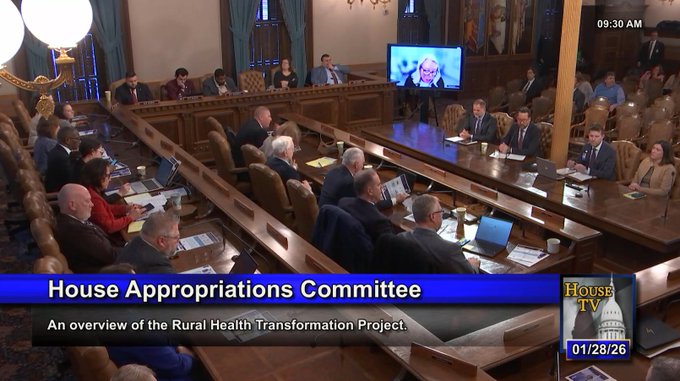
Michigan hospitals testified before the House Appropriations Committee on funding allocated to the state through the RHTP. Michigan was awarded $173 million in RHTP funding in December 2025 to support rural communities and address access-to-care challenges. MHA members testifying in front of the committee included Tonya Darner, CEO, UP Health System; Andrew Raymond, CEO, Kalkaska Memorial Health Center; and Peter Marinoff, president and CEO, Munson South Region. Lauren LaPine-Ray, DrPH, MPH, vice president of policy and rural health, MHA, and Gabe Schneider, director, government relations, Munson Healthcare, also responded to committee questions and shared feedback in support of rural hospitals and the program.
The House Appropriations Committee heard testimony Jan. 28 from rural hospital leaders. Appearing (from left to right) are Tonya Darner (Zoom), Gabe Schneider, Peter Marinoff, Andrew Raymond and Lauren LaPine-Ray.
During testimony, members highlighted challenges facing rural healthcare, including access to maternity care, EMS transportation, behavioral health services, and workforce recruitment and retention. Members noted that 22% of counties are considered maternity deserts and at least 11 hospital labor and delivery units have closed since 2010. Testimony also underscored the role rural hospitals play in supporting overextended EMS systems by holding patients when transport is unavailable, coordinating complex transfers and absorbing unreimbursed costs.
Members emphasized that RHTP funding should be targeted toward these challenges to better serve rural communities and maintain access to care.
The House Health Policy Committee voted Jan. 28 to advance House Bill (HB) 4878, sponsored by Rep. Curtis VanderWall (R-Ludington). HB 4878 protects hospitals’ contract pharmacy arrangements under the federal 340B program and includes state-level drug price transparency and hospital community benefit reporting requirements. The legislation allows eligible 340B hospitals to continue stretching limited resources to support care for vulnerable patients and communities across the state, without using state or federal taxpayer dollars. The MHA and its 340B member hospitals support the integral program protections this legislation affords, both for maintaining access to community-based care and improving affordability across Michigan communities. HB 4878 now heads to the House Rules Committee for further consideration.
The Senate Committee on Civil Rights, Judiciary and Public Safety voted in favor of HB 4418 and HB 4419, which update next of kin designations in a healthcare setting. The bills, sponsored by Rep. Jamie Thompson (R-Brownstown Township) and Rep. Angela Witwer (D-Delta Township), seek to reduce barriers in the process of designating a next of kin to inform medical decisions for a patient who is unable to make those decisions themselves. Current law requires families to pursue guardianship, a process that can be lengthy and burdensome during medical emergencies. The MHA worked with bill sponsors and stakeholders to clarify language in HB 4418 based on member hospital feedback. The bills have been referred to the full Senate for further consideration.
Lastly, the Senate Health Policy Committee heard testimony on Senate Bills (SB) 701 and 702, which make changes to medical debt collection processes in the state. The bipartisan legislation, sponsored by Sen. Jonathan Lindsey (R-Coldwater) and Sen. Sarah Anthony (D-Lansing), make changes to how and when medical debt is collected from patients. The MHA is reviewing the legislation and remains committed to working with lawmakers on opportunities to improve healthcare affordability.
The MHA has launched a new webpage dedicated to the Rural Health Transformation Program (RHTP), providing members with a centralized source of information on Michigan’s participation in the program. The webpage includes an overview of the state’s award, key focus areas, implementation timelines and details on how the program is expected to support long-term changes in rural healthcare delivery.
Members may use the webpage as a resource to better understand the scope of the RHTP and what to expect from the Michigan Department of Health and Human Services and the Centers for Medicare & Medicaid Services as additional guidance and funding opportunities are released. The MHA will continue to update the webpage as new information becomes available.
The Michigan Department of Health and Human Services (MDHHS) is accepting applications to serve on the Rural Health Transformation (RHT) Advisory Council, which will support implementation of Michigan’s RHT Program to improve rural health. The council will convene quarterly, with meetings lasting between 60 to 90 minutes and may hold additional sessions as needed to support program activities.
The Members of the RHT Advisory Council will help:
Shape an effective engagement strategy that elevates community and partner voices throughout the program.
Offer practical recommendations to MDHHS to support informed decision-making.
Ensure that the RHT Program remains responsive and ground in community needs.
Ideal candidates are those who:
Work directly with or represent rural communities.
Understand rural health challenges, service gaps or barriers to care.
Value collaboration and inclusive partnership.
Are available to participate in scheduled meetings and advisory activities.
The MDHHS will select a group that reflects Michigan’s rural regions and key sectors, including public and behavioral health, healthcare delivery, community organizations, tribal health, academia, workforce and policy partners. Priority will be given to applicants with a strong awareness of rural challenges and alignment with the goals of the RHT Program.
The MHA encourages rural healthcare providers and leaders to apply to serve on this advisory council.
Legislation to waive the collection of improper unemployment benefits cleared the Michigan Senate in a unanimous vote, while bills creating a new pathway for internationally educated physicians advanced in the House during the week of …
The MHA is pleased to offer its popular Healthcare Leadership Academy in 2026. In partnership with Executive Core, two power-packed modules in February and May will feature leadership 360 feedback with personalized executive coaching, the …
A needs assessment survey supported by the Michigan Center for Rural Health, the Improving Veterans Access to Healthcare and the Frontier Veterans program is seeking to identify the needs of veterans and their providers in …
The Michigan Department of Health and Human Services (MDHHS) Bureau of Laboratories is inviting public health partners to complete the 2025 Customer Satisfaction Survey by Dec. 31, 2025, to gather feedback that will help improve statewide …
The MHA Health Access & Community Impact Council held its second meeting of the program year Dec. 4, diving into priority areas outlined in the 2025-26 MHA Strategic Action Plan. Guided by co-chairs Jeremy Cannon, …
To help address the alarming rate of maternal and infant mortality, Detroit-based Henry Ford Health established a hospital-based doula program in 2024 that makes a trained professional available to provide emotional, physical and educational support …
A challenging economic climate means continuing health industry profitability is unlikely.
The majority of Americans want systemic changes the system’s insiders resist.
Longterm, inattention to structural flaws will result in an inadequate public utility that serves all but a few that can afford more. …
As a result, the health industry’s become an enemy to the population it’s pledged to serve. Institutional distrust for government, organized religion and big business now includes the health system, especially among young Americans. …”
MHA Endorsed Business Partner CorroHealth is offering an opportunity to help members get ahead of 2026 budget pressures in coding and clinical documentation improvement.
Common Ground published a story Dec. 9 on the behavioral health collaborative that the MHA has launched to address postpartum depression and perinatal mood disorders. Lauren LaPine-Ray, vice president, policy and rural health, MHA, is …
Common Ground published a story Dec. 9 on the behavioral health collaborative that the MHA has launched to address postpartum depression and perinatal mood disorders.
Lauren LaPine-Ray, vice president, policy and rural health, MHA, is quoted in the story discussing the MHA’s role in convening the collaborative and the need to address these issues.
“For mothers, depression rates continue to increase,” said LaPine-Ray. “Making sure we have real support for behavioral-health services in this state is somewhere we urgently need to see change and investment.”
The story also highlights collaborative partners, including Pine Rest Christian Mental Health Services, with their Mother & Baby Day perinatal mood disorder program, and Michigan State University’s ROSE (Reach Out, Stay, Strong, Essentials) postpartum depression prevention program.
Members with any questions regarding media requests should contact John Karasinski at the MHA.

 Lauren LaPine-Ray, DrPH, MPH, vice president, policy and rural health, MHA, is quoted in the article, raising concerns about rural hospitals’ ability to access critical funds due to the complexity and competitiveness of state grants.