
Report: Access, Affordability & Community Health Improved by Hospital Programming, Investments

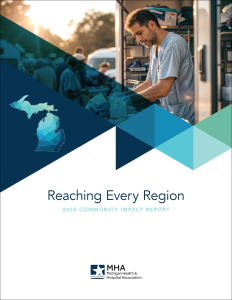
2025 MHA Community Impact Report

The Michigan Health & Hospital Association (MHA) released today its 2025 Community Impact Report highlighting community programming and investments from Michigan hospitals that are improving access to care, addressing affordability and advancing the health of communities across every region of the state.

The report showcases 12 hospital-led programs that go beyond the traditional care setting to address community health needs across the state. It also outlines investments totaling more than $4.5 billion in community benefit activities in fiscal year (FY) 2023, from education and prevention services to clinical research, healthcare workforce support and more.

“Michigan hospitals continue to redefine care delivery and create new, innovative access points across the state,” said MHA CEO Brian Peters. “The MHA Community Impact Report is a strong reminder that our hospitals are committed to listening – and responding – to the needs of their communities.”

Programs featured in the report include University of Michigan Health-Sparrow’s mobile health clinic; Henry Ford Health’s hospital-based doula program; Corewell Health Gerber Hospital’s vaping cessation initiative; Mackinac Straits Health System’s retail pharmacy; and efforts by Bronson Battle Creek Hospital to address food insecurity; among many others. This work is a result of strategic investments, local partnerships and support from state and federal healthcare champions.

“Improving community health goes beyond the bedside,” said MHA Board Chair Bill Manns, president and CEO, Bronson Healthcare. “When we invest in programs that address socioeconomic challenges like food insecurity, we’re helping people overcome the barriers that stand between them and a healthier life.”

The full report and community impact stories from hospitals across the state can be accessed on the MHA website.

Based in Greater Lansing, the MHA is the statewide leader representing all community hospitals in Michigan. Established in 1919, the MHA represents the interests of its member hospitals and health systems in both the legislative and regulatory arenas on key issues and supports their efforts to provide quality, cost-effective and accessible care. The MHA’s mission is to advance the health of individuals and communities.

Michigan Rural Health Transformation Program Application Diminishes Potential Impact

The following statement can be attributed to Brian Peters, CEO of the Michigan Health & Hospital Association.

We are disappointed the Michigan Rural Health Transformation Program application submitted by the Michigan Department of Health and Human Services does not include explicit support for Michigan’s 73 rural hospitals.

The application lists four initiatives, none of which include recommendations from Michigan’s rural hospital leaders, who know rural healthcare needs best. Michigan hospitals are set to lose more than $6 billion over the next 10 years due to the federal H.R. 1 Reconciliation Bill. It’s unfortunate Michigan’s application ignored this impact and the intent of Congress to assist rural hospitals most impacted by these federal changes through this program.

This application provided an opportunity to maximize the healthcare impact for rural communities by providing the resources needed by rural Michigan’s leading healthcare providers. While the four initiatives are well intended, the application as submitted fails to maintain access to care in the most meaningful way.

Bridge: Five reasons health insurance rates are rising so much in Michigan

Bridge published a story Nov. 5 sharing five reasons why health insurance rates are rising at increasing rates in the state, which included workforce challenges, expiring enhanced premium tax credits, inflation and drug prices.

MHA CEO Brian Peters is quoted in the story, discussing the benefits of hospital mergers and acquisitions when it comes to maintaining access to care and affording high fixed hospital costs. He also highlighted the MHA’s federal advocacy efforts to extend the enhanced premium tax credits.

“The cost of electronic medical record infrastructure is extraordinary today. The cost of medical liability insurance coverage, the cost of physician practice subsidization,” said Peters. “You’re better able to bear that underlying cost if you’re part of a larger system that has more capital resources.”

Members with any questions regarding media requests should contact John Karasinski at the MHA.

Bipartisan State Budget Protects Healthcare

The following statement can be attributed to Brian Peters, CEO of the Michigan Health & Hospital Association.

Michigan’s elected officials demonstrated today a strong, bipartisan commitment to protecting healthcare funding in the state budget. We thank all of those who worked together when it mattered most, especially Gov. Whitmer, Senate Majority Leader Brinks and Speaker of the House Hall for their leadership in agreeing to a budget that will continue to advance the health of individuals and communities throughout the state. Hospitals, healthcare workers and patients have secure state funding for another year, maintaining access to care and protecting important service lines.

Michigan Hospital Collaboratives Launch to Improve Community Health

More than 50 Michigan hospitals are coming together to improve outcomes in maternal health, behavioral health and chronic disease across the state through new community benefit collaboratives launched by the Michigan Health & Hospital Association (MHA). The goal is to leverage community impact programming to maximize statewide improvements in these three areas.

The MHA will lead participating hospitals in implementing multi-year, scalable projects focused on enhancing group prenatal care, improving perinatal mood disorder screening and support, preventing postpartum depression and expanding food access and nutrition education. The collaborative topics were selected based on a review of all Community Health Needs Assessments completed by Michigan hospitals. Each collaborative is modeled after existing programs at Michigan hospitals and healthcare organizations designed to address healthcare barriers and improve health outcomes.

“This work reflects Michigan hospitals’ commitment to investing in their communities far beyond their four walls to improve population health,” said MHA CEO Brian Peters. “These collaboratives are designed to scale local success into making a statewide impact that advances the health and well-being of Michiganders where they live, work and grow.”

Each collaborative has various components that can be tailored to meet the unique needs of a hospital, depending on size, available resources and patient populations. The implementation of the collaboratives is supported by funding from the Michigan Health Endowment Fund. Public Policy Associates will facilitate program evaluations.

The list of participating hospitals for each collaborative is available below.

Behavioral Health Collaborative  

  • Henry Ford Health
  • MyMichigan Medical Center Alma
  • MyMichigan Medical Center Clare
  • MyMichigan Medical Center Gladwin
  • MyMichigan Medical Center Midland
  • MyMichigan Medical Center Mt. Pleasant
  • MyMichigan Medical Center Saginaw
  • MyMichigan Medical Center Sault
  • MyMichigan Medical Center Standish
  • MyMichigan Medical Center Tawas
  • MyMichigan Medical Center West Branch
  • ProMedica Monroe Regional Hospital
  • ProMedica Charles and Virginia Hickman Hospital
  • Trinity Health Ann Arbor
  • University of Michigan Health-Sparrow Lansing
  • University of Michigan Health-West

Chronic Disease Collaborative

  • Aspirus Iron River Hospital & Clinics
  • Aspirus Keweenaw Hospital & Clinics
  • Aspire Rural Health System Deckerville Community Hospital
  • Aspire Rural Health System Hills & Dales Healthcare
  • Aspire Rural Health System
  • Beacon Kalamazoo (formerly Borgess Hospital)
  • Bronson Battle Creek Hospital
  • Henry Ford Health
  • Kalkaska Memorial Health Center
  • Munson Medical Center
  • MyMichigan Medical Center Alma
  • MyMichigan Medical Center Clare
  • MyMichigan Medical Center Gladwin
  • MyMichigan Medical Center Midland
  • MyMichigan Medical Center Mt. Pleasant
  • MyMichigan Medical Center Saginaw
  • MyMichigan Medical Center Sault
  • MyMichigan Medical Center Standish
  • MyMichigan Medical Center Tawas
  • MyMichigan Medical Center West Branch
  • Scheurer Health
  • Schoolcraft Memorial Hospital

Maternal Health Collaborative  

  • Bronson Methodist Hospital
  • Corewell Health Lakeland Hospitals – St. Joseph Hospital
  • Henry Ford Health
  • MyMichigan Medical Center Alma
  • MyMichigan Medical Center Clare
  • MyMichigan Medical Center Gladwin
  • MyMichigan Medical Center Midland
  • MyMichigan Medical Center Mt. Pleasant
  • MyMichigan Medical Center Saginaw
  • MyMichigan Medical Center Sault
  • MyMichigan Medical Center Standish
  • MyMichigan Medical Center Tawas
  • MyMichigan Medical Center West Branch
  • Three Rivers Health Hospital (Beacon Health System)

To learn more about community benefit efforts across the state, visit the MHA Community Benefit webpage.

Based in Greater Lansing, the MHA is the statewide leader representing all community hospitals in Michigan. Established in 1919, the MHA represents the interests of its member hospitals and health systems in both the legislative and regulatory arenas on key issues and supports their efforts to provide quality, cost-effective and accessible care. The MHA’s mission is to advance the health of individuals and communities.
Peters Reaffirms Commitment to Protecting Healthcare Access Throughout Michigan

The following statement can be attributed to Brian Peters, CEO of the Michigan Health & Hospital Association.

The Speaker is wasting Michiganders’ time and resources doubling down on defending these disastrous budget cuts and resorting to personal attacks. Attacking me does not change the real cuts his budget threatens to make against patients, healthcare workers and hospitals. I’m happy to be the target of his outrage and criticism if that distracts him from cutting funding for those who report to work every day to save lives.

The fact is the Rural Health Transformation funding is a lottery ticket that pales in comparison to the more than $8.5 billion hospitals would lose from state and federal cuts. State lawmakers have no influence on when or how much federal rural money is distributed. At best, it would only make up for 3% of these cuts, if it comes to fruition.

We will not be bullied away from defending our patients. We remain steadfast in our commitment to protecting healthcare access throughout Michigan.

House Budget Endangers 20,000 Hospital Jobs and $4.9 Billion Economic Loss

An estimated 20,000 hospital jobs could be lost in Michigan and lead to a $4.9 billion loss to the state’s economy if the House version of the state budget ultimately is signed into law, according to new estimates from the Michigan Health & Hospital Association (MHA).

The estimates consider the more than $2.5 billion in potential hospital funding cuts included in House Bill 4706. The impact on jobs would be particularly profound, as on average, 60% of a hospital’s budget is due to labor. Such a cut could have an additional estimated induced and indirect economic loss of $2.4 billion on the economy. More than one million jobs are directly, indirectly or induced by healthcare in the state.

“Healthcare is the largest private-sector employer in the state, with hospitals employing the most direct jobs within the sector with approximately 222,000 employees,” said MHA CEO Brian Peters. “Our calculations show the House version of the state budget could ultimately lead to a 9% reduction in the direct hospital workforce. Hospitals are one of the largest employers in each of their communities, meaning job losses to this magnitude would be felt in every corner of Michigan.”

Provisions of the budget bill that would lead to losses include:

  • New language that places $2.5 billion of hospital provider-tax funded payments in contingency line, requiring unnecessary administrative and legislative actions that could jeopardize timely hospital payments.
  • Elimination of at least $100 million of funding from the Specialty Network Access Fee (SNAF), which provides reimbursement to physicians caring for patients with Medicaid coverage.
  • Elimination of $10 million to support the Maternal Levels of Care verification and MI-AIM safety program for birthing hospitals.

Hospitals depend on stable funding, predictable reimbursements and policies that reflect the real costs of care. This is necessary from all healthcare payors, including the state. Eroding established funding levels and risking both the certainty and the timeliness of payments prevents hospitals from making needed investments in the hospital workforce, patient care and capital improvements.

House Budget Guts Hospital Funding

The following statement can be attributed to Brian Peters, CEO of the Michigan Health & Hospital Association.

The proposed state budget from the Michigan House of Representatives guts hospital funding and would be disastrous if even a semblance of the cuts eventually makes it into the state budget. Michigan hospitals already stand to lose more than $6 billion over the next ten years due to federal budget cuts. Slashing more funding that supports delivering healthcare services and the nurses, physicians and other staff employed by hospitals harms Michigan and our more than 10 million residents.

Hospitals are already bracing for busier emergency departments, sicker patients and higher rates of uncompensated care. We are extremely disappointed in the message being sent to healthcare providers to do more with less. Hospitals can only stretch resources so far before it impacts their ability to provide the care our communities need.

Hospitals need a real budget by Sept. 30 that supports healthcare and those who show up to work every day to care for Michiganders. It is time to stop playing political games and get to the table with real solutions that give our state the basic support that it needs.

Media Recap: Medicaid and Healthcare Costs

The MHA received media coverage during the week of Aug. 18 that continued to focus on the impact the One Big Beautiful Bill Act (OBBBA) will have on Medicaid as well as comments related to the impact hospital consolidations have on healthcare access.

Gongwer published a story Aug. 20 on the impact hospital consolidations have on healthcare costs and access to care for employees. MHA CEO Brian Peters was quoted in the article disputing the claim that hospitals are profiteers.

“Bashing community hospitals and the 220,000 hospital workers who show up every day of the year to care for Michigan patients is misguided and inflammatory,” said Peters. “Hospitals are focused on providing safe, high-quality, affordable care in every community they serve.”

NPR also published a story following an interview with Peters regarding the impact the OBBBA and new work requirements will have on healthcare in Michigan.

“The state of Michigan Department of Health and Human Services has estimated that as many as 700,000 Michiganders could lose coverage because of the reconciliation bill,” said Peters.

The new work requirements will necessitate that hundreds of thousands of enrollees document their eligibility every six months. Peters noted in the interview that there’s no evidence of widespread waste and abuse in the state’s Medicaid program.

“When you look at the Medicaid population here in the state of Michigan, we know that almost all of those folks are working and working full time,” said Peters.

Members with any questions regarding media requests should contact John Karasinski at the MHA.

Medicare & Medicaid Improve Michigan’s Health for 60 Years

The following statement can be attributed to Brian Peters, CEO of the Michigan Health & Hospital Association.

Today marks the 60th anniversary of Medicare and Medicaid making a monumental difference in improving the health of Michiganders and supporting healthcare providers.

This anniversary reminds all of us about the value these programs bring to the health of our citizens and access to care throughout Michigan. At a time when the federal government has taken steps to limit these programs that will result in Michigan hospitals losing $6 billion over the next ten years, healthcare providers will continue to do everything in our power to protect these vital programs and the people they serve.

Nearly half of Michigan residents receive health coverage from these two insurance programs, and 40% of all babies born in the state every year are covered by Medicaid, demonstrating the reliance our state has on publicly available health insurance coverage. These programs help vulnerable Michiganders receive preventative care, cancer treatment, and important hospital and post-acute services during their time of need.

Our message to lawmakers is clear: act now to protect these programs before it is too late. If the harmful policies signed into law earlier this month come to pass, we will see less healthcare services offered in all areas of the state, more uninsured and sicker patients, and longer wait times in emergency departments.

The creation of these programs was a huge step forward for the health of our country. We can’t afford to go backwards by undermining Medicare and Medicaid and what they do for millions of Michiganders.