MHA Highlights Behavioral Health Priorities at Michigan Children and Families Summit

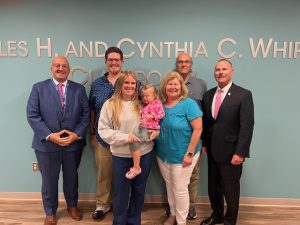
Lauren LaPine, senior director, legislative and public policy, MHA (middle) pictured during Michigan Children and Families Summit.

Lauren LaPine, senior director, legislative and public policy, MHA, participated in a discussion Oct. 3 in Grand Rapids during the Michigan Children and Families Summit hosted by the Steelcase Foundation. The summit explored the results of a Harvard study on the impact of loneliness in Michigan families that the foundation supported with the national nonpartisan think tank Capita.

The summit was a continuation of a collaborative roundtable held in May, where participants explored the growing epidemic of loneliness affecting families across America, with a particular focus on its impact in Michigan.

The event brought together a diverse group of stakeholders, including representatives from government, associations and nonprofit organizations, all deeply engaged in addressing the rising levels of loneliness among Michigan families and identifying the key factors contributing to this concerning trend.

LaPine discussed the state of behavioral health and its contribution to the topic. The conversation also delved into the critical challenges confronting Michigan hospitals, with a focus on the behavioral health priorities the MHA is leading to address these issues within the state.

The event was led by Daniel Williams, president, Steelcase Foundation, and Tracie Coffman, program officer, W.K. Kellog Foundation. Other speakers during the event included Joe Waters, founder and CEO, Capita; Elliot Haspel, senior fellow, Capita; State Senate Majority Leader Winnie Brinks; U.S. Representative Hillary Scholten; Kent County Commissioner and Chair Stan Stek; Dr. Kim Carter, Battle Creek Public Schools and Jacob Maas, West MiWorks!.

Members with questions about the event or behavioral health are encouraged to contact Lauren LaPine at the MHA.
MHA Race of the Week – U.S. Senate

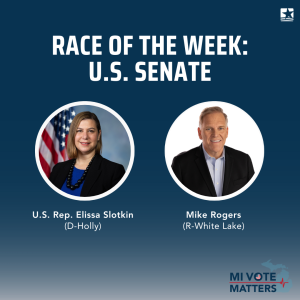
MHA RACE OF THE WEEK

The MHA’s Race of the Week series highlights the most pivotal statewide races for the 2024 General Election. The series will provide hospitals and healthcare advocates with the resources they need to make informed decisions on Election Day, including candidates’ views and background.

MICHIGAN CANDIDATES FOR U.S. SENATE

U.S. Rep. Elissa Slotkin (D-Holly) is a former national security official currently serving Michigan’s 7th Congressional District, which includes all of Ingham, Livingston, Shiawassee and Clinton counties, as well as parts of Eaton, Genesee and Oakland counties.

Like many Americans, healthcare is a deeply personal issue for Rep. Slotkin. In Congress, she worked across the aisle to help pass legislation to make prescription drug prices more transparent and fought to pass laws that capped the cost of insulin for seniors and allowed Medicare to negotiate for lower drug prices. Slotkin also worked closely with the MHA and the hospitals in her district during the COVID-19 pandemic.

Slotkin is a third-generation Michigander who believes government works best when there are two healthy parties that debate the big issues facing Americans. For more information, visit elissaslotkin.org.

Mike Rogers (R-White Lake) is a former state senator and member of the U.S. House of Representatives for Michigan’s 8th congressional district. Prior to his time in the legislature, Rogers worked as a lieutenant in the U.S. Army and a special agent with the Federal Bureau of Investigation.

Rogers, also a Michigan native, is known for his work on Michigan’s 529 College Savings Program and efforts passing legislation to help low-income families receive healthcare. Additionally, Rogers served as Chairman of the House Intelligence Committee and was a part of the House Energy and Commerce Committee.

Rogers entered the private sector in 2015 to champion small businesses before announcing in August 2023 his candidacy for the U.S. Senate. To learn more, visit rogersforsenate.com.

WHY IT MATTERS

Congress is responsible for lawmaking and budgetary decisions critical to Michigan’s healthcare community and residents. In addition to setting the course on federal funding that impacts Michigan’s Medicare and Medicaid populations, among other issues, Congress is responsible for making policy decisions that can vastly impact the delivery and access to healthcare in the state, as well as confirmation of Supreme Court nominees. Due to the major financial and policy decisions made in Washington, DC, Michigan relies on its federal officials to advocate and protect the needs of state residents, which is why electing healthcare champions to federal offices is so important.

For more information or to request 2024 Election materials, visit the MHA Election webpage or contact the MHA.

Legislation Impacting Hospitals Introduced in State Legislature

A variety of bills impacting hospitals and health systems were introduced and discussed in the state legislature during the week of Sept. 23.

Senate Bill (SB) 701, introduced by Sen. Singh (D-East Lansing), updates the statutory framework for the rural and obstetrical access pools funded in the fiscal year 2025 state budget. The MHA supports SB 701 as an additional statutory clarification to highlight the importance of funding for rural providers. The bill now goes to the governor for her signature.

The Senate Health Policy Committee took testimony on SB 1006, introduced by Senator McMorrow (D-Royal Oak), which would require hospitals to stock and offer intrauterine devices (IUDs) for birth control immediately postpartum. The testimony focused on the potential efficacy of the procedure and the potential risks to the patient. The MHA has not yet taken a position on the legislation and has expressed concerns regarding provider discretion, appropriate settings and potential supply chain disruptions. The committee did not take a vote on the legislation.

House Bill (HB) 5964 was introduced by Rep. Conlin (D-Ann Arbor). The legislation would repeal the sunset on the Interstate Medical Licensure Compact, which allows physicians who are licensed and in good standing to practice in any compact state without first getting a state specific license. The MHA supported bill was referred to the House Health Policy Committee.

Rep. Young (D-Detroit) introduced HB 5999, which would prohibit mandatory overtime for nurses working in Michigan’s hospitals. The MHA is opposed to this one-size-fits-all prohibition that does not account for national workforce shortages, risk of patient harm or new restrictions on employer discretion as a result of citizen-initiated laws on earned sick time. The MHA continues to work with lawmakers to understand the impact this bill, along with government mandated nurse staffing ratios, will have on access to healthcare in Michigan. The bill was referred to the House Labor Committee.

Members with questions can reach out to Elizabeth Kutter at the MHA.

CE Credits Available for Health Equity Regulatory Requirements Webinar

The MHA and the MHA Keystone Center are hosting an educational webinar from 8:30 to 9:30 a.m. Oct. 10 about the current and future state of regulatory and accrediting health equity requirements from the Centers for Medicare & Medicaid (CMS) and The Joint Commission (TJC). 

Leading the discussion is Julia Finken, senior vice president for accreditation and regulatory compliance for Patton Healthcare Consulting and Barrins & Associates. With more than 25 years of healthcare expertise and nearly two decades at TJC, Finken will also walk members through the MHA Keystone Center’s Guide and Action Plan to Integrating CMS and TJC Health Equity and Health Disparities Requirements and its online learning module series. These resources were created to provide actionable strategies for implementing compliant health equity programming in an acute care setting.

At the conclusion of this activity, participants should be able to:

  • Explain priority areas across the CMS and TJC requirements.
  • Summarize compliance expectations for these new regulations.
  • Outline future health equity priorities and expectations from CMS and TJC.
  • Demonstrate how the MHA Keystone Center’s tools can assist hospitals and health systems with creating actionable strategies for advancing health equity that meet regulatory and accreditation requirements.

The webinar is eligible for nursing and social worker continuing education credits. 

Registration for the webinar is free of charge to MHA members thanks to the generosity of Alliance-HNI Health Care Services, an associate member of the MHA.

Members with questions about registration should contact the MHA Keystone Center.

NAIC Meeting Evaluates Impact of Pharmaceutical Costs on Rural Hospitals

Laura Appel, executive vice president of government relations and public policy, MHA (middle) pictured during a presentation at the Midwest Zone meeting of NAIC.

Michigan Department of Insurance and Financial Services Director Anita Fox invited the MHA and Munson Healthcare to present to the Midwest Zone meeting of the National Association of Insurance Commissioners (NAIC) held Sept. 25. The topic was the impact of pharmaceutical costs and complexities on rural hospitals.

Bradley Beaman, clinical utilization pharmacist at Munson Healthcare, shared specific examples of the pharmacy overhead costs confronting all hospitals and how small, rural hospitals have fewer financial resources to manage these costs. The insurance commissioners also heard from Kelly Anderson, Ph.D., MPP, about the patient impact of reducing access to pharmacy services. Kelly Edmiston, policy research manager at the NAIC Center for Insurance Policy and Research, presented on the financial risks facing rural hospitals and the past and current rates of rural hospital closures.

The NAIC Midwest Zone is made up of insurance commissioners and department directors from 13 states. The Commissioners engaged in a lengthy discussion about the fixed costs of hospital pharmacy operations and the role of insurance coverage in assuring access to care for prescription drugs and other services in rural areas of their states. Recommendations from the NAIC Zones become part of the full NAIC policy-making discussion. The MHA is committed to growing its involvement with the NAIC and other national policy-making organizations to influence decision-making that impacts Michigan hospitals.

For more information about this recent meeting and the NAIC, members may contact Laura Appel at the MHA.

Upcoming MDHHS Maternal Health Offerings

MDHHS to Host Statewide Maternal and Infant Health Data Meeting – Oct. 28

The Michigan Department of Health and Human Services (MDHHS) Division of Maternal and Infant Health is partnering with the Michigan Perinatal Quality Collaborative (MI PQC) to offer its Statewide Maternal and Infant Health Data Meeting from 4 to 6 p.m. on Oct. 28. The event will showcase maternal and infant health data across the state and regionally.

Members interested in attending the event can register online.

MDHHS Invites Community-Based Organizations to Apply for Maternal Mortality Surveillance Grant – Oct. 7 Deadline

The MDHHS is offering funding support to a select number of projects focused on improving maternal health, with an emphasis on pre-pregnancy, pregnancy and postpartum care. Community-based organizations are encouraged to apply for funding by Oct. 7.

Members interested in learning more about the funding opportunity can download the informational flyer or review the online application.

Final Rules Strengthen Access to Mental Health, Substance Use Disorder Benefits

The United States Departments of Labor, Health and Human Services and the Treasury issued a set of final rules Sept. 9 on the Mental Health Parity and Addiction Equity Act (MHPAEA) of 2008.

The rulings aim to promote equitable access to mental health and Substance Use Disorder (SUD) benefits and reduce barriers to accessing these services. They also reinforce the requirement that mental health and SUD benefits be on par with medical and surgical benefits (M/S).

If a health plan provides benefits for a mental health condition or SUD, it must provide meaningful benefits for that condition or disorder in every classification for which meaningful M/S benefits are offered. The rulings also restrict self-funded, non-federal governmental plans from opting out of providing mental health/SUD benefits. Additionally, it provides concrete factors used to determine out-of-network reimbursement rates.

The final rules also provide protection from non-quantitative treatment limitations (NQTLs) on mental health and substance use disorder benefits. NQTLs are conditions that restrict the scope of benefits, such as prior authorization requirements. The rulings prohibit insurance plans from using biased information when applying NQTLs. Issuers must also collect and assess data on the NQTLs they place and adapt accordingly if the data shows they are negatively impacting access to MH/SUD services compared to M/S benefits.

The final rules apply to:

  • Group health insurance coverage beginning on or after Jan. 1, 2025. The meaningful benefits standard, the prohibition on discriminatory factors and evidentiary standards, the relevant data evaluation requirements and the related requirements in the provisions for comparative analyses will apply beginning on or after Jan. 1, 2026.
  • Health insurance issuers offering individual health insurance coverage for policy years beginning on or after Jan. 1, 2026.

Members with questions may contact Lauren LaPine at the MHA.
Latest AHA Trustee Insights Explores AI in Healthcare, Workplace Equity and Community Partnerships

The September edition of Trustee Insights, a monthly digital package from the American Hospital Association (AHA), outlines how artificial intelligence (AI) will change healthcare operations and how trustees can provide meaningful leadership and guidance.

The issue explores how AI can be used in strategic planning, incorporated into culture and used for clinical improvement and organizational performance. It also explains how partners play a critical role in prioritizing justice and inclusivity in patient care, quality and experience.

Lastly, the package provides key questions that board members should consider on equitable access, workplace equity and leveraging AI implementation.

For information about MHA trustee resources or webinars, contact Erin Steward at the MHA.

McLaren Port Huron Nurse Receives Q2 MHA Keystone Center Speak-up! Award

speak up
Melissa Burgess, RN at McLaren Port Huron Hospital pictured with her family, McLaren leadership and MHA CEO Brian Peters.

The Michigan Health & Hospital Association (MHA) Keystone Center celebrated Melissa Burgess, RN at McLaren Port Huron Hospital as its quarterly MHA Keystone Center Speak-up! Award recipient in September.

The quarterly MHA Keystone Center Speak-up! Award celebrates individuals or teams in Michigan hospitals demonstrating a commitment to the prevention of patient or staff harm.

Burgess was recognized for her swift intervention for a behavioral health patient. Working closely with the patient, she noticed a status change that prompted her to consult additional team members. Following a reevaluation, the patient was able to be provided with the adequate level of enhanced care they required.

“Melissa’s action is a direct reflection of her dedication to her patients and the trusted care we deliver to our community,” said McLaren Port Huron President and CEO Eric Cecava. “The level of her commitment is inspiring to our organization and empowering to her fellow caregivers, and we are grateful and proud to have her as an influential member of our team.”

Additional award finalists for the second quarter of 2024 include:

  • Tim Carew, Bronson Healthcare
  • Tiffany Holloway, Trinity Health Livonia Hospital
  • Jessica Winkelman, Corewell Health Dearborn Hospital

“We feel honored to celebrate alongside healthcare workers like Melissa who advocate for their patients every day in Michigan hospitals,” said MHA CEO Brian Peters. “Her decisive action demonstrates her commitment to her patient’s well-being and McLaren’s dedication to promoting a safety culture.”

More information about the MHA Keystone Center Speak-up! Award, including criteria and a nomination form, are available online.

2024 Election Materials Available for Michigan Hospitals

The MHA is offering election communication materials geared toward hospital staff, volunteers, patients and visitors to encourage voter participation in the 2024 general election. Additionally, the MHA elections webpage will be updated regularly with relevant announcements and Race of the Week spotlights leading up to Election Day.

Election materials available for Michigan hospitals and health systems, include:

  • Complimentary Your Vote is Vital and Key Election Date posters to display throughout offices, waiting rooms and elevators. Both options are offered as 8.5” x 11” designs and available free of charge through an online order form.
  • A 2024 MHA Candidate Guide outlining all Michigan candidates by office and district.
  • Sample election social media policy with guidelines to ensure the political views and opinions of hospital staff do not interfere with professional responsibilities nor misrepresent a hospital’s position on a candidate or issue.

In addition to the presidential race, Michigan voters will have a unique opportunity to cast votes on the following political contests:

  • One U.S. Senate seat.
  • All 13 Michigan members of the U.S. House of Representatives.
  • All 110 seats of the Michigan House of Representatives.
  • Two Michigan Supreme Court seats.

Members are encouraged to connect with the MHA team about candidates who are serving as strong healthcare champions. Those who feel particularly supportive of a candidate may consider hosting a fundraiser, convening with other leaders in the community or contacting Stacy Dowdy at the MHA about engaging the MHA Health Political Action Committee (PAC).

Questions about election materials may be sent to the MHA communications team. For more information about the 2024 general election, visit the Michigan Voter Information Center or contact the MHA Advocacy Team.