Media Coverage Includes Focus on 340B, Tariffs & Medicaid

Elizabeth Kutter

The MHA received media coverage the week of March 3 on the Michigan Senate passing legislation that protects the 340B program, the potential impact of tariffs on hospitals and healthcare costs, as well as a radio appearance discussing potential federal Medicaid funding cuts.

Michigan Public aired a story March 6 following the broad bi-partisan passage of Senate Bills 94 and 95 by the full chamber. Senate Bill 94 would safeguard the 340B program, ensuring cost savings and preserves access to affordable healthcare services in both urban and rural Michigan communities. Further, this legislation adds first of its kind drug manufacturer transparency requirements, making Michigan’s legislation the strongest in the nation.

Elizabeth KutterElizabeth Kutter, senior director, government and political affairs, MHA, was interviewed by Michigan Public for the story.

“You have to be an entity that proves their eligibility in the program, which by default means that you are serving patients who are extremely vulnerable,” said Kutter. “You’re serving kids. You’re serving cancer patients. You’re serving people who, if your hospital closes or if healthcare access becomes limited, suddenly you’re seeing a very serious hospital desert for patients.”

Gongwer and MIRS also covered the passage of the bills.

In addition, Crain’s Detroit Business published an article March 3 looking at the impact of potential tariffs on a variety of Michigan industries, including healthcare. MHA CEO Brian Peters is quoted in the story addressing the impact to hospitals.

“Implementing tariffs on Canada, Mexico and China without exceptions for medications and medical supplies could jeopardize the availability and further increase the prices of already-expensive vital medications and health care devices Michigan hospitals need to provide appropriate patient care,” said Peters. “Tariffs will particularly exacerbate existing pharmaceutical shortages. China is responsible for providing a significant number of cardiac and oncology drugs, as well as active pharmaceutical ingredients needed to produce prescription drugs domestically. Many healthcare supplies are also produced in China and the United States does not have existing capacity to meet an increased demand for product.”

Peters also appeared on WJR 760AM March 3 to discuss the impact of potential federal Medicaid funding cuts on Michigan hospitals.

Members with any questions regarding media requests should contact John Karasinski at the MHA.

340B Protections Pass Senate Committee & Governor Delivers State of the State Address

Legislation that would implement 340B program protections advanced in the Senate Oversight Committee and Gov. Whitmer delivered her seventh annual State of the State address to the Michigan Legislature during the week of Feb. 24.

Deidra Wilson, senior vice president, government relations and public policy, McLaren Health Care; and Ben Frederick, associate vice president of advocacy and government relations, Memorial Healthcare testified Feb. 27 in the Senate Oversight Committee on legislation regarding 340B Protections.

Senate Bill (SB) 94, sponsored by Sen. Sam Singh (D-East Lansing), and SB 95, sponsored by Sen. Jonathan Lindsey (R-Allen), saw extensive action in the Senate Oversight Committee Feb. 27. SB 94 protects the 340B program in Michigan and is paired with SB 95, which requires hospital compliance with federal transparency laws. Two MHA members provided testimony during the committee in support: Deidra Wilson, senior vice president, government relations and public policy, McLaren Health Care; and Ben Frederick, associate vice president of advocacy and government relations, Memorial Healthcare.

SB 94 safeguards the 340B program, ensuring cost savings and preserves access to affordable healthcare services in both urban and rural Michigan communities. Further, this legislation adds first of its kind drug manufacturer transparency requirements, making Michigan’s legislation the strongest in the nation.

During testimony, Wilson first thanked the committee for their swift action on reintroduction of the bills and the importance of expediting this legislation to support communities. She discussed services for cancer patients across the state, such as covering copays, rural OB services and other vital services for vulnerable populations that are impacted when pharmaceutical manufacturers create restrictions around the 340B program. Wilson concluded her testimony by stating that hospitals prioritize the needs of patients and communities over the profits of drug manufacturers. Frederick emphasized the impact the 340B program has in rural communities, especially for independent and community hospitals, and shared how these rural areas can provide essential OB, cancer and family medicine services to preserve and improve access for patients. Following a successful hearing, the Senate Oversight Committee voted 5-0 to report SB 94 and SB 95 to the full Senate. The bills now await a full vote in the Senate before it can be sent to the House of Representatives.

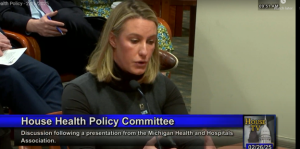
Elizabeth Kutter, senior director, government and political affairs, MHA testimony provided an overview of the 340B program in the House Health Policy Committee Feb. 26. 

The House Health Policy Committee also heard testimony on the importance of the 340B program in the state Feb. 26. Elizabeth Kutter, senior director, government and political affairs, MHA, provided an overview of the program, including examples of how the program benefits patients and communities across the state. Wilson and Frederick also testified, sharing how the program works for their hospital systems. The educational hearing enabled House Health Policy members to ask questions and engage in a constructive dialogue around the topic. The MHA continues to advocate for the 340B program and support Michigan hospitals’ efforts to expand access to quality, community-based care. Members are encouraged to use the MHA 340B Action Alert to contact their lawmakers in support of this legislation.

Lastly, Gov. Whitmer outlined her upcoming priorities to a joint convention of the Michigan Legislature in her State of the State address Feb. 26. One key highlight in her address included reducing medical debt for Michiganders. While no specific policies were discussed, she cited 700,000 Michiganders currently have medical debt and that legislators should work to find solutions for this issue going forward. In addition to this, the governor discussed working in a bipartisan fashion on issues like road funding, building affordable housing and lowering costs in the state.

Members with questions may contact Elizabeth Kutter at the MHA.